San Francisco International Airport handles over 50 million passengers annually, and a growing share of them are now leaving the terminal in a vehicle with nobody behind the wheel. Waymo, Alphabet's autonomous driving subsidiary, has progressively expanded its commercial robotaxi service — branded Waymo One — across the Bay Area, and SFO is one of the most high-profile waypoints in its network. If you've been searching for practical details on catching a Waymo from SFO, this guide covers exactly where the service operates, what it costs, how safe it is, and where the boundaries still are in 2026.
Is Waymo Truly Self-Driving? Understanding the SAE Level 4 Distinction
Before booking a ride, it's critical to understand what Waymo actually is — and what it isn't. The Society of Automotive Engineers (SAE) defines six levels of driving automation, from Level 0 (no automation) to Level 5 (full autonomy in all conditions, everywhere). Most consumer vehicles you can buy today — including Teslas running FSD (Supervised), GM's Super Cruise, and Ford's BlueCruise — operate at SAE Level 2. That means the human driver must remain engaged, hands on or near the wheel, eyes on the road, legally responsible at all times.
Waymo One is fundamentally different. It operates at SAE Level 4 — high automation within a defined operational design domain (ODD). Inside its geofenced service area, the vehicle handles all driving tasks without a human driver present. There is no steering wheel accessible to passengers, no expectation that you'll take over. If the system encounters a scenario it cannot handle, it is designed to execute a minimal-risk maneuver (pull over safely) rather than hand control to a passenger.
| Level | Description | Example |
|---|---|---|
| Level 0 | No automation | Conventional vehicle |
| Level 1 | Driver assistance (steering OR speed) | Adaptive cruise control |
| Level 2 | Partial automation (steering AND speed, driver supervises) | Tesla Autopilot, GM Super Cruise |
| Level 3 | Conditional automation (driver on standby) | Mercedes Drive Pilot (limited markets) |
| Level 4 | High automation in defined ODD — no driver needed | Waymo One, Zoox |
| Level 5 | Full automation everywhere (not yet achieved) | None currently deployed |
This distinction matters because it shapes everything about the service: where it can go, how it handles edge cases, and what regulations apply. Waymo is not a "self-driving car you can buy." It's a ride-hailing service that uses Level 4 vehicles in approved zones.
Where Can I Catch a Waymo from SFO Right Now?
Waymo One's Bay Area service territory has expanded significantly since its initial San Francisco launch. As of 2026, the operational area covers most of San Francisco proper, portions of the Peninsula, and select East Bay corridors. SFO was added as a permitted destination following approval from the California Public Utilities Commission (CPUC), which regulates autonomous vehicle passenger service in the state.
| Zone | Status | Notes |
|---|---|---|
| San Francisco (full city) | ✅ Active | Core service area, 24/7 |
| SFO Airport | ✅ Active | Designated pickup/dropoff zones at terminals |
| South San Francisco / Brisbane | ✅ Active | Peninsula coverage expanding |
| Daly City | ✅ Active | Limited highway segments |
| Oakland / Berkeley | ✅ Active | East Bay service zone |
| Mountain View / Sunnyvale | ✅ Active | Silicon Valley corridor |
| San Jose | Partial | Select zones, expanding |
| SJC Airport | Limited | Check app for availability |
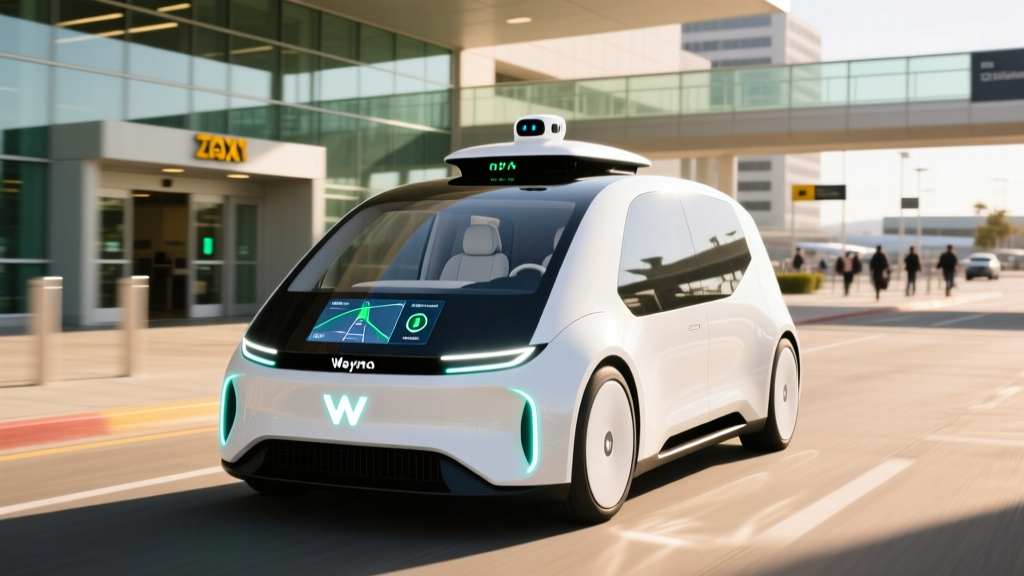
How SFO pickup works: After collecting luggage, open the Waymo One app and enter your destination. The app will direct you to a designated rideshare pickup area (similar to where Uber/Lyft collect passengers). Waymo vehicles are identifiable by their roof-mounted lidar array and Waymo branding on the doors. The vehicle pulls up, you verify the ride in the app, and the doors unlock. Inside, there's a screen showing your route, climate controls, and a "pull over" button.
One important caveat: Waymo's geofence does not cover every road in the Bay Area. If your destination falls outside the operational zone, the app will notify you before confirming the ride and suggest the nearest dropoff point within its service boundary.
Waymo vs. Uber and Lyft: Pricing Comparison from SFO
Robotaxi pricing has been a moving target as Waymo scales operations. Initially, rides were heavily subsidized to build ridership. In 2026, Waymo One pricing is broadly competitive with UberX and Lyft standard rides, though it varies by time of day, demand, and distance.
| Service | Typical Fare | Surge Potential | Wait Time |
|---|---|---|---|
| Waymo One | $30–$45 | Moderate (demand pricing) | 3–8 min |
| UberX | $28–$55 | High (surge during peaks) | 2–6 min |
| Lyft Standard | $26–$50 | High (prime time pricing) | 2–7 min |
| Waymo (shared/pooled) | $18–$28 | Low | 5–12 min |
| Taxi (SFO metered) | $45–$65 | None (metered) | 0–3 min (taxi stand) |
A few things worth noting from real-world use:
- No tipping. Waymo rides don't involve a driver to tip, which saves $3–$8 per ride versus rideshare.
- No surprise surge multipliers. Waymo uses demand-based pricing, but it tends to be less volatile than Uber's surge or Lyft's prime time. During major events (Giants games, concerts), Waymo pricing stays more predictable.
- Wait times can be longer at SFO during peak arrival banks (late morning, early evening) because the fleet density at the airport is lower than in central SF. Budget an extra 5 minutes versus a rideshare.
- Tolls and airport fees are included in the quoted fare, same as Uber/Lyft.
How Safe Are Waymo Robotaxis? The Real Data
Safety is the single most scrutinized aspect of robotaxi operations, and for good reason. Waymo has published safety data and submitted to regulatory reporting requirements that give us concrete numbers — not just marketing claims.
- Cumulative fully autonomous miles driven: Over 10 million miles (driverless, no human behind the wheel) across all markets
- At-fault collision rate: Waymo reports a significantly lower rate of at-fault, police-reportable crashes per million miles compared to human driver benchmarks in the same geographies, per data submitted to NHTSA
- Injury severity: The vast majority of incidents involving Waymo vehicles have been low-speed, minor-contact events (e.g., sideswipes at intersections, low-speed rear-end contacts by human-driven vehicles)
- No passenger fatalities have been reported in Waymo One commercial service
- CPUC incident reports: Waymo is required to report all collisions involving its vehicles to the California DMV and CPUC; these are public records
For context, the Insurance Institute for Highway Safety (IIHS) and NHTSA data show that human drivers in urban environments average roughly 4–5 police-reportable crashes per million miles. Waymo's published data suggests its vehicles are involved in fewer at-fault crashes per million miles in comparable urban driving, though direct comparison requires careful normalization for road type, speed, and weather.
Notable incidents have occurred — including a 2023 event where a Waymo vehicle was struck by a pickup truck in San Francisco, and a small number of low-speed contacts with pedestrians or cyclists. Each incident triggers a regulatory report and, in some cases, a temporary service pause while Waymo and regulators review the event. This transparency is a strength of the current regulatory framework, even when incidents make headlines.
The Technology Stack: Lidar, Cameras, and Geofencing
Waymo's approach to autonomous driving differs fundamentally from Tesla's camera-centric strategy. The Waymo Driver — the company's name for its integrated hardware/software system — uses a multi-sensor fusion architecture:
- Lidar: Multiple roof-mounted and body-integrated lidar units providing 360° 3D point-cloud mapping up to 500+ meters. Lidar works independently of ambient light — critical for night driving and glare conditions.
- Cameras: High-resolution cameras covering 360° for object classification, traffic light/signal detection, lane marking recognition, and reading signage.
- Radar: Short- and long-range radar units for velocity detection of other vehicles and objects, especially in rain or fog where camera and lidar performance can degrade.
- HD Maps: Pre-built centimeter-accurate maps of every road in the service area, continuously updated. The vehicle localizes itself within these maps in real time.
- Compute: Custom-designed onboard computing platform processing sensor data, running prediction models for other road users, and planning trajectories in real time.
This lidar-heavy approach is more expensive per vehicle than a camera-only system (estimates place Waymo's sensor suite at $100,000–$150,000 per vehicle, though costs are declining with each generation). The tradeoff is redundancy: if one sensor modality is impaired (camera blinded by sun glare, lidar degraded by heavy rain), the others compensate. This multi-sensor architecture is a key reason Waymo has achieved Level 4 deployment while camera-only systems remain at Level 2.
Geofencing is the other critical component. Waymo maps and validates every road segment in its service area before allowing driverless operations. The vehicle will not operate outside this approved zone. This is why you can't take a Waymo from SFO to Sacramento — the system simply doesn't have the mapped, validated coverage for that route.
Regulatory Landscape: Who Approves Robotaxi Operations?
Autonomous vehicle regulation in the United States is a patchwork of federal and state authority, and California has the most developed framework in the country:
- California DMV: Issues permits for autonomous vehicle testing and deployment. Waymo holds a Driverless Testing Permit and a Deployment Permit allowing commercial passenger service. The DMV requires monthly disengagement reports and collision reports (OL 316 forms).
- California CPUC: Regulates the commercial ride-hailing aspect — fares, insurance requirements, accessibility obligations, and passenger safety. CPUC approval was required for Waymo to charge fares and for the SFO airport expansion.
- NHTSA (federal): Sets vehicle safety standards (FMVSS) and investigates safety defects. NHTSA has issued standing general orders requiring crash reporting for vehicles with SAE Level 2+ and above systems. Waymo vehicles must meet all applicable FMVSS, and the company has obtained exemptions for certain requirements (e.g., manual steering controls) on its purpose-built vehicles.
- SFO Airport: As a San Francisco Airport Commission facility, SFO has its own ground transportation rules. Waymo needed separate approval to operate at the airport's designated rideshare zones, similar to how Uber and Lyft were onboarded years earlier.
This layered regulatory structure means expansion to new cities is slow and deliberate. Waymo cannot simply flip a switch and begin service in a new metro — it needs state permits, local agreements, and CPUC authorization for each new area.
Current Limitations: What Waymo Cannot Do
Level 4 autonomy is impressive, but it comes with defined boundaries. Understanding these limitations before you book a Waymo from SFO will set accurate expectations:
Geographic Boundaries
- Geofence limits: The vehicle will not drive outside its mapped service area. Destinations in Marin County (north of the Golden Gate Bridge), far East Bay (Livermore, Walnut Creek), or deep Peninsula (past San Jose) may be unavailable.
- Highway restrictions: While Waymo has expanded to some highway segments (portions of I-280, I-80, and US-101 near SFO), not all freeway routes are approved. The app determines the route.
Weather and Environmental Limits
- Heavy rain and flooding: Lidar performance degrades in heavy precipitation. During severe Bay Area atmospheric river events, Waymo may reduce service availability or pause operations in affected zones.
- Dense fog: San Francisco's famous fog can reduce sensor range. Waymo has improved its fog-handling capabilities with each hardware generation, but extreme fog may trigger service restrictions.
- Construction zones: Major, unmapped construction can confuse the system. Waymo's HD maps are updated frequently, but sudden lane closures or detours may cause the vehicle to pull over and wait for remote assistance.
Operational Edge Cases
- No trunk access for passengers: On the Jaguar I-PACE vehicles currently in the fleet, trunk access is managed by the vehicle system. Large luggage may require you to confirm fit in the app before booking.
- No intermediate stops: Unlike Uber/Lyft, you generally cannot add a mid-trip stop (e.g., "stop at a pharmacy on the way"). The ride is point A to point B.
- Accessibility: Waymo has been deploying wheelchair-accessible vehicles (WAVs) in its fleet, but availability is more limited than standard vehicles. The app allows you to request a WAV, but wait times may be longer.
- No pets (service animals excepted): Standard Waymo rides do not allow pets. Service animals are accommodated per ADA requirements.
How to Use Waymo One: Step-by-Step from SFO
- Download the Waymo One app (iOS/Android) and create an account before your trip. You'll need a payment method on file.
- After landing at SFO, collect your luggage and proceed to the rideshare pickup level (follow signs for "Ride App Pickup" — same level as Uber/Lyft).
- Open the app and enter your destination. The app will confirm whether the destination is within the service area and show an estimated fare and wait time.
- Confirm the ride. The app will show your vehicle's license plate, model (typically a white Jaguar I-PACE or newer Waymo-custom vehicle), and an estimated arrival time.
- When the vehicle arrives, verify the license plate matches your app. Tap "Start Ride" on your phone — the doors will unlock automatically.
- Inside the vehicle, buckle up. The rear seat screen displays your route, estimated arrival time, and climate controls. A "Pull Over" button is available if you need to stop early.
- At your destination, the vehicle will pull to the curb, and the doors will unlock. Exit and the ride is automatically charged to your payment method.
Frequently Asked Questions
Can I take a Waymo from SFO to destinations outside San Francisco?
It depends on the destination. Waymo's Bay Area geofence covers San Francisco, parts of the Peninsula (South San Francisco, Daly City, Brisbane, Mountain View, Sunnyvale), and select East Bay areas (Oakland, Berkeley). Destinations in Marin, the far Peninsula, or the deep East Bay may fall outside the service zone. The app will confirm availability before you book.
How much does a Waymo from SFO to downtown San Francisco cost?
Expect $30–$45 for a standard ride from SFO to downtown SF (roughly 14 miles), comparable to UberX and slightly more predictable during peak demand. Shared/pooled rides may be $18–$28. No tip is required since there's no driver.
Is it safe to ride in a car with no driver?
Waymo's published safety data shows a lower at-fault crash rate per million miles than human driver benchmarks in comparable urban environments. Over 10 million fully autonomous miles have been driven with no passenger fatalities. The vehicles are equipped with redundant sensors (lidar, radar, cameras) and are remotely monitored. That said, low-speed incidents do occur, and the system has known limitations in severe weather.
What happens if the Waymo vehicle gets confused or stuck?
Waymo vehicles have a remote assistance system. If the vehicle encounters an unfamiliar scenario (e.g., an unusual construction zone), it will pull over safely and connect with a remote operations team that can provide guidance. The vehicle does not hand control to the passenger. You can also press the "Pull Over" button at any time to request a safe stop.
Can I bring luggage on a Waymo from SFO?
Yes, but with caveats. Standard carry-on bags and one checked-size suitcase typically fit in the Jaguar I-PACE's cargo area. For multiple large bags or oversized items, the app may prompt you to confirm luggage fit before booking. If you have excessive luggage, a traditional rideshare with a larger vehicle option (UberXL, Lyft XL) may be more practical.
Does Waymo operate 24/7 at SFO?
Waymo One in San Francisco operates around the clock, including SFO service. However, vehicle availability may be lower during late-night and very early-morning hours, resulting in longer wait times. During major airport arrival peaks, demand pricing may also increase fares.
How does Waymo compare to Tesla's FSD for getting around the Bay Area?
They are fundamentally different products. Waymo One is a Level 4 robotaxi service — no driver needed, but limited to a geofenced area. Tesla's Full Self-Driving (Supervised) is a Level 2 driver-assist system that requires you to own or rent a Tesla, remain fully engaged as the driver, and accept legal responsibility for the vehicle. FSD can drive on more roads (no geofence), but it is not autonomous — you are driving the car, with assistance. For a visitor arriving at SFO without a Tesla, Waymo is the only hands-off autonomous option.