Waymo on Freeway Routes: What's Actually Available in 2026
If you've seen a white Jaguar I-PACE with a spinning lidar turret gliding through Phoenix or San Francisco, you've seen a Waymo robotaxi. But one question keeps surfacing from riders and EV enthusiasts alike: can you actually take a Waymo on freeway routes?
The short answer is yes — but with significant geographic and operational constraints. Waymo's fifth-generation and sixth-generation (Owl) driverless vehicles are capable of freeway driving, and as of early 2026, the company has expanded highway-capable service to select corridors in approved metro areas. This is not a nationwide rollout, and it's not a "summon a car anywhere" service. It's a tightly geofenced, regulator-approved operation that represents the most mature Level 4 robotaxi platform in the United States.
Here's exactly how Waymo freeway service works, where you can use it, what it costs, and what the safety data actually shows.
Understanding Waymo's SAE Level 4 Autonomy
Before discussing freeway capability, it's critical to distinguish what Waymo actually is — because the EV and smart-driving space is flooded with misleading autonomy claims.
Waymo's driverless service operates at SAE Level 4. This means the vehicle handles all driving tasks within its defined Operational Design Domain (ODD) — specific geofenced areas under specific conditions — with no human driver present. There is no steering wheel interaction, no "hands on wheel" reminder, no driver supervision requirement.
This is fundamentally different from Level 2 driver-assist systems like Tesla Autopilot, FSD (Supervised), GM Super Cruise, or Ford BlueCruise, which require an attentive human driver at all times. Waymo's front seats are occupied by passengers, not drivers.
| Level | Name | Who's Driving? | Examples |
|---|---|---|---|
| Level 0 | No Automation | Human | Standard car |
| Level 1 | Driver Assistance | Human (system assists) | Adaptive cruise control |
| Level 2 | Partial Automation | Human (must supervise) | Autopilot, FSD Supervised, BlueCruise, Super Cruise |
| Level 3 | Conditional Automation | System (human on standby) | Mercedes DRIVE PILOT (limited markets) |
| Level 4 | High Automation | System (no human needed in ODD) | Waymo, Zoox (geofenced areas) |
| Level 5 | Full Automation | System (everywhere, all conditions) | Does not yet exist commercially |
The key constraint for Level 4 is the Operational Design Domain — Waymo vehicles can only operate in areas that have been exhaustively mapped, tested, and approved. Drive outside that geofence, and the service won't let you book a ride.
Where Can You Ride a Waymo on Freeway Routes Right Now?
As of early 2026, Waymo operates commercial driverless service in four primary U.S. metro areas, with freeway-capable routes available in most of them. The service area has expanded significantly since the Phoenix-only days, but each city has specific highway corridors that are approved.
| Metro Area | Surface Streets | Freeway Routes | Key Freeway Corridors | Notes |
|---|---|---|---|---|
| Phoenix, AZ | ✅ | ✅ | I-10, I-17, Loop 101, Loop 202 | Largest service area (~600+ sq mi); freeway since 2024 |
| San Francisco, CA | ✅ | ✅ | US-101, I-280, I-80 (select segments) | Freeway service to SFO airport launched 2024 |
| Los Angeles, CA | ✅ | ✅ | I-10, I-405, US-101 (approved corridors) | Gradual expansion; freeway routes growing |
| Austin, TX | ✅ | ⚠️ Limited | Select highway segments | Expansion ongoing; surface streets primary |
Critical nuance: Even in cities with freeway service, you can't book a Waymo to any arbitrary highway destination. The service only allows rides where both the origin and destination fall within the approved geofence, and the routing algorithm selects only approved freeway segments. If your trip requires an unmapped interchange or an unapproved highway stretch, the app will either reroute on surface streets or decline the ride.
Airport service is a major use case. Waymo offers rides to Phoenix Sky Harbor (PHX) and San Francisco International (SFO) via freeway routes — a practical application where highway driving is essential.
Waymo Pricing: How Does It Compare to Uber and Lyft?
Waymo positions its robotaxi service as a premium rideshare alternative — not a budget option. Pricing is dynamic, similar to Uber/Lyft surge pricing, but without a human driver's earnings to factor in. Here's what riders typically see:
| Route Example | Waymo One | UberX | Lyft Standard |
|---|---|---|---|
| 5-mile city trip (Phoenix) | $12–$18 | $10–$16 | $9–$15 |
| 15-mile freeway trip (SF to SFO) | $30–$45 | $28–$42 | $25–$40 |
| 10-mile trip (LA, midday) | $18–$28 | $16–$25 | $15–$24 |
| Surge/peak pricing (Friday night) | +20–40% | +50–200% | +40–150% |
Key takeaway: Waymo pricing is generally comparable to or slightly above standard UberX/Lyft rates during normal hours, but it tends to surge less aggressively during peak demand. There's no driver to tip (though the app offers the option), and the experience is consistent — no variable vehicle quality, no driver conversation pressure, no routing disputes.
To book, download the Waymo One app (available on iOS and Android), set your pickup and dropoff within the service area, and confirm. Wait times vary from 2 to 10 minutes depending on fleet density and time of day. The vehicle arrives, you unlock it via the app (confirming your name on the windshield screen), and the ride proceeds entirely autonomously.
Waymo's Safety Record: What the Data Actually Shows
Safety is the most scrutinized aspect of any robotaxi operation. Waymo has published more transparency reports than any competitor, and the data paints a specific — and important — picture.
- Autonomous miles driven: Over 30 million fully driverless miles (cumulative across all cities)
- Injury-relevant crash rate: Waymo reported a 85% reduction in injury-causing crash involvement compared to human benchmarks in Phoenix, per their 2024 safety study published with insurance-data partner Swiss Re
- Contact rate: Police-contactable crashes occurred at roughly 1 per 1.4 million autonomous miles, vs. human benchmarks of approximately 1 per 500,000 miles (NHTSA baseline)
- Most incidents: Low-speed, single-vehicle contact (e.g., scraping a bollard, tapping a curb) — not high-speed collisions
- Freeway incidents: Extremely rare in published data; highway driving represents a small fraction of total autonomous miles due to limited freeway geofence coverage
Sources: Waymo Safety Reports, NHTSA AV Safety Data
The Swiss Re partnership is significant: by comparing Waymo's claims data against human driver baselines using the same geographic areas, Waymo has produced some of the most methodologically sound comparative safety data in the industry. The results consistently show fewer at-fault collisions per million miles than human drivers in the same metro areas.
However, context matters. Waymo's geofenced areas are mapped in extreme detail, the vehicles don't operate in heavy snow or ice, and the fleet avoids construction zones it can't parse. The comparison isn't "Waymo vs. all human driving everywhere" — it's "Waymo in favorable, well-mapped urban/suburban corridors vs. human drivers in those same corridors." That's still valuable, but it's not a blanket autonomy endorsement.
The National Highway Traffic Safety Administration (NHTSA) requires all AV operators to report crashes involving their vehicles, and Waymo has generally complied with transparency requests, though advocacy groups continue to push for more granular public data on disengagement rates and near-miss events.
The Technology Stack: How a Waymo Vehicle Sees the Freeway
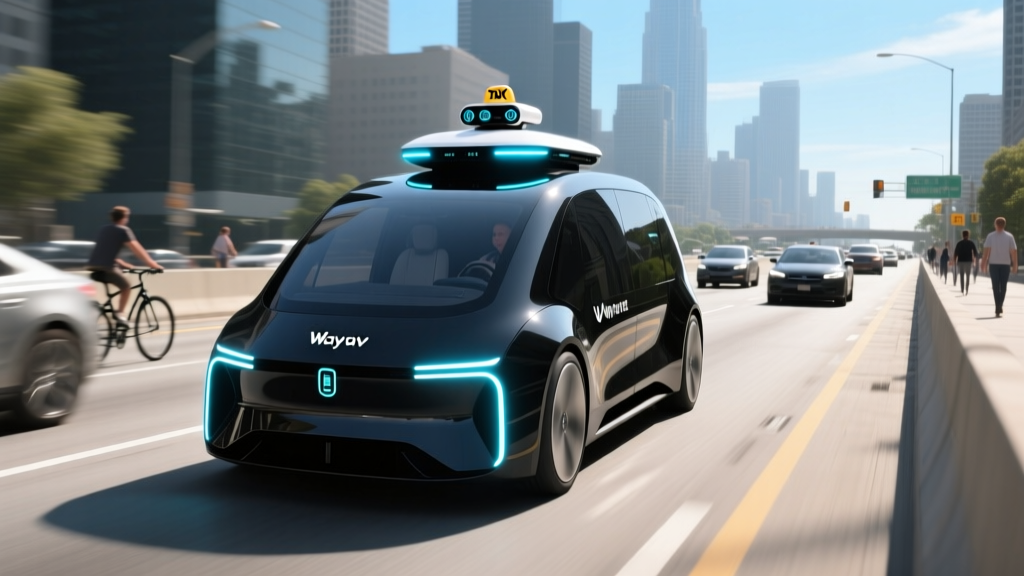
Waymo's approach to autonomous driving is sensor-fusion-heavy, which stands in direct contrast to Tesla's camera-only ("Tesla Vision") strategy. The current fleet uses the sixth-generation "Waymo Driver" hardware suite, mounted on the all-electric Zeekr RT1 minivan (replacing earlier Jaguar I-PACE vehicles in newer deployments).
- LiDAR: Multiple solid-state and spinning units providing 360° 3D point-cloud mapping to ~500m range — critical for freeway merge detection and high-speed object tracking
- Cameras: High-resolution imaging array (visible spectrum) for lane markings, traffic signals, signage, and object classification
- Radar: Imaging radar units for velocity detection of moving objects, performance in rain/fog, and redundancy
- Audio sensors: External microphones to detect emergency vehicle sirens
- HD Maps: Centimeter-precision pre-mapped routes, updated continuously — the vehicle "knows" every lane, curb, and merge point before it arrives
- Compute: Custom-designed onboard AI processing (Waymo's proprietary hardware), no reliance on cloud connectivity for real-time driving decisions
For freeway driving specifically, lidar is the differentiator. At 65–75 mph, a vehicle needs to detect, classify, and predict the behavior of surrounding traffic at long range. Camera-only systems can struggle with depth perception at highway speed and in high-contrast lighting (sun glare, tunnel transitions). Lidar provides reliable distance measurement regardless of lighting conditions, which is why Waymo has consistently invested in the technology despite its higher hardware cost.
The HD mapping dependency is both a strength and a limitation. On approved freeway segments, the Waymo vehicle has effectively memorized the road geometry — it knows exactly where lanes merge, where barriers begin, and where exits diverge. But this also means the vehicle cannot simply drive on an unmapped highway. If the geofence doesn't include that stretch of I-10, the car won't go there.
Current Limitations: Where Waymo on Freeway Still Falls Short
Despite being the most advanced commercial robotaxi in the U.S., Waymo's freeway service has real, practical limitations that riders should understand before relying on it.
- Geofence restrictions: You can only travel on freeway segments that Waymo has mapped and received regulatory approval for. Adjacent unapproved highway exits or corridors are inaccessible.
- Weather constraints: Heavy rain, fog, and dust storms can trigger service suspension. Waymo does not operate in snow or ice conditions. Phoenix monsoon storms have caused service pauses.
- Construction zones: Major highway construction with lane shifts, temporary barriers, or unmapped detours may cause the vehicle to reroute or decline the trip.
- No inter-city travel: You cannot book a Waymo from Phoenix to Tucson or SF to LA. Service is metro-area-only, even on connecting freeways.
- Pickup/dropoff constraints: Freeway rides must begin and end at surface-street locations within the geofence. No highway shoulder pickups.
- Speed limits: Waymo vehicles obey posted speed limits and do not exceed them, even when surrounding traffic is speeding significantly. This can result in slower-than-expected freeway trips.
- Emergency vehicle interactions: While the system detects and yields to emergency vehicles, complex multi-lane emergency scenes can cause the vehicle to stop and wait, extending trip time.
- Limited cargo/pets: No large items, no unaccompanied minors, and pet policies vary by city. This is a passenger ride service, not a moving van.
The weather limitation is particularly relevant for freeway riding. At highway speeds, sensor performance in heavy precipitation degrades more noticeably than at city speeds. Waymo's conservative approach means that if the system's confidence drops below threshold, the vehicle will pull over safely or decline to start the trip — better a delayed ride than a compromised one, but frustrating if you're trying to catch a flight.
The Regulatory Landscape: Who Approves Robotaxi Freeway Operations?
Robotaxi operations in the United States are governed by a patchwork of state and local regulations — there is no single federal "robotaxi license." Here's how it works for Waymo specifically:
- Arizona: The most permissive regulatory environment. Arizona has no specific AV operating permit requirement; Waymo has operated commercially since 2020 under general business licensing. The Arizona Department of Transportation oversees freeway access.
- California: The most regulated. Waymo holds permits from both the California DMV (testing and deployment permits) and the California Public Utilities Commission (CPUC), which regulates commercial passenger service. CPUC approval was required before Waymo could charge fares or expand service areas.
- Texas: Austin operations fall under Texas Department of Licensing and Regulation oversight, with local coordination through the City of Austin.
- Federal (NHTSA): The National Highway Traffic Safety Administration sets vehicle safety standards and requires crash reporting but does not currently issue operational permits for robotaxis. Federal rulemaking on AV standards remains in progress.
For freeway operations specifically, state DOTs and highway patrols have jurisdiction. In California, the California Highway Patrol (CHP) coordinates with Waymo on freeway incident protocols. Each new freeway corridor requires separate testing, validation, and often regulatory sign-off before it goes live to paying riders.
This regulatory fragmentation is why Waymo's expansion is city-by-city rather than a continuous network. A robotaxi approved for I-10 in Phoenix has no authority to drive I-10 in New Mexico.
The Vehicle: Electric Platform and Fleet Specs
Waymo's current fleet transition is worth noting for EV-focused readers. The earlier fleet of Jaguar I-PACE vehicles (90 kWh NMC battery, ~234-mile EPA range) is being supplemented and gradually replaced by the Zeekr RT1 — a purpose-built electric minivan designed in partnership with Geely's Zeekr brand.
| Spec | Jaguar I-PACE (Gen 5) | Zeekr RT1 (Gen 6) |
|---|---|---|
| Vehicle Type | Electric SUV | Electric Minivan |
| Battery (usable) | ~84 kWh (NMC) | ~100 kWh (NMC, est.) |
| EPA Range | ~234 mi | ~280 mi (est.) |
| Sensor Generation | 5th Gen Waymo Driver | 6th Gen Waymo Driver |
| Passenger Capacity | 3 (rear seat) | 4–5 |
| Fleet Status (2026) | Active, being supplemented | Deploying in newer markets |
Both vehicles are fully electric, which reduces operating cost per mile and aligns with Waymo's sustainability commitments. The fleet charges at dedicated depot chargers (Level 2 and DC fast charging) between shifts. Riders don't interact with charging — the vehicles are managed to ensure adequate battery for every dispatched trip.
Is Waymo Freeway Service Right for You?
Waymo on the freeway works — and the data suggests it works safely within its approved corridors. But it's not a replacement for owning a car, taking a road trip, or traveling between cities. It's a premium, geofenced urban mobility service that happens to include specific highway segments.
Choose Waymo freeway service if:
- You live or work in Phoenix, San Francisco, or Los Angeles and your trip stays within the geofenced area
- You need an airport ride (PHX, SFO) and the route is within the service zone
- You value a consistent, driver-free experience with predictable pricing
- You're comfortable with the vehicle strictly obeying speed limits (no "keeping up with traffic" above posted limits)
Look elsewhere (Uber, Lyft, personal vehicle) if:
- Your trip crosses metro area boundaries or goes into unmapped territory
- You need to travel in severe weather conditions
- You're carrying large luggage, equipment, or pets (policy-dependent)
- You need the fastest possible trip and are willing to exceed speed limits
- You're outside the current four-city service area
Frequently Asked Questions
Is Waymo on freeway routes truly self-driving, or is there a remote operator?
Waymo vehicles are genuinely driverless — no human in the driver's seat, no remote joystick control. However, Waymo does employ remote fleet assistance agents who can help the vehicle resolve confusing situations (e.g., an unusual construction zone) by confirming a path or approving a maneuver. The remote agent does not steer or accelerate the vehicle in real-time; they provide high-level guidance that the vehicle's onboard system then executes. This is a key distinction from teleoperation.
How fast does a Waymo drive on the freeway?
Waymo vehicles obey posted speed limits. On a 65 mph freeway, the vehicle will travel at or near 65 mph. It will not exceed the limit to match faster traffic flow. This is a deliberate safety and regulatory compliance decision.
What happens if the Waymo vehicle encounters an unexpected situation on the highway?
The vehicle's system is designed to execute a "minimal risk condition" (MRC) maneuver — typically activating hazard lights, moving to the shoulder or rightmost lane, and stopping safely. Remote fleet assistance may be engaged to help resolve the situation. If the vehicle cannot proceed, Waymo dispatches roadside assistance.
Can I schedule a Waymo freeway ride in advance?
Yes, the Waymo One app allows scheduled rides, typically up to several days in advance. This is particularly useful for airport trips where timing matters. Scheduled rides are subject to the same geofence and service-area constraints.
How does Waymo's freeway safety compare to Tesla FSD on highways?
This is a fundamentally different comparison. Tesla FSD (Supervised) is a Level 2 driver-assist system — the human driver is legally and practically responsible for the vehicle at all times. Waymo is Level 4 — no driver is present. Tesla FSD can drive on any highway nationwide (within its ODD), while Waymo is limited to approved geofenced corridors. Direct safety-rate comparisons are complicated by the different operating models, supervision requirements, and data-reporting methodologies.
Does Waymo operate at night on the freeway?
Yes. Waymo operates 24/7 in most service areas, including nighttime freeway trips. The lidar and radar sensor suite is not dependent on visible light, though camera performance in very dark, unlit highway sections relies on the vehicle's lighting and sensor sensitivity. Nighttime operations are within the approved ODD.
What is Waymo's accident reporting process?
Waymo is required to report crashes to state regulators (California DMV, Arizona authorities) and to NHTSA under the Standing General Order for automated vehicles. Public transparency reports are published periodically, though the frequency and granularity have been subjects of advocacy-group criticism. Riders can report concerns through the Waymo One app.