Can You Take a Waymo on the Highway? The Short Answer
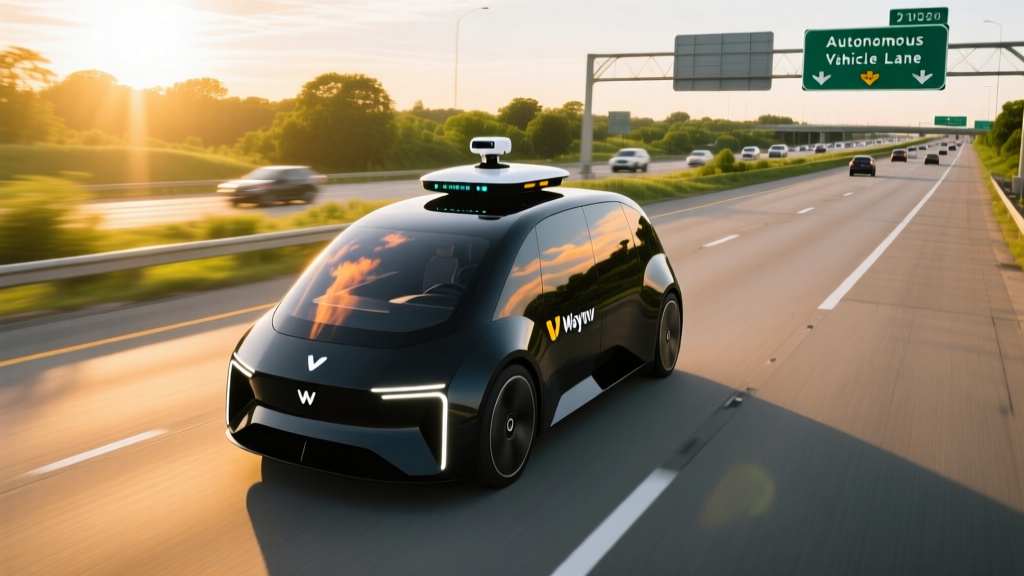
Yes — but only on specific freeway segments within Waymo One's geofenced service areas. As of early 2026, Waymo's fifth-generation and sixth-generation (Jaguar I-PACE and Hyundai Ioniq 5-based) robotaxis can operate on select controlled-access highways in Phoenix, San Francisco, Los Angeles, and Austin. However, freeway access is tightly constrained: the vehicle will only enter and exit highways within its approved operational design domain (ODD), and it will not take you on unrestricted interstate trips between cities.
If you're asking "do Waymos go on the freeway" because you want to hop on I-10 across Arizona or cruise I-5 from LA to San Francisco, the answer is no. These are not long-distance autonomous vehicles. They are geofenced urban and suburban mobility services that include limited highway segments as connectors between surface streets.
Waymo operates at SAE Level 4 within its defined ODD. This means the system performs all driving tasks without human intervention — but only under specific conditions (geofenced areas, weather limits, mapped routes). This is fundamentally different from Level 2 systems like Tesla Autopilot, GM Super Cruise, or Ford BlueCruise, which require an attentive human driver at all times. A Waymo has no steering wheel accessible to passengers and no expectation that you will take over.
Where Can I Ride a Waymo Right Now?
Waymo One, the company's commercial ride-hailing service, operates in a growing but still limited set of metro areas. Each city has a specific geofence boundary that determines where the car can travel — including which freeway segments are accessible.
| City | Service Name | Freeway Access | Approx. Service Area | Status (2026) |
|---|---|---|---|---|
| Phoenix, AZ (East Valley) | Waymo One | Yes — I-10, US-60, Loop 101, Loop 202 segments | ~315 sq mi | Fully open to public |
| San Francisco, CA | Waymo One | Yes — US-101, I-280, I-80 (limited segments) | ~55 sq mi (expanding) | Fully open to public |
| Los Angeles, CA | Waymo One | Yes — I-10, US-101, I-110 (geofenced corridors) | ~80 sq mi | Fully open to public |
| Austin, TX | Waymo One | Limited — select Mopac, I-35 segments | ~45 sq mi | Open to public |
| Atlanta, GA | Waymo (Uber integration) | Announced — not yet active | TBD | Limited pilot / announced |
Key takeaway: Freeway driving is available in Phoenix, San Francisco, LA, and Austin, but only on pre-mapped highway segments that connect surface-street origins and destinations within the geofence. You cannot book a Waymo from downtown Phoenix to Tucson or from San Francisco to Sacramento. If your route requires leaving the ODD, the app will not allow the booking or will route you on surface streets instead.
How Much Does a Waymo Ride Cost vs. Uber or Lyft?
Waymo One pricing is designed to compete directly with Uber and Lyft in the same markets. Rides are priced dynamically based on distance, time, and demand, but Waymo has generally avoided the aggressive surge multipliers that rideshare platforms apply during peak hours.
| Route (Example) | Waymo One | UberX | Lyft Standard |
|---|---|---|---|
| SFO Airport to downtown SF (~14 mi) | $35–$48 | $32–$55 | $30–$52 |
| Downtown Phoenix to Sky Harbor (~5 mi) | $12–$18 | $11–$22 | $10–$20 |
| Santa Monica to DTLA (~16 mi) | $38–$52 | $34–$60 | $33–$58 |
What you get for the price: A private, climate-controlled ride in a Jaguar I-PACE or newer Hyundai Ioniq 5-based vehicle with no driver to tip. The vehicles are maintained by Waymo's fleet operations team, and the interiors are cleaned between rides. You can request a car seat option in some markets. Waymo also integrates with Uber's app in select cities, so you can book a Waymo vehicle directly through Uber.
How to use it: Download the Waymo One app (iOS/Android), create an account, enter your pickup and dropoff. The app will show you whether your route is within the service area, the estimated fare, and the ETA for vehicle arrival. Payment is handled in-app via credit card.
How Safe Are Waymo Robotaxis? The Real Data
This is the question that matters most, and it's where concrete data — not marketing — should drive the conversation. Waymo has published safety reports and has been subject to NHTSA scrutiny, California DMV incident reporting, and independent analysis.
- Total autonomous miles driven: Over 30 million fully driverless miles across all markets (per Waymo's published data and NHTSA filings).
- Injury-causing crash rate: Waymo's published analysis, benchmarked against NHTSA's national crash data, showed an 85% reduction in injury-causing crash rates compared to human drivers in comparable urban environments.
- Police-reported crashes: Waymo vehicles have been involved in collisions, but the majority have been low-speed incidents where the Waymo was rear-ended or struck by a human-driven vehicle — consistent with urban crash patterns.
- Disengagement rate (CA DMV data): Waymo consistently reports among the lowest disengagement rates of all autonomous vehicle testers in California, measured in thousands of miles between interventions.
- NHTSA Standing General Order: Waymo reports crashes involving its ADS-equipped vehicles to NHTSA under the Standing General Order requirement. These reports are publicly accessible.
Sources: NHTSA AV Safety, Waymo Safety Reports, California DMV Autonomous Vehicle Disengagement Reports.
Context that matters: Robotaxi safety data is still being accumulated. Waymo's 30+ million driverless miles are significant but represent a fraction of the ~3 trillion miles driven annually by Americans. The comparison baseline (human drivers) includes all road types, weather conditions, and driver demographics. Waymo's ODD excludes many of the highest-risk scenarios (unmapped rural roads, extreme weather, construction zones without clear markings).
Additionally, Waymo vehicles have drawn public attention for incidents like blocking emergency vehicles, idling in intersections, or minor curb contact. The company has addressed many of these through software updates, and the San Francisco Fire Department has reported improved coordination with Waymo vehicles at emergency scenes over time.
Under the Hood: Waymo's Sensor and Technology Stack
Unlike Tesla's camera-only approach for its Autopilot and FSD (Supervised) systems, Waymo relies on a multi-sensor fusion architecture — a deliberate design choice for a Level 4 system that carries no human backup driver.
- LiDAR: Multiple roof-mounted and body-integrated LiDAR units providing 360° 3D point-cloud mapping. LiDAR gives precise depth perception independent of lighting conditions — critical for nighttime and glare scenarios where cameras struggle.
- Cameras: High-resolution surround-view cameras for lane detection, traffic signal recognition, pedestrian/object classification, and reading road signs.
- Radar: Short- and long-range radar units for velocity detection of surrounding vehicles, particularly useful in rain and fog where LiDAR and camera performance can degrade.
- Audio detection: External microphones to detect emergency vehicle sirens, triggering pre-programmed pull-over protocols.
- HD Mapping: Waymo pre-maps every inch of its service area at centimeter-level precision. The vehicle localizes itself within this map in real time, cross-referencing sensor data against known landmarks.
Why this matters for freeway driving: Highway operation demands high-speed object detection (vehicles merging at 65+ mph), long-range perception (reading lane closures 500+ feet ahead), and rapid decision-making. The LiDAR-plus-radar combination gives Waymo's system redundant depth and velocity data that a camera-only system must infer computationally. This redundancy is a core reason Level 4 operators like Waymo favor multi-sensor stacks over vision-only approaches.
What Waymo Can't Do: Current Limitations
Understanding the boundaries of Waymo's service is just as important as knowing where it works. Here are the hard constraints as of 2026:
- Geofence boundaries: The vehicle will not travel outside its pre-approved ODD. If you try to book a ride that crosses the boundary, the app will reject the request or reroute you.
- No intercity trips: You cannot take a Waymo from one metro area to another. Phoenix to Flagstaff, LA to San Diego — not possible.
- Weather restrictions: Heavy rain, dense fog, and snow can trigger operational pauses or reduced speed limits. Phoenix's monsoon season and San Francisco's fog are real-world constraints. Waymo does not operate in snow-affected cities.
- Construction zones: While Waymo has improved its handling of temporary lane shifts and construction barrels, complex or rapidly changing construction zones may cause the vehicle to stop and wait or reroute.
- Airport access: SFO, Sky Harbor (PHX), and LAX are now accessible via Waymo, but specific pickup/dropoff zones are designated. You cannot be dropped at any terminal curb — you must use the approved robotaxi zones.
- No stopping mid-route: Unlike a human rideshare driver, you cannot ask a Waymo to "stop at the pharmacy" or make an unscheduled detour. The route is fixed at booking.
- Passenger capacity: Current Waymo vehicles seat up to 3 passengers (no front-seat passenger area). Larger groups or those needing wheelchair-accessible vehicles have limited options.
- Luggage: Trunk space is available, but oversized items (surfboards, large furniture) are not accommodated.
Who Regulates Waymo? The Federal and State Landscape
Autonomous vehicle regulation in the US is a patchwork. There is no single federal "robotaxi license." Instead, Waymo navigates multiple regulatory layers:
- NHTSA (federal): Sets vehicle safety standards (FMVSS). Waymo has received exemptions for certain standards that assume a human driver (e.g., steering wheel, mirror requirements). NHTSA also requires crash reporting under its Standing General Order and can open defect investigations.
- California DMV: Issues deployment permits for autonomous vehicles in California. Waymo holds a Driverless Testing Permit and a Deployment Permit. The DMV publishes annual disengagement reports and can suspend permits — as it did briefly with Cruise in late 2023 following a pedestrian-dragging incident.
- California Public Utilities Commission (CPUC): Regulates commercial passenger service (ride-hailing) in California. Waymo received CPUC approval to operate paid robotaxi service in San Francisco and LA.
- Arizona: Has a more permissive regulatory framework. Waymo has operated commercially in Phoenix since 2020 under state executive orders that encourage AV testing and deployment.
- Texas (Austin): Operates under state AV legislation that allows testing and deployment with minimal local restriction.
The regulatory environment remains fluid. Following the Cruise incident in San Francisco, scrutiny on robotaxi operations intensified, and several cities have pushed for more local control over AV deployment. Waymo has generally maintained a more cautious public posture than Cruise did, which has helped it avoid similar regulatory backlash.
Waymo on the Freeway vs. Tesla FSD: Different Categories Entirely
A common source of confusion is comparing Waymo's freeway driving to Tesla's Full Self-Driving (Supervised) on highways. These are fundamentally different systems:
| Attribute | Waymo (Level 4 Robotaxi) | Tesla FSD Supervised (Level 2) |
|---|---|---|
| SAE Level | Level 4 (no driver needed) | Level 2 (driver must supervise at all times) |
| Freeway capability | Geofenced segments only, within ODD | Any mapped highway, nationwide |
| Human backup | None — no steering wheel for passengers | Required — driver must be alert and ready to take over |
| Sensor suite | LiDAR + cameras + radar + HD maps | Cameras only (Tesla Vision) |
| Service model | Ride-hailing (you're a passenger) | Personal vehicle (you're the driver) |
| Geographic limit | Strict geofence (specific cities) | No geofence (works on roads nationwide) |
Tesla's FSD (Supervised) can handle highway on-ramps, lane changes, and exits on virtually any US freeway, but it requires an attentive human behind the wheel. Waymo's Level 4 system handles freeway segments with zero human involvement, but only within tightly defined geographic boundaries. They solve different problems.
Frequently Asked Questions
Can I take a Waymo from one city to another on the freeway?
No. Waymo's service is geofenced to specific metropolitan areas. You cannot book an intercity trip (e.g., San Francisco to Los Angeles or Phoenix to Tucson). The vehicle will only travel on freeway segments within its approved operational design domain and will not cross service-area boundaries.
How fast does a Waymo drive on the freeway?
Waymo vehicles generally travel at or near the posted speed limit on freeway segments, typically 55–65 mph depending on the corridor. The system adjusts speed for traffic density, weather conditions, and construction zones. Waymo has stated that its vehicles do not exceed speed limits.
What happens if the Waymo encounters an emergency on the highway?
Waymo vehicles are programmed to execute safe pullover maneuvers — moving to the shoulder or exiting the freeway — if the system detects a fault or an unresolved scenario. Waymo's remote assistance team can provide guidance (not remote driving) to help the vehicle navigate edge cases. Emergency responders are contacted automatically if a collision is detected.
Is Waymo available at major airports?
Yes, as of 2026, Waymo One serves Sky Harbor International Airport (PHX) in Phoenix, San Francisco International Airport (SFO), and Los Angeles International Airport (LAX) with designated pickup and dropoff zones. Austin-Bergstrom (AUS) access has been announced. You must use the specified robotaxi pickup areas — not general rideshare curbs.
Does Waymo operate at night and in the rain?
Waymo operates 24/7 in its service areas, including nighttime. The LiDAR-based sensor suite does not rely on visible light, so nighttime performance is strong. However, heavy rain, dense fog, or severe weather events may trigger reduced operations or temporary service pauses for safety reasons.
Is this truly self-driving or is there a remote human controlling the car?
Waymo vehicles are genuinely self-driving within their ODD — there is no remote human "driving" the car via joystick or teleoperation. Waymo does employ a remote assistance team that can provide high-level guidance (e.g., confirming it's safe to proceed past an unusual obstacle), but these agents do not steer, brake, or accelerate the vehicle. The driving decisions are made by the onboard computer.