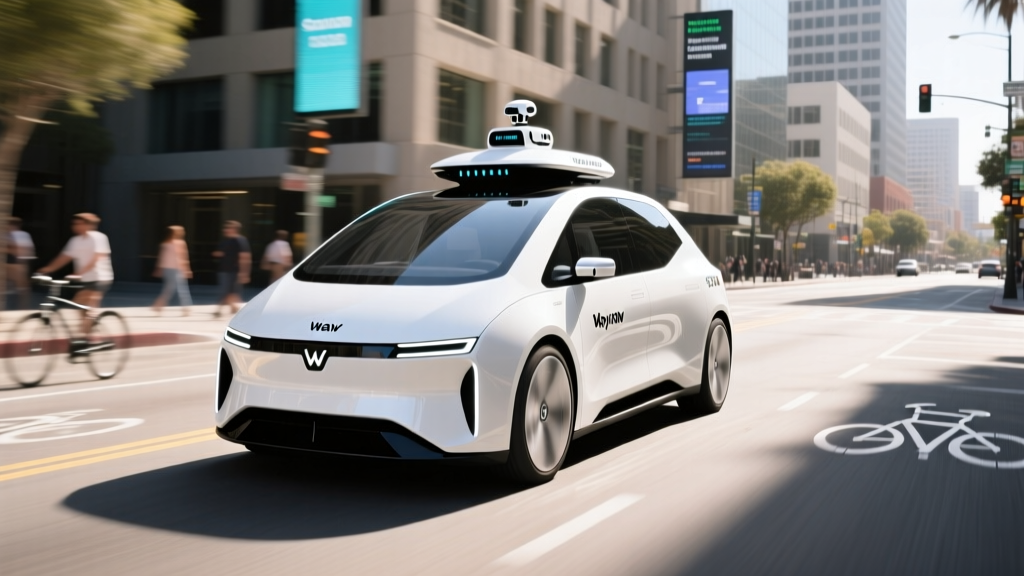
Waymo operates the largest fully driverless ride-hail fleet in the United States, but pinning down exact vehicle counts requires parsing regulatory filings, fleet permits, and company disclosures that update quarterly rather than in real time. As of early 2026, Waymo's active commercial fleet is estimated at approximately 1,000 to 1,500 vehicles across its paid service areas, with the majority concentrated in Phoenix, San Francisco, and Los Angeles. The company has publicly stated it surpassed 10 million paid trips by late 2025, but fleet size is a moving target that depends on vehicle rotation, maintenance cycles, and expansion pacing.
This guide breaks down what we know about Waymo's fleet composition, where you can actually hail a driverless ride today, how the economics compare to Uber and Lyft, and what the safety data actually shows when you look past the headlines.
What Level of Autonomy Is Waymo Actually Operating?
Before discussing fleet size, it is critical to distinguish Waymo's driverless robotaxis from the driver-assist systems sold by Tesla, GM, Ford, and others. Waymo operates at SAE Level 4 within its approved geofenced service areas — meaning no human driver is present, no steering wheel is functional, and the system handles all driving tasks within its operational design domain (ODD). If the vehicle encounters a scenario it cannot handle, it executes a minimal-risk maneuver (pulling over safely) rather than handing control to a passenger.
SAE Automation Levels: Where Waymo Sits
| Level | Description | Examples |
|---|---|---|
| Level 2 | Driver assist — human must supervise at all times | Tesla Autopilot/FSD Supervised, GM Super Cruise, Ford BlueCruise |
| Level 3 | Conditional automation — driver can disengage in limited scenarios, must take over when requested | Mercedes DRIVE PILOT (approved in NV/CA, limited to <40 mph traffic jams) |
| Level 4 | High automation — no driver required within defined ODD/geofence | Waymo One, Zoox (testing) |
| Level 5 | Full automation — no geofence, all conditions, all roads | Does not exist commercially anywhere as of 2026 |
Source: SAE International J3016
This distinction matters because consumer surveys consistently show confusion between Level 2 driver-assist (where you must watch the road and keep hands available) and Level 4 robotaxis (where you are purely a passenger). Waymo's vehicles have no driver seat controls active during commercial trips. You cannot "take over" — and you do not need to.
Fleet Size Breakdown: How Many Waymo Cars Are on the Road
Waymo does not publish a live fleet counter, but we can reconstruct approximate numbers from California DMV autonomous vehicle permits, Arizona regulatory filings, and the company's own milestone announcements. The fleet is composed primarily of two vehicle platforms:
- Jaguar I-PACE (5th-generation Waymo Driver): The workhorse of the fleet — an all-electric SUV with a ~70 kWh usable battery (NMC chemistry), EPA range of approximately 234 miles when new, and the integrated roof-mounted lidar/sensor suite. Estimated 800–1,000+ units in active commercial rotation.
- Zeekr RT (6th-generation Waymo Driver): A purpose-built robotaxi introduced in limited numbers starting late 2024/early 2025, designed with lower production cost, improved sensor integration, and easier passenger access. Estimated 100–300 units in early deployment as of 2026.
The total fleet figure of ~1,000–1,500 vehicles includes cars in active paid service, vehicles undergoing maintenance or sensor recalibration, and units used for mapping and testing in expansion cities. Not all vehicles are on the road simultaneously — Waymo operates shifts, and vehicles cycle through charging and cleaning. At any given moment in a major market like San Francisco, you might see 200–400 Waymo vehicles actively serving rides.
Fleet growth context: Waymo's fleet was estimated at roughly 300–400 vehicles in 2023 and has scaled steadily as the company expanded from Phoenix-only to multi-city operations. Growth is constrained not by vehicle production but by regulatory approval pacing, mapping requirements, and local permitting in each new city.
Where Can You Actually Use Waymo Right Now?
Waymo One — the company's commercial ride-hail app — operates paid, fully driverless service in a limited set of metro areas. Availability is geofenced: even within an approved city, the service area covers specific zones, not every street. Here is the current operational status:
| City | Service Status | Coverage Notes |
|---|---|---|
| Phoenix, AZ | Fully operational, open to public | Largest service area (~225+ sq mi including Chandler, Tempe, Mesa, Scottsdale, Sky Harbor Airport). Longest-running market since 2020. |
| San Francisco, CA | Fully operational, open to public | Covers most of SF proper including downtown, Mission, SoMa, Sunset, Richmond. Highway trips to SFO approved. |
| Los Angeles, CA | Fully operational, open to public | Service area covers central LA, Hollywood, Westside, Downtown. Expanded through 2025. |
| Austin, TX | Operational / expanding | Launched driverless service in 2025. Coverage area growing; initial zones include central and south Austin. |
| Mountain View, CA | Limited / testing phase | Waymo's headquarters city; limited trusted-tester and early access. Not fully open to public as of early 2026. |
To use Waymo One, you download the app (available on iOS and Android), enter your pickup and dropoff within the service area, and request a ride. There is no waitlist in most operational cities as of 2026 — Phoenix and San Francisco are generally open access, though LA and Austin may still have periodic demand-based limitations. You do not need a special invitation or trusted-tester status in fully launched markets.
How Much Does Waymo Cost vs Uber and Lyft?
Waymo prices its rides to be competitive with UberX and Lyft standard fares in each market — sometimes slightly cheaper, sometimes slightly more expensive, depending on distance, time of day, and demand. The company does not use traditional surge pricing in the same way rideshare platforms do, but fares do vary by time and route.
| Route Example | Waymo One | UberX (est.) | Lyft (est.) |
|---|---|---|---|
| SF: Mission → Financial District (~4 mi) | $12–$16 | $11–$18 | $10–$17 |
| Phoenix: Chandler → Sky Harbor Airport (~18 mi) | $28–$38 | $30–$45 | $28–$42 |
| LA: Hollywood → Santa Monica (~16 mi) | $24–$34 | $22–$40 | $20–$38 |
Note: UberX and Lyft fares are estimates based on typical non-surge pricing and vary significantly with demand. Waymo fares are upfront and locked at request time. Tipping is available in the Waymo app but not expected the way it is with human drivers.
The key economic difference: Waymo's cost structure eliminates the driver payout (typically 70–80% of a rideshare fare goes to the driver). However, Waymo absorbs vehicle cost (~$100,000+ per equipped I-PACE including sensor suite), operations, remote assistance staff, insurance, and charging infrastructure. The company has not disclosed profitability on a per-market basis, and analysts widely agree that Waymo operates at a loss in most markets as it scales. For riders, the practical takeaway is that pricing is currently subsidized and competitive — potentially subject to increase as the service matures.
Waymo Safety Record: What the Data Actually Shows
Waymo Safety Data Points (through 2025)
- Total autonomous miles driven: 50+ million fully driverless miles (cumulative across all markets)
- Paid trips completed: 10+ million (milestone announced late 2025)
- Injury-causing crash rate: ~85% lower than human benchmark for injury-causing crashes, per Waymo's peer-reviewed study published in collaboration with insurance data analysis (2024)
- Police-reported crash rate: ~57% lower than human benchmark for any police-reported crash
- Fatalities: Zero confirmed passenger or pedestrian fatalities in Waymo driverless operations as of early 2026
Source: Waymo Safety Report; NHTSA AV Safety Data
These numbers require context. Waymo operates in geofenced urban and suburban areas at moderate speeds (typically under 45 mph), in mapped environments, and avoids certain high-risk scenarios by design (unpaved roads, unmapped construction zones). Comparing its crash rate to the national human average — which includes rural highways, drunk driving, and high-speed interstates — is not a perfectly apples-to-apples comparison. However, when Waymo's data is compared specifically to urban human driving benchmarks in similar environments, the safety advantage persists, though the gap narrows.
Notable incidents have occurred. In early 2024, a Waymo vehicle in San Francisco struck a pedestrian who had been pushed into the vehicle's path by another human-driven car; the pedestrian sustained minor injuries. Waymo's system detected the person but could not stop in time given physics constraints. The NHTSA reviewed the incident, and no systemic fleet defect was identified. Several minor low-speed collisions with fixed objects (cones, curbs, parked cars) have also been logged in public reports — typical of urban driving but amplified by the scrutiny driverless vehicles receive.
The Technology Stack: Lidar, Cameras, and Geofencing
Waymo's approach to autonomous driving is fundamentally different from Tesla's camera-centric FSD system. Waymo uses a redundant, multi-sensor stack that fuses data from several hardware systems simultaneously:
- Lidar (roof-mounted, 360°): Custom-built spinning and solid-state lidar units provide precise 3D point-cloud mapping of the environment in real time, independent of lighting conditions. This is Waymo's primary depth-perception system.
- Cameras (multiple, 360° coverage): High-resolution cameras handle traffic-light detection, sign reading, lane-marking identification, and object classification (pedestrian vs cyclist vs vehicle).
- Radar (multiple units): Used for velocity detection of moving objects, performance in rain and fog where lidar and cameras degrade, and redundancy.
- Audio detection: External microphones detect emergency vehicle sirens and trigger appropriate response behavior (pulling over).
- HD pre-mapped routes: Waymo does not drive on unmapped roads. Every inch of the service area is pre-mapped at centimeter-level precision, and the vehicle localizes itself within this map in real time.
The 6th-generation Waymo Driver (on the Zeekr RT platform) improved sensor range and resolution, reduced per-vehicle hardware cost, and added better rain/fog performance — but the fundamental architecture remains lidar-forward, not camera-only. This is a deliberate engineering choice: lidar provides direct distance measurement without relying on neural-network inference from 2D images, which Waymo considers a necessary redundancy for Level 4 operations where no human backup exists.
Geofencing is equally critical. Waymo vehicles will not operate outside their approved service area. If you request a ride that would take the vehicle outside the geofence, the app simply won't allow it. The geofence is defined not just by geography but by road type, speed limit, and mapping completeness. If a road within the geofence is undergoing major construction that alters the map, Waymo may temporarily restrict routing through that segment.
Current Limitations: What Waymo Cannot Do
Level 4 autonomy within a geofence is genuinely impressive, but it is not Level 5. Here are the real, practical limitations riders encounter:
- No service outside geofenced zones: You cannot take a Waymo from San Francisco to Sacramento, or from central Phoenix to Tucson. The car will not drive beyond its mapped, approved area.
- Weather constraints: Heavy rain, fog, and dust storms can cause Waymo to reduce speed, increase following distance, or in extreme cases, pause service entirely. Phoenix monsoon season and San Francisco fog are real operational factors. Snow and ice (not relevant in current markets) would be a hard stop.
- Highway limitations: While Waymo has received approval for highway operation to SFO airport in San Francisco, not all geofenced areas include freeway segments. Most urban trips are on surface streets.
- No complex unpaved or unmapped routes: Construction zones that significantly alter road geometry, private driveways, parking garages (beyond designated pickup/dropoff points), and rural roads are out of scope.
- Pickup/dropoff precision: Waymo pulls to a safe, legal stopping point — but it may not stop at the exact front door of your destination. You might need to walk a short distance from the drop-off point.
- Wait times: In high-demand periods or at the edges of the service area, wait times can exceed 10–15 minutes, longer than Uber/Lyft in some cases because the fleet is smaller.
- No child seats: Waymo vehicles do not provide car seats, and children under a certain age/size may not ride without one (check local laws and Waymo's rider policy).
What Waymo Is NOT
Waymo is not a car you can buy. It is not available in all cities. It does not drive on highways everywhere. It does not operate in heavy snow. And it is absolutely not the same technology category as Tesla's FSD Supervised, which remains a Level 2 driver-assist system requiring continuous human attention and intervention. Conflating the two creates dangerous expectations for consumers. Waymo's vehicle has no active driver controls; Tesla's requires a licensed, attentive driver at all times.
Regulatory Landscape: Who Approves Robotaxi Operations?
Robotaxi deployment in the United States is regulated at the state and local level — there is no single federal "robotaxi license." The key regulatory bodies:
- California Public Utilities Commission (CPUC): Issues permits for commercial autonomous ride-hail in California. Waymo holds a TCP (Transportation Charter-Party Carrier) permit with autonomous vehicle authorization. The CPUC also requires incident reporting and sets fare regulations.
- California DMV: Issues autonomous vehicle testing and deployment permits. Companies must submit annual disengagement reports (though the reporting format has been debated and revised).
- Arizona: Has a more permissive regulatory framework. Waymo has operated commercially in Phoenix since 2020 under state-level authorization with minimal local friction compared to California.
- Texas (Austin): The Texas Department of Transportation and local authorities oversee AV operations. Austin's regulatory environment is moderately permissive.
- NHTSA (federal): Does not "approve" robotaxi services but has authority to investigate safety defects, issue recalls, and require incident reporting through its Standing General Order for crashes involving automated driving systems.
The patchwork nature of regulation means expansion is city-by-city, not national. Each new metro area requires mapping, testing, regulatory engagement, and often public-comment periods. This is a primary reason Waymo's fleet and service area grow incrementally rather than explosively.
Frequently Asked Questions
How many Waymo cars are on the road total across all cities?
Based on regulatory filings, fleet permits, and company disclosures, Waymo's total fleet is estimated at approximately 1,000 to 1,500 vehicles as of early 2026. This includes Jaguar I-PACE SUVs equipped with the 5th-generation Waymo Driver and a growing number of Zeekr RT vehicles with the 6th-generation system. Not all vehicles are on the road simultaneously — the fleet rotates through charging, maintenance, and operational shifts.
Is Waymo truly self-driving, or is there a remote human controlling it?
Waymo vehicles are genuinely driverless — there is no human in the car and no remote "joystick" operator driving the vehicle in real time. Waymo does employ remote assistance staff who can provide high-level guidance in edge cases (for example, confirming whether a construction-zone flagger is directing traffic), but these staff do not steer, accelerate, or brake the vehicle. The AI system makes all real-time driving decisions. This is a Level 4 operation per SAE J3016.
Can I use Waymo at the airport?
Yes, in Phoenix (Sky Harbor Airport, PHX) and San Francisco (SFO), Waymo offers rides to and from the airport within its geofenced service area. Airport pickups typically use designated ride-app zones. Check the Waymo One app for current airport availability in your city.
What happens if a Waymo vehicle gets into an accident?
Waymo carries commercial insurance for all trips. If a collision occurs, the vehicle's systems log detailed sensor data, and Waymo's incident response team coordinates with local authorities. Passengers can report issues through the in-app support or the in-vehicle help button. NHTSA requires reporting of crashes involving automated driving systems through its Standing General Order.
Will Waymo come to my city?
Waymo has announced interest in expanding to additional US metros, but each new city requires regulatory approval, HD mapping, and local testing — a process that typically takes 12–24+ months from announcement to paid service. As of 2026, confirmed operational cities are Phoenix, San Francisco, Los Angeles, and Austin. Announced or testing-phase cities may include additional metros, but timelines remain subject to regulatory and operational readiness.
How does Waymo compare to Tesla's Full Self-Driving?
They are fundamentally different categories. Waymo is a Level 4 driverless robotaxi service — you are a passenger with no driving responsibility, operating within a geofenced area. Tesla FSD (Supervised) is a Level 2 driver-assist system that requires a licensed, attentive driver who must monitor the road and be prepared to take over at any moment. Tesla's system uses cameras only (no lidar), is not geofenced, and can be used on any road — but the human driver is legally and practically responsible. Calling both "self-driving" creates confusion that has real safety consequences.
This article reflects publicly available data as of early 2026. Fleet size estimates are based on regulatory filings, industry analysis, and company disclosures; Waymo does not publish a real-time fleet count. Pricing examples are illustrative and subject to change. Always verify current service availability and fares in the Waymo One app. For tax, legal, or regulatory questions, consult official sources or a qualified professional.