Waymo is no longer a pilot program confined to a few Phoenix suburbs. As of early 2026, Alphabet's autonomous-vehicle subsidiary operates the largest paid driverless ride-hail network in the United States, and the company is adding new metropolitan zones faster than any competitor. If you have been searching for Waymo expanding coverage details — where you can actually hail a car, what it costs, and whether the safety record holds up at scale — this guide consolidates the numbers that matter.
Is Waymo Truly Self-Driving? SAE Automation Levels Explained
Consumer driver-assistance systems such as Tesla Autopilot, Ford BlueCruise, and GM Super Cruise are classified as SAE Level 2: the vehicle can manage steering and acceleration under certain conditions, but a licensed driver must remain attentive and ready to intervene at any moment. Waymo's commercial robotaxi service, branded Waymo One, operates at SAE Level 4 within its defined operational design domain (ODD). That means no human driver is present in the vehicle, no remote teleoperator is steering in real time, and the system handles all driving tasks — or executes a safe stop — within its approved geographic and environmental boundaries.
SAE Level 4 (Driverless — Geofenced) — Waymo One. No driver in the vehicle. Operates only within approved ODD boundaries and conditions.
SAE Level 5 (Full Autonomy — Anywhere) — No production system currently operates at this level anywhere in the world.
The distinction is not academic. When Waymo's vehicle encounters a situation outside its capability — an unmapped construction zone, for example — it does not hand control to a passenger. It pulls over safely and ends the trip or requests remote assistance for routing guidance (not real-time driving). This is fundamentally different from a Level 2 system asking the driver to "take over now."
Where Can I Use Waymo Right Now? Service Availability by City
Waymo has grown from a single Phoenix metro launch to a multi-city network. Below is the current operational status as of Q1 2026. Service areas are geofenced — the car will only operate within approved boundaries, and you cannot hail a ride to a destination outside the zone.
| City / Region | Status | Approximate Service Area | Vehicle Platform |
|---|---|---|---|
| Phoenix, AZ (Metro) | Fully operational — open to public | ~500+ sq mi (Tempe, Scottsdale, Chandler, Mesa, airport) | Jaguar I-PACE (Gen 6 sensor suite) |
| San Francisco, CA | Fully operational — open to public | ~70 sq mi city core + expansion corridors | Jaguar I-PACE (Gen 6) |
| Los Angeles, CA | Operational — expanding zones | Santa Monica, Hollywood, Downtown LA, Westside corridors | Jaguar I-PACE (Gen 6) |
| Austin, TX | Operational — phased public rollout | Central Austin, South Congress, select suburban corridors | Jaguar I-PACE (Gen 6) |
| Atlanta, GA | Announced — early rider access (2026) | Midtown, Buckhead, initial geofenced zone | Hyundai IONIQ 5 (Gen 7 platform) |
Phoenix remains Waymo's most mature market, with airport runs to Phoenix Sky Harbor (PHX) available 24/7. San Francisco is the densest urban environment Waymo navigates, handling unprotected left turns, cable car tracks, and aggressive cyclist behavior. Los Angeles service has expanded incrementally, with freeway-capable routes now part of the ODD on select corridors. Austin launched with a limited footprint and is scaling through 2026. Atlanta represents the newest market, currently in early-access testing with Waymo's next-generation Hyundai IONIQ 5-based platform featuring the Gen 7 sensor suite.
Additional cities have been announced for future expansion but are not yet operational for paid rides. Always check the Waymo One app for the current geofence boundary in your area before planning a trip.
Waymo Pricing vs. Uber and Lyft: What Does a Ride Actually Cost?
Waymo uses a dynamic pricing model similar to rideshare platforms, calculating fares based on distance, time, and demand. There is no separate "autonomy premium" — Waymo prices to be competitive with UberX and Lyft Standard in the same corridor.
| Route Example | Waymo One | UberX | Lyft Standard |
|---|---|---|---|
| SF: Embarcadero → Mission District (~4 mi) | $14–$18 | $13–$19 | $12–$17 |
| Phoenix: Downtown → Sky Harbor Airport (~6 mi) | $18–$24 | $16–$25 | $15–$22 |
| LA: Santa Monica → Downtown (~16 mi) | $32–$42 | $28–$45 | $26–$40 |
| Austin: South Congress → Airport (~8 mi) | $20–$26 | $18–$27 | $17–$24 |
Key pricing observations:
- No surge pricing in the traditional sense. Waymo uses demand-based adjustments, but because fleet supply is fixed (no gig-economy drivers logging on and off), pricing tends to be more predictable than Uber/Lyft surge.
- No tipping. There is no driver to tip, which effectively reduces total trip cost by 15–20% compared to a tipped rideshare.
- Promo credits. Waymo frequently offers first-rider credits ($5–$15 off) and referral bonuses in newly launched markets. Check the app for current promotions in your city.
- Wait times. In Phoenix and San Francisco, average pickup time runs 3–7 minutes during non-peak hours. During peak demand, waits can stretch to 10–15 minutes as the fixed fleet cycles through trips.
How Safe Are Waymo Robotaxis? The Data Behind the Headlines
Safety is the most scrutinized dimension of autonomous driving, and Waymo publishes more operational data than any competitor. Here is what the numbers show.
• Cumulative fully autonomous miles driven: 10+ million miles (driverless, no human behind the wheel)
• Contacted police-reported crashes: Significantly fewer per million miles than human benchmarks in comparable urban environments
• Injury severity: The vast majority of reported incidents involve minor, low-speed contact — typically another vehicle striking the Waymo at an intersection. No reported passenger fatalities.
• Disengagement model: Unlike Level 2 systems that track "miles per disengagement," Waymo's Level 4 vehicles do not have a driver to disengage. Instead, the system may execute a "minimal risk condition" (safe pullover) when encountering scenarios outside its ODD.
According to data Waymo has submitted to the National Highway Traffic Safety Administration (NHTSA) and published in peer-reviewed analyses, Waymo vehicles in driverless operation show lower rates of police-reported crashes and lower injury-severity metrics compared to human-driver benchmarks in the same urban environments. A study published by the Insurance Institute for Highway Safety (IIHS) noted that robotaxi operations, when confined to well-mapped geofenced zones, eliminate impairment-related and distraction-related crashes — two of the leading causes of urban collisions.
However, context matters. Waymo's ODD excludes many of the high-risk scenarios human drivers face daily: rural highways at 75 mph, unmapped dirt roads, and severe weather. Comparing Waymo's crash rate to the national average (which includes rural interstates and impaired driving) requires careful normalization. The most honest comparison is urban, sub-45-mph environments in fair weather — and in that slice, the data favors Waymo.
Under the Hood: Waymo's Technology Stack
Waymo's approach to autonomous driving is sensor-redundant and compute-heavy — fundamentally different from camera-only systems like Tesla's FSD. The current Gen 6 fleet (Jaguar I-PACE) and the incoming Gen 7 platform (Hyundai IONIQ 5) use a layered perception stack:
Waymo's custom-built lidar units provide high-resolution 3D point clouds up to 500+ meters. Lidar is independent of ambient lighting, giving the system reliable depth perception at night, in tunnels, and in direct sun glare — conditions where camera-only systems can struggle.
Camera Array
Multiple high-dynamic-range cameras provide color and texture data: reading traffic-light states, identifying road-sign text, detecting brake lights, and classifying objects (pedestrian vs. cyclist vs. construction barrel).
Radar
Millimeter-wave radar complements lidar for velocity detection of moving objects, particularly useful in rain or fog where lidar return degrades.
HD Maps + Geofencing
Waymo pre-maps every inch of its service area at centimeter-level resolution. The vehicle knows where every lane marking, speed limit change, and crosswalk exists before it arrives. This is why Waymo cannot simply "drive anywhere" — the vehicle requires a validated map to operate.
Compute Platform
Custom AI inference hardware processes sensor fusion in real time, running Waymo's trained neural networks for object detection, prediction (what will that pedestrian do next?), and planning (what trajectory should the vehicle take?).
The trade-off of this approach is cost and complexity. Each Gen 6 I-PACE is estimated to carry well over $100,000 in sensor and compute hardware on top of the vehicle's base MSRP of ~$71,000. The Gen 7 platform aims to reduce per-vehicle sensor cost significantly through next-generation lidar miniaturization and higher-volume production, which is essential for Waymo to scale the fleet profitably.
Regulatory Landscape: Who Approves Robotaxi Operations?
Robotaxi deployment in the United States is governed by a patchwork of state and local regulations — there is no single federal license for autonomous ride-hail.
- California (CPUC + DMV): The California Public Utilities Commission issues permits for commercial autonomous ride-hail, while the DMV manages testing permits and disengagement reporting. San Francisco and Los Angeles operations require CPUC authorization. The CPUC has the power to cap fleet sizes, restrict operating hours, and revoke permits — which it exercised in 2023 when it suspended Cruise's permit following a serious incident in San Francisco.
- Arizona: Arizona has maintained the most permissive regulatory environment for autonomous vehicles. Waymo has operated commercially in Phoenix since 2020 with relatively few restrictions, which is why Phoenix remains the largest service area.
- Texas: Austin operates under a state autonomous-vehicle framework that permits driverless commercial service with local coordination. Waymo coordinates with the City of Austin on geofence boundaries and incident reporting.
- Georgia: Atlanta's regulatory framework for commercial robotaxi service is being finalized in coordination with state and city authorities as Waymo begins early-access operations in 2026.
- Federal (NHTSA): NHTSA does not "approve" autonomous vehicles for deployment but has authority to investigate safety defects, issue recalls, and mandate standing general incident reports from all ADS-equipped vehicles. Waymo is subject to NHTSA's standing general order requiring crash reporting for vehicles equipped with automated driving systems.
Current Limitations: Where Waymo Cannot (Yet) Drive
Waymo's Level 4 autonomy is impressive within its ODD, but the boundaries of that domain are real and consequential. Here is what the system does not handle today:
- Heavy rain and fog: While radar and lidar provide some weather resilience, severe precipitation degrades sensor performance. Waymo may restrict or pause service during heavy downpours — common in Phoenix monsoon season and San Francisco winter storms.
- Snow and ice: Waymo does not currently operate in snow-belt cities. Snow-covered lane markings and reduced friction coefficients are outside the validated ODD.
- Highway driving above ~65 mph: Most Waymo service areas include limited freeway segments at moderate speeds, but the system is not designed for 75-mph interstate travel between cities.
- Unmapped or rapidly changing construction zones: If a construction zone significantly alters lane geometry and the HD map has not been updated, the vehicle may reroute or end the trip early.
- Rural and suburban fringe areas: Service is confined to the geofenced urban core and approved corridors. You cannot hail a Waymo to a remote hiking trailhead or a suburb outside the zone.
- Complex emergency-vehicle interactions: While Waymo has improved its response to approaching emergency vehicles, multi-vehicle incident scenes with conflicting hand signals from first responders remain challenging edge cases.
These limitations are not unique to Waymo — they apply to every Level 4 system operating today. The geofenced urban ODD is a deliberate engineering choice: solve the hardest urban navigation problems in a controlled geographic area before expanding to highways, weather extremes, and unmapped environments.
How to Use Waymo One: Practical Rider Guide
Getting a ride is straightforward if you are within a live service area:
- Download the Waymo One app (iOS/Android). Create an account with payment information.
- Enter your pickup and drop-off locations. The app will confirm whether both are within the current geofence.
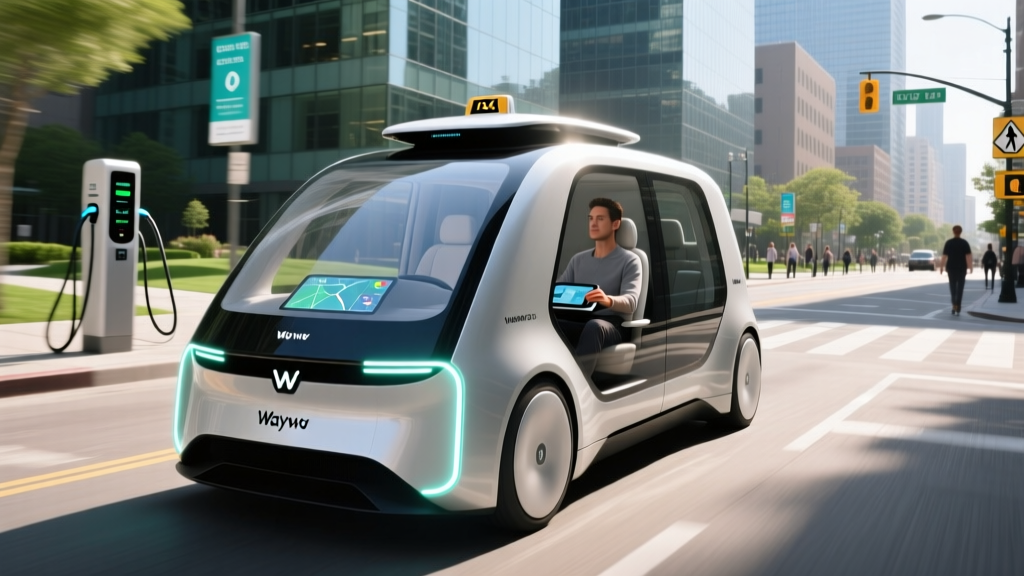
- Confirm your ride. The app shows estimated fare, wait time, and vehicle details (typically a white Jaguar I-PACE with Waymo branding and a visible lidar dome).
- Vehicle arrival. The car pulls to your pickup point. The app unlocks the doors when you are adjacent to the vehicle. There is no driver — you sit in the rear seats.
- In-ride experience. A rear-seat screen shows your route, current speed, and a visualization of what the car "sees" (detected vehicles, pedestrians, cyclists). You can adjust climate controls and select music. A "pull over" button is available at all times if you need to end the trip early.
- Arrival and payment. The ride ends automatically at your destination. Payment processes through the app — no tipping interface, no cash exchange.
Accessibility: Waymo offers wheelchair-accessible vehicles (WAVs) in select markets, though availability is more limited than standard vehicles. Request WAV service through the app where available.
Frequently Asked Questions
Is Waymo safer than a human Uber driver?
In the specific environments where Waymo operates — urban streets under 45 mph, fair weather, geofenced and HD-mapped — available data indicates lower rates of police-reported crashes compared to human-driver benchmarks. Waymo eliminates impaired driving, distracted driving, and fatigue, which together cause a large share of urban crashes. However, Waymo does not yet operate in many higher-risk scenarios (high-speed highways, severe weather) where a direct comparison is not possible. Review data from NHTSA and Waymo's published safety reports for the latest figures.
Can I take a Waymo from San Francisco to Los Angeles?
No. Waymo's service is geofenced to each metropolitan area. You cannot book an intercity trip. Each city operates as an independent zone, and the vehicle will not drive outside its approved ODD.
What happens if the Waymo vehicle gets confused or encounters an obstacle?
The vehicle is designed to enter a "minimal risk condition" — it will slow down, pull over to a safe location, and either wait for the situation to resolve or end the trip. A remote support team can provide routing guidance (e.g., "the construction zone has cleared, proceed") but does not steer the vehicle in real time. You can also press the pull-over button at any time.
Does Waymo work at night?
Yes. Waymo operates 24/7 in Phoenix and during extended hours in San Francisco and Los Angeles. The lidar and radar sensor suite does not depend on visible light, so nighttime driving is within the system's capability. Service hours may vary by city — check the app for your market.
Why doesn't Waymo operate in my city yet?
Each new city requires HD mapping of the entire service area, regulatory approval from state and local authorities, fleet deployment, and extensive validation testing before paid service begins. Waymo has prioritized cities with favorable regulatory environments and manageable weather conditions. Expansion to snow-belt cities and more complex regulatory jurisdictions will take additional time.
Is Waymo expanding to more cities in 2026?
Yes. Atlanta is the newest market with early-access rides beginning in 2026, and Waymo has signaled additional city announcements throughout the year. The pace of expansion depends on regulatory approvals, fleet production (particularly the Gen 7 Hyundai IONIQ 5 platform), and operational validation in each new environment. Follow the Waymo blog and the Waymo One app for real-time availability updates.