If you've seen a white SUV cruising San Francisco or Phoenix streets with a roof rack bristling with sensors and no one behind the wheel, you've likely wondered: is Waymo electric or gas? The short answer is that Waymo's commercial robotaxi fleet is entirely electric — but the full picture involves multiple vehicle platforms, hundreds of millions of autonomous miles, and a technology stack that goes far beyond the battery.
This guide breaks down exactly what powers Waymo's driverless taxis, where you can hail one today, what it costs compared to Uber or Lyft, and what the real safety data shows. We'll also explain the critical difference between Waymo's Level 4 autonomy and the Level 2 driver-assist systems you find in consumer vehicles.
Waymo's All-Electric Fleet: Vehicle Specs at a Glance
Waymo does not operate any internal-combustion vehicles in its commercial ride-hailing service. The fleet has evolved through several generations, and as of 2026, two primary vehicle platforms carry paying passengers:
| Spec | Jaguar I-PACE (Gen 5/6) | Zeekr M-Vision (Gen 6, rolling deployment) |
|---|---|---|
| Powertrain | Dual-motor AWD BEV | SEA-platform BEV (RWD/AWD TBD) |
| Battery Capacity | 90 kWh (usable ~84 kWh), NMC | ~100 kWh (estimated), NMC |
| EPA Range | 234 miles (stock); ~180-200 mi with sensor load | ~250 miles (estimated, purpose-built efficiency) |
| DC Fast Charge | 100 kW peak (CCS1); 10-80% in ~45 min | Higher-rate architecture (details TBD) |
| 0-60 mph | 4.5 sec (stock) | N/A — comfort-tuned for passengers |
| Autonomy Generation | 5th/6th-gen Waymo Driver | 6th-gen Waymo Driver (integrated) |
| Role | Primary revenue fleet | Next-gen expansion vehicle |
The Jaguar I-PACE has been Waymo's workhorse since 2018. It's a premium electric SUV with a 90 kWh NMC battery, but Waymo's extensive sensor suite and onboard computing draw additional power, effectively reducing real-world operational range to roughly 180-200 miles before the vehicle must return to a depot for charging. Fleet operations manage this through shift-based scheduling and depot-level DC fast charging.
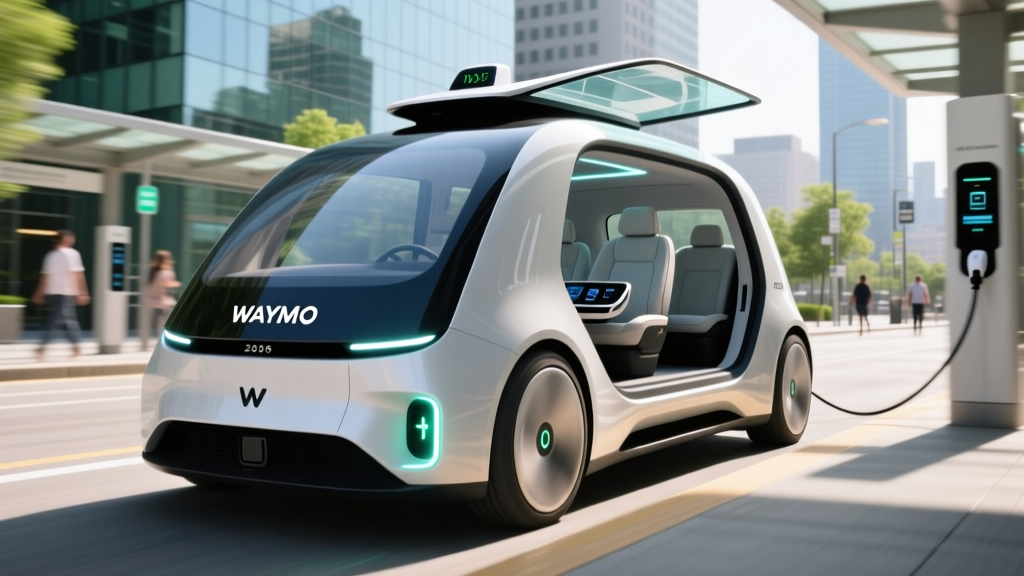
The Zeekr M-Vision, a purpose-built robotaxi designed in collaboration with Geely's Zeekr brand, began limited deployment in late 2024 and is scaling through 2025-2026. Unlike the I-PACE, it was engineered from the ground up without a steering wheel or pedals for driverless-only operation, with a lower floor for easier entry and integrated 6th-generation sensors.
Where Can You Ride a Waymo Right Now?
Waymo One, the company's commercial ride-hailing service, operates in specific geofenced zones within approved metro areas. As of early 2026, confirmed live service cities include:
| City | Service Area Coverage | Availability | Notes |
|---|---|---|---|
| Phoenix, AZ (Metro) | ~315 sq mi: Chandler, Tempe, Mesa, Scottsdale, downtown Phoenix, Sky Harbor Airport | 24/7 | Largest and longest-running market; airport rides available |
| San Francisco, CA | ~70 sq mi: most of SF proper, expanding south | 24/7 | Fully open to public; no waitlist since late 2023 |
| Los Angeles, CA | ~80+ sq mi: Santa Monica, Hollywood, downtown LA, Beverly Hills, LAX | 24/7 | Expanded significantly through 2025; LAX service launched |
| Austin, TX | Limited initial zone, expanding | Limited hours initially | Announced expansion; early rider programs active |
Waymo has also announced planned expansion to additional cities including Tokyo (testing phase, not commercial) and other U.S. metros, but those remain in testing or regulatory approval stages — not yet available for public rides.
SAE Autonomy Levels: Why Waymo Is Level 4, Not Level 2
Waymo's robotaxi service operates at SAE Level 4 (High Automation) within its geofenced service areas. This means the vehicle handles all driving tasks — steering, braking, navigation, hazard response — with no human driver present and no expectation of human intervention within its operational design domain (ODD).
This is fundamentally different from SAE Level 2 systems like Tesla Autopilot, Ford BlueCruise, or GM Super Cruise, which require an attentive human driver ready to take over at any moment. Waymo has no driver to take over. There is no steering wheel accessible to a passenger.
| SAE Level | Name | Who Drives? | Example |
|---|---|---|---|
| Level 0 | No Automation | Human does everything | Traditional car |
| Level 1 | Driver Assistance | Human + one system (steering OR speed) | Adaptive cruise control |
| Level 2 | Partial Automation | Human supervises; system handles steering AND speed | Tesla Autopilot, BlueCruise |
| Level 3 | Conditional Automation | System drives in specific conditions; human must be ready | Mercedes Drive Pilot (limited markets) |
| Level 4 | High Automation | System drives fully within its ODD; no human needed | Waymo One, Zoox |
| Level 5 | Full Automation | System drives everywhere, all conditions | Does not exist commercially |
The distinction matters enormously for safety expectations and regulatory treatment. When you ride in a Waymo, you are a passenger — not a driver, not a supervisor. The vehicle's AI and remote-assistance infrastructure handle everything.
How Much Does Waymo Cost vs. Uber and Lyft?
Waymo One pricing is designed to be competitive with Uber and Lyft in the same markets, though it varies by city, time of day, and trip distance. Here's how typical fares compare based on reported rider data:
| Trip Type | Waymo One | UberX / Lyft | Uber Comfort / Lyft Lux |
|---|---|---|---|
| Short trip (~3 mi, Phoenix) | $8-12 | $8-14 | $14-20 |
| Medium trip (~8 mi, SF) | $18-28 | $16-30 | $28-45 |
| Airport run (~15 mi, LAX) | $35-50 | $30-55 | $50-80 |
Key pricing notes:
- No surge pricing in the traditional Uber/Lyft sense — Waymo uses demand-based pricing but has historically kept multipliers more moderate.
- No tipping — there's no driver to tip, which effectively reduces the total trip cost by 15-20% compared to a tipped rideshare ride.
- Promotional credits are frequently available for new riders, sometimes making initial rides significantly cheaper.
- Wait times in high-demand zones (SF downtown Friday night, for example) can be longer than Uber/Lyft due to limited fleet size.
To use Waymo One, download the Waymo app (iOS/Android), create an account, set your pickup and dropoff within the service zone, and confirm your ride. The vehicle arrives, you unlock it via the app, and it drives you to your destination. In-app support and a live help line are available throughout the ride.
Waymo Safety Record: What the Real Data Shows
As of early 2026, Waymo reports over 30 million fully driverless miles completed across its commercial fleet. The company publishes periodic safety reports and has submitted data to NHTSA as part of the agency's Standing General Order requiring crash reporting from ADS-equipped vehicles.
Independent analysis from the Insurance Institute for Highway Safety (IIHS) and academic researchers (notably a University of Michigan study analyzing California DMV and insurance data) have found that Waymo vehicles are involved in police-reported crashes at a lower rate per million miles than human benchmark drivers — approximately 85% fewer injury-causing crashes and 57% fewer property-damage-only crashes compared to human drivers in comparable urban environments.
However, important context:
- Most reported incidents involve the Waymo vehicle being rear-ended or side-swiped by a human driver — not the Waymo causing the collision.
- Minor contact events (e.g., brushing a parked car, low-speed chain-link fence contact) have been reported and are logged under NHTSA reporting requirements.
- Software-related pauses: Waymo has occasionally issued fleet-wide operational pauses after specific edge-case events (e.g., a vehicle contacting a downed power line in Phoenix in 2024), using these to update software before resuming service.
- Pedestrian interactions: A small number of incidents involving pedestrians near crosswalks have been investigated by NHTSA, though no fatalities involving a Waymo driverless vehicle have been reported as of early 2026.
Waymo's safety approach relies on extensive simulation (billions of simulated miles), geofencing to known-mapped areas, and a remote-assistance system where human specialists can provide guidance to vehicles encountering ambiguous situations (construction zones, unusual obstacles). The vehicle never hands control to a remote operator for real-time driving — remote assistance provides high-level routing advice while the vehicle's AI continues to execute safe driving maneuvers.
The Technology Stack: Sensors, Lidar, and Geofencing
Unlike Tesla's camera-only approach to autonomy, Waymo uses a multi-sensor fusion system that combines several complementary technologies:
| Component | Technology | Purpose |
|---|---|---|
| Lidar | Custom-built 360° lidar arrays (roof + body-mounted) | Real-time 3D point cloud mapping; object detection to 500m; works in darkness |
| Cameras | 29+ high-resolution cameras (visible spectrum) | Traffic light state, signage, lane markings, object classification |
| Radar | 6+ radar units (improved resolution in 6th gen) | Velocity detection of moving objects; penetration through rain/fog |
| Audio detection | External microphones | Siren detection (emergency vehicles), horn detection |
| HD Mapping | Centimeter-precision pre-mapped routes | Provides baseline road geometry, speed limits, lane configurations |
| Compute | Custom AI inference hardware (vehicle-mounted) | Real-time perception, prediction, planning at vehicle level |
The 6th-generation Waymo Driver, introduced on the Zeekr platform and retrofitted to newer I-PACE vehicles, features improved lidar with longer range and better resolution in adverse weather, plus cameras with enhanced dynamic range for challenging lighting conditions (direct sun, tunnel transitions, night driving).
Geofencing is a core operational constraint: Waymo vehicles only operate within pre-mapped, pre-approved zones. Every road in the service area has been driven, mapped at centimeter precision, and approved for autonomous operation. If a requested trip would take the vehicle outside its geofence, the app simply won't allow the booking. This is both a safety feature and a regulatory requirement.
Current Limitations: Where Waymo Can't Go (Yet)
Despite being Level 4, Waymo's robotaxi service has significant operational boundaries. Understanding these prevents unrealistic expectations about where and when the service is available.
- Weather restrictions: Heavy rain, dense fog, and snow can trigger service suspensions or reduced operational areas. Phoenix handles monsoon-season downpours with temporary pauses; San Francisco fog is generally manageable but dense fog events can limit service.
- Geofence boundaries: You cannot hail a Waymo outside its approved service zone. Suburban areas beyond the mapped perimeter, rural roads, and highways outside the designated corridors are off-limits.
- Highway limitations: Waymo vehicles do operate on some highways (including freeway segments in Phoenix and LA), but not all highway routes are approved. Complex multi-level interchanges and very high-speed corridors may be excluded.
- Construction zones: Major, unmapped construction can cause the vehicle to pull over safely and request remote assistance, potentially adding time to your trip.
- No intercity travel: Waymo is a metro-area ride service, not a long-distance option. You cannot book a Phoenix-to-Tucson trip.
- Accessibility: While the I-PACE can accommodate foldable wheelchairs with advance notice, the fleet is not universally ADA-compliant for all mobility devices. The Zeekr M-Vision was designed with a lower floor for improved accessibility.
- Passenger requirements: Riders must be 18+ (or accompanied by an adult, depending on city). Unaccompanied minors are not permitted. No pets (service animals excepted).
Regulatory Landscape: Who Approves Robotaxi Operations?
Robotaxi operations in the United States require approval from multiple regulatory bodies, and the framework varies by state:
- California (CPUC + DMV): The California Public Utilities Commission issues permits for commercial passenger service, while the DMV manages autonomous vehicle testing permits. Waymo holds both a DMV deployment permit and a CPUC TCP (Transportation Charter Party) permit for commercial rides.
- Arizona (ADOT + Governor's Office): Arizona has maintained a permissive regulatory environment since 2015, with minimal state-level permitting barriers. Waymo's Phoenix operations began under this framework.
- Texas (TxDOT + local authorities): Austin operations require coordination with city and state transportation authorities.
- Federal (NHTSA): The National Highway Traffic Safety Administration sets vehicle safety standards and issues Standing General Orders requiring crash reporting from all ADS-equipped vehicles. NHTSA can investigate and order recalls of autonomous driving systems.
The patchwork nature of state-level regulation means Waymo must pursue approval in each new market individually, which is a significant factor in the pace of geographic expansion. Federal legislation creating a unified national framework for autonomous vehicle deployment has been proposed multiple times but has not passed as of 2026.
Frequently Asked Questions
Is Waymo electric or gas-powered?
Waymo's entire commercial robotaxi fleet is battery-electric. The primary vehicle is the Jaguar I-PACE (90 kWh battery, 234-mile EPA range), and the next-generation Zeekr M-Vision is also a purpose-built EV. Waymo does not operate any gasoline or hybrid vehicles in its ride-hailing service.
How long can a Waymo drive before it needs to recharge?
The Jaguar I-PACE has a stock EPA range of 234 miles, but the sensor suite and onboard computing draw additional power, reducing effective operational range to roughly 180-200 miles. Waymo manages this through shift scheduling — vehicles return to depot chargers between shifts, typically charging via DC fast charging (100 kW on CCS1 for the I-PACE, taking roughly 45 minutes from 10-80%).
Is Waymo truly self-driving, or is there a remote human controlling it?
Waymo operates at SAE Level 4 — the vehicle drives itself with no human in the car and no remote driver. A remote-assistance team can provide high-level guidance (e.g., "the lane ahead is closed, reroute"), but the vehicle's onboard AI handles all real-time driving decisions. No human is remotely steering or braking the car.
Can I use Waymo at the airport?
Yes, in markets where airport service is approved. Phoenix Sky Harbor (PHX) and Los Angeles International (LAX) both have Waymo One pickup/dropoff zones. San Francisco International (SFO) availability depends on current geofence boundaries and regulatory approvals — check the Waymo app for real-time availability.
What happens if the Waymo vehicle encounters something it can't handle?
The vehicle is programmed to execute a "minimal risk condition" — it will safely pull over, activate hazard lights, and contact remote assistance. A human specialist can then provide routing guidance or dispatch roadside support. The vehicle will not attempt maneuvers outside its confidence threshold.
How does Waymo's safety compare to a human Uber/Lyft driver?
Based on available data (30+ million driverless miles, IIHS analysis, NHTSA crash reports), Waymo vehicles are involved in fewer injury-causing crashes per million miles than human drivers in comparable urban environments. However, the dataset is still relatively small compared to the billions of human-driven miles annually, and Waymo operates in geofenced, pre-mapped areas — not the full range of conditions a human driver encounters.