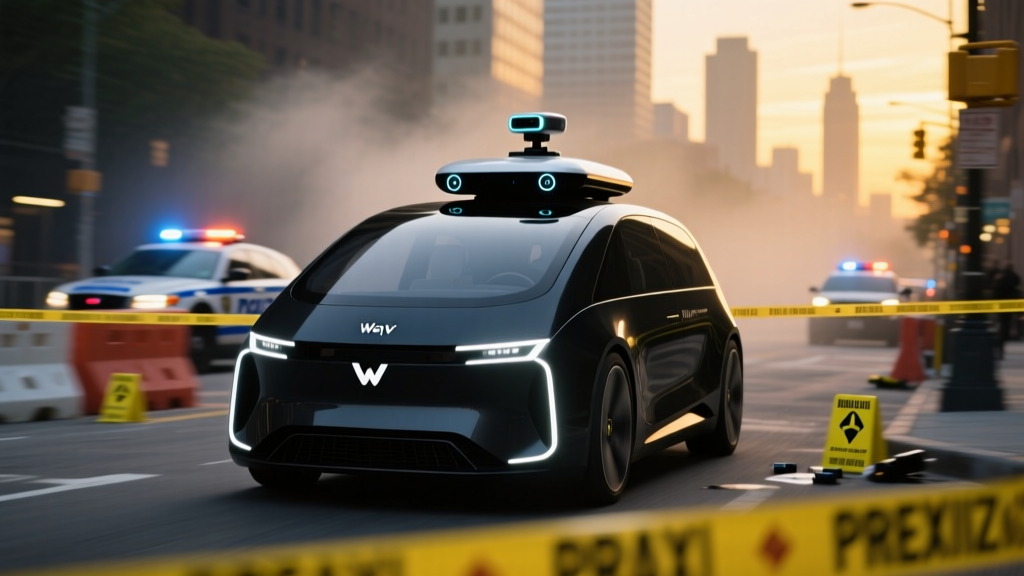
In early 2024, a viral video showed a Waymo robotaxi navigating directly through an active police crime scene in San Francisco, driving past yellow tape and parked cruisers without human intervention. The clip ignited a debate about how autonomous vehicles handle unpredictable, high-stakes environments that no map or training dataset fully anticipates. As Waymo expands its driverless service across multiple U.S. cities through 2026, understanding how these vehicles respond to edge cases—crime scenes, accidents, protests, and road hazards—is essential for anyone considering robotaxi rides or tracking the autonomous driving industry.
This article breaks down Waymo's technology stack, real-world safety record, service availability, pricing, and the specific limitations that surface when a self-driving car encounters scenarios it wasn't explicitly programmed to handle.
SAE Automation Levels: Where Robotaxis Actually Sit
Before examining crime-scene encounters, it's critical to distinguish robotaxis from consumer driver-assist systems. They occupy entirely different tiers of the SAE automation scale.
| SAE Level | Definition | Example Systems | Driver Required? |
|---|---|---|---|
| Level 2 | Partial automation — steering + acceleration assisted | Tesla Autopilot, GM Super Cruise, Ford BlueCruise | Yes, always |
| Level 3 | Conditional automation — system drives in limited conditions | Mercedes Drive Pilot (select markets) | Yes, on standby |
| Level 4 | High automation — no driver needed within operational domain | Waymo One, Zoox, Cruise (pre-suspension) | No (within geofence) |
| Level 5 | Full automation — any road, any condition | None currently deployed | No |
Waymo operates at SAE Level 4. This means the vehicle handles all driving tasks without a human behind the wheel—but only within a defined Operational Design Domain (ODD). That ODD includes specific geofenced areas, speed limits, weather conditions, and road types. Outside that domain, the vehicle is not designed to operate.
This is fundamentally different from Tesla's Full Self-Driving (Supervised), which remains a Level 2 system requiring continuous driver attention regardless of the "FSD" branding. Consumer vehicles sold today do not offer Level 4 capability.
How Waymo's Technology Stack Processes Unpredictable Scenarios
When a Waymo vehicle encounters an unexpected situation—a crime scene, a fallen tree, a protest blocking the road—its response depends on a layered sensor and decision-making architecture.
Waymo 6th-Generation Driver System (2025–2026 Fleet)
- LiDAR: Multiple custom-built units providing 360° 3D point-cloud mapping up to 500+ meters, detecting object shape and distance regardless of lighting
- Cameras: High-resolution surround cameras for lane markings, traffic signals, signage, and object classification (pedestrian, cyclist, vehicle, debris)
- Radar: Forward and corner radar units for velocity detection of moving objects, functional in rain and fog where cameras degrade
- External audio sensors: Microphones to detect sirens from emergency vehicles
- HD Maps: Pre-built centimeter-accurate maps of every operational road, including lane geometry, speed limits, and curb positions
- Machine learning models: Trained on billions of simulated and real-world miles to classify objects and predict behavior of other road users
This sensor suite is notably different from Tesla's camera-only approach. Waymo relies on LiDAR as a primary depth sensor, which provides reliable distance measurements independent of ambient light or visual contrast—a significant advantage in scenarios like a nighttime crime scene where visual cues may be ambiguous.
What Happens When a Robotaxi Hits an Edge Case
When the Waymo system detects an anomaly it cannot confidently resolve—tape across a road, an unusual cluster of parked emergency vehicles, an officer directing traffic in an unexpected pattern—it follows a decision hierarchy:
- Slow and assess: The vehicle reduces speed and increases sensor scanning of the environment.
- Attempt reroute: If the map shows an alternate path, the vehicle will reroute around the obstacle.
- Remote assistance: If the vehicle cannot resolve the scenario, it contacts Waymo's remote guidance team. These are not remote drivers—they do not steer the car. Instead, they provide high-level guidance (e.g., "the lane is clear, proceed" or "wait for the officer to wave you through").
- Safe stop: If no resolution is available, the vehicle executes a controlled stop in a safe location (pulling to the curb, activating hazards) and waits or requests a remote tow/assistance dispatch.
In the crime-scene video that circulated in 2024, the Waymo vehicle appeared to follow a combination of steps 1 and 2: it slowed, assessed the scene, and proceeded along a path its sensors determined to be clear. Whether this was the optimal response remains debated among safety researchers.
Where Can You Use Waymo Right Now?
As of early 2026, Waymo One—the company's commercial rider-hailing service—operates in the following metro areas, with ongoing expansion:
| City | Status | Approximate Coverage Area | Notes |
|---|---|---|---|
| Phoenix, AZ | Fully operational | ~225 sq mi (metro-wide including suburbs) | Longest-running market; highway trips added 2024 |
| San Francisco, CA | Fully operational | ~50 sq mi (city core + select neighborhoods) | Gradual expansion since 2022; some restricted zones |
| Los Angeles, CA | Fully operational | ~80 sq mi (West LA, Hollywood, downtown corridors) | Launched mid-2024; expanding eastward |
| Austin, TX | Operational (limited) | ~40 sq mi (central Austin) | Restarted driverless ops in 2025 after Uber partnership |
| Atlanta, GA | Announced / early access | TBD | Partnership with Uber; expected full launch 2026 |
Each city's geofence is strictly enforced. A Waymo vehicle will not drive outside its mapped operational area, and the app will not allow you to request a ride that exits the boundary. Within these zones, service typically runs 24/7, though availability may be limited during severe weather or major events.
Pricing: Waymo vs. Uber and Lyft
Robotaxi pricing has converged closely with traditional rideshare, though it fluctuates with demand just like surge pricing.
| Route Example | Waymo One | UberX | Lyft Standard |
|---|---|---|---|
| SFO Airport → Downtown SF (~14 mi) | $38–$48 | $35–$52 | $33–$50 |
| Phoenix Sky Harbor → Scottsdale (~12 mi) | $28–$36 | $25–$40 | $24–$38 |
| Downtown LA → Santa Monica (~15 mi) | $32–$45 | $30–$48 | $28–$46 |
| Short trip, ~3 miles (urban) | $10–$15 | $9–$16 | $8–$15 |
Waymo pricing is generally competitive with mid-range UberX and Lyft fares, though it does not offer budget tiers like Uber Pool or Lyft Shared. Tipping is not expected (there's no driver), and the fare shown at booking is the fare you pay—no surge multiplier surprises after the ride begins, a notable advantage over traditional rideshare during peak demand.
According to Waymo's official rider information, pricing factors include distance, time, and demand, but the company has committed to transparent upfront pricing without the volatility of human-driver surge models.
Safety Record: What the Data Actually Shows
Waymo has published safety data covering over 7 million fully driverless miles as of mid-2024, with continued accumulation through 2025–2026. The company has partnered with independent researchers and submitted data to the National Highway Traffic Safety Administration (NHTSA) as part of the federal Standing General Order requiring crash reporting for autonomous vehicles.
Waymo Safety Metrics (Driverless Operations)
- Total driverless miles: 7+ million (as of mid-2024 reporting; significantly higher by early 2026)
- Injury-critical crashes: 77% fewer than human benchmarks in comparable urban driving environments (per Waymo's peer-reviewed study published 2024)
- Police-reported crash rate: Approximately 0.41 per million miles vs. human baseline of ~2.1 per million miles in similar urban contexts
- Contact rate with other vehicles/objects: Significantly lower than human drivers in the same geographies, though minor low-speed contacts (e.g., scraping a cone, light bumper taps) do occur
- Remote assistance interventions: Waymo does not publish exact rates, but industry analysis suggests roughly 1–3 remote guidance contacts per 1,000 miles in complex urban environments
These numbers are encouraging but come with context. Waymo's operational domain excludes the most dangerous driving scenarios: high-speed rural highways, extreme weather, and unmapped construction zones. The human benchmark comparison is drawn from urban driving data in similar geographies, not from all driving conditions nationwide.
The Insurance Institute for Highway Safety (IIHS) has noted that while robotaxi crash rates appear favorable in controlled urban environments, the sample size remains small relative to the billions of miles driven by human drivers annually, and long-term statistical confidence requires more data.
The Crime-Scene Question Specifically
The 2024 crime-scene incident in San Francisco did not result in a crash or injury, but it raised questions about whether the vehicle should have stopped entirely rather than proceeding through an active investigation zone. Law enforcement officials noted that while the vehicle did not interfere with the investigation, its presence in a cordoned area was unexpected.
Waymo has stated that its vehicles are trained to recognize emergency vehicles and yield to law enforcement direction, but static crime scenes without an officer actively directing traffic present an ambiguous scenario. The vehicle's sensors detected a clear drivable path and proceeded—a decision that was technically safe but operationally questionable.
Following several such incidents, Waymo updated its software to improve recognition of police tape, emergency vehicle clusters, and other indicators of active scenes, increasing the likelihood that the vehicle will stop and request remote guidance rather than proceeding autonomously.
Current Limitations: What Waymo Cannot Handle
Despite impressive technology, Level 4 robotaxis face hard constraints that riders and observers should understand clearly.
- Heavy rain and fog: LiDAR and camera performance degrades in heavy precipitation. Waymo may reduce service availability or pull vehicles from the road during significant storms, particularly in San Francisco.
- Snow and ice: Waymo does not currently operate in snow-belt cities. Snow-covered lane markings and icy road surfaces are outside the current ODD.
- Unmapped construction zones: If road geometry has changed since the HD map was last updated and the vehicle cannot confidently resolve the new layout, it will stop and request guidance.
- Active law enforcement direction: A human officer using hand signals to direct traffic in an unusual pattern can confuse the system. Waymo vehicles are trained on standard traffic-control gestures, but non-standard or improvised signals may trigger a safe stop.
- Geofence boundaries: The vehicle simply will not drive outside its mapped zone. No exceptions, no overrides.
- Complex parking structures: Waymo drops riders at street-level designated points. It does not navigate multi-story parking garages or valet scenarios.
- Emergency vehicle right-of-way: While Waymo vehicles detect sirens and attempt to pull over, execution can be slow or awkward compared to a human driver, particularly in dense traffic.
- Passenger emergencies: There is no driver to assist with a medical emergency, altercation, or other in-cabin crisis. Riders can contact Waymo support via the in-app help button, but response is remote.
These limitations are not failures of the technology—they are the defined boundaries of the current ODD. Waymo's approach is to operate safely within a known domain rather than attempt the anything-anywhere promise of Level 5 autonomy, which no company has achieved.
Regulatory Landscape: Who Approves Robotaxi Operations
Robotaxi deployment in the United States is governed by a patchwork of state and federal regulations, not a single national framework.
- Federal (NHTSA): Sets vehicle safety standards and requires crash reporting under the Standing General Order (issued 2021, updated 2023). NHTSA does not "approve" robotaxi services but can issue recalls or investigations—such as the 2024 recall of Waymo software following incidents where vehicles drove over towed cables near a crash scene.
- California (DMV + CPUC): The California DMV issues testing and deployment permits. The California Public Utilities Commission (CPUC) regulates commercial passenger service. Waymo holds both a DMV driverless testing permit and a CPUC commercial permit for San Francisco and Los Angeles operations.
- Arizona: Among the most permissive regulatory environments. No specific state permit is required beyond standard vehicle registration and insurance. Phoenix has been Waymo's longest-running market largely because of this regulatory openness.
- Texas: Autonomous vehicle operations are governed under state law (Texas Transportation Code §545.451+), requiring a registered autonomous vehicle and insurance meeting state minimums. Austin operations restarted following legislative clarity in 2025.
- Other states: Each new market requires engagement with local and state regulators. There is no federal preemption—Waymo must satisfy each jurisdiction individually.
This fragmented regulatory environment means expansion is slow and deliberate. A city cannot simply "get" Waymo service; the company must map the area, validate its ODD, secure local agreements, and receive regulatory approval—a process that takes 12–24 months per new metro area.
Is This Truly Self-Driving, or Is Someone Still in Control?
This is the most common question riders ask, and the answer is precise: Waymo robotaxis are truly self-driving within their operational domain. There is no human in the vehicle. There is no joystick-wielding remote driver. The onboard computer makes all real-time driving decisions—steering, braking, accelerating, lane changes—autonomously.
However, the remote guidance team provides a safety net for edge cases the vehicle cannot resolve alone. These remote operators do not drive the car in real time. They provide contextual information or permission ("proceed through the intersection" or "remain stopped") that the vehicle's planning system then executes. This is fundamentally different from teleoperation, where a remote human directly controls the vehicle.
For comparison, consumer systems like Tesla Autopilot, Ford BlueCruise, and GM Super Cruise are SAE Level 2. A human driver must remain attentive and ready to take over at any moment, even when the system appears to be handling all driving tasks. The legal and functional responsibility rests with the human in the driver's seat at all times.
Waymo's Level 4 system shifts that responsibility to the vehicle and the company. If a crash occurs during autonomous operation, Waymo—not a human driver—bears liability, which is reflected in the company's insurance and indemnification structure.
Frequently Asked Questions
Can I request a Waymo ride right now?
If you're in Phoenix, San Francisco, Los Angeles, or Austin (within the geofenced service areas), yes. Download the Waymo One app, create an account, and request a ride just like Uber or Lyft. Wait times typically range from 2–10 minutes depending on demand and your location within the zone. Atlanta service is expected to launch fully in 2026.
What happens if a Waymo car gets into an accident?
The vehicle is programmed to stop safely, activate hazard lights, and contact Waymo support automatically. Emergency services are dispatched if needed. Riders can contact support through the in-app help button or the in-vehicle intercom. Waymo's insurance covers rider injuries and third-party damages. All incidents are reported to NHTSA under the Standing General Order.
How does Waymo handle school zones and playgrounds?
Waymo's HD maps include school zone boundaries and time-of-day speed restrictions. The vehicles reduce speed automatically during active school hours and increase sensor vigilance for pedestrians and children. The system is designed to be more conservative in these zones than a typical human driver.
Can Waymo drive on highways?
Yes, in select markets. Phoenix operations include highway driving on designated routes, and San Francisco added limited highway segments in 2024–2025. Highway driving is more technically straightforward than dense urban navigation (fewer pedestrians, predictable lane geometry), but Waymo has been cautious about adding highway routes to its ODD, validating each corridor individually.
Is Waymo safer than a human driver?
In its operational domain—mapped urban streets in fair weather—the available data suggests yes. Waymo's reported crash rate is significantly lower than the human baseline for comparable urban driving. However, this comparison is specific to the conditions Waymo operates in. The company does not operate in the most dangerous driving scenarios (rural highways at night in snow), so a blanket "safer than humans everywhere" claim is not supported by current data.
What if I need to change my destination mid-ride?
You can update your destination through the Waymo One app during the ride, as long as the new destination is within the service area. The vehicle will recalculate its route and proceed accordingly.