If you have ordered food delivery in Phoenix or Los Angeles recently, you might have noticed something unusual pulling up to the curb: a Jaguar I-PACE with spinning lidar pods and no one behind the wheel. The Waymo DoorDash partnership has quietly become one of the most visible real-world deployments of autonomous last-mile delivery, blending robotaxi technology with the on-demand logistics of food and convenience orders.
But how does it actually work? Where is it available? And how does a vehicle designed to carry passengers end up delivering your Tuesday-night burrito? Here is a detailed breakdown of the Waymo DoorDash autonomous delivery service, grounded in operational data, regulatory filings, and real-world user experience.
Is This Truly Self-Driving? Understanding the SAE Automation Level
The short answer: yes, the Waymo vehicles used for DoorDash deliveries are genuinely driverless. This is not a Level 2 driver-assist system like Tesla Autopilot or GM Super Cruise, which require an attentive human behind the wheel at all times. The Waymo Driver operates at SAE Level 4 — meaning the system handles all driving tasks within a defined operational design domain (ODD) with no human intervention required.
| Level | Name | Who Drives? | Example |
|---|---|---|---|
| Level 0 | No Automation | Human | Conventional car |
| Level 1 | Driver Assistance | Human + system assists | Adaptive cruise control |
| Level 2 | Partial Automation | Human (must supervise) | Autopilot, BlueCruise, FSD Supervised |
| Level 3 | Conditional Automation | System (human on standby) | Mercedes DRIVE PILOT (limited markets) |
| Level 4 | High Automation | System (no human needed in ODD) | Waymo Driver, Zoox |
| Level 5 | Full Automation | System (everywhere, all conditions) | Does not yet exist commercially |
Waymo's Level 4 designation means it operates without a human driver, but only within its geofenced service areas and approved conditions. It will not handle every road or weather scenario — that would require Level 5.
The distinction matters because consumers frequently confuse advanced driver-assist features (Level 2) with true autonomy. When you order via DoorDash and a Waymo vehicle arrives, there is genuinely no one inside. A remote support team monitors the fleet, but they do not joystick-drive the vehicles in real time.
Where Can You Use Waymo DoorDash Right Now?
As of early 2026, the Waymo DoorDash autonomous delivery partnership operates in select metros where Waymo already runs its commercial robotaxi service. The overlap is deliberate: delivery routes stay within the validated geofence.
| Metro Area | Service Zone Coverage | Status |
|---|---|---|
| Phoenix, AZ (East Valley) | ~225 sq mi covering Tempe, Chandler, Mesa, Gilbert | Live — largest zone |
| Los Angeles, CA | ~80 sq mi covering Santa Monica, Hollywood, Downtown LA | Live — expanding |
| San Francisco, CA | Select neighborhoods within the broader Waymo SF geofence | Live — limited zones |
| Austin, TX | Announced expansion area | Announced — not yet live for delivery |
The Phoenix East Valley remains the most mature deployment zone. Waymo has operated commercially there since 2020, and the geofence has expanded incrementally as the system validated more road types and traffic scenarios. Los Angeles followed, with DoorDash deliveries concentrated in dense, high-order-volume neighborhoods where short trip distances make autonomous logistics efficient.
If your delivery address falls outside the geofence, the DoorDash app will route your order to a conventional human driver instead. There is no option to specifically request a Waymo vehicle — the system assigns autonomous or human delivery based on address eligibility and vehicle availability.
How Waymo DoorDash Delivery Actually Works
The user experience is designed to feel almost identical to a standard DoorDash order, with a few key differences once the vehicle arrives:
- Place your order on the DoorDash app as usual. If your address is within the Waymo geofence and a vehicle is available, the app may indicate an autonomous delivery.
- Track the vehicle in real time on the app map, just like a human-driven delivery.
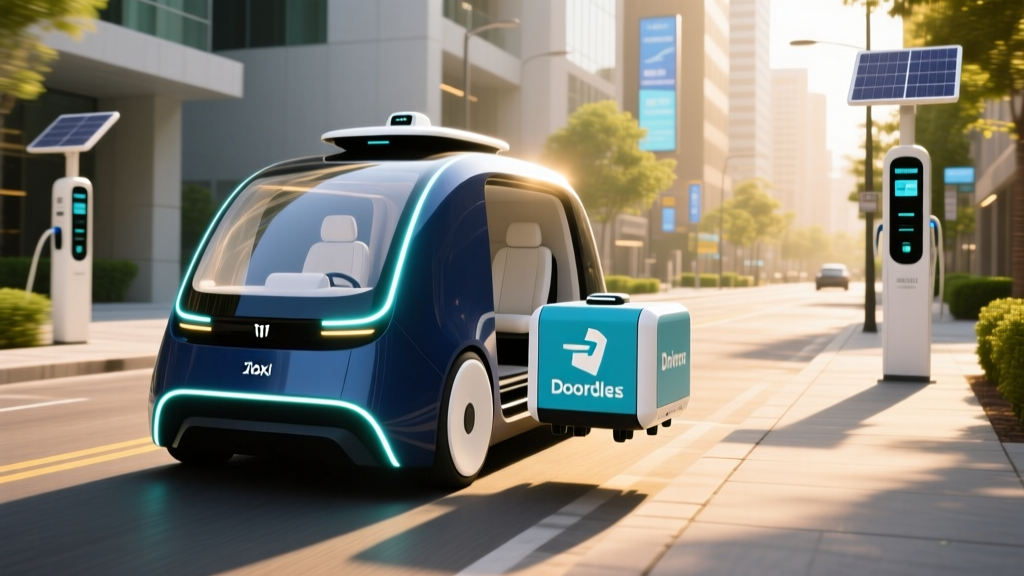
- Vehicle arrives at the curb. The Jaguar I-PACE pulls up and stops. There is no driver to hand you the bag.
- Unlock the compartment. You receive a notification and a PIN code or in-app unlock button. The rear cargo area opens, and you retrieve your order.
- Vehicle departs. Once you close the compartment, the Waymo vehicle moves on to its next task or returns to a staging area.
The food is secured in the rear cargo area using custom retention systems to prevent spills during transit. Early in the partnership, Waymo and DoorDash tested various packaging and securing methods to handle the stop-and-go urban driving patterns typical of delivery routes.
Pricing: How Does Waymo Delivery Cost Compare to Uber and Lyft?
One of the most common questions is whether a robotaxi delivery costs more than a human-driven one. The answer is nuanced:
| Cost Factor | Waymo via DoorDash | Standard DoorDash (Human Driver) | Uber Eats |
|---|---|---|---|
| Delivery fee | $2.99–$5.99 (varies by distance) | $1.99–$7.99 | $0.49–$8.99 |
| Service fee | ~10–15% of subtotal | ~10–15% of subtotal | ~10–15% of subtotal |
| Tip expectation | None (no driver to tip) | $2–$5 typical | $2–$5 typical |
| Surge pricing | Not currently applied | Common during peak hours | Common during peak hours |
| DashPass benefit | Eligible — $0 delivery fee on qualifying orders | Eligible — $0 delivery fee on qualifying orders | Uber One equivalent |
The effective cost to the consumer is often slightly lower with Waymo delivery, primarily because there is no tip expectation. A standard DoorDash delivery with a $3 tip on a $25 order might cost $35–$37 all-in; the same order via Waymo might land at $31–$34. DoorDash has not introduced a separate "autonomous delivery surcharge" — the pricing structure mirrors standard delivery fees.
From DoorDash's perspective, the economics are different. The company does not pay a per-delivery wage to a Waymo vehicle the way it compensates human dashers. Instead, the partnership involves a commercial agreement between Waymo and DoorDash, with Waymo absorbing the vehicle operating cost and DoorDash managing the logistics platform. As Waymo's fleet scales and per-mile operating costs decline, this model could become meaningfully cheaper for the platform — but those savings have not yet been fully passed to consumers.
Safety Record: What the Data Actually Shows
Safety is the most scrutinized aspect of any driverless deployment. Waymo has accumulated significant operational mileage, and the data is publicly reported through regulatory filings and peer-reviewed research.
- Total autonomous miles driven: Over 10 million fully driverless miles across all services (Waymo Safety Report)
- Contact rate: Waymo's fully autonomous vehicles showed a 76% lower rate of police-reported crash involvement compared to human benchmarks, per a study published in partnership with insurance data analysts
- Injury severity: When incidents do occur, they are overwhelmingly low-speed, low-severity — primarily rear-end contacts at intersections or minor curb contacts during pickup maneuvers
- Disengagement rate: Waymo reports fewer than 0.05 remote-assistance events per 1,000 autonomous miles in mature operating zones like Phoenix
Sources: Waymo Safety Data, NHTSA AV Safety Reports, peer-reviewed insurance industry analyses. Note: Direct comparison to human drivers requires careful normalization — Waymo operates in geofenced urban areas at moderate speeds, not highways or rural roads.
For the DoorDash delivery use case specifically, the safety profile is arguably even more favorable than passenger rides. Delivery trips tend to be shorter (2–5 miles on average), occur at lower speeds, and do not involve passenger loading/unloading in complex locations. The vehicle simply navigates to a restaurant, waits for order loading by restaurant staff, drives to the customer, and waits for retrieval.
That said, the system is not infallible. Publicly documented incidents in San Francisco have included vehicles briefly blocking emergency scenes, minor contact with construction-zone cones, and one widely reported incident involving a towed Waymo vehicle. Waymo addressed these through software updates and operational adjustments. The NHTSA requires standing crash-reporting orders for all Level 4 operators, which provides a baseline of transparency that Level 2 systems do not face.
Technology Stack: Lidar, Cameras, and the Sensor Suite
Waymo's approach to autonomy differs fundamentally from camera-only systems (most notably Tesla's vision-based FSD). The Waymo Driver uses a multi-modal sensor stack:
- Lidar: Multiple roof-mounted and side-mounted units providing 360° 3D point-cloud mapping out to 500+ meters. Lidar is the primary sensor for object detection and distance measurement, independent of lighting conditions.
- Cameras: High-resolution surround cameras for traffic-light state recognition, signage reading, lane-marking detection, and object classification (pedestrian vs. cyclist vs. vehicle).
- Radar: Millimeter-wave radar for velocity measurement of moving objects and redundancy in adverse weather where lidar and cameras may degrade.
- Audio detection: External microphones that detect emergency vehicle sirens, enabling the system to pull over or yield appropriately.
- HD mapping: Centimeter-precision pre-mapped road data for every street in the geofence, updated continuously. The vehicle localizes against this map in real time.
The redundancy across sensor types is a core design philosophy. If fog degrades lidar range, radar fills the gap. If glare blinds a camera, lidar still detects the object ahead. This multi-sensor approach is more expensive per vehicle than a camera-only system — the sensor suite on a single Waymo I-PACE is estimated to add $50,000–$100,000 in hardware cost — but it provides the safety margin required for Level 4 operation without a human fallback.
For delivery operations, the vehicle does not require a passenger-facing interior monitoring system (no rider cameras, no in-cabin screens). The cargo area is fitted with securing mechanisms and, in some configurations, temperature monitoring for food quality.
Regulatory Landscape: Who Approves Robotaxi Deliveries?
Autonomous vehicle deployment in the United States is governed by a patchwork of state and local regulations. There is no single federal "robotaxi license." Instead:
- Federal (NHTSA): Sets vehicle safety standards (FMVSS) and requires crash reporting for all Level 4 operators. NHTSA does not "approve" AV operations but can issue recalls or investigate safety defects. Waymo received a specific FMVSS exemption for its purpose-built vehicle variant that lacks a steering wheel in certain configurations.
- State level: Each state determines whether driverless testing and commercial operation are permitted. Arizona has been the most permissive, with no specific AV legislation required for commercial deployment — Waymo has operated freely there since 2020. California requires permits from both the DMV (for testing) and the California Public Utilities Commission (CPUC) (for commercial passenger and delivery services). California's CPUC has granted Waymo a statewide deployment permit.
- Local/municipal: Cities can impose additional requirements, including geofence restrictions, operating-hour limits, and coordination with local emergency services. San Francisco, for example, initially imposed fleet-size caps and nighttime restrictions that have been gradually relaxed as operational data accumulated.
For the DoorDash delivery use case specifically, regulatory approval falls under the same commercial AV deployment permits that cover Waymo's passenger rides. Delivering a burrito is legally less complex than carrying a passenger — there are no passenger-safety liability questions, no need for in-vehicle emergency controls, and lower risk exposure overall.
Current Limitations: Where the System Falls Short
Despite impressive capabilities, Waymo DoorDash delivery has real operational constraints that users should understand:
- Geofence boundaries: If a restaurant or delivery address falls outside the mapped zone, the order defaults to a human driver. The geofence does not cover freeways, rural roads, or unmapped suburban streets.
- Heavy rain and fog: While Waymo's sensor suite handles light rain and overcast conditions, heavy downpours and dense fog can degrade lidar and camera performance. In these conditions, the system may reduce speed significantly or pause operations entirely.
- Construction zones: Rapidly changing lane configurations, temporary signage, and flaggers can challenge the system. Waymo handles many construction scenarios but may route around complex ones or request remote assistance.
- Apartment and gated-community delivery: The vehicle cannot navigate parking garages, open gates, walk food to a third-floor apartment, or buzz an intercom. Deliveries are curb-side only — if your address requires building access, a human driver is still necessary.
- Alcohol and age-restricted items: Autonomous delivery cannot currently verify ID at the curb for alcohol, tobacco, or other age-restricted orders. These default to human drivers.
- Multi-restaurant batching: Standard DoorDash orders sometimes batch items from multiple restaurants. Waymo deliveries are typically single-restaurant to minimize route complexity and food-temperature degradation.
- Late-night hours: In some cities, operational hours are restricted. Phoenix operates broadly, but San Francisco has had nighttime fleet limitations.
These limitations are not theoretical — they define the daily experience of the service. A user in a gated community in Chandler, AZ, will find that Waymo cannot complete their delivery, while someone at a single-family home on a well-mapped street in Tempe will get consistent autonomous service.
What This Means for the Future of Autonomous Delivery
The Waymo DoorDash partnership is significant not because it is the largest deployment — it is still a fraction of DoorDash's total delivery volume — but because it demonstrates a viable commercial model for autonomous last-mile logistics. The key takeaways for anyone watching this space:
Economics are approaching viability. Waymo's per-mile operating cost has declined with each hardware generation. The 6th-generation sensor suite is substantially cheaper than earlier iterations, and fleet utilization (the percentage of time vehicles spend on revenue-generating trips) improves as dispatch algorithms optimize. DoorDash benefits from reduced per-delivery labor cost, and Waymo benefits from additional fleet utilization during off-peak passenger-ride hours.
Delivery is an easier problem than rides. No passengers means no in-vehicle safety monitoring, no rider behavior issues, no need for door-to-door navigation in complex buildings. The vehicle parks at the curb, a compartment opens, and it leaves. This simplicity makes delivery a natural early use case for scaling autonomous operations.
Expansion will be gradual and city-by-city. Each new metro requires extensive mapping, regulatory approval, and operational validation. Austin, Miami, and Atlanta are on Waymo's announced roadmap, but timelines remain dependent on local regulatory processes and operational readiness. Expect steady, measured expansion rather than a sudden nationwide rollout.
Frequently Asked Questions
Can I specifically request a Waymo vehicle for my DoorDash order?
No. DoorDash assigns autonomous or human delivery based on your address, vehicle availability, and order type. There is no toggle in the app to choose. If you are in an eligible zone and a Waymo vehicle is available, you may receive one automatically.
How much does a Waymo DoorDash delivery cost compared to a regular delivery?
The delivery and service fees are comparable to standard DoorDash pricing ($2.99–$5.99 delivery fee, 10–15% service fee). The main savings come from the absence of a tip — there is no driver to tip. DashPass subscribers receive the same $0 delivery fee benefit on qualifying orders.
What happens if the Waymo vehicle gets stuck or cannot complete my delivery?
Waymo's remote support team monitors the fleet continuously. If a vehicle encounters a scenario it cannot handle — a blocked road, an unusual construction zone — it will either reroute, wait for the situation to clear, or request remote guidance. If the delivery cannot be completed, DoorDash's system reassigns the order to a human driver, and you receive your food with a delay.
Is my food safe in a driverless vehicle?
Waymo and DoorDash designed custom cargo-securing systems for the I-PACE delivery configuration. Food is placed in retention racks or secured bags to prevent tipping and spillage. The cargo area is enclosed and locked during transit, opening only when the customer authenticates via the app at the curb.
Does Waymo deliver in bad weather?
Light rain and overcast conditions are within the system's operational design domain. However, heavy rain, dense fog, or severe weather events may cause the system to reduce operating speed, limit service availability, or pause operations entirely. In these cases, your order will be fulfilled by a human driver.
How is Waymo DoorDash different from sidewalk delivery robots like Starship?
Sidewalk robots (Starship, Serve Robotics) operate on pedestrian pathways at very low speeds (3–6 mph) and handle short-range deliveries, typically under 2 miles. Waymo's I-PACE is a full-size vehicle operating on public roads at normal traffic speeds (25–45 mph), covering longer distances within the geofence. They solve different segments of the last-mile problem: sidewalk robots for dense urban/campus environments, Waymo for broader suburban and urban delivery radii.
Is Waymo planning to expand DoorDash delivery to more cities?
Waymo has announced planned expansion to Austin, Miami, and other metros for its broader robotaxi service. DoorDash delivery availability will follow in those cities once the passenger service is established and regulatory approvals for commercial delivery are in place. Specific timelines have not been publicly committed.
Sources referenced: Waymo Safety Data, NHTSA Automated Vehicle Safety, CPUC Autonomous Vehicle Programs. Pricing and service availability reflect conditions as of early 2026 and are subject to change.