Where Can You Actually Hail a Driverless Waymo Right Now?
If you've been tracking the expansion of Waymo's commercial robotaxi service — branded as Waymo One — you've likely seen a flood of headlines about new city launches. Sorting announced pilot programs from live, bookable rides is essential before you plan a trip around the experience. As of early 2026, Waymo One operates fully driverless commercial service in a specific set of geofenced metro areas. These are not test zones requiring a waitlist invitation; they are open-to-the-public services you can book through the Waymo app today.
| Metro Area | Service Zone Coverage | Hours | Airport Service |
|---|---|---|---|
| Phoenix, AZ (Metro) | ~225 sq mi — Chandler, Tempe, Gilbert, Mesa, parts of Scottsdale & downtown Phoenix | 24/7 | Phoenix Sky Harbor (PHX) — yes |
| San Francisco, CA | ~50 sq mi — most of SF proper including SoMa, Mission, Marina, Sunset | 24/7 | SFO — announced, limited rollout |
| Los Angeles, CA | ~80 sq mi — Santa Monica, Hollywood, Downtown LA, West Hollywood, Beverly Hills corridor | 24/7 | LAX — not yet available |
| Austin, TX | ~45 sq mi — Downtown, South Congress, East Austin, parts of North Austin | Limited hours initially | AUS — not yet available |
Phoenix remains Waymo's most mature market. The service has operated commercially there since 2020 (originally under the Early Rider program branding), and the geofenced zone has expanded steadily to cover most of the East Valley suburbs. San Francisco launched widespread public access in 2024 after a prolonged period of invitation-only operation. Los Angeles followed with commercial service covering key corridors, and Austin represents Waymo's newest market entry, with the service zone expected to expand through 2026.
Cities like Miami, Nashville, and Tokyo have been mentioned in Waymo's roadmap or testing announcements, but none of these offer bookable Waymo One rides as of this writing. If you're outside the four live metros, you cannot currently use the service.
Understanding SAE Automation Levels: Why Waymo Is Different From Your Car's Autopilot
A critical distinction gets blurred constantly in EV and autonomous-vehicle coverage. The driver-assistance features in consumer vehicles — Tesla Autopilot and FSD (Supervised), Ford BlueCruise, GM Super Cruise, Toyota Safety Sense — are SAE Level 2 systems. They require continuous driver supervision. You must keep your eyes on the road and hands available to take over at any moment. The driver is legally and operationally responsible.
Waymo One is fundamentally different. It operates at SAE Level 4 — high automation within a defined operational design domain (ODD). There is no driver in the vehicle. No steering wheel is being held, no pedals are being monitored. The system handles all driving tasks within its geofenced service area, and if it encounters a situation it cannot handle, it executes a safe stop (a "minimal risk condition") rather than handing control to a passenger.
| Level | Name | Who Drives? | Real-World Example |
|---|---|---|---|
| Level 0 | No Automation | Human, always | Basic cruise control, no steering assist |
| Level 1 | Driver Assistance | Human (one feature assisted) | Adaptive cruise OR lane-keeping, not both simultaneously |
| Level 2 | Partial Automation | Human (must supervise constantly) | Tesla Autopilot, BlueCruise, Super Cruise |
| Level 3 | Conditional Automation | System (in narrow conditions, human on standby) | Mercedes Drive Pilot (limited markets, <40 mph traffic jams) |
| Level 4 | High Automation | System (no human needed in ODD) | Waymo One, Zoox (geofenced areas) |
| Level 5 | Full Automation | System (everywhere, all conditions) | Does not exist commercially |
This distinction matters for buyers evaluating EVs with advanced driver-assist packages. A $15,000 FSD (Supervised) purchase does not make your Tesla a robotaxi. It remains a Level 2 system requiring your full attention. Waymo's Level 4 service, by contrast, lets you read your phone, nap, or work during the ride — because the system, not you, is the driver.
How to Use Waymo One and What It Costs vs. Uber and Lyft
Booking a Waymo One ride is straightforward and mirrors the rideshare experience you already know. Download the Waymo app (iOS or Android), create an account, enter your pickup and dropoff locations, and confirm. The app shows an upfront price before you confirm — no surge pricing in the traditional Uber sense, though demand-based adjustments have been tested in some markets.
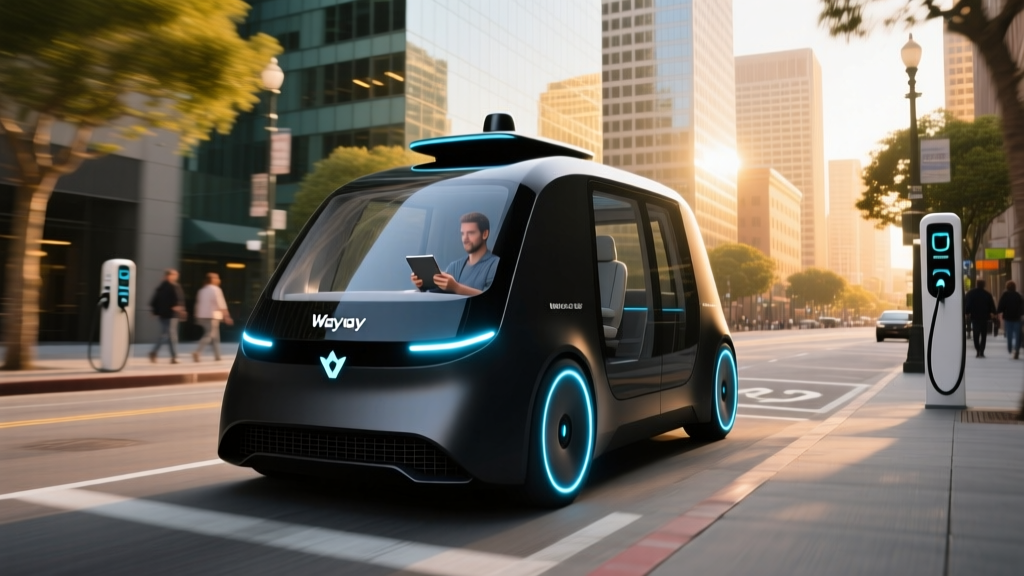
The vehicle that arrives is a Jaguar I-PACE electric SUV (being supplemented by newer platforms including the Zeekr RT and Hyundai Ioniq 5 in testing), fully outfitted with Waymo's sensor suite. There's no driver. You sit in the back, buckle up, and the ride begins. In-app controls let you adjust climate, change music, add stops, and contact support.
| Route (Approximate) | Distance | Waymo One | UberX | Lyft Standard |
|---|---|---|---|---|
| Downtown Phoenix → Sky Harbor Airport | 5 mi | $15–$20 | $14–$22 | $13–$20 |
| Santa Monica → Downtown LA | 16 mi | $30–$42 | $28–$45 | $26–$40 |
| SF Mission District → Marina | 5 mi | $16–$24 | $15–$25 | $14–$23 |
| Chandler, AZ → Tempe, AZ | 12 mi | $22–$30 | $20–$32 | $19–$28 |
The pricing takeaway: Waymo One is generally competitive with standard UberX and Lyft fares, and often cheaper during peak surge periods when human-driver rideshares spike. Waymo does not currently charge a separate "autonomous vehicle premium." However, it's also not significantly cheaper — this is not a budget alternative, it's a comparable-priced service with a different experience. Promotional pricing and first-ride credits are periodically offered to new users in expansion markets.
Waymo's Safety Record: What the Real Data Shows
Safety is the single most scrutinized aspect of robotaxi operations, and rightly so. Waymo has published the most extensive safety data of any Level 4 operator, and independent analyses from insurance and research organizations have supplemented the company's own figures.
Waymo Safety Data Points (Cumulative through Late 2025)
- Total autonomous miles driven: Over 30 million fully driverless miles across all markets (Source: Waymo Safety Report)
- Injury-causing crash rate vs. human benchmark: Waymo's data, analyzed by the Insurance Institute for Highway Safety (IIHS) and Swiss Re, showed a 76% reduction in injury-causing crash rates compared to human-driven vehicles in comparable urban environments
- Police-reported crash rate: Approximately 85% lower than human drivers in the same geographies
- Contactless incidents: The vast majority of reported incidents involve minor low-speed contact, often with other vehicles striking the Waymo vehicle — not the Waymo vehicle initiating contact
The context matters. Waymo vehicles operate in dense urban environments where low-speed collisions are common. The vehicles are highly visible (roof-mounted lidar arrays, distinctive branding), tend to drive conservatively, and obey speed limits strictly. This conservative driving style is a deliberate safety choice — it reduces crash severity but can frustrate human drivers behind them, which contributes to rear-end incidents where the Waymo vehicle is struck, not the at-fault party.
For comparison, the National Highway Traffic Safety Administration (NHTSA) reports that human drivers in the U.S. experience approximately 5.5 police-reported crashes per million vehicle miles. Waymo's reported rate in comparable urban conditions falls well below this baseline. However, it's important to note that Waymo's operational domain — geofenced, well-mapped urban corridors with favorable weather — is not directly comparable to the full spectrum of driving conditions human drivers face nationwide.
The Technology Stack: Lidar, Cameras, Radar, and HD Maps
Waymo's approach to autonomous driving is sensor-diverse, which stands in direct contrast to Tesla's camera-only ("Tesla Vision") strategy. The current-generation Waymo Driver hardware suite, known as the 6th-generation system deployed on newer vehicles, includes:
- Lidar: Multiple roof- and body-mounted lidar units providing 360-degree, high-resolution 3D point-cloud mapping of the environment. Lidar works independently of lighting conditions, giving the system reliable depth perception at night, in glare, and in shadow.
- Cameras: A suite of high-resolution cameras covering 360 degrees, used for object classification (pedestrian vs. cyclist vs. vehicle), traffic-light state detection, signage reading, and lane-marking recognition.
- Radar: Imaging radar units for velocity detection of moving objects, performance in rain and fog (where lidar and cameras degrade), and redundancy.
- External audio sensors: Microphones that detect sirens from emergency vehicles, enabling the system to pull over appropriately.
- HD Maps: Waymo pre-maps every inch of its service territory at centimeter-level resolution. The vehicle localizes itself against this map in real time. This is why Waymo is geofenced — it cannot operate in areas it has not mapped.
The sensor-fusion approach gives Waymo redundancy that camera-only systems lack. If heavy rain degrades camera visibility, lidar and radar continue providing environmental data. If a plastic bag blows across the road, the system can classify it as non-threatening using multi-sensor confirmation rather than relying on a single camera feed. This redundancy comes at a cost — the sensor suite on each Waymo vehicle is estimated to add tens of thousands of dollars in hardware — but for a fleet-operated robotaxi, per-vehicle cost is amortized over thousands of revenue-generating rides.
Regulatory Framework: Who Approves Robotaxi Operations?
Robotaxi deployment in the United States is governed by a patchwork of state-level regulations, not a unified federal framework. The NHTSA sets vehicle safety standards (FMVSS) but does not directly approve or license autonomous driving services. That authority falls to individual states.
- Arizona: The most permissive regulatory environment. The Arizona Department of Transportation issues permits for autonomous vehicle testing and commercial operation. Waymo has held a commercial permit since 2020. No safety driver is required for Level 4 operations.
- California: The California Public Utilities Commission (CPUC) and the Department of Motor Vehicles (DMV) jointly regulate. The DMV issues testing and deployment permits; the CPUC regulates commercial passenger service. Waymo received its CPUC commercial deployment permit for San Francisco in 2024 and expanded to Los Angeles subsequently. California also requires detailed incident reporting (disengagement reports, collision reports), making it the most transparent regulatory jurisdiction.
- Texas: The Texas Department of Transportation oversees autonomous vehicle operations under the state's 2017 autonomous vehicle law. Austin's launch required coordination with local authorities on geofencing and first-responder protocols.
At the federal level, NHTSA has issued standing general orders requiring crash reporting for vehicles operating with Level 2 and above automated driving systems. This has generated a public database of robotaxi incidents, though interpretation requires context — a minor bumper tap that would go unreported between human drivers may trigger a filing for an autonomous vehicle.
Current Limitations: Where Robotaxis Cannot Go and What They Cannot Do
Despite impressive safety metrics and expanding coverage, Waymo One has hard operational limits that riders should understand before relying on the service.
- Geofence boundaries: The service simply does not exist outside mapped zones. Requesting a ride from a location outside the geofence returns an "area not available" message. You cannot ride from downtown Phoenix to Tucson — the 110-mile stretch of I-10 between them is not in Waymo's operational domain.
- Weather restrictions: Heavy rain, dense fog, and snow degrade sensor performance. In Phoenix, monsoon-season downpours can trigger service pauses. Waymo does not currently operate in snow-belt cities, and winter conditions with road-salt spray and obscured lane markings present unsolved challenges for lidar and camera systems.
- Construction zones: Major, unmapped road construction can confuse the system. Waymo's HD maps are updated frequently, but sudden lane closures or temporary traffic patterns may cause the vehicle to reroute conservatively or pull over and request remote assistance.
- Airport service gaps: Despite Phoenix Sky Harbor being served, major airports like LAX and SFO have been slow to integrate robotaxi pickup/dropoff. SFO service has been announced with limited rollout; LAX remains unavailable.
- Passenger restrictions: Waymo One currently requires riders to be 18+ with a valid account. Unaccompanied minors cannot ride. Car seats are not available, and riders must bring their own if traveling with young children (subject to vehicle capacity).
- No highway operation (most markets): Waymo's service is predominantly urban and suburban surface-street driving. Limited highway segments are included in some geofences (certain freeway on/off-ramps and short highway stretches), but long-distance highway travel is not part of the service model.
- Wait times: In high-demand periods or at the edges of geofenced zones, wait times can extend to 15–20+ minutes. Fleet size is finite and rebalancing takes time.
These limitations define the current "operational design domain" — the conditions under which the Level 4 system can safely function. They are not bugs; they are deliberate engineering boundaries. The system refuses to operate when conditions exceed its validated capability, which is arguably the most important safety feature of all.
Frequently Asked Questions
Is Waymo truly self-driving, or is there a remote human controlling the car?
Waymo One vehicles are genuinely driverless — SAE Level 4. There is no human driver in the vehicle, and no remote operator "driving" the car in real time. Waymo does employ a remote assistance team that can provide high-level guidance (e.g., confirming whether a cone in the road can be driven around), but the vehicle's onboard system handles all real-time driving decisions — steering, braking, acceleration, lane changes — autonomously. Remote assistants do not joystick the vehicle.
Can I use Waymo if I'm visiting from out of town?
Yes, as long as your pickup and dropoff are within the active geofenced service area. Download the Waymo app, create an account, and book like any rideshare. No local residency is required. The service is popular with visitors to Phoenix and San Francisco specifically because it offers a novel experience alongside practical transportation.
How does Waymo handle emergencies or accidents?
If a collision occurs, the vehicle's systems automatically contact Waymo's incident response team and emergency services if needed. The vehicle will pull to a safe location if possible. In-car communication allows riders to speak directly with Waymo support at any time. All incidents are reported to state regulators per standing general orders from NHTSA.
Will Waymo expand to more cities in 2026?
Waymo has announced intentions to expand to additional U.S. metros and has conducted testing or mapping in cities including Miami and Nashville. However, each new city launch requires regulatory approval, extensive mapping, validation driving, and fleet deployment. Announced expansion timelines should be treated as targets, not guarantees. Check the Waymo app for real-time service availability — if you can't book a ride, the service isn't live in your area regardless of news coverage.
How does Waymo compare to Cruise or Zoox?
Cruise (majority-owned by GM) suspended all operations in late 2023 following a serious incident in San Francisco and has been slowly resuming limited testing with safety drivers as of 2025 — it does not currently offer commercial driverless rides. Zoox (owned by Amazon) has been testing its purpose-built bidirectional vehicle in limited areas but has not launched a broad commercial service comparable to Waymo One. Waymo is currently the only robotaxi operator offering scaled, bookable, fully driverless rides to the general public in multiple U.S. cities.
What electric vehicle does Waymo use?
The primary fleet vehicle is the Jaguar I-PACE, an all-electric SUV with a 90 kWh battery pack and approximately 230 miles of EPA range. Waymo has also announced partnerships for next-generation vehicles including the Zeekr RT (a purpose-built robotaxi platform from Geely) and the Hyundai Ioniq 5, both of which are in testing phases. The I-PACE's EPA range is sufficient for a full day of urban rides with opportunity charging between shifts.