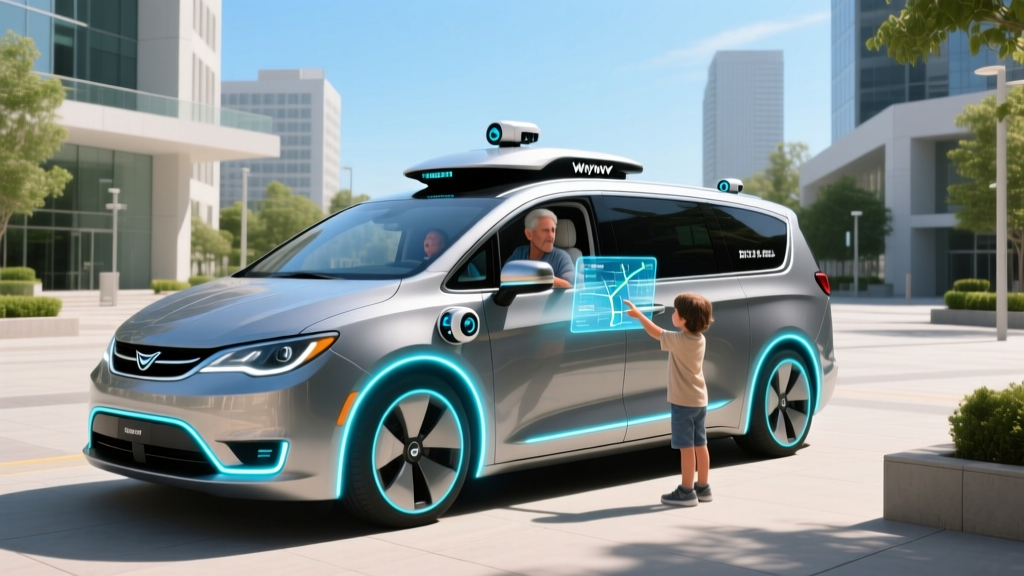
If you have seen a Chrysler Pacifica minivan navigating city streets with no one in the driver's seat, you have likely spotted one of Waymo's longest-serving robotaxi platforms. The Waymo Chrysler Pacifica — officially the Pacifica Hybrid retrofitted with Waymo's fifth-generation autonomous driving hardware — has logged millions of fully driverless miles across multiple U.S. metro areas. While Waymo has begun integrating newer vehicles like the Jaguar I-PACE and the Zeekr RT into its fleet, the Pacifica remains a recognizable workhorse of the Waymo One commercial service.
This guide breaks down exactly what the Waymo Chrysler Pacifica robotaxi is, where you can ride in one today, how much it costs, and what the real safety data says.
SAE Automation Level: True Driverless, Not Driver-Assist
SAE Level 4 — High Automation (Geofenced Driverless)
The Waymo Chrysler Pacifica operates at SAE Level 4 within its approved operational design domain (ODD). This means the vehicle handles all driving tasks — steering, braking, acceleration, route planning, and hazard response — with no human driver present. This is fundamentally different from Level 2 driver-assist systems like Tesla Autopilot, GM Super Cruise, or Ford BlueCruise, which require an attentive human behind the wheel at all times.
| Level | Name | Who Drives? | Example |
|---|---|---|---|
| Level 0 | No Automation | Human only | Basic cruise control |
| Level 1 | Driver Assistance | Human + one assist (steering OR speed) | Adaptive cruise control |
| Level 2 | Partial Automation | Human (must supervise) | Tesla Autopilot, GM Super Cruise |
| Level 3 | Conditional Automation | System drives in limited conditions; human on standby | Mercedes DRIVE PILOT (select markets) |
| Level 4 | High Automation | System drives fully within geofenced ODD; no human needed | Waymo One (Pacifica, I-PACE, Zeekr) |
| Level 5 | Full Automation | System drives everywhere, all conditions | Does not yet exist commercially |
The critical takeaway: when you step into a Waymo Chrysler Pacifica, there is nobody in the front seat. The vehicle is designed to complete the entire trip autonomously within its mapped service area, and a remote support team monitors fleet operations — but no remote operator is "joystick-driving" the car in real time.
Where Can You Ride a Waymo Chrysler Pacifica Right Now?
Waymo One, the commercial ride-hailing service that deploys the Pacifica fleet alongside newer vehicles, is currently operational in the following metro areas:
| Metro Area | Status | Approximate Coverage Area | Notes |
|---|---|---|---|
| Phoenix, AZ (Metro) | Live — fully driverless | ~225+ sq mi across Chandler, Tempe, Mesa, Scottsdale, Phoenix | Original launch market; largest coverage footprint; Pacifica-heavy fleet |
| San Francisco, CA | Live — fully driverless | Most of SF proper, including downtown, Sunset, Richmond | Mixed fleet (Pacifica + I-PACE); 24/7 operation |
| Los Angeles, CA | Live — fully driverless | Santa Monica, Hollywood, Downtown LA, Beverly Hills, expanding | Growing geofence; Pacifica and newer vehicles |
| Austin, TX | Live — limited commercial | Central Austin, Downtown, South Congress corridor | Expansion ongoing; initial rider programs first |
Waymo has announced plans to expand to additional cities, but those expansions are not yet live for commercial rides. If you are outside the geofenced zones listed above, you cannot currently hail a Waymo Chrysler Pacifica — the service is restricted to pre-mapped areas that Waymo has extensively validated.
The Technology Stack: How the Pacifica Robotaxi Sees the Road
The Chrysler Pacifica Hybrid used by Waymo is not a stock minivan. Each vehicle is retrofitted with Waymo's 5th-generation Waymo Driver sensor suite, a custom hardware and software package designed for Level 4 autonomy. Here is what is onboard:
- LiDAR: Multiple roof-mounted and body-integrated LiDAR units providing 360-degree, high-resolution 3D point-cloud mapping out to several hundred meters. LiDAR works independently of ambient light, giving the system reliable depth perception at night and in glare conditions where cameras struggle.
- Cameras: A surround-view array of high-dynamic-range cameras covering all directions, used for lane detection, traffic light and sign recognition, pedestrian classification, and reading construction-zone signage.
- Radar: Multiple radar units for velocity detection of moving objects (vehicles, cyclists) and redundancy in low-visibility conditions like rain or fog.
- Audio detection: External microphones that can detect emergency vehicle sirens and adjust behavior accordingly (pulling over, yielding).
- HD Mapping: Waymo builds and maintains centimeter-precision maps of every street in its service area. The vehicle localizes itself against these maps in real time, cross-referencing sensor data to know its exact position within inches.
- Compute: A custom trunk-mounted computing platform processes sensor fusion, prediction, and planning — making hundreds of driving decisions per second.
This multi-sensor approach stands in contrast to camera-only systems (notably Tesla's vision-based FSD). Waymo's use of LiDAR provides a hardware-level redundancy that does not depend solely on neural-network inference from 2D image data. The trade-off is cost and complexity: each Pacifica retrofit is estimated to carry well over $100,000 in sensor and compute hardware, though Waymo has stated each successive generation reduces this figure.
The Pacifica Hybrid's plug-in hybrid powertrain (16-kWh battery, ~32 miles of electric-only range, 2.5-liter inline-4 engine) also provides operational flexibility — the vehicle can run on electric power in low-speed urban environments and fall back to the gasoline engine for longer repositioning drives, reducing downtime for charging.
Pricing: Waymo One vs. Uber and Lyft
Waymo One operates on a ride-hailing model similar to Uber or Lyft. You download the Waymo One app, enter your pickup and drop-off locations within the service area, and a driverless Pacifica (or another fleet vehicle) is dispatched. Pricing is dynamic and varies by city, time of day, and demand, but here is a representative comparison based on typical urban rides:
| Service | Typical Fare (5 mi) | Surge Pricing? | Tipping? | Availability |
|---|---|---|---|---|
| Waymo One | $12 – $20 | Yes, but generally less aggressive than Uber/Lyft surge | Optional via app | Geofenced areas only |
| UberX | $10 – $22 | Yes, often significant during peak hours | Expected (15-20%) | Widespread |
| Lyft | $10 – $20 | Yes | Expected (15-20%) | Widespread |
In practice, Waymo One fares tend to be competitive with UberX and Lyft on standard rides, and often cheaper during high-demand periods because Waymo's surge multipliers have historically been more moderate. The absence of a human driver also removes the social pressure of tipping, though the app does offer the option. For riders in Phoenix and San Francisco, Waymo One has become a genuine daily-transportation alternative rather than a novelty ride.
Waymo has also offered promotional pricing, loyalty programs, and partnerships (for example, integration with Uber's app in some markets) that can reduce per-ride costs further.
Safety Record: What the Data Actually Shows
Waymo Safety Data (through 2025, published 2024-2025):
- 30+ million fully driverless miles completed on public roads across all Waymo One markets.
- 85% reduction in injury-causing crash rates compared to human benchmarks in comparable urban environments, based on Waymo's peer-reviewed analysis and NHTSA comparative data.
- 57% reduction in police-reported crash rates of any severity vs. human drivers in the same operational areas.
- Waymo publishes periodic safety performance data and has submitted findings to NHTSA's ADS reporting framework.
Sources: Waymo Safety Report (2024), NHTSA Standing General Order on ADS crash reporting, IIHS autonomous vehicle research.
The data paints a picture of a system that is meaningfully safer than the average human driver in its operational domain — particularly in avoiding the types of crashes that cause injuries (rear-end collisions, intersection T-bones, and pedestrian strikes). However, the data also comes with important context:
- Waymo operates in geofenced, well-mapped urban areas with relatively predictable traffic patterns. This is not the same as handling rural highways, unmapped roads, or extreme weather.
- Incidents do occur. Waymo vehicles have been involved in minor collisions (often low-speed, property-damage-only), and under NHTSA's Standing General Order, the company is required to report these. Most involve other human drivers striking the Waymo vehicle, not the reverse.
- Two high-profile incidents in 2024 (involving a Waymo vehicle being vandalized and a collision with a pedestrian who entered the roadway unexpectedly) were investigated and addressed through software updates and operational adjustments.
Regulatory Landscape: Who Approves Robotaxi Operations?
Robotaxi deployment in the United States involves overlapping layers of regulation:
- State level: Each state sets its own rules for autonomous vehicle testing and commercial deployment. Arizona (where Waymo launched in Phoenix) has among the most permissive regulatory frameworks, requiring minimal permitting. California, through the California Public Utilities Commission (CPUC) and the DMV, requires both a testing permit and a commercial deployment permit — a multi-step process involving safety data submissions.
- Federal level: NHTSA oversees vehicle safety standards and has issued a Standing General Order requiring all ADS developers to report crashes. The federal government does not currently have a comprehensive regulatory framework for Level 4 deployment, leaving significant authority to states.
- Local/municipal: Cities often negotiate directly with robotaxi operators on issues like curb management, emergency response protocols, and service-area boundaries. San Francisco's Board of Supervisors, for example, held extensive public hearings before approving Waymo's expansion.
Waymo's approach has been to work within existing regulatory frameworks rather than challenge them — a contrast to some competitors that have faced license suspensions (notably Cruise, which had its California permit suspended in late 2023 following a serious incident in San Francisco and has since restructured its operations).
Current Limitations: What the Waymo Pacifica Cannot Do
Important: Level 4 autonomy is geofenced and conditional. The Waymo Chrysler Pacifica is driverless, but only within strict operational boundaries. Here is what it cannot currently handle:
- Geofence boundaries: If your trip starts or ends outside Waymo's mapped service area, the app will not allow you to book the ride. There is no gradual handoff to a human driver — the service simply is not available.
- Heavy weather: Waymo's Pacifica fleet will reduce service or pause operations entirely during heavy rain, fog, or dust storms that exceed the sensor suite's validated performance envelope. Phoenix monsoon season and San Francisco fog events have both triggered service interruptions.
- Construction zones: While the system handles many standard construction-zone configurations, complex or rapidly changing work zones with temporary lane shifts, flaggers, and non-standard signage may cause the vehicle to pull over safely and request remote guidance or reroute.
- Highway speeds above ODD: Waymo's urban ODD primarily covers surface streets and lower-speed arterials. While the Pacifica can handle some highway segments (Waymo has expanded highway driving in Phoenix and LA), it does not operate on all freeways or at speeds above its validated envelope.
- Unmapped areas: Waymo's HD maps are built street-by-street. Any road not mapped to centimeter precision is a no-go. This means spontaneous detours through residential neighborhoods outside the service area are not possible.
- Accessibility limitations: The Pacifica Hybrid minivan platform does offer more interior space than a sedan, but Waymo's wheelchair-accessible vehicle (WAV) availability varies by market and wait times can be longer. The company has committed to expanding WAV access.
- Pets and unaccompanied minors: Waymo's current terms of service generally require riders to be 18+ (with some teen-rider programs in select markets with parental consent). Pets must be in carriers.
The Pacifica's Role in Waymo's Fleet Future
The Chrysler Pacifica Hybrid was Waymo's first volume production-vehicle partner, and the fleet of retrofitted minivans has been instrumental in proving Level 4 commercial viability. However, Waymo is actively diversifying its fleet:
- Jaguar I-PACE: All-electric SUV with Waymo Driver integration, deployed in San Francisco and Los Angeles. Offers a quieter, zero-tailpipe-emission ride experience.
- Zeekr RT: A purpose-built robotaxi vehicle designed from the ground up for autonomous operation — no steering wheel or pedals in the production configuration — expected to begin entering service as Waymo scales.
- Hyundai Ioniq 5: Waymo announced a partnership with Hyundai to integrate the Waymo Driver into the Ioniq 5 platform for future fleet deployment.
The Pacifica will likely remain in service for years given its proven track record and the sheer number of units already in the fleet, but it represents Waymo's "generation one" vehicle platform. Newer vehicles benefit from the 5th-generation (and future 6th-generation) Waymo Driver hardware with lower per-unit sensor costs, better integration, and all-electric powertrains that reduce operating expenses.
Frequently Asked Questions
Is the Waymo Chrysler Pacifica truly self-driving, or is there a safety driver?
In Waymo One commercial service, the Pacifica operates fully driverless — no one sits in the driver's seat. There is no steering wheel override or hidden safety driver. Remote fleet support monitors operations, but no one is remotely controlling the vehicle in real time. This is SAE Level 4, not Level 2 driver-assist.
How much does a Waymo ride cost compared to Uber or Lyft?
Waymo One fares are generally in line with UberX and Lyft for comparable rides — typically $12 to $20 for a 5-mile urban trip. During peak demand, Waymo's surge pricing has historically been less aggressive than Uber or Lyft, making it sometimes the cheaper option. There is no human driver to tip, though the app allows optional gratuities.
How safe are Waymo's driverless Pacificas?
Based on Waymo's published safety data and NHTSA crash reporting, Waymo vehicles show an approximately 85% reduction in injury-causing crashes and a 57% reduction in all police-reported crashes compared to human benchmarks in comparable urban environments. Over 30 million fully driverless miles have been completed. Incidents do occur, but at a significantly lower rate than human-driven vehicles in the same areas.
Can I use Waymo in any city?
No. Waymo One is currently live in Phoenix (metro), San Francisco, Los Angeles, and Austin — all within specific geofenced areas. You must be within the mapped service zone to request a ride. Expansion to additional cities is planned but not yet live.
What happens if the Waymo Pacifica encounters a situation it cannot handle?
The vehicle is programmed to reach a safe state — typically pulling over to the side of the road or stopping in a safe location. Remote fleet support can then assess the situation and provide high-level guidance (such as authorizing a new route around an obstacle), but they do not joystick-drive the car. If needed, roadside assistance is dispatched.
Why does Waymo use a Chrysler Pacifica minivan?
The Pacifica Hybrid offers a spacious interior (comfortable for up to 3 rear passengers plus cargo), a plug-in hybrid powertrain for operational flexibility, and was available as a production vehicle that Waymo could integrate its sensor suite into at scale. The minivan form factor also makes ingress and egress easier for a wide range of riders compared to a low-slung sedan.
Will the Pacifica be replaced in Waymo's fleet?
Waymo is already supplementing the Pacifica with the all-electric Jaguar I-PACE and has announced partnerships for purpose-built platforms like the Zeekr RT and Hyundai Ioniq 5. The Pacifica will remain in service for the near term but represents Waymo's first-generation vehicle platform.