Searches for "waymo child" spike every time a headline surfaces about a rider under 18, a school-zone encounter, or a parent wondering whether a driverless car can be trusted with their kid. The question is fair: Waymo's 6th-generation robotaxi has no steering wheel, no driver, and no adult in the front seat. Before you book a ride — or let your teenager book one — here is what the data, the policy, and the technology actually say.
What Level of Autonomy Is a Waymo Robotaxi?
Waymo's commercial service (branded Waymo One) operates at SAE Level 4 within its defined Operational Design Domain (ODD). That means the vehicle handles all driving tasks — steering, braking, lane changes, unprotected left turns — with no human fallback expected inside the geofenced service area. This is fundamentally different from a Tesla on FSD (Supervised) or GM Super Cruise, both of which remain SAE Level 2 and require an attentive driver at all times.
| Level | Who Drives | Example |
|---|---|---|
| Level 2 | Human (hands on or eyes on) | Tesla Autopilot, FSD Supervised, BlueCruise |
| Level 3 | System, human on standby | Mercedes DRIVE PILOT (limited markets) |
| Level 4 | System, no human needed in ODD | Waymo One, Zoox (pilot programs) |
| Level 5 | System, everywhere, all conditions | Does not exist commercially |
For parents, the practical upshot: a Waymo robotaxi is not a "self-driving car with a backup driver." It is a purpose-built driverless service. The child policy — not the autonomy level — is what determines whether your kid can ride alone.
Waymo's Child and Minor Rider Policy
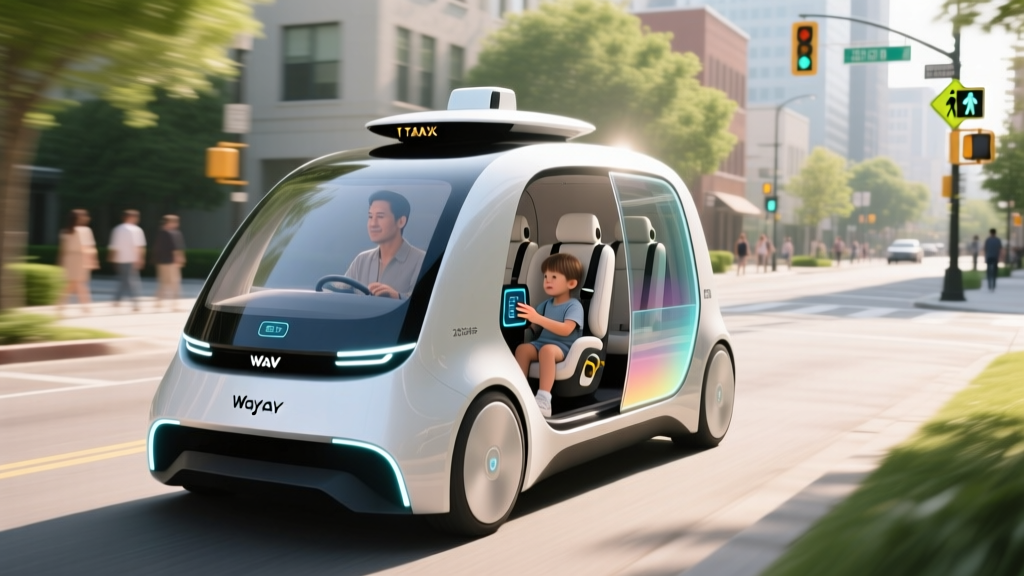
As of early 2026, Waymo's rider agreement requires the account holder to be at least 18 years old, and unaccompanied minors (under 18) are not permitted to ride. A child may ride with an adult account holder, but Waymo does not provide child safety seats, and riders are responsible for ensuring any child restraint complies with state law. In practice, this means:
- Under 18, alone: Not permitted.
- Under 18, with adult: Permitted; adult must bring an appropriate car seat or booster if state law requires one (California law requires a booster until age 8 or 4'9" height).
- 18-year-old teen: May create their own Waymo One account and ride alone.
The "waymo child" search trend often conflates two different scenarios — a child riding in the car versus a child pedestrian near the car. Both matter, but they're governed by different safety systems.
Where Can You Actually Hail a Waymo Right Now?
Waymo One is not nationwide. Service is geofenced, and expansion has been deliberate rather than rapid. As of Q1 2026, fully driverless commercial rides are available in:
| Metro Area | Service Zone Size | Status |
|---|---|---|
| Phoenix, AZ (East Valley + Downtown) | ~225 sq mi | Live, 24/7 |
| San Francisco, CA | ~50 sq mi (city core) | Live, 24/7 |
| Los Angeles, CA | ~80 sq mi (initial zones) | Live, limited hours expanding |
| Austin, TX | ~45 sq mi | Live (2025 launch) |
| Atlanta, GA | Announced zones | Paid pilot, not full commercial |
If you are outside these geofences, the Waymo app will not let you book. Expansion announcements (Miami, Nashville) are announced, not live — do not plan a family trip around them.
Waymo's Safety Record: The Actual Numbers
This is where parents should spend the most time. Waymo has published, and independent researchers have validated, the largest peer-reviewed dataset on Level 4 robotaxi safety. The most-cited study, conducted with the Insurance Institute for Highway Safety (IIHS) and Swiss Re, compared Waymo's crash rates against a human baseline of 100 billion miles.
- Total fully driverless miles: ~15 million+ (commercial, no human behind the wheel)
- Total autonomous miles (incl. testing): 40+ million
- Injury-causing crash rate vs. human baseline: 85% lower (IIHS/Swiss Re study)
- Police-reportable crash rate vs. human baseline: 57% lower
- Fatalities in commercial service: 0 (as of publication)
Source: Waymo Safety Report 2024, IIHS partnership study. Rates are per million miles.
Context matters. Waymo's geofenced zones avoid the highest-risk driving (rural two-lane roads, extreme snow). The comparison is not "Waymo vs. all humans everywhere" — it's "Waymo vs. humans in the same urban environments." Within that scope, the data is strong, but it is not infinite-mile proof. A single serious incident involving a child pedestrian would reshape the statistics and the regulatory conversation immediately.
Incidents Involving Schools and Children
A handful of publicized incidents — a Waymo vehicle passing a stopped school bus in Austin (2024), minor low-speed contacts near crosswalks — drew NHTSA scrutiny and prompted Waymo to issue software updates specifically targeting school-bus stop-arm detection and school-zone speed enforcement. NHTSA opened and closed preliminary evaluations; no recall was mandated, but the agency continues to monitor through its Standing General Order on automated-driving incidents.
How the Tech Stack Detects Small, Fast-Moving Humans
The reason a parent might specifically search "waymo child" is that children are the hardest road users to predict: shorter (below many sightlines), faster to change direction, and more likely to dart from between parked cars. Waymo's 6th-generation "Driver" addresses this with a sensor stack that is categorically different from camera-only approaches:
- 5 LiDAR units — generate a real-time 3D point cloud, detecting a child-sized object at 500+ meters regardless of lighting.
- 29 cameras — high-res, overlapping fields of view; read crosswalk signals, detect a school-bus stop arm, identify a child's backpack poking above a hedge.
- 6 radar units — all-weather object tracking, especially useful in Phoenix monsoon rain or SF fog where LiDAR can degrade.
- External audio receivers — detect sirens, horns, and (in software updates) the specific acoustic signature of a school bus stop-arm deployment.
The system does not rely on a single sensor to spot a child. Fusion across LiDAR + camera + radar means a child stepping off a curb in low sun (camera-blinding conditions) is still tracked by LiDAR. A child in heavy rain (LiDAR noise) is still tracked by radar.
Compare this with a camera-only Level 2 system (e.g., Tesla FSD Supervised), which depends on visible-light image recognition. In edge cases — a small child at dusk, partially occluded — the sensor diversity of a Level 4 robotaxi is a genuine safety advantage, not a marketing bullet.
What a Waymo Ride Costs vs. Uber and Lyft
For a parent budgeting rides to school, practice, or the airport, price matters. Waymo's pricing in 2026 tracks closely with UberX/Lyft Standard, with no surge pricing and no tip expectation.
| Route (example) | Waymo One | UberX | Lyft Standard |
|---|---|---|---|
| 3-mile urban hop | $10–$13 | $9–$16 (surge) | $9–$15 |
| 10-mile cross-town | $22–$28 | $20–$35 | $19–$32 |
| Airport run (15 mi) | $35–$45 | $30–$55 | $28–$50 |
Waymo's price is stable; Uber and Lyft surge during rain, rush hour, and events — precisely when a parent most wants a ride. For recurring trips (daily school drop-off), Waymo offers no subscription plan yet, so budgeting is per-ride.
Current Limitations a Parent Must Know
- Heavy rain / monsoon / snow: Service pauses or shrinks its ODD. Phoenix monsoon storms routinely trigger pull-overs.
- Outside the geofence: Cannot be hailed to or from addresses beyond mapped zones — no "take my kid to grandma's in Tucson."
- Unaccompanied minors: Against policy, and the in-cabin camera will flag it.
- Car seats provided: You must bring and install your own; the vehicle has no driver to help.
- Road construction / unmapped detours: The vehicle will refuse the route or pull over safely and end the trip.
- Medical or behavioral emergencies mid-ride: In-cabin support is remote (video call with a Waymo specialist), not a physically present adult.
Regulatory Oversight: Who Watches Waymo?
Waymo operates under a patchwork of state approvals. The California Public Utilities Commission (CPUC) grants the passenger-service permit in CA; Arizona's approach is lighter-touch via executive order; Texas and Georgia have their own frameworks. Federally, NHTSA retains defect-and-recall authority but does not pre-approve robotaxi operations. This means safety standards vary by state, and a parent in Phoenix is riding under a different regulatory regime than one in San Francisco.
FAQ: Waymo and Kids
Can my 16-year-old ride Waymo alone?
No. Waymo's terms require the account holder and rider to be 18+. An 18-year-old may ride solo; anyone under 18 must be accompanied by an adult.
Does Waymo provide a child car seat?
No. You must bring and properly install your own car seat or booster. The vehicle has no driver to assist, and Waymo's cleaning/turnaround process does not include seat installation.
What happens if my child gets sick or scared mid-ride?
The in-cabin screen connects to a live Waymo specialist via video. They can end the trip, pull the vehicle over safely, and dispatch help. They cannot physically comfort or assist a child.
Has a Waymo ever hit a child?
As of this publication, Waymo has not reported a fatality or life-threatening injury to a child pedestrian or rider. Minor low-speed contacts near crosswalks have occurred and been reported to NHTSA under the Standing General Order; none resulted in serious injury.
Is Waymo safer than me driving my kid?
Per the IIHS/Swiss Re study, Waymo's injury-causing crash rate in its ODD is ~85% lower than the human baseline for comparable urban driving. That said, the dataset covers tens of millions of miles, not billions, and your own driving record may be better or worse than the baseline. The data favors Waymo for routine urban trips; it does not yet cover rural, high-speed, or severe-weather driving where many family trips occur.
How do I verify Waymo is operating legally in my city?
Check your state's public utilities or motor vehicle commission for the current passenger-service permit. In California, the CPUC publishes an active-permit list. In Arizona, the Governor's Office of Highway Safety oversees AV operations.
The Practical Verdict for Parents
A Waymo robotaxi is, by available data, one of the safest urban ride options for a child accompanied by an adult — thanks to Level 4 sensor redundancy, no distracted-driver risk, and strict speed compliance in school zones. It is not, however, a substitute for parental supervision: no car seat is provided, no adult is physically present, and service can strand you if weather or geofence limits hit mid-trip. For a sober 18-year-old heading home from a late event, Waymo is arguably safer than a random rideshare driver at 1 a.m. For a 12-year-old going to soccer practice alone, it is not an option today — and likely won't be for years, given liability and regulatory headwinds.
If "waymo child" brought you here because you're weighing a real trip, the checklist is simple: adult accompanying, car seat in hand, route inside the geofence, weather clear, and a backup plan if the vehicle pulls over. Meet all five, and the data supports the ride.