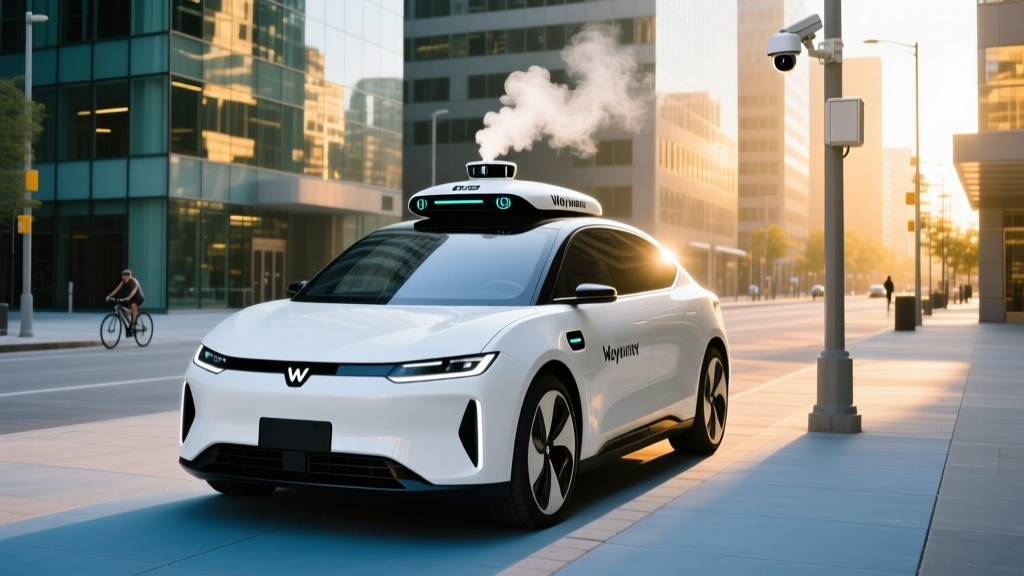
When viral images of Waymo robotaxis engulfed in flames circulated across social media in early 2025, the reaction was swift and polarized. Critics seized on the footage as proof that autonomous vehicles are inherently dangerous. Supporters pointed out that the vehicles were vandalized while parked — not malfunctioning during operation. The truth, as with most things in the autonomous driving space, requires looking past the headlines and into the data.
This article examines the arson incidents in context, reviews Waymo's actual safety record with concrete numbers, explains the SAE Level 4 technology stack powering the sixth-generation Waymo Driver, and gives you the practical information you need to evaluate robotaxi services as a rider in 2026.
The Arson Incidents: What Actually Happened to Waymo Cars Set on Fire
In January 2025, a coordinated act of vandalism in San Francisco resulted in multiple parked Waymo vehicles being set ablaze. The incidents occurred in a Waymo depot area, not on public roads during passenger service. Law enforcement classified the events as arson and property destruction — not product failures, battery thermal events, or software-caused malfunctions.
Waymo's sixth-generation vehicles are built on the Jaguar I-PACE platform, which uses a 90 kWh NMC lithium-ion battery pack. While EV battery fires do occur (typically from severe crash damage or manufacturing defects), the Waymo arson incidents involved accelerants applied externally to stationary vehicles. No passengers were present. No autonomous driving system was engaged. The National Highway Traffic Safety Administration (NHTSA) did not open a defect investigation related to these incidents.
For context, the U.S. Fire Administration reports that conventional gasoline vehicles experience fires at a rate of roughly 1,530 fires per billion vehicle-miles traveled. EV fires remain statistically rarer per vehicle, though they can be more difficult to extinguish due to lithium-ion thermal runaway characteristics. The Waymo arson events tell us about societal tensions around autonomous technology — not about robotaxi safety engineering.
SAE Automation Levels: Why Robotaxis Are Fundamentally Different From Autopilot
Understanding the Waymo arson incidents requires first understanding what a robotaxi actually is — and what it isn't. Consumer vehicles with features like Tesla's FSD (Supervised), GM's Super Cruise, or Ford's BlueCruise are SAE Level 2 systems. The driver must remain attentive and is legally responsible for the vehicle at all times.
Waymo operates at SAE Level 4 — high automation within a defined operational design domain (ODD). There is no driver. There is no steering wheel accessible to passengers. The system handles all driving tasks within its geofenced service area, and if it encounters a situation it cannot handle, it executes a minimal risk condition (pulling over safely) rather than handing control to a human.
| Feature | Level 2 (e.g., FSD Supervised, Super Cruise) | Level 4 (Waymo, Zoox) |
|---|---|---|
| Driver required? | Yes — always attentive | No — no driver present |
| Liability | Human driver | Operator/company |
| Operational domain | Broad (any road) | Geofenced service area |
| Available for purchase? | Yes (consumer vehicles) | No (ride-hail only) |
| Failure response | Alerts driver to take over | Autonomous safe stop |
You cannot buy a Waymo. You can only ride in one. This is a fundamental difference from consumer EVs where you own the vehicle and bear responsibility for its operation.
Where Can You Actually Ride in a Waymo Right Now?
As of mid-2026, Waymo's commercial robotaxi service — branded Waymo One — operates in several U.S. metropolitan areas. Service areas are geofenced, meaning the vehicle will only navigate within approved zones that have been extensively mapped and validated.
| City | Status | Service Area Notes |
|---|---|---|
| San Francisco, CA | Fully operational | Citywide coverage including SFO airport routes |
| Phoenix, AZ (East Valley) | Fully operational | Chandler, Tempe, Mesa, Gilbert, Scottsdale; PHX airport |
| Los Angeles, CA | Fully operational | Santa Monica, Hollywood, Downtown, LAX routes |
| Austin, TX | Operational (expanding) | Downtown, South Austin, airport corridor |
| Atlanta, GA | Launched 2025 | Initial zones in Midtown, Buckhead, expanding |
Waymo has announced intentions to expand to additional cities, but announced expansion is not live service. If a city isn't listed above, you cannot currently hail a Waymo there. Always check the Waymo One app for real-time availability in your area.
How Much Does Waymo Cost Compared to Uber and Lyft?
Waymo One uses dynamic pricing similar to traditional rideshare platforms. There is no surge pricing in the Uber sense, but prices do vary by time of day, demand, and trip distance. Based on rider reports and published fare data from 2025-2026:
| Scenario | Waymo One | UberX | Lyft Standard |
|---|---|---|---|
| Short trip (3 mi, off-peak) | $9–$13 | $8–$12 | $8–$11 |
| Medium trip (8 mi, off-peak) | $16–$24 | $14–$22 | $14–$21 |
| Airport run (15 mi, peak) | $35–$50 | $30–$55 | $28–$52 |
| Wait time charge | $0 (no driver wage) | $0.35–$0.60/min | $0.35–$0.55/min |
| Tipping | Not expected | 15–20% typical | 15–20% typical |
Waymo fares are generally competitive with Uber and Lyft — sometimes slightly higher on short trips, sometimes lower on airport runs where the absence of surge pricing and tipping keeps costs predictable. The real value proposition isn't price; it's consistency. A Waymo won't cancel on you because a human driver found a better fare, and it won't make conversation if you don't want it to.
How to use Waymo One: Download the Waymo One app (iOS/Android), create an account, enter your pickup and destination within the service area, and confirm. The vehicle arrives autonomously, you unlock it via the app, and it drives you to your destination. Payment is automatic through the app — no cash, no tipping prompt.
Waymo's Safety Record: What the Data Actually Shows
- Cumulative autonomous miles driven: Over 30 million fully driverless miles across all markets
- Injury-causing crash rate: Waymo reports approximately 85% fewer injury-causing crashes per million miles compared to human benchmarks in comparable urban environments
- Police-reported crash rate: Approximately 60% fewer than human drivers in equivalent geographies
- Fatalities involving Waymo in autonomous mode: Zero as of mid-2026
- Contact rate (minor incidents): Most police-reported contacts involve low-speed scenarios where other parties struck the Waymo vehicle
Sources: NHTSA AV safety data, Waymo Safety Report publications. Human benchmark comparisons use SHRP2 naturalistic driving study data.
The data paints a picture of a system that is, by the numbers, performing better than the average human driver in urban environments — particularly in the categories that matter most (injury prevention and fatality avoidance). However, robotaxis are not infallible.
Documented edge-case incidents include:
- Temporary confusion in construction zones: Waymo vehicles have occasionally stopped in travel lanes when encountering unexpected road reconfigurations, creating rear-end collision risk from following human drivers.
- First responder interactions: Early-generation systems struggled with recognizing hand signals from police officers directing traffic. Sixth-gen systems have improved here, but complex multi-officer scenes remain challenging.
- Low-speed contacts: The majority of incidents in Waymo's safety reports involve other vehicles or cyclists striking the Waymo at low speed — often because the robotaxi stopped more cautiously than a human driver would, surprising following traffic.
The Insurance Institute for Highway Safety (IIHS) has noted that while AV crash data is still limited in volume compared to human driving statistics, the early signal from Waymo's operations suggests significant potential for reducing the most common crash types (rear-end, intersection, and impaired-driving crashes).
The Sixth-Generation Waymo Driver: Technology Stack Breakdown
Waymo's sensor suite represents a fundamentally different approach to autonomous driving than the camera-only philosophy championed by Tesla. The sixth-generation Waymo Driver, deployed on the Jaguar I-PACE fleet, uses a redundant multi-modal perception system:
| Sensor Type | Count | Purpose |
|---|---|---|
| LiDAR (custom-built) | 5 units | 360° 3D point cloud; object detection to 500m; works in darkness |
| Cameras (high-res) | 29 cameras | Traffic light state, signage, lane markings, object classification |
| Radar (imaging) | 6 units | Velocity measurement, performance in rain/fog, redundancy |
| External audio receivers | Multiple | Siren detection, horn detection for emergency vehicle awareness |
| IMU + GPS + HD maps | Integrated | Localization within centimeters; pre-mapped road geometry |
This sensor redundancy is the core philosophical difference between Waymo's Level 4 approach and camera-only Level 2 systems. If one sensor modality degrades (e.g., cameras blinded by direct sun glare), LiDAR and radar continue providing perception data. The trade-off is cost — each Waymo vehicle carries an estimated $100,000–$150,000 in sensor and compute hardware, which is why this model works only for fleet-operated ride-hail services, not consumer vehicles.
Geofencing and HD mapping: Before Waymo operates in any area, it creates centimeter-accurate 3D maps of every road, intersection, curb, and traffic control device. The vehicle cross-references its real-time LiDAR point cloud against these maps for localization. This means Waymo cannot simply drive into unmapped territory — it is physically constrained to its operational design domain.
Regulatory Oversight: Who Approves Robotaxi Operations?
Robotaxi operations in the United States exist at the intersection of federal and state authority, and the regulatory landscape remains fragmented:
- Federal (NHTSA): Regulates vehicle safety standards. Has issued standing general orders requiring crash reporting from AV operators. Does not currently "approve" AV systems but can issue recalls and defect investigations.
- State level: This is where operational authority lives. California's Public Utilities Commission (CPUC) and Department of Motor Vehicles (DMV) jointly regulate robotaxi deployment — the DMV issues testing and deployment permits, while the CPUC regulates commercial passenger service. Arizona takes a lighter-touch approach via executive order. Texas passed legislation in 2023 enabling AV operations with insurance and registration requirements.
- Local/municipal: Cities often negotiate operational agreements covering pickup zones, congestion management, and first-responder protocols.
The arson incidents in San Francisco did not result in any regulatory suspension of Waymo's operating permits. California's DMV and CPUC reviewed the events and determined they were criminal acts, not systemic safety failures. However, the incidents did intensify public debate around AV deployment in urban areas, and San Francisco supervisors have periodically pushed for tighter operational restrictions on robotaxi fleets.
Current Limitations: Where Robotaxis Still Fall Short
- Heavy weather: Waymo service may be suspended or restricted during heavy rain, dense fog, or snow. LiDAR performance degrades in precipitation, and camera visibility drops. Phoenix's dry climate was an ideal first market for this reason.
- Unmapped areas: If you request a destination outside the geofenced zone, the app will not allow it. No improvisation, no "close enough" drop-offs in unfamiliar territory.
- Complex construction zones: While improving, temporary lane shifts, flaggers, and unmarked detours can cause the vehicle to stop and request remote assistance (Waymo's "roadside assistance" team can provide guidance but cannot remotely drive the vehicle).
- Multi-point trips: No intermediate stops. You cannot ask a Waymo to wait while you run into a store.
- Accessibility: The Jaguar I-PACE fleet requires passengers to enter a standard SUV. Wheelchair-accessible vehicles remain limited in availability. Waymo has announced plans for accessible fleet vehicles, but deployment is ongoing.
- Pets and unaccompanied minors: Pets must be in carriers. Riders must be 18+ (unaccompanied minor service is not available).
- Highway speeds: While Waymo vehicles can handle highway segments within their geofence (including airport freeway routes), the system is optimized for urban and suburban environments, not long-distance highway travel.
These limitations are not temporary inconveniences that a software update will solve next quarter. They represent fundamental constraints of current Level 4 autonomy — the system works exceptionally well within its designed domain but cannot generalize the way a human driver can.
The Bigger Picture: Vandalism, Public Sentiment, and AV Adoption
The incidents of Waymo cars set on fire were not isolated. They occurred during a period of heightened tension between AV operators and some residents of San Francisco and other cities. Prior incidents included cones placed on Waymo hoods to disable their roof-mounted LiDAR, vehicles blocked in by deliberately parked cars, and tires slashed.
This pattern reflects genuine public concerns that deserve serious engagement rather than dismissal:
- Traffic disruption: Robotaxis that stop cautiously or pull over when confused can block travel lanes, affecting buses, emergency vehicles, and traffic flow.
- Labor displacement: Rideshare and taxi drivers see robotaxis as an existential threat to their livelihoods.
- Data and surveillance: Vehicles bristling with 29 cameras and LiDAR sensors continuously mapping public streets raise privacy questions that regulation has not fully addressed.
- Accountability gaps: When a robotaxi blocks a fire truck or causes a traffic jam, the lines of accountability are less clear than with a human driver who can be cited on the spot.
Waymo has responded by increasing community engagement, publishing more detailed safety data, and working with first responders on interaction protocols. Whether these efforts will shift public sentiment in markets where opposition runs deep remains an open question.
Frequently Asked Questions
Is Waymo truly self-driving, or is there a remote human operator controlling the car?
Waymo is genuinely self-driving within its geofenced service area. There is no remote human "driving" the vehicle in real time. Waymo does employ a roadside assistance team that can provide high-level guidance (e.g., confirming it's safe to proceed past an unusual obstacle), but this team cannot steer, accelerate, or brake the vehicle remotely. The AI system makes all real-time driving decisions.
Have any passengers been injured in a Waymo robotaxi?
Waymo reports that its injury-causing crash rate is approximately 85% lower than human benchmarks. Minor contacts have occurred — most commonly low-speed incidents where another vehicle struck the Waymo. As of mid-2026, there have been no passenger fatalities in a Waymo operating in autonomous mode. NHTSA's standing general order requires reporting of all crashes involving ADS-equipped vehicles, and this data is publicly searchable.
What happens if a Waymo gets into an accident while I'm riding in it?
The vehicle's systems are designed to safely stop, secure the scene, and contact Waymo support automatically. Emergency services are dispatched if needed. As a passenger, you are not liable for the accident — Waymo carries commercial insurance that covers riders. You would follow the same post-accident process as any rideshare passenger (reporting, documentation, medical attention if needed).
Can I use Waymo if I'm visiting a city where it operates?
Yes. Waymo One is available to anyone who downloads the app and creates an account. You do not need to be a resident. Tourists frequently use Waymo for airport transfers and city navigation in Phoenix, San Francisco, Los Angeles, and Austin.
Why were Waymo cars set on fire, and has it happened since?
The January 2025 arson incidents in San Francisco were acts of vandalism targeting parked, unoccupied vehicles at a depot location. They were motivated by anti-AV sentiment, not by any vehicle malfunction. The incidents were investigated as criminal property destruction. Waymo has since increased physical security at fleet depots. No similar arson events have been reported at Waymo facilities as of mid-2026.
How does Waymo compare to Tesla's FSD for getting around a city?
These are fundamentally different products. Tesla FSD (Supervised) is a Level 2 driver-assist system — you must own the car, remain attentive, and bear full legal responsibility. Waymo is a Level 4 ride-hail service — you don't own the car, there's no driver, and Waymo bears operational responsibility. You cannot buy Waymo's technology for your personal vehicle. If you want autonomous transportation without ownership, Waymo is the only scaled Level 4 option in the U.S. as of 2026.
This article reflects publicly available data and Waymo's published safety reports as of mid-2026. Robotaxi service areas, pricing, and regulations change frequently. Always verify current information through the Waymo One app and your state's regulatory agencies before relying on autonomous ride-hail services.