The State of Waymo Cars in San Francisco Right Now
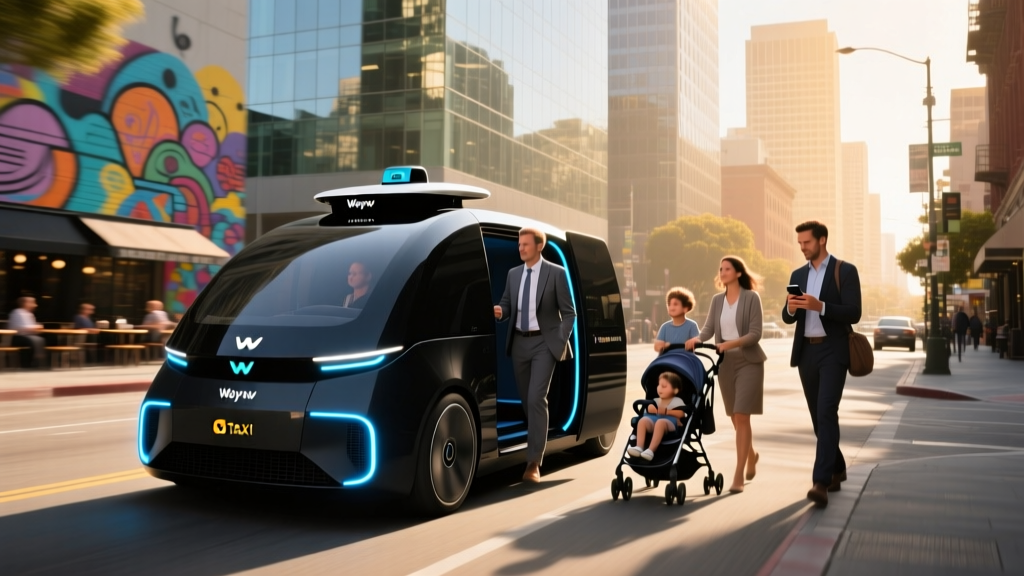
San Francisco is the undisputed capital of commercial robotaxi service. As of early 2026, Waymo One operates the largest fleet of fully driverless vehicles in the United States, with thousands of rides completed daily across the city. If you've seen a white Jaguar I-PACE with a prominent rooftop sensor array gliding through SoMa or the Mission without anyone in the driver's seat, you've seen a Waymo 6th-generation vehicle in commercial operation.
Unlike Tesla's Full Self-Driving (Supervised) or GM's Super Cruise — both of which require an attentive human behind the wheel — Waymo's robotaxi has no driver. No steering wheel for a passenger to grab, no pedals to press, no expectation that you'll monitor the road. You sit in the back, tap a destination in the app, and the car handles everything within its operational domain.
Waymo One operates at SAE Level 4 — the vehicle performs all driving tasks within a defined operational design domain (ODD) with no human intervention required. This is fundamentally different from Level 2 systems like Tesla Autopilot, FSD Supervised, or Ford BlueCruise, where a licensed driver must remain engaged and ready to take over at any moment. Level 4 means the car is the driver, within its geofenced service area.
Where Can You Actually Catch a Waymo in San Francisco?
Waymo's San Francisco service area has expanded significantly since the California Public Utilities Commission (CPUC) granted full commercial deployment permits in August 2023. As of 2026, the geofenced zone covers most of the city proper, including neighborhoods that were previously restricted.
| Region | Service Status | Hours | Notes |
|---|---|---|---|
| San Francisco (citywide) | Live — full commercial | 24/7 | Covers most neighborhoods including SoMa, Mission, Marina, Richmond, Sunset, Financial District |
| San Francisco International Airport (SFO) | Live | 24/7 | Designated pickup/dropoff zones at terminals; added in 2024 |
| Phoenix Metro (AZ) | Live — full commercial | 24/7 | Original launch market; covers 225+ sq mi including Chandler, Tempe, Scottsdale, Mesa, Phoenix Sky Harbor |
| Los Angeles (CA) | Live — commercial | Extended hours | Expansion ongoing across LA basin |
| Austin (TX) | Live — limited commercial | Limited hours | Ramping up service area in 2026 |
Within San Francisco, Waymo's geofence now spans from the Embarcadero to the Outer Sunset, and from the Presidio down to the Excelsior. The system avoids certain unmapped or construction-heavy corridors, and the app will tell you if your requested pickup or dropoff falls outside the operational boundary. Highway driving on I-280 and US-101 within the city limits is supported for airport runs.
How to Use Waymo One and What It Costs vs. Uber or Lyft
Riding in a Waymo is straightforward, but the logistics differ from a typical rideshare:
- Download the Waymo One app (iOS/Android) and create an account with a payment method.
- Enter your pickup and dropoff — the app confirms whether both points are inside the service area.
- Wait for your vehicle — ETAs in dense SF neighborhoods typically run 2–6 minutes during peak hours.
- Unlock the car via the app when it arrives. You'll need to confirm your identity through the in-car screen.
- Tap "Start Ride" on the rear-seat screen. The vehicle departs autonomously.
- Arrive and exit — the app charges your payment method automatically.
There is no driver to rate, no tip screen, and no conversation. The in-car display shows your route, current speed, and a visualization of what the car's sensors are detecting (pedestrians, cyclists, other vehicles). You can adjust climate control and play music through the car's speakers via the app.
| Factor | Waymo One | UberX | Lyft Standard |
|---|---|---|---|
| Typical 3-mile SF ride | $10–$16 | $12–$22 | $11–$20 |
| SFO to downtown SF (~14 mi) | $35–$50 | $40–$65 | $38–$60 |
| Surge pricing | Rare / mild | Common during peak | Common during peak |
| Tipping | Not applicable | Expected (15–20%) | Expected (15–20%) |
| Wait time (peak SF) | 2–6 min | 3–8 min | 3–8 min |
| Consistency of route/pricing | High — algorithmic | Varies by driver | Varies by driver |
Waymo's pricing is generally competitive with UberX and Lyft Standard for standard rides, and the absence of tipping (and surge pricing in most conditions) often makes it cheaper for the same route. Promotional ride credits are frequently available for new users.
The Safety Record: What the Data Actually Shows
Safety is the single most scrutinized aspect of robotaxi operations, and Waymo has published more peer-reviewed data than any competitor. As of early 2026, Waymo's fully autonomous fleet has accumulated over 40 million driverless miles across its operating cities, with San Francisco representing a significant portion of that total.
- 40+ million fully autonomous (no human driver) miles completed
- 85% reduction in injury-causing crash rates compared to human benchmarks in comparable driving environments (per Waymo's peer-reviewed study published with the Insurance Institute for Highway Safety)
- 57% reduction in any-severity police-reportable crashes vs. human baseline
- Contact events: The vast majority of minor contacts involve stationary objects (curbs, cones) or low-speed scenarios; no fatalities have been attributed to Waymo autonomous operations
- Disengagement rate: Not publicly reported for driverless ops (the metric applies to test vehicles with safety drivers); Waymo's remote-assistance interventions are infrequent and typically involve the vehicle pulling over safely to await guidance
Sources: IIHS, Waymo safety reports, NHTSA Standing General Order crash data
Context matters. San Francisco's hilly, dense urban environment with heavy pedestrian traffic, frequent construction zones, and aggressive human drivers is one of the most challenging robotaxi operating environments in the world. Waymo's safety record in this setting — measured against human crash rates on the same road types — is the strongest data point in favor of Level 4 autonomy in urban settings.
That said, incidents have occurred. In 2024, a Waymo vehicle in Phoenix struck a pedestrian who stepped into traffic from behind a parked truck; the vehicle braked but could not avoid contact at low speed. The pedestrian sustained minor injuries. NHTSA investigated and closed the matter without ordering a recall. These edge cases — particularly involving pedestrians emerging from occlusion — remain the hardest scenarios for any autonomous system.
Under the Hood: The Jaguar I-PACE Robotaxi Tech Stack
Waymo's current production robotaxi is built on the Jaguar I-PACE all-electric SUV platform, modified extensively for autonomous operation. The I-PACE was chosen for its 90 kWh battery pack (providing ample range for a full day of urban robotaxi service), its smooth electric powertrain (no transmission shifts to complicate motion planning), and its structural compatibility with Waymo's custom sensor integration.
- LiDAR: Multiple custom-designed, high-resolution LiDAR units providing 360° 3D point-cloud mapping at ranges exceeding 300 meters. LiDAR is Waymo's primary depth-perception sensor and the core differentiator vs. Tesla's camera-only approach.
- Cameras: High-dynamic-range cameras covering 360° with overlapping fields of view, optimized for traffic-light detection, signage recognition, and object classification in varied lighting.
- Radar: Imaging radar units for velocity detection of moving objects and performance in rain/fog where LiDAR and cameras may degrade.
- Audio detection: External microphones to detect emergency vehicle sirens and trigger appropriate yielding behavior.
- Compute: Custom Waymo-designed compute platform (successor to the "Driver" hardware) processing sensor fusion, perception, prediction, and planning in real time.
The LiDAR-first approach is the defining technical choice that separates Waymo from Tesla's FSD. Tesla relies exclusively on cameras and neural networks for perception — an approach Elon Musk has compared to "human-like vision." Waymo's position is that LiDAR provides redundant, physics-based depth measurement that doesn't depend on learned inference, offering a safety margin in scenarios where camera-based systems can be fooled (glare, occlusion, unusual object shapes).
The 6th-generation system also features improved weather sealing and thermal management, allowing operation in moderate rain and fog — conditions that previously triggered operational pullbacks. Heavy rain, snow, and dense fog remain outside the system's operational design domain.
Regulatory Framework: Who Approves Robotaxi Operations?
Robotaxi operations in the United States are governed by a patchwork of state and federal regulations. In California — Waymo's primary operating state — three agencies hold authority:
- California DMV: Issues Autonomous Vehicle Testing and Deployment permits. Waymo holds a Deployment Permit allowing driverless commercial operation.
- California Public Utilities Commission (CPUC): Regulates commercial passenger service. The CPUC granted Waymo full commercial deployment authority in August 2023, allowing 24/7 fare-charging rides.
- NHTSA (federal): Oversees vehicle safety standards and crash reporting. NHTSA's Standing General Order requires all Level 4 operators to report crashes involving their vehicles. NHTSA can issue recalls or investigations if systemic safety issues emerge.
In Arizona, Waymo operates under a more permissive regulatory framework established by executive order, with no state-level permit process comparable to California's. Texas (Austin) has its own emerging framework. There is currently no comprehensive federal legislation governing Level 4 autonomous vehicle deployment — the regulatory environment remains state-by-state.
Current Limitations: Where Waymo Can't (Yet) Drive
Despite the impressive expansion, Waymo's Level 4 system has well-defined boundaries. Understanding these limitations is essential for anyone planning to rely on robotaxi service:
- Geofence boundaries: You cannot request a ride to or from any location outside the mapped service area. If your destination crosses the geofence line, the app will reject the request.
- Weather restrictions: Heavy rain, dense fog, and any snow/ice conditions will trigger service suspension or refusal. San Francisco's occasional atmospheric river events can shut down operations temporarily.
- Construction zones: Major, unmapped road construction can cause the vehicle to pull over safely and request remote guidance. Expect longer trip times in areas with active lane closures or detours.
- Multi-level parking structures: Waymo cannot navigate parking garages. Pickup and dropoff occur at street-level addresses only.
- Unpaved roads: The system requires well-maintained, clearly marked paved roads. Rural or dirt roads are not supported.
- Highway limitations: While some highway segments (e.g., US-101 to SFO) are supported, the system does not handle all highway interchanges or long-distance highway routes outside the geofence.
- Emergency scenarios: If the vehicle encounters an unresolvable situation, it will execute a minimal-risk condition (pulling over safely) and connect to a remote assistance operator. This can add delay to your trip.
- Accessibility: The Jaguar I-PACE platform does not currently accommodate wheelchair users. Waymo has announced plans for accessible vehicle options but these are not yet in commercial service.
For most daily urban trips within San Francisco — commuting, dining, airport runs, social outings — these limitations rarely surface. But if you're planning a trip to Muir Woods, a ride during a major storm, or a run to a suburban address outside the geofence, you'll need a backup plan (traditional rideshare, personal vehicle, or transit).
Frequently Asked Questions
Is Waymo truly self-driving, or is there a remote human controlling the car?
Waymo's vehicles are genuinely autonomous within their operational domain. There is no remote human "driving" the car via joystick or teleoperation. When the system encounters a scenario it cannot resolve, it contacts a remote assistance operator who provides high-level guidance (e.g., "proceed around the obstacle" or "pull over here") — but the vehicle still executes all steering, braking, and acceleration decisions itself. The remote operator cannot directly control the vehicle's trajectory.
How much does a Waymo ride cost compared to Uber or Lyft in San Francisco?
For a typical 3-mile ride within San Francisco, Waymo One costs $10–$16, which is generally on par with or slightly cheaper than UberX ($12–$22) and Lyft Standard ($11–$20) for the same route. The difference widens during surge periods, as Waymo's pricing does not spike as aggressively. There is no tipping expectation. Airport runs (SFO to downtown) typically cost $35–$50.
How safe are Waymo robotaxis compared to human drivers?
Waymo's published, peer-reviewed data (conducted with IIHS) shows an 85% reduction in injury-causing crashes and a 57% reduction in police-reportable crashes compared to human driving benchmarks in comparable environments. Across 40+ million fully driverless miles, no fatalities have been attributed to Waymo's autonomous operations. That said, minor contact incidents do occur, and the system continues to be refined for edge cases like pedestrians emerging from occlusion.
Can I use Waymo to get to SFO airport from downtown San Francisco?
Yes. Waymo One supports rides to and from San Francisco International Airport (SFO) with designated pickup and dropoff zones at each terminal. Highway driving on US-101 and I-280 within the supported corridor is part of the operational domain. Expect the ride to cost $35–$50 and take 20–35 minutes depending on traffic.
What happens if the Waymo car encounters a situation it can't handle?
The vehicle will execute what's called a "minimal risk condition" — typically pulling over to a safe location at the side of the road or in a parking area. It then contacts a remote assistance operator who reviews the sensor data and provides guidance. In most cases, the vehicle resumes its route within a minute or two. In rare cases, the ride may be terminated early and you'll be charged only for the distance covered.
Does Waymo operate at night and in the rain?
Waymo One in San Francisco operates 24/7, including overnight hours. The sensor suite (LiDAR, radar, cameras) is designed for nighttime operation and performs well in low-light conditions. Moderate rain is handled, but heavy downpours, dense fog, or any conditions that significantly degrade sensor performance will trigger a service pause. You'll be notified in the app if service is temporarily unavailable in your area.
Waymo's robotaxi service in San Francisco represents the most mature Level 4 autonomous vehicle deployment in the world. For residents and visitors who operate within the geofenced zone, it's no longer a futuristic experiment — it's a practical, competitively priced transportation option with a safety record that increasingly outpaces human drivers in the same urban environment. The technology's limitations (weather, geofence, accessibility) are real but narrowing, and each expansion cycle brings the service closer to true citywide ubiquity.