In early June 2025, viral footage of self-driving vehicles engulfed in flames during civil unrest in Los Angeles sparked one of the most searched questions in the autonomous vehicle space: how many Waymo cars were burned in LA? The images were jarring — rows of white Jaguar I-PACE robotaxis, stripped of their sensor arrays or set ablaze in surface lots, became an unintended symbol of the vulnerability of Level 4 autonomous infrastructure to real-world chaos.
This article breaks down the verified numbers behind the LA incidents, contextualizes them within Waymo's broader safety record, and examines what the events reveal about the regulatory, operational, and societal challenges facing robotaxi deployment in 2026.
The LA Incidents: What Actually Happened to Waymo's Fleet
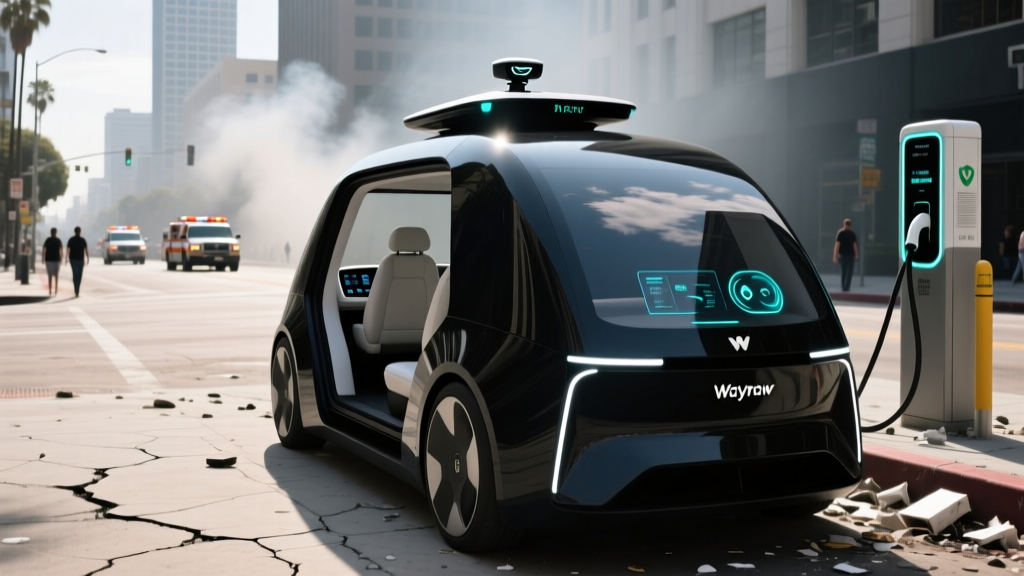
During the civil unrest that swept parts of Los Angeles in June 2025, Waymo's robotaxi fleet became an unexpected casualty. According to Reuters reporting and statements from Waymo, approximately 30 to 35 Waymo vehicles were vandalized, damaged, or destroyed by fire across multiple locations in the LA metro area. The majority of the damage occurred at a surface parking lot in downtown Los Angeles where Waymo staged vehicles between shifts.
Key facts about the incidents:
- Vehicles affected: Estimated 30–35 Jaguar I-PACE robotaxis (out of a LA fleet numbering in the low hundreds at the time)
- Damage type: Arson, vandalism, sensor destruction — not collisions or autonomous system failures
- Injuries: None — the vehicles were unoccupied and parked when damaged
- Service disruption: Waymo temporarily suspended LA operations for approximately 48 hours before resuming with a reduced fleet
- Root cause: Civil unrest and targeted property destruction, not technology failure
Understanding SAE Automation Levels: Why Robotaxis Are Different
To properly evaluate the LA incidents and Waymo's safety profile, it's essential to distinguish between the SAE automation levels. Consumer vehicles like Teslas with FSD (Supervised) or GM vehicles with Super Cruise operate at SAE Level 2 — the human driver must remain engaged and is legally responsible. Waymo and Zoox operate at SAE Level 4 — fully driverless within a defined operational design domain (ODD), with no human behind the wheel.
| Level | Name | Driver Required? | Examples |
|---|---|---|---|
| Level 2 | Partial Automation | Yes — full-time supervision | Tesla Autopilot/FSD, GM Super Cruise, Ford BlueCruise |
| Level 3 | Conditional Automation | Yes — must be available to take over | Mercedes DRIVE PILOT (limited markets/conditions) |
| Level 4 | High Automation | No — fully driverless in ODD | Waymo One, Zoox (limited areas) |
| Level 5 | Full Automation | No — any condition, any location | Does not exist commercially |
This distinction is critical: when we discuss Waymo's safety record, we're evaluating a system where no human backup exists. The vehicle must handle every scenario within its geofenced area or execute a safe pullover. That's a fundamentally different engineering challenge than Level 2 driver-assist.
Where Can You Use Waymo Right Now?
As of early 2026, Waymo One — the company's commercial ride-hailing service — operates in a defined set of metro areas. Expansion continues, but each new city requires regulatory approval, mapping, and fleet staging infrastructure.
| City | Status | Coverage Area | Vehicle |
|---|---|---|---|
| Phoenix, AZ | Fully operational | ~315 sq mi (metro-wide) | Jaguar I-PACE / Zeekr RT |
| San Francisco, CA | Fully operational | City-wide + select suburbs | Jaguar I-PACE / Zeekr RT |
| Los Angeles, CA | Operational (post-recovery) | Downtown, Hollywood, Westside, Valley | Jaguar I-PACE / Zeekr RT |
| Austin, TX | Operational | Central + expanding | Zeekr RT |
| Atlanta, GA | Limited launch (partner: Uber) | Select zones | Hyundai Ioniq 5 / Zeekr RT |
Waymo's geofencing means rides can only originate and terminate within mapped zones. You cannot, for example, hail a Waymo from downtown LA to San Diego. The system is designed for dense urban and suburban corridors, not long-haul or rural travel.
Waymo's Safety Record: The Data Behind the Headlines
The LA vehicle burnings were a property-loss event, not a driving-safety event. To evaluate Waymo's actual road safety, we need to look at collision data, intervention rates, and comparative benchmarks.
• Total autonomous miles driven: Over 50 million fully driverless miles (cumulative across all cities)
• Injury-causing collision rate: Approximately 85% lower than human benchmarks in comparable urban environments (per Waymo's published safety data)
• Fatality record: Zero passenger fatalities attributed to the autonomous system as of early 2026
• NHTSA standing orders: All Level 4 operators must report crashes within 24 hours — Waymo has complied, with most reported incidents involving other human-driven vehicles striking the robotaxi
According to data submitted to the National Highway Traffic Safety Administration (NHTSA), the majority of collisions involving Waymo vehicles are low-speed incidents where another party (a human driver, cyclist, or pedestrian) is the primary contributing factor. Waymo's sensor suite — combining lidar, radar, and cameras — provides 360-degree perception that doesn't fatigue, get distracted, or drive impaired.
However, edge cases remain. Waymo vehicles have been documented:
- Striking stationary objects in construction zones with shifted lane markings
- Experiencing delays in recognizing emergency vehicles parked at unusual angles
- Struggling in severe weather (heavy rain, fog) that degrades lidar and camera performance
How Much Does Waymo Cost vs. Uber and Lyft?
One of the most common questions from prospective robotaxi riders is whether the experience costs more or less than a traditional rideshare. In 2026, Waymo One pricing is broadly competitive with Uber and Lyft — sometimes cheaper, sometimes slightly more expensive depending on demand and distance.
| Service | Base Fare Range | Surge Pricing? | Tipping |
|---|---|---|---|
| Waymo One | $9 – $16 | Yes (demand-based) | In-app, optional |
| UberX | $10 – $18 | Yes | Expected |
| Lyft | $10 – $17 | Yes | Expected |
Using Waymo is straightforward: download the Waymo One app (or request via Uber in select partner markets), enter your pickup and drop-off, and a vehicle arrives — no driver to rate, no conversation required. The in-app experience includes real-time route tracking, a "pull over" button, and direct support chat.
Waymo's Technology Stack: How a Level 4 Robotaxi Sees the World
Unlike Tesla's camera-only approach to autonomy, Waymo relies on a multi-sensor fusion architecture. Every vehicle in the fleet carries a redundant suite of perception hardware designed to function across diverse lighting, weather, and traffic conditions.
Waymo 6th-Generation Sensor Suite (Zeekr RT & Jaguar I-PACE)
- Lidar: Custom-built, roof-mounted units providing high-resolution 360° 3D point clouds — effective to ~500 meters in clear conditions
- Cameras: 29+ cameras covering all directions, including high-dynamic-range sensors for glare/low-light
- Radar: 6 radar units for velocity detection and performance in rain/fog where lidar degrades
- Audio detection: External microphones to detect sirens from emergency vehicles
- Compute: Custom AI inference hardware processing sensor data in real time at the vehicle edge
- HD Mapping: Centimeter-precision pre-mapped environments — the system knows every lane, curb, and signal before it arrives
The reliance on HD mapping and geofencing is both Waymo's strength and its constraint. The system performs exceptionally well within its mapped domain because it has prior knowledge of the environment. But this means Waymo cannot simply "drive anywhere" — each new neighborhood requires extensive mapping, validation, and regulatory approval before the service can launch there.
Regulatory Landscape: Who Approves Robotaxi Operations?
Robotaxi deployment in the United States is governed by a patchwork of state and local regulations — there is no single federal license to operate a driverless vehicle commercially.
- California: The California DMV and the California Public Utilities Commission (CPUC) jointly regulate testing and commercial deployment. The CPUC issues permits for driverless commercial passenger service.
- Arizona: Among the most permissive regulatory environments. Waymo has operated commercially in Phoenix since 2020 with relatively few restrictions.
- Texas: Austin allows robotaxi operations under a local permitting framework; state-level regulation is evolving.
- Federal (NHTSA): Oversees vehicle safety standards and crash reporting but does not directly approve or deny robotaxi service launches. NHTSA's Standing General Order requires all ADS-equipped vehicles to report crashes.
Following the 2023 Cruise incident in San Francisco (where a pedestrian was dragged by a robotaxi), several jurisdictions tightened oversight. California temporarily suspended Cruise's permit, and the company subsequently restructured its operations. This regulatory environment means Waymo's expansion pace is governed as much by political and bureaucratic factors as by technology readiness.
Current Limitations: Where Robotaxis Still Fall Short
What Waymo Cannot Do Today
- Severe weather: Heavy rain, snow, dense fog, and ice degrade sensor performance — service may be suspended or routes restricted
- Unmapped areas: The vehicle cannot operate outside its geofenced zone, even if the destination is only a few blocks beyond the boundary
- Construction zones: Rapidly shifting lane configurations and temporary signage can confuse the system, leading to conservative behavior or pullovers
- Complex unprompted interactions: Hand signals from a police officer directing traffic, informal negotiation with other drivers at a 4-way stop — these remain challenging edge cases
- Highway driving: Most Waymo operations focus on surface streets; high-speed highway routing is limited or unavailable in many markets
- Accessibility: While vehicles are equipped with features for riders with disabilities, the wheelchair-accessible vehicle option remains limited in availability
- Vandalism and physical security: As the LA incidents demonstrated, parked and staged fleets are vulnerable to targeted property destruction — a risk unique to driverless operations without on-site human attendants
What the LA Burnings Mean for the Robotaxi Industry
The destruction of roughly 35 Waymo vehicles in Los Angeles was not a technology failure — it was a societal one. But it raised important questions for the industry:
- Fleet staging security: Robotaxi operators maintain staging lots where vehicles charge and await dispatch. These lots, often in industrial or downtown areas, became targets. Expect increased investment in physical security, surveillance, and distributed staging.
- Public perception: Self-driving vehicles are conspicuous — their sensor arrays make them easy to identify. In moments of civil unrest, they can become symbols of corporate presence or technological displacement, making them targets independent of their actual function.
- Insurance and fleet economics: While Waymo's parent company Alphabet can absorb the loss of 35 vehicles, smaller operators or those in earlier growth stages may face material financial impact from similar events. Fleet insurance premiums for robotaxi operators in high-risk urban areas may rise.
- Regulatory response: LA city officials and the CPUC reviewed operational protocols following the incidents, with discussions about whether robotaxi fleets should be required to have real-time remote monitoring of parked vehicles and expedited evacuation protocols.
For riders and prospective riders, the core takeaway is that the LA incidents did not reveal a flaw in Waymo's autonomous driving system. They revealed that any fleet of high-value, identifiable vehicles parked in urban lots is vulnerable during periods of civil unrest — a risk that applies equally to traditional rental car fleets, delivery vans, and rideshare driver vehicles.
Frequently Asked Questions
How many Waymo cars were burned in LA?
Approximately 30 to 35 Waymo vehicles were damaged or destroyed by fire during civil unrest in Los Angeles in June 2025. The vehicles were parked in staging lots and were unoccupied at the time. The incidents were acts of vandalism and arson, not autonomous system failures.
Is Waymo truly self-driving or is there a human driver?
Waymo operates at SAE Level 4, meaning the vehicles are fully driverless within their geofenced operational areas. There is no human driver in the vehicle. Remote assistance operators can provide guidance in edge cases, but they do not "drive" the vehicle in real time.
Where can I ride in a Waymo right now?
As of 2026, Waymo One is operational in Phoenix (AZ), San Francisco (CA), Los Angeles (CA), Austin (TX), and select zones in Atlanta (GA) via an Uber partnership. Each city has a defined geofenced service area.
How much does a Waymo ride cost?
Waymo One fares are competitive with Uber and Lyft — typically $9–$16 for a 5-mile urban ride, with demand-based surge pricing. There is no human driver to tip, though in-app tipping is available and optional.
Has anyone been killed in a Waymo robotaxi?
As of early 2026, there have been zero passenger fatalities attributed to Waymo's autonomous driving system. NHTSA crash reports show that most collisions involving Waymo vehicles are low-speed incidents caused by other road users.
Can Waymo drive in the rain or snow?
Waymo can operate in light to moderate rain, but heavy rain, snow, dense fog, and icy conditions can degrade lidar and camera performance. Service may be restricted or suspended during severe weather events.
What vehicles does Waymo use?
Waymo's current fleet primarily consists of the Jaguar I-PACE (an all-electric SUV with a 90 kWh battery and EPA-estimated 234-mile range) and the newer Zeekr RT, a purpose-built electric robotaxi designed in collaboration with Geely's Zeekr brand.
Is Waymo safer than a human driver?
Waymo's published data indicates its vehicles are involved in injury-causing collisions at approximately 85% lower rates than human benchmarks in comparable urban environments. However, this data covers geofenced, mapped urban areas — not all driving conditions.