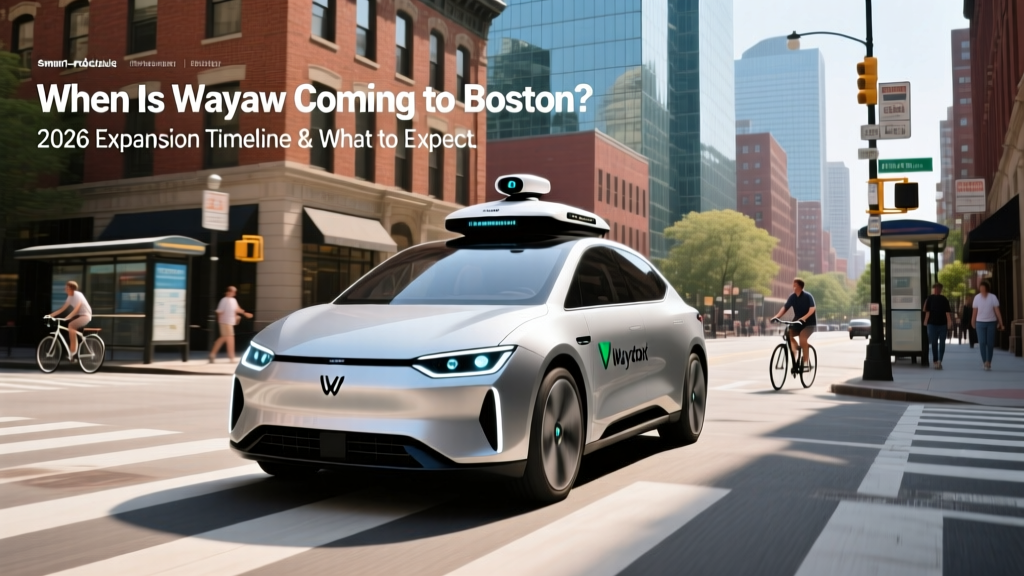
Boston is one of the most anticipated cities in Waymo's expansion roadmap — a dense, transit-rich metro with tech-savvy riders and a strong academic ecosystem. But if you've been searching for when Waymo is coming to Boston, the honest answer requires unpacking regulatory hurdles, weather challenges, and Waymo's phased rollout strategy. Here's what we know as of early 2026, grounded in confirmed announcements and real operational data — not speculation.
Where Waymo Operates Right Now (And Where It's Headed)
Before addressing Boston specifically, it's essential to understand Waymo's current footprint. The company has been methodically expanding its commercial robotaxi service, Waymo One, since its 2020 Phoenix launch.
| City | Status | Service Area Size | Hours | Launch Year |
|---|---|---|---|---|
| Phoenix, AZ | Fully operational | ~225 sq mi | 24/7 | 2020 |
| San Francisco, CA | Fully operational | ~47 sq mi (city core + expansion zones) | 24/7 | 2022 |
| Los Angeles, CA | Fully operational | ~80+ sq mi | 24/7 | 2023 |
| Austin, TX | Operational (expanding) | ~45+ sq mi | Limited hours → expanding | 2024 |
| Atlanta, GA | Announced / early testing | TBD | TBD | Expected 2025–2026 |
| Boston, MA | Not yet announced | N/A | N/A | TBD |
Waymo has prioritized Sun Belt and West Coast cities where weather conditions are more predictable, road layouts are grid-friendly, and state regulatory frameworks are established. Boston — with its narrow colonial-era streets, heavy snowfall, and complex multi-jurisdictional regulatory environment — represents a fundamentally different challenge.
So When Is Waymo Actually Coming to Boston?
As of early 2026, Waymo has not officially announced a Boston launch date. The company has not included Boston in its confirmed expansion roadmap, which currently focuses on Atlanta and additional California and Texas markets.
That doesn't mean Boston is off the table. Waymo's historical pattern suggests a city enters the pipeline roughly 18–24 months before commercial launch. The sequence typically follows:
- Mapping and data collection — Waymo vehicles drive the area in manual mode to build HD maps.
- Early testing with safety drivers — Autonomous operation with a human behind the wheel, limited geofence.
- Trusted Tester program — Select riders get free or discounted rides with no safety driver.
- Commercial launch (Waymo One) — Open to the public, paid service.
Boston has not publicly entered Phase 1 as of this writing. Based on Waymo's expansion cadence and the city's unique challenges, a realistic estimate for a commercial Boston launch would be 2027 at the earliest, more likely 2028 or beyond.
SAE Automation Level: What Waymo Actually Is
Waymo's robotaxi service operates at SAE Level 4 — meaning the vehicle handles all driving tasks within a defined operational design domain (geofenced area, specific conditions) with no human driver present. This is fundamentally different from Level 2 driver-assist systems like Tesla Autopilot or GM Super Cruise, which require continuous driver supervision. Waymo vehicles have no steering wheel accessible to passengers. Learn more about SAE automation levels from SAE International.
Why Boston Is a Harder Problem Than Phoenix or LA
Boston's absence from Waymo's near-term roadmap isn't an oversight — it reflects genuine technical and regulatory barriers that don't exist in the company's current markets.
Key Challenges for Boston Robotaxi Deployment
- Winter weather — Snow accumulation, ice, and slush obscure lane markings, reduce lidar/camera effectiveness, and alter road friction. Waymo's current fleet has limited cold-weather validation compared to Sun Belt operations.
- Road geometry — Boston's streets predate the automobile. Rotaries (notably the infamous rotary intersections), irregular lane configurations, and frequent construction zones present edge cases that require extensive mapping and validation.
- Dense mixed traffic — High concentrations of pedestrians, cyclists, double-parked delivery trucks, and MBTA buses create a chaotic environment that's orders of magnitude more complex than suburban Phoenix.
- Regulatory framework — Massachusetts has no comprehensive state-level autonomous vehicle deployment law comparable to Arizona's permissive framework or California's DMV/CPUC dual-permit system. Boston would likely require city-level approval from the Boston Transportation Department plus state-level action.
- Geofence complexity — A viable Boston service area would need to cover downtown, Back Bay, the Seaport, Cambridge (MIT/Harvard corridor), and potentially Logan Airport — each with distinct road characteristics.
Waymo's Technology Stack: What Would Need to Adapt
Understanding Waymo's sensor suite helps explain why Boston's environment poses specific challenges.
Waymo 6th-Generation Driver System
| Component | Specification | Boston Relevance |
|---|---|---|
| Lidar | Custom-designed, 360° coverage, ~200m+ range | Snow and heavy rain can attenuate lidar returns; requires algorithmic compensation |
| Cameras | High-resolution, multiple focal lengths, HDR | Lane markings obscured by snow/ice reduce camera-based localization accuracy |
| Radar | Imaging radar for velocity and object detection | Performs well in precipitation — a key redundancy for Boston winters |
| HD Maps | Centimeter-precision, frequently updated | Boston's frequent construction and seasonal road changes demand higher map-update frequency |
| Compute | Custom AI inference hardware, redundant systems | Edge-case density in Boston requires more complex real-time decision-making |
Unlike Tesla's camera-only approach, Waymo's multi-sensor fusion (lidar + camera + radar) provides redundancy that's particularly valuable in adverse weather. However, Waymo has acknowledged that heavy snowfall remains a limiting condition — the system will pull over safely rather than operate outside its confidence threshold. For Boston, this means service disruptions during and immediately after winter storms are likely.
What Will a Boston Waymo Ride Actually Cost?
While Boston pricing hasn't been announced, Waymo's pricing in existing markets provides a reliable framework. Waymo One uses dynamic pricing similar to rideshare, but with notable differences.
| Metric | Waymo One (Current Markets) | UberX (Comparable) | Lyft (Comparable) |
|---|---|---|---|
| Base fare (typical 5-mi trip) | $12–$18 | $11–$16 | $10–$15 |
| Surge pricing | Less aggressive than Uber/Lyft surge | Can 2–3x during peak | Can 1.5–2.5x during peak |
| Wait time | 3–8 min (varies by area/demand) | 2–6 min | 2–7 min |
| Tipping | Not expected (in-app option available) | Expected ($2–$5 typical) | Expected ($2–$5 typical) |
| Vehicle | Jaguar I-PACE (all-electric, premium) | Varies widely | Varies widely |
In practice, Waymo rides tend to be roughly comparable to UberX/Lyft pricing for standard trips, sometimes slightly higher during off-peak hours and notably lower during surge periods. The consistent vehicle quality (all Jaguar I-PACE electric SUVs) and absence of driver-interaction variability are value-adds that many riders cite as worth a small premium. For Boston, expect similar pricing dynamics — a downtown-to-Cambridge trip would likely run $14–$22 depending on demand.
How Safe Are Waymo Robotaxis? The Real Data
Safety is the most scrutinized aspect of robotaxi deployment. Waymo has published more operational data than any competitor, though independent third-party validation remains an evolving area.
Waymo Safety Record — Key Data Points
- Cumulative autonomous miles driven: Over 30 million fully driverless miles as of early 2026 (source: Waymo).
- Injury-critical crash rate: Waymo reports an 85% reduction in injury-causing crashes compared to human benchmark rates in comparable operating environments, based on internal analysis reviewed by third-party researchers.
- Contact rate: Property-damage-only contact incidents occur at roughly 0.4–0.6 per 100,000 autonomous miles — lower than human driver averages for urban environments.
- NHTSA standing general order: Waymo reports all incidents as required under NHTSA's Standing General Order for ADS-equipped vehicles. Most reported incidents involve low-speed contacts where the other party (human driver, cyclist, pedestrian) was the primary causative factor.
- Notable incidents: A small number of collisions with parked vehicles and one widely reported incident involving a pedestrian in San Francisco (2023) prompted operational adjustments. No fatalities have been attributed to Waymo's driverless operations.
For context, the NHTSA FARS database records approximately 1.35 fatalities per 100 million vehicle miles nationally. Waymo's driverless fleet has not recorded a fatality across its operational history — though the sample size (tens of millions of miles, not billions) means statistical equivalence claims require careful interpretation.
The Regulatory Landscape: Who Approves Robotaxi Service?
Robotaxi deployment in the U.S. is governed by a patchwork of state and local regulations. There is no single federal license for autonomous vehicle operations.
| Jurisdiction Level | Role | Boston/Massachusetts Status |
|---|---|---|
| Federal (NHTSA) | Vehicle safety standards, crash reporting mandates, defect investigations | Applies uniformly — Waymo's vehicle modifications require NHTSA exemptions (granted) |
| State (legislature + DMV/DOT) | Permits for testing and commercial deployment, insurance requirements | Massachusetts has no comprehensive AV commercial deployment law as of 2026. Testing permits exist but are limited. |
| City (Boston Transportation Dept.) | Local operating agreements, curb management, construction-zone data sharing | No known active engagement with Waymo |
| Insurance | Commercial liability coverage for driverless operations | Waymo self-insures and carries commercial policies; Massachusetts would set minimum requirements |
For Waymo to launch commercially in Boston, Massachusetts would likely need to pass legislation (or the Massachusetts DOT would need to establish a regulatory framework) explicitly permitting driverless commercial passenger service. This is the single biggest non-technical barrier. States like Arizona, California, and Texas have already built these frameworks; Massachusetts has been more cautious.
How to Use Waymo One (And What Boston Riders Should Prepare For)
When Waymo does eventually reach Boston, the rider experience will mirror the current app-based flow used in live markets:
- Download the Waymo One app (iOS/Android) and create an account with a payment method.
- Enter your pickup and destination — both must fall within the active geofence.
- Confirm the ride — the app shows an estimated wait time, vehicle location, and fare estimate.
- Unlock the vehicle — when the car arrives, the app prompts you to unlock the doors (verified by the vehicle's exterior cameras confirming you're the rider).
- Ride — the vehicle is fully autonomous. An in-screen display shows the route, speed, and detected objects. Music and climate controls are available.
- Arrival — the vehicle pulls to the curb, doors unlock, and you exit. Payment is automatic.
Boston riders should note: Waymo currently cannot accommodate car seats, wheelchair-accessible vehicles, or multiple-stop trips in most markets. Pet policies vary. These limitations may evolve before a Boston launch.
Current Limitations: What Waymo Cannot Do (Anywhere, Including a Future Boston)
Operational Constraints That Will Apply to Boston
- Heavy snow and ice — Service will likely be suspended or geographically restricted during significant winter weather events. Expect 12–48 hour recovery windows after major storms while roads are cleared and maps are revalidated.
- Geofence boundaries — You cannot ride outside the mapped service area. A Boston geofence would likely exclude suburban areas initially.
- Highway driving — Waymo's current operations are primarily surface-street. Limited highway segments are included in some markets, but this capability expands slowly.
- Construction zones — Major, unmapped construction can trigger route rerouting or ride cancellation. Boston's perpetual construction environment (especially around the Seaport and I-90 corridor) would be a persistent challenge.
- Special events — Large-scale events (marathons, parades, protests) that alter road configurations may result in temporary service suspension in affected zones.
- No human override — Passengers cannot steer, brake, or direct the vehicle. If the system encounters an unresolvable situation, it will pull over safely and contact remote assistance.
Frequently Asked Questions
Is Waymo testing in Boston right now?
No. As of early 2026, Waymo has not been observed conducting mapping or testing operations in the Boston metropolitan area. The company has not announced Boston as a future market.
Could another robotaxi company launch in Boston before Waymo?
Possible, but unlikely in the near term. Cruise (GM) suspended nationwide operations in late 2023 and has been slowly resuming in limited markets. Zoox (Amazon) is focused on Las Vegas and the Bay Area. No major robotaxi operator has announced Boston plans, largely due to the regulatory and weather barriers described above.
Is Waymo truly self-driving, or is there a human involved?
Waymo One is SAE Level 4 — fully driverless within its geofenced service area. There is no human driver in the vehicle, and passengers cannot control the vehicle. Remote assistance operators can provide high-level guidance (e.g., confirming it's safe to proceed around an obstacle) but do not remotely drive the vehicle in real time.
How much would a Waymo ride cost in Boston?
Based on current market pricing, expect fares comparable to UberX/Lyft for standard trips — approximately $12–$22 for typical downtown-to-Cambridge or downtown-to-Seaport rides, with less surge volatility than traditional rideshare.
Will Waymo work in Boston winters?
Expect service limitations. Waymo's sensor suite handles light rain and moderate conditions well, but heavy snow, ice-covered roads, and obscured lane markings will likely trigger service suspensions. Boston riders should plan for Waymo as a fair-weather complement to the MBTA and traditional rideshare, not a full replacement during winter months.
What vehicle does Waymo use?
Waymo's current commercial fleet consists exclusively of the Jaguar I-PACE, an all-electric SUV with a 90 kWh battery pack and approximately 234 miles of EPA range. The 6th-generation Waymo Driver system is integrated into the vehicle's roof rack, front grille, and rear bumper housing lidar, cameras, and radar sensors. Waymo has announced a future partnership with Geely/Zeekr for a purpose-built robotaxi vehicle, but it is not yet in commercial service.