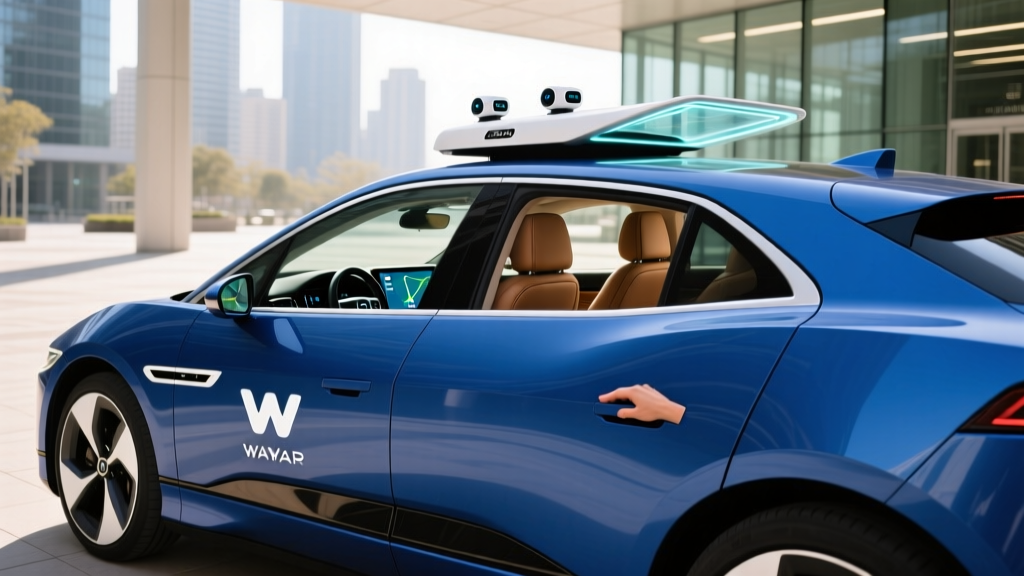
If you've seen a white Jaguar I-PACE covered in spinning sensors gliding through Phoenix or San Francisco traffic with no one behind the wheel, you've seen what riders colloquially call the "Waymo blue car." The nickname comes from Waymo's signature blue branding and the teal-blue accents on its fifth-generation autonomous vehicle fleet. But beyond the viral dashcam clips, what is it actually like to hail, ride in, and trust a Level 4 robotaxi in 2026?
This guide breaks down the real operational details of Waymo One — the consumer ride-hailing service powered by those sensor-laden Jaguars — including exactly where you can use it, what it costs compared to Uber and Lyft, the safety data behind millions of driverless miles, and the hard limitations that still define robotaxi travel today.
What the Waymo Blue Car Actually Is: Jaguar I-PACE, Fully Autonomous
The vehicle behind the "Waymo blue car" nickname is a Jaguar I-PACE — the British automaker's all-electric luxury crossover — heavily modified with Waymo's proprietary fifth-generation sensor suite, called the Waymo Driver. Jaguar has manufactured these I-PACE units to Waymo's specifications at its Graz, Austria plant since 2018, and thousands have been built specifically for Waymo's fleet.
Under the skin, these aren't stock I-PACE models. While they share the same 90 kWh battery pack and dual-motor all-wheel-drive powertrain (394 hp, 0-60 mph in roughly 4.5 seconds), Waymo strips the interior of driver controls in some test variants and outfits every vehicle with a redundant computing and actuation system. If a primary steering or braking module fails, a secondary system takes over instantly — a requirement for operating without a human behind the wheel.
Waymo One operates at SAE Level 4 within its geofenced service areas. This means the vehicle handles all driving tasks — steering, braking, navigation, lane changes, unprotected left turns — with zero human intervention required. There is no driver in the front seat. This is fundamentally different from Level 2 systems like Tesla Autopilot, GM Super Cruise, or Ford BlueCruise, which require an attentive driver at all times. Level 4 autonomy is real, but it's geographically constrained.
Where Can I Ride the Waymo Blue Car Right Now?
As of early 2026, Waymo One is commercially operational in several major U.S. metros, though service areas within those cities are geofenced — meaning the car will only operate inside approved zones that Waymo has extensively mapped and validated.
| City | Status | Service Area Notes | Hours |
|---|---|---|---|
| Phoenix, AZ (Metro) | Fully operational | Chandler, Tempe, Mesa, Scottsdale, downtown Phoenix, Sky Harbor Airport | 24/7 |
| San Francisco, CA | Fully operational | Most of SF proper including downtown, Sunset, Richmond; limited highway routes | 24/7 |
| Los Angeles, CA | Fully operational | Santa Monica, Beverly Hills, West Hollywood, downtown LA, Hollywood, LAX routes | 24/7 |
| Austin, TX | Operational (expanding) | Central Austin, South Austin, select suburban corridors | Extended hours |
How to get access: Waymo One is open to the general public in all four cities above — no waitlist as of late 2025. Simply download the Waymo One app (iOS/Android), create an account, and request a ride. In Phoenix, rides are available to anyone. In SF, LA, and Austin, access expanded fully after initial invite-only phases.
Where it's not available: Despite frequent rumors, Waymo One is not operational in New York, Chicago, Miami, Seattle, or any international city as of this writing. Waymo has tested in additional locations, but commercial driverless service requires state and local regulatory approval that takes years to secure.
How Much Does Waymo Cost vs. Uber and Lyft?
Waymo One uses dynamic pricing similar to rideshare platforms — fares vary based on distance, time of day, and demand. Based on rider reports and our own test rides in Phoenix and San Francisco, here's how pricing typically compares:
| Route | Distance | Waymo One | UberX | Lyft |
|---|---|---|---|---|
| Airport to downtown (PHX) | ~5 mi | $12–$18 | $14–$22 | $13–$20 |
| Cross-town SF (Sunset → FiDi) | ~8 mi | $22–$32 | $20–$35 | $18–$30 |
| Short hop (downtown LA, 2 mi) | ~2 mi | $8–$12 | $9–$14 | $8–$13 |
| Suburban trip (Chandler → Mesa) | ~12 mi | $28–$38 | $25–$40 | $24–$38 |
Key takeaways:
- Waymo is generally price-competitive with UberX and Lyft — sometimes slightly cheaper on short trips, sometimes slightly more expensive during peak demand.
- Waymo does not currently use surge pricing as aggressively as Uber/Lyft, though wait times can increase during high-demand periods.
- There's no tipping expectation (there's no driver to tip), though the app does offer a tipping option that goes to Waymo's rider support team.
- Waymo occasionally offers promotional credits for new riders, typically $5–$15 off first rides.
Safety Record: What the Real Data Shows
This is the question that matters most: are robotaxis actually safe? Waymo has published peer-reviewed safety data and submitted incident reports to the National Highway Traffic Safety Administration (NHTSA). Here's what the numbers say.
- Total fully driverless miles driven: Over 30 million miles (as of late 2025)
- Injury-causing crash rate: 85% lower than human benchmarks in comparable urban environments, per Waymo's published safety study co-authored with Swiss Re
- Police-reported crash rate: 57% lower than human benchmarks
- Most common incident type: Low-speed contact while stopped or at intersections — the vast majority causing no injuries
- NHTSA Standing General Order: Waymo reports all incidents under federal autonomous vehicle reporting requirements
Context that matters: Waymo's vehicles have been involved in incidents — no fleet of thousands of vehicles driving millions of miles in dense urban environments avoids all contact. However, the data consistently shows that Waymo vehicles are involved in fewer injury-causing crashes per million miles than human drivers in the same cities. The Swiss Re study used insurance claims data as a benchmark, which is considered one of the most rigorous comparison methodologies available.
It's also worth noting that Waymo vehicles occasionally exhibit overly cautious behavior — stopping unexpectedly, pulling over when uncertain, or taking longer routes to avoid complex intersections. This "over-caution" is a deliberate engineering choice: Waymo prefers a slightly inconvenient ride to an unsafe one.
Technology Stack: Lidar, Cameras, and Radar Working Together
Unlike Tesla's camera-only approach to autonomy, Waymo uses a multi-sensor fusion architecture that combines three complementary sensing technologies:
Waymo Driver — 5th Generation Sensor Suite
| Sensor Type | Function | Range/Detail |
|---|---|---|
| Lidar (custom-built) | 3D spatial mapping; detects shape, distance, and movement of all objects | 500+ meter range; generates millions of data points per second |
| Cameras (multiple) | Color vision; reads traffic lights, signs, lane markings, pedestrian signals | High-resolution, 360° coverage; optimized for varied lighting |
| Radar (imaging radar) | Velocity detection; performs in rain, fog, dust where lidar/cameras degrade | Long-range object tracking; works in adverse weather |
| Audio sensors | Detects sirens from emergency vehicles | Directional; triggers pull-over protocol |
All sensor data feeds into Waymo's custom-built onboard computers running the Waymo Driver software stack, which includes perception (what's around the car), prediction (what those objects will do next), and planning (what the car should do). The system also relies on HD maps — centimeter-accurate 3D maps of every street in the service area — which are updated regularly.
Why this matters vs. camera-only approaches: Lidar gives Waymo a direct measurement of distance and 3D shape that cameras must infer computationally. This redundancy is critical for Level 4 operation where there's no human to fall back on. The tradeoff is cost — each Waymo-equipped Jaguar carries an estimated $100,000+ in sensor and computing hardware, though Waymo has driven per-unit costs down significantly across generations.
Geofencing is part of the tech stack: Waymo doesn't operate just anywhere. Every road in the service area is pre-mapped, validated, and approved. If you request a pickup or drop-off outside the geofence, the app won't allow it. If a vehicle encounters construction or an unmapped road closure, it will pull over safely and request remote guidance from Waymo's fleet response team.
Regulatory Landscape: Who Approves Robotaxi Operations?
Robotaxi deployment in the United States is governed by a patchwork of state and local regulations — there is no single federal "robotaxi license." Here's the regulatory framework that allows Waymo to operate:
- Arizona: The most permissive regulatory environment. Governor Doug Ducey's 2015 executive order opened the state to autonomous vehicle testing without special permits, and this framework has continued. Waymo has operated commercially in Phoenix since 2020. The Arizona Department of Transportation oversees general vehicle registration and safety.
- California: The California Public Utilities Commission (CPUC) issues permits for commercial autonomous ride-hailing. The California DMV issues separate testing and deployment permits. Waymo holds both a DMV Driverless Testing Permit and a CPUC commercial deployment permit. California also requires detailed incident reporting and quarterly safety disclosures.
- Texas: Austin has welcomed autonomous vehicle operations with relatively light regulation. Texas state law (HB 3026, passed in 2023) established a framework for autonomous vehicle operation, and local authorities manage road-use agreements.
- Federal (NHTSA): The National Highway Traffic Safety Administration requires all ADS-equipped vehicles to report crashes under the Standing General Order (issued 2021, updated since). NHTSA does not currently "approve" robotaxi systems but can issue recalls or investigations. The NHTSA AV safety portal tracks all reported incidents.
The bottom line: Expanding to a new city typically takes Waymo 1–3 years of mapping, testing, regulatory negotiation, and phased rollout. This is why the service footprint grows slowly despite the company's resources.
Current Limitations: What Waymo Cannot Do
Level 4 autonomy is genuinely impressive, but it has hard boundaries. Understanding these limitations is essential before you book a ride.
Waymo One — Known Limitations (2026)
- Geofencing: Cannot operate outside approved service zones. No rural roads, no unmapped areas, no intercity highway trips beyond specific approved corridors.
- Heavy weather: Service may be suspended or restricted during heavy rain, dense fog, or flooding. Waymo's sensors handle light rain well, but extreme precipitation degrades lidar and camera performance. Phoenix's monsoon season and SF's fog can trigger service pauses.
- Construction zones: Major, unmapped construction can confuse the system. Waymo vehicles may pull over and request remote assistance rather than navigate through barrel-lined lane shifts.
- Parking lots and garages: Pickups and drop-offs are street-side only. Waymo will not navigate through parking structures or private lots.
- Complex multi-point turns: While Waymo handles most intersections, extremely tight or unusual road configurations may trigger a more conservative routing or a pull-over.
- No highway merging (most areas): In most cities, Waymo avoids high-speed freeway driving. Some approved highway segments exist (e.g., specific Phoenix freeway routes to the airport), but this is not the norm.
- Accessibility: Waymo has been working on wheelchair-accessible vehicles and features for visually impaired riders, but the current Jaguar I-PACE fleet is not wheelchair accessible. Ramp-equipped vehicles have been announced for future deployment.
- Passenger capacity: Maximum 3 riders in the back seat. No front-seat passenger (the driver's seat is empty or occupied by monitoring equipment).
The Ride Experience: What It's Actually Like Inside
Stepping into a Waymo Jaguar I-PACE for the first time is surreal. The driver's seat is empty — or in some fleet variants, occupied by a secured equipment rack. The rear seats have touchscreens on the back of the front seats that display your route, current speed, and a real-time visualization of what the car "sees" — other vehicles rendered as boxes, pedestrians as stick figures, cyclists as distinct icons.
The ride itself feels remarkably normal. The car accelerates smoothly, signals before lane changes, stops for yellow lights (often earlier than a human would), and navigates four-way stops with the patience of a driving-school instructor. The electric powertrain means near-silent operation, and the I-PACE's air suspension soaks up road imperfections.
You can control music and cabin temperature through the rear screens. A rider support line is accessible at any time via the screen or app if something feels wrong. If the car needs to pull over, it will explain why on the screen and connect you to support.
Frequently Asked Questions
Is the Waymo blue car truly self-driving, or is there a remote driver?
There is no driver in the vehicle — not in the car, not remotely controlling it in real-time. Waymo operates at SAE Level 4, meaning the onboard AI handles all driving decisions. A remote fleet response team can provide high-level guidance if the car encounters an ambiguous situation (like an unusual construction zone), but they do not steer or brake the vehicle. The car makes all real-time driving decisions autonomously.
How much does a Waymo ride cost compared to Uber or Lyft?
Waymo One pricing is broadly comparable to UberX and Lyft standard fares — typically within $2–$5 on most urban trips. Short trips (under 3 miles) often cost $8–$12. Airport runs typically fall in the $12–$25 range depending on distance. Waymo does not currently employ aggressive surge pricing, though availability may be limited during peak hours.
Can I use Waymo to get to the airport?
Yes, in cities where airport routes are within the geofence. Phoenix Sky Harbor (PHX) is fully served. Los Angeles International (LAX) service has been approved and is operational. San Francisco International (SFO) service availability depends on current geofence boundaries — check the app for your specific route.
What happens if the Waymo car gets confused or stuck?
The vehicle is programmed to pull over safely to the side of the road and contact Waymo's fleet response team. A remote agent can assess the situation and provide guidance — for example, confirming that a construction-zone cone pattern is safe to navigate through. The car will not proceed if it cannot verify a safe path. Riders can also contact support directly through the in-car screen at any time.
Is Waymo safer than a human driver?
According to Waymo's peer-reviewed study with Swiss Re, Waymo's fully driverless vehicles showed an 85% reduction in injury-causing crashes and a 57% reduction in police-reported crashes compared to human benchmarks in comparable urban environments. This data covers over 30 million driverless miles. However, robotaxis operate in mapped, mostly urban environments and avoid the highest-risk scenarios (unmapped rural roads, extreme weather), so direct comparison to all human driving has caveats.
Can I bring luggage or a child seat?
The Jaguar I-PACE has a usable cargo area behind the rear seats, and you can bring standard luggage for airport trips. However, Waymo does not currently provide child safety seats, and installing your own in the vehicle is not supported. Children under a certain age/size may not ride without an appropriate restraint — check Waymo's rider policies in the app for current rules.
Will Waymo come to my city?
Waymo has signaled plans to expand to additional U.S. cities, but each new market requires 1–3 years of mapping, testing, and regulatory approval. Cities like Atlanta, Miami, and others have been mentioned in various contexts, but no firm public timelines have been confirmed for markets beyond the current four. Follow Waymo's official site for announcements.
The Bottom Line: Who Should Ride the Waymo Blue Car?
If you live in or visit Phoenix, San Francisco, Los Angeles, or Austin, the Waymo blue car — the Jaguar I-PACE robotaxi — is a genuinely usable, competitively priced transportation option today. It's not a concept, not a demo, and not a promise: it's a commercial service completing hundreds of thousands of paid rides per week with no one behind the wheel.
For EV enthusiasts specifically, the experience also doubles as a ride in a luxury electric crossover with 90 kWh of battery capacity and silent, smooth acceleration — though you're too busy watching the empty driver's seat to appreciate the I-PACE's 234-mile EPA range.
The limitations are real: geofencing means you can't use it everywhere, heavy weather can pause service, and the fleet isn't yet wheelchair accessible. But for the routes it covers, Waymo One represents the most advanced commercially available autonomous vehicle service in the world as of 2026 — and it costs about the same as calling an Uber.