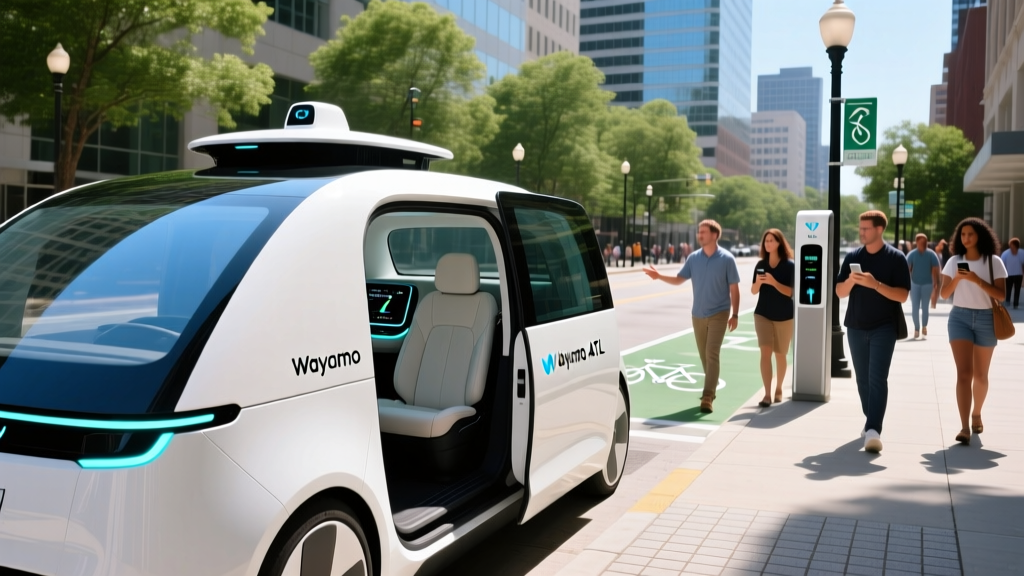
If you have been searching for information on Waymo ATL, you are likely trying to determine whether Waymo's driverless robotaxi service is available in Atlanta, how to hail one, and whether it is genuinely safe and affordable compared to traditional rideshare. This guide covers the operational reality of Waymo's Atlanta presence, the technology behind its vehicles, verified safety data, and the practical limitations every potential rider should understand before booking.
Is This Truly Self-Driving or Just Driver-Assist?
The distinction between consumer driver-assist systems and robotaxi services is the single most important concept to grasp before stepping into a Waymo vehicle. Waymo operates at SAE Level 4 — meaning the vehicle handles all driving tasks within a defined operational design domain (ODD) with no human driver behind the wheel, no steering wheel input expected, and no rider intervention required. This is fundamentally different from Level 2 systems like Tesla Autopilot, Ford BlueCruise, or GM Super Cruise, which require continuous driver supervision.
SAE Automation Levels: Where Waymo Sits
| SAE Level | Definition | Example |
|---|---|---|
| Level 0 | No automation | Traditional vehicle, no ADAS |
| Level 1 | Single-axis assist (steering OR speed) | Adaptive cruise control only |
| Level 2 | Combined assist (steering AND speed); driver must supervise | Tesla Autopilot, FSD Supervised, BlueCruise, Super Cruise |
| Level 3 | Conditional automation; driver on standby | Mercedes Drive Pilot (limited conditions) |
| Level 4 | High automation in defined ODD; no driver needed | Waymo One, Zoox (geofenced areas) |
| Level 5 | Full automation everywhere, all conditions | Does not yet exist commercially |
Source: SAE International J3016
When you ride in a Waymo, there is nobody in the driver's seat. The vehicle navigates, merges, handles intersections, and pulls over for emergencies autonomously within its mapped service area. This is not a promise of future capability — it is the current operational reality in cities where Waymo One is live.
Where Can I Use Waymo ATL Right Now?
Waymo's Atlanta operations have been in development through testing and early-access phases. The company began mapping and testing in the Atlanta metropolitan area, and service availability depends on regulatory approval from the Georgia Department of Public Safety and local jurisdictions. Waymo's rollout strategy follows a consistent pattern: extensive testing with safety drivers, followed by a Trusted Tester program (invite-only), and eventually full public access via the Waymo One app.
Waymo Service Availability by City (2026)
| City | Status | Service Area | Access |
|---|---|---|---|
| Phoenix, AZ | Fully operational | ~225 sq mi (Chandler, Tempe, Scottsdale, Phoenix downtown, Sky Harbor airport) | Open to public via Waymo One app |
| San Francisco, CA | Fully operational | City-wide with some zone restrictions | Open to public via Waymo One app |
| Los Angeles, CA | Operational (expanding) | Downtown LA, Hollywood, Santa Monica, Westside corridors | Open to public via Waymo One app |
| Atlanta, GA | Testing / early access | Select corridors under development | Trusted Tester / limited access |
| Austin, TX | Testing | Select zones | Trusted Tester |
Availability subject to change. Check the Waymo One app for real-time service boundaries.
For Atlanta specifically, riders should download the Waymo One app and check whether their pickup and drop-off locations fall within the active geofence. If Waymo ATL is still in Trusted Tester mode, you can join the waitlist through the app. Waymo typically prioritizes early access for residents within the initial service zone and expands outward based on operational performance data.
How to Hail a Waymo and What It Costs vs Uber/Lyft
Using Waymo is straightforward once you are in an active service zone:
- Download the Waymo One app (iOS/Android) and create an account with payment information.
- Enter your destination — the app confirms whether both pickup and drop-off are within the geofenced service area.
- Confirm your ride — the app provides an upfront price, estimated arrival time, and vehicle details.
- Locate your vehicle — the app shows the vehicle's approach in real time. When it arrives, the app prompts you to unlock the doors using a PIN displayed on-screen.
- Buckle up and press "Start Ride" on the rear-seat screen. The vehicle departs autonomously.
Estimated Pricing: Waymo vs Uber vs Lyft (5-Mile Trip)
| Service | Base Fare (est.) | 5-Mile Trip (est.) | Surge Pricing | Tip Expected? |
|---|---|---|---|---|
| Waymo One | ~$5-8 | $12-18 | No traditional surge; demand pricing limited | No (no driver) |
| UberX | ~$3-5 | $10-20 | Yes, can exceed 2x | Yes, ~15-20% |
| Lyft Standard | ~$3-5 | $10-19 | Yes, Prime Time pricing | Yes, ~15-20% |
Estimates based on Phoenix and San Francisco pricing data. Actual fares vary by city, time, and route. Waymo pricing is typically competitive with UberX/Lyft without tip factored in, and often cheaper during high-demand periods when rideshare surges.
A key economic advantage of Waymo: no tipping. With rideshare, a $15 trip becomes $18-20 after a 15-20% tip. Waymo's upfront pricing is the final price, which frequently makes it the cheaper option during peak hours when Uber and Lyft apply surge multipliers. Waymo also offers Waymo Pass subscription pricing in some markets, which can reduce per-ride costs for frequent riders.
How Safe Are Waymo Robotaxis? The Real Data
Safety is the most scrutinized aspect of robotaxi operations, and Waymo publishes more operational transparency data than any other Level 4 operator. As of early 2026, Waymo's fleet has accumulated over 30 million fully autonomous miles (no human behind the wheel) across its operational cities, with tens of millions more driven with safety operators during testing phases.
Waymo Safety Record: Key Data Points
- Total autonomous miles driven: 30+ million (driverless, no safety operator)
- Contacted property damage claims rate: ~57% lower than human benchmark in comparable urban driving environments (per Waymo's published safety analysis)
- Injury-causing crash rate: ~85% lower than human benchmark in Waymo's operating areas
- NHTSA Standing General Order compliance: All incidents reported per federal requirements for ADS-equipped vehicles
- Fleet vehicle: Jaguar I-PACE (all-electric, 90 kWh battery, ~292 HP) retrofitted with 6th-generation Waymo Driver sensor suite
Sources: NHTSA Automated Vehicle Safety, Waymo Safety Reports
Context matters here. Waymo operates primarily in dense urban environments where low-speed collisions (fender-benders, side-swipes at intersections) are common for all road users. The relevant comparison is not highway fatality statistics but urban driving benchmarks at comparable speeds. Waymo's data consistently shows lower rates of both property-damage and injury-causing incidents compared to human drivers in the same operating environments.
That said, Waymo vehicles have been involved in incidents — no transportation system is incident-free. Most reported events involve low-speed contact where the Waymo vehicle was rear-ended or side-swiped by a human driver. The NHTSA Standing General Order requires all automated driving system operators to report crashes, providing a public record that consumer driver-assist systems (Level 2) are not subject to in the same structured way.
Under the Hood: Waymo's Technology Stack
Waymo's approach to autonomous driving is sensor-dense and hardware-redundant — a fundamentally different philosophy from camera-only systems like Tesla's FSD. The 6th-generation Waymo Driver, installed on the Jaguar I-PACE fleet, integrates multiple sensor modalities to build a real-time 3D understanding of the environment.
Waymo 6th-Gen Sensor Suite
| Sensor Type | Role | Key Specs |
|---|---|---|
| LiDAR (multiple units) | 3D spatial mapping, object detection at range | 360° coverage, detection beyond 500m, custom-built |
| Cameras (multiple high-res) | Traffic light state, signage, lane markings, object classification | 360° visual coverage, HDR capability |
| Radar (multiple units) | Velocity detection, performance in rain/fog | All-weather object tracking |
| External audio sensors | Emergency vehicle siren detection | Directional siren classification |
| IMU + GPS + HD Maps | Precise localization within centimeters | Pre-mapped ODD with centimeter accuracy |
The critical differentiator is LiDAR. Unlike camera-only systems that must infer depth from 2D images, LiDAR directly measures the distance to objects by timing laser pulse reflections. This provides a precise 3D point cloud of the environment regardless of lighting conditions — a Waymo vehicle can "see" a pedestrian stepping off a curb at night just as effectively as at noon. The trade-off is cost and complexity: each Waymo vehicle carries hundreds of thousands of dollars in sensor hardware and compute, which is viable for a fleet operator but not for consumer vehicles at current pricing.
Waymo also relies on HD pre-mapped geofencing. Before any road is added to the service area, Waymo maps it at centimeter-level resolution, encoding lane geometry, traffic signal positions, crosswalk locations, and speed limits. The vehicle uses this map as a baseline understanding and layers real-time sensor data on top to detect dynamic changes (construction zones, stopped vehicles, pedestrians). This means Waymo cannot simply drive anywhere — it can only operate on roads it has mapped and approved.
Current Limitations: Where Waymo ATL Cannot Go
Understanding what Waymo cannot do is as important as understanding what it can. Level 4 autonomy means full self-driving within a defined Operational Design Domain — and those boundaries are strict.
Waymo Operational Limitations
- Geofence boundaries: Rides can only start and end within the mapped service zone. If your destination falls outside the zone, the app will not allow the booking.
- Heavy rain and flooding: While the 6th-gen system handles light-to-moderate rain, severe weather events (flash flooding, heavy downpours reducing visibility below operational thresholds) trigger service suspension in affected zones.
- Ice and snow: Waymo does not currently operate in snow or icy conditions. Atlanta's occasional winter ice events would suspend service.
- Construction zones: Major, unmapped road construction may cause the vehicle to reroute or, in some cases, safely pull over and request remote assistance.
- Highway driving: Waymo's current ODD includes some highway segments (e.g., airport runs in Phoenix), but many freeway scenarios remain outside the service area, particularly complex multi-lane interchanges at high speed.
- Unmapped roads: Subdivisions, private roads, parking garages, and any road not in Waymo's HD map are inaccessible.
- Remote assistance: In edge cases (unusual obstacles, complex detour scenarios), the vehicle may pause and connect to a remote guidance specialist who provides directional input — but does not remotely "drive" the car in real time.
For Atlanta riders specifically, the geofence is the most practical limitation. Waymo's initial Atlanta service area will likely cover a defined urban corridor — think Midtown, Downtown, Buckhead, and select connecting arterials — rather than the full metro sprawl. Suburban pickups in Marietta, Alpharetta, or Decatur may not be available at launch.
Regulatory Landscape: Who Approves Robotaxi Operations?
Robotaxi deployment in the United States requires navigating a patchwork of federal, state, and local regulations. Unlike consumer vehicles sold through dealerships (regulated primarily by NHTSA at the federal level), robotaxi operations are governed at the state level with local coordination.
At the federal level, NHTSA sets vehicle safety standards and requires crash reporting under the Standing General Order for all vehicles equipped with SAE Level 2 and above automated systems. However, NHTSA does not currently "approve" or "license" robotaxi services — that authority falls to individual states.
At the state level, Georgia has taken steps to establish a framework for autonomous vehicle testing and deployment. Key regulatory elements include:
- Georgia Code §40-6 provisions allowing autonomous vehicles to operate on public roads, provided they comply with all traffic laws and carry appropriate insurance.
- No safety driver mandate for vehicles meeting specific automation criteria, enabling fully driverless operations.
- Insurance requirements: Operators must carry minimum liability coverage (typically $1M+ per incident for commercial passenger service).
- Local coordination: City-level permitting for pickup/drop-off zones, curb management, and coordination with emergency services.
This state-by-state approach means Waymo's Atlanta launch timeline depends on completing regulatory engagement with Georgia authorities, the City of Atlanta, and potentially GDOT (Georgia Department of Transportation). Compare this to Arizona, where the state government took an explicitly permissive approach, enabling Waymo's Phoenix launch years ahead of more cautious jurisdictions like San Francisco, where the CPUC (California Public Utilities Commission) and DMV both held regulatory authority and imposed phased rollout requirements.
The Vehicle: Jaguar I-PACE Platform Specs
Waymo's current fleet vehicle is the Jaguar I-PACE, an all-electric crossover purpose-built in partnership with Jaguar Land Rover. Here are the platform specifications relevant to riders and EV-curious readers:
| Specification | Value |
|---|---|
| Battery capacity | 90 kWh (NMC chemistry) |
| EPA range (stock I-PACE) | ~234 miles (reduced in Waymo config due to sensor power draw and added weight) |
| Powertrain | Dual-motor AWD, ~292 HP / 512 lb-ft torque |
| 0-60 mph | ~4.5 seconds (stock; Waymo config is heavier) |
| DC fast charging | Up to 100 kW peak (10-80% in ~45 min) |
| Waymo sensor suite weight (est.) | ~150-200 lbs added |
| Operational charging strategy | Fleet depot charging, opportunity top-ups between rides |
The I-PACE was selected for its smooth ride quality, quiet cabin (important for rider experience with no driver to interact with), and platform compatibility with Waymo's sensor integration requirements. Waymo has announced that its next-generation vehicle, developed in partnership with Chinese automaker BYD and Geely's Zeekr brand, will feature a purpose-built robotaxi design without a steering wheel or pedals — though that vehicle is not yet in commercial service as of 2026.
Frequently Asked Questions About Waymo ATL
Can anyone ride a Waymo in Atlanta right now?
Access depends on Waymo's current rollout phase in Atlanta. If the service is in Trusted Tester mode, you need an invitation or waitlist position. Once Waymo ATL opens to the public, any user with the Waymo One app and a valid payment method can request rides within the geofenced service area. Check the app for real-time availability.
Is a Waymo ride cheaper than Uber or Lyft?
Waymo's pricing is generally competitive with UberX and Lyft Standard base fares. The advantage becomes significant during surge/Prime Time periods, when Waymo typically does not apply the same multipliers. Additionally, there is no driver to tip, which saves $3-5 on a typical $15 ride. For a standard off-peak trip, expect comparable or slightly lower pricing than rideshare.
What happens if the Waymo vehicle encounters an emergency?
The vehicle is programmed to execute a Minimal Risk Condition (MRC) maneuver — typically a controlled pull-over to the side of the road with hazard lights activated. Riders can contact Waymo support via an in-app button or the rear-seat screen at any time. Remote guidance specialists can provide directional input to help the vehicle navigate unusual situations, but they do not control steering or braking in real time.
Does Waymo operate in rain?
Yes, in light to moderate rain. The 6th-generation sensor suite with its multi-modal approach (LiDAR + radar + cameras) handles precipitation better than earlier generations. However, severe weather events — heavy downpours, flash flooding, ice storms — will trigger service suspension in affected zones. Atlanta's occasional winter ice events would likely pause operations.
How is Waymo different from Tesla's Full Self-Driving?
They are fundamentally different categories. Tesla FSD (Supervised) is an SAE Level 2 driver-assist system that requires the driver to remain fully engaged, hands near the wheel, eyes on the road, ready to take over at any moment. Waymo is SAE Level 4 — there is no driver, no steering wheel input needed, and no rider supervision required within the geofenced area. Tesla FSD can theoretically drive on any road; Waymo can only drive on pre-mapped, approved roads. Tesla's approach is camera-only; Waymo uses LiDAR, radar, cameras, and HD maps together.
Can I request a specific route or make stops?
Waymo selects the route autonomously based on real-time traffic conditions and its operational mapping. You cannot manually choose a route. Multi-stop trips are supported in some markets — check the app for availability. You cannot ask the vehicle to stop at an arbitrary location outside of the booked destination.
What if I leave something in the Waymo vehicle?
After each ride, the vehicle's interior cameras scan the cabin for left-behind items. If something is detected, Waymo support contacts you. You can also report lost items through the app. Waymo coordinates item recovery, typically at a local operations hub.
Bottom Line for Atlanta Riders
Waymo ATL represents the expansion of the most mature Level 4 robotaxi service in the United States into a new major metro market. For Atlanta residents and visitors, the practical value proposition is straightforward: competitive pricing with rideshare, no surge multipliers, no tipping, and a safety record that data shows is stronger than the human driving benchmark in comparable urban conditions.
The limitations are equally real: geofenced service areas mean you cannot hail a Waymo to every destination, weather restrictions apply during severe conditions, and the service area at launch will cover a fraction of metro Atlanta. For airport runs, downtown-to-Midtown commutes, and evening trips within the urban core, Waymo ATL is positioned to become a practical daily transportation option — not a technology demo, but a fare-competitive, safety-verified mobility service.
Download the Waymo One app, check your address against the service map, and join the waitlist if you are in the initial coverage zone. The robotaxi future is not a concept car render — it is an app download away, one city at a time.