The Waymo Atlanta Launch: Where Things Stand
Waymo's expansion into Atlanta represents one of the most significant robotaxi deployments outside its legacy markets of Phoenix, San Francisco, and Los Angeles. The Waymo Atlanta launch brings the company's 6th-generation Waymo Driver hardware to a sprawling Sun Belt metro known for heavy congestion, complex highway interchanges, and unpredictable weather — a stress test unlike any the service has faced at scale.
This guide breaks down what riders can actually expect: where the cars operate, what a ride costs compared to Uber and Lyft, the safety data behind Waymo's claims, the sensor suite doing the driving, and the hard limitations that still apply. No hype — just the numbers and facts you need before hailing your first driverless ride in Georgia.
Is Waymo Truly Self-Driving? Understanding SAE Level 4
Before discussing the Atlanta deployment, it's essential to distinguish what Waymo is — and what it isn't. Consumer vehicles with features like Tesla Autopilot, Ford BlueCruise, or GM Super Cruise are SAE Level 2 driver-assistance systems. The driver must remain engaged, hands on or near the wheel, and is legally responsible for the vehicle at all times.
Waymo's robotaxi is fundamentally different. It operates at SAE Level 4 — high automation within a defined operational design domain (ODD). There is no driver in the vehicle, no steering wheel for a passenger to grab, and no expectation that a rider will intervene. If the system encounters a scenario it cannot handle, it is designed to execute a safe stop rather than hand control to an unprepared occupant.
| Level | Name | Who Drives? | Example |
|---|---|---|---|
| Level 0 | No Automation | Human | Standard car |
| Level 1 | Driver Assistance | Human + system assists | Adaptive cruise control |
| Level 2 | Partial Automation | Human (must supervise) | Autopilot, BlueCruise, Super Cruise |
| Level 3 | Conditional Automation | System (human on standby) | Mercedes Drive Pilot (limited markets) |
| Level 4 | High Automation | System (no human needed in ODD) | Waymo, Zoox robotaxi |
| Level 5 | Full Automation | System (all conditions) | Does not yet exist |
The critical constraint: Level 4 autonomy is geofenced. Waymo vehicles operate only within a mapped and approved service area under specific conditions. Outside that boundary — or in conditions that exceed the system's ODD — the service simply won't dispatch a car.
Where Can You Use Waymo in Atlanta Right Now?
Waymo's Atlanta service area covers a defined corridor rather than the entire metro. Based on Waymo's announced deployment footprint, the initial operational zone includes:
| Zone | Coverage | Status |
|---|---|---|
| Midtown / Buckhead | Peachtree corridor, Lenox, Atlantic Station | Live |
| Downtown / Old Fourth Ward | Centennial Park, Ponce City Market, BeltLine Eastside | Live |
| West Midtown / Howell Mill | Westside Provisions, Marietta Street corridor | Live |
| Virginia-Highland / Inman Park | Residential streets, Virginia Ave commercial strip | Live |
| Airport (ATL) | Hartsfield-Jackson curbside pickup | Announced — check app for availability |
| Decatur / Eastside suburbs | Limited coverage near Decatur Square | Expanding |
| Perimeter / Sandy Springs | Northern suburbs | Not yet available |
Atlanta is the first Waymo market where highway driving is a meaningful component of the service area from day one. The I-75/I-85 Connector and portions of the Downtown Connector are included in the geofence — a notable technical milestone, since merging onto a multi-lane interstate at 65+ mph is a far more demanding scenario than the surface-street driving that characterized Waymo's early Phoenix deployment.
To check live availability for your specific origin and destination, open the Waymo One app and enter your trip. If either endpoint falls outside the geofence, the app will tell you before you book.
How to Ride and What It Costs vs. Uber and Lyft
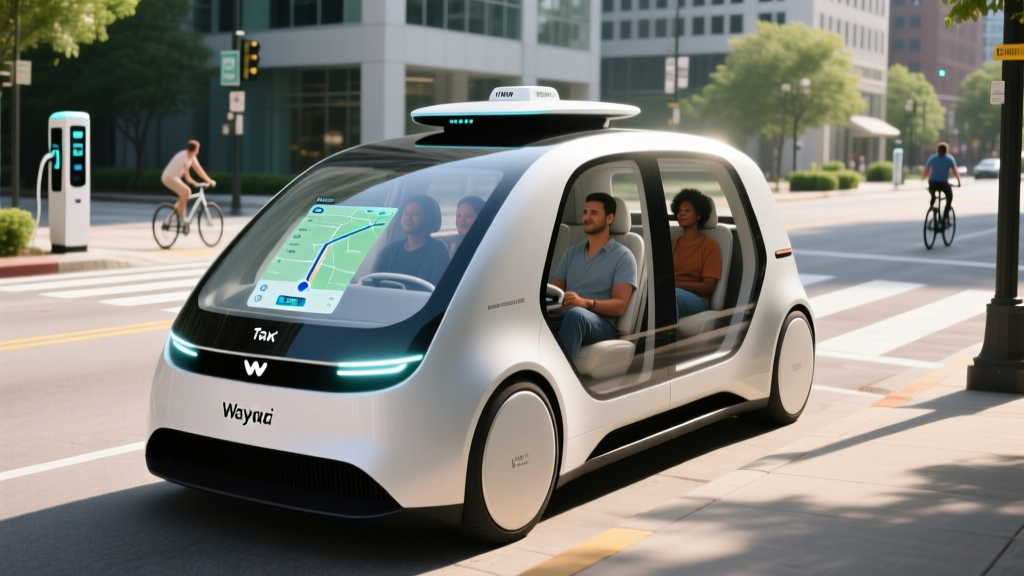
Booking a Waymo in Atlanta works identically to other markets. Download the Waymo One app, create an account, enter your pickup and dropoff, and confirm. The vehicle arrives driverless — you unlock it via the app, buckle up, and the ride begins. In-vehicle screens display your route, and you can pull over safely via a stop button if needed.
Pricing has been one of the biggest questions around the Waymo Atlanta launch. Here's how typical fares compare to traditional rideshare in the Atlanta market:
| Route (Approx.) | Distance | Waymo | UberX | Lyft Standard |
|---|---|---|---|---|
| Midtown → Buckhead (Lenox) | ~4 mi | $12–$16 | $11–$18 | $10–$17 |
| Downtown → Ponce City Market | ~2.5 mi | $9–$12 | $9–$14 | $8–$13 |
| Buckhead → Virginia-Highland | ~3 mi | $11–$14 | $10–$16 | $10–$15 |
| Midtown → West Midtown | ~2 mi | $8–$11 | $8–$13 | $8–$12 |
| Downtown → Decatur Square | ~6 mi | $16–$22 | $15–$24 | $14–$22 |
Pricing is approximate and subject to demand-based adjustments on all platforms. Waymo fares have generally been competitive with UberX/Lyft Standard, without the surge spikes common during peak hours on rideshare apps. Waymo does not currently offer a shared/pool option in Atlanta.
The key pricing insight: Waymo fares tend to be more predictable than rideshare. You won't see the 2.5x surge pricing that Uber and Lyft apply during concerts, Braves games, or rush hour. However, Waymo also doesn't offer budget tiers like Uber Share or Lyft Shared — every ride is a private, solo trip.
Safety Record: What the Data Actually Shows
Safety is the single most important question around any robotaxi deployment. Waymo has published the most extensive safety data of any autonomous vehicle operator, and the numbers are worth examining in detail.
- 30+ million fully autonomous (driverless) miles driven across all markets as of early 2026
- ~85% reduction in injury-causing crash rate compared to human baseline in comparable urban environments (per NHTSA-referenced Waymo safety reports)
- ~57% reduction in police-reported crash involvement vs. human drivers per million miles
- Contact rate: Most minor contacts occur at speeds below 10 mph (parking, low-speed maneuvering) and rarely result in injury
- Waymo publishes quarterly safety transparency reports available on its website
For context, human drivers in the U.S. experience approximately 1.3 fatal crashes per 100 million vehicle miles and roughly 50 injury-causing crashes per 100 million miles, according to NHTSA data. Waymo's reported rates in its operating cities are materially lower on both metrics, though the comparison requires careful framing: Waymo operates in geofenced, mapped areas and avoids conditions (heavy snow, unmapped construction zones) that human drivers routinely encounter.
Atlanta introduces new variables. The city's driving culture — aggressive lane changes, frequent unprotected left turns, and the notorious I-85 merge zones — will test Waymo's 6th-generation system in ways that Phoenix's grid-layout suburbs did not. Early riders should expect conservative driving behavior: Waymo vehicles tend to yield more often than a human driver would, maintain larger following distances, and occasionally pause at complex intersections while the system confirms its path is clear.
Per IIHS research on automated vehicle safety, the long-term promise of robotaxis rests on eliminating the factors behind ~94% of human-caused crashes: distraction, impairment, fatigue, and speeding. Waymo's system never texts, never drinks, never gets drowsy, and never exceeds posted speed limits. The trade-off is that the system can be overly cautious in ways that occasionally frustrate riders and, in rare cases, cause rear-end contacts when the Waymo stops more abruptly than a trailing human driver expects.
The Technology Stack: Lidar, Cameras, and the 6th-Gen Waymo Driver
Waymo's approach to autonomous driving is sensor-fusion heavy — a deliberate contrast to Tesla's camera-only (vision-only) philosophy. The 6th-generation Waymo Driver, which equips the vehicles deployed in Atlanta (currently based on the Zeekr M-Vision platform and Jaguar I-PACE), integrates:
| Sensor / Component | Specification | Purpose |
|---|---|---|
| Lidar | Custom-built, 360° long-range | Precise 3D mapping of surroundings to 500+ meters; works in darkness |
| Cameras | Multi-spectrum, 360° array | Traffic light state, signage, color detection, object classification |
| Radar | 4D imaging radar | Velocity detection of moving objects; performs in rain and fog |
| External audio sensors | Microphone array | Detects sirens from emergency vehicles by direction and distance |
| HD Maps | Centimeter-precision pre-mapped routes | Provides lane geometry, curb positions, speed limits in advance |
| Compute | Custom Waymo AI compute platform | Real-time sensor fusion, prediction, and path planning |
The lidar-first approach gives Waymo a significant advantage in depth perception and low-light performance. Where camera-only systems must infer distance from 2D images (a computationally harder problem), lidar directly measures distance via laser pulses. The trade-off is hardware cost and complexity — a Waymo vehicle's sensor suite is estimated to add $30,000–$50,000+ in hardware, which is viable for a fleet operator but not for consumer vehicles.
Geofencing is the other key technology component. Waymo doesn't attempt to drive everywhere. Its HD maps contain centimeter-level detail about every lane, crosswalk, and signalized intersection in the service area. When Atlanta adds a turn lane or changes signal timing, Waymo's mapping team updates the geofence before vehicles operate in that zone. This is why expansion is gradual — each new neighborhood must be mapped and validated before riders can book trips there.
Regulatory Landscape: Who Approves Robotaxi Operations?
Robotaxi deployment in the United States is governed by a patchwork of state and local regulations, not a single federal framework. In Georgia, the regulatory picture for the Waymo Atlanta launch looks like this:
- State level: Georgia passed autonomous vehicle legislation (HB 472, signed 2017) that permits the operation of fully autonomous vehicles on public roads without a human driver, provided the vehicle is registered, insured, and compliant with federal motor vehicle safety standards. This was a prerequisite for Waymo's entry.
- Federal level: The NHTSA retains authority over vehicle safety standards. Waymo vehicles must meet all applicable FMVSS requirements, though the agency has granted limited exemptions for vehicles without traditional controls (steering wheels, pedals) in specific deployments.
- City/county level: The City of Atlanta and Fulton County coordinate on curbside pickup/dropoff zones, parking enforcement exemptions, and first-responder protocols for interacting with driverless vehicles.
- Insurance: Waymo carries commercial insurance covering all rides. Riders are not liable for crashes or vehicle damage during a trip.
This regulatory environment is notably more permissive than California, where the CPUC and DMV both exercise oversight and where Waymo faced a suspension of its San Francisco operations in 2023 following incident reviews. Georgia's framework was designed to attract AV investment, and the result is a faster path to commercial deployment — though it also means less public reporting of incidents than California mandates.
Current Limitations: What Waymo Still Can't Do
Level 4 autonomy is impressive, but it is not Level 5. The Waymo Atlanta launch comes with real, practical limitations that riders should understand before booking:
- Heavy rain and thunderstorms: Atlanta's frequent afternoon thunderstorms can reduce lidar and camera performance. Waymo may pause service or restrict the geofence during severe weather events. Light rain is handled well; torrential downpours are a no-go.
- Unmapped construction zones: If a road within the geofence undergoes sudden lane reconfiguration (e.g., overnight barrier placement on Peachtree Street), Waymo may reroute or decline the trip until maps are updated.
- Geofence boundaries: You cannot ride from Midtown to Marietta, Alpharetta, or Newnan. If your destination falls outside the service area, the app will not let you book. Period.
- Airport service: ATL airport rides are announced but subject to separate airport authority agreements. Check the app for live availability — do not assume you can catch a Waymo to your 6 AM flight until confirmed.
- No stops mid-trip: You cannot ask the vehicle to stop at a convenience store or wait while you run an errand. It's point A to point B only.
- Limited cargo and accessibility: Current Waymo vehicles can accommodate standard luggage but are not wheelchair-accessible in all configurations. Service animal policies follow ADA requirements.
- Conservative driving: Expect the vehicle to drive at or below the speed limit, take wider turns than a human, and occasionally pause at unprotected left turns. This is by design — safety over speed — but it means your trip may take 10–15% longer than a rideshare with an aggressive driver.
The weather limitation deserves emphasis. Atlanta averages roughly 45 inches of rain annually, with heavy convective storms common from March through September. In Phoenix, Waymo rarely encounters weather that degrades sensor performance. In Atlanta, weather-related service interruptions will be a regular occurrence — not daily, but frequent enough that you should have a backup plan (Uber, Lyft, MARTA) for getting where you need to go.
Frequently Asked Questions
Where can I use Waymo in Atlanta right now?
The current service area covers Midtown, Buckhead, Downtown, Old Fourth Ward, West Midtown, and Virginia-Highland. Suburbs like Sandy Springs, Marietta, and Lawrenceville are not included. Use the Waymo One app to check specific addresses.
How much does a Waymo ride cost compared to Uber or Lyft?
Waymo fares in Atlanta are generally comparable to UberX and Lyft Standard — typically $8–$22 for rides within the service area. The main advantage is price stability: Waymo does not apply the aggressive surge multipliers that rideshare apps use during peak demand. However, Waymo does not offer shared-ride or budget tiers.
How safe are Waymo robotaxis?
Waymo has logged over 30 million fully driverless miles and reports injury-causing crash rates approximately 85% lower than human drivers in comparable urban settings, per data referenced in NHTSA filings. Most contacts that do occur are low-speed (under 10 mph) and non-injury. That said, Atlanta's complex traffic environment is new territory, and the long-term safety record there is still being established.
Is Waymo actually self-driving, or is there a remote driver?
There is no driver in the vehicle — not remote, not hidden. Waymo operates at SAE Level 4, meaning the AI system handles all driving tasks within its geofenced service area without any human intervention. Remote support staff can assist with routing decisions if the vehicle encounters an unusual scenario, but they do not steer, brake, or accelerate the vehicle.
What happens if the Waymo gets confused or stuck?
If the system encounters a scenario it cannot resolve (e.g., a completely blocked road with no alternate route within the geofence), it will pull over safely and contact Waymo's roadside assistance team. A human remote operator can provide high-level guidance (e.g., "proceed around the obstacle"), and if necessary, a physical response team will dispatch to the vehicle. Riders are never expected to take control.
Can I use Waymo to get to Hartsfield-Jackson Airport (ATL)?
Airport service has been announced as part of the Atlanta rollout, but availability depends on agreements with the airport authority. Check the Waymo One app before planning an airport trip — do not rely on it until you've confirmed a booking in the app.
Does Waymo operate at night?
Yes. Waymo's lidar and radar sensors are not dependent on visible light, so nighttime driving is well within the system's capability. Service hours in Atlanta typically run from early morning through late evening, though exact hours are set in the app.
Bottom Line: Should You Try Waymo in Atlanta?
The Waymo Atlanta launch is a genuine milestone — Level 4 driverless rides in one of America's most congested and complex driving environments. For short trips within the Midtown-Buckhead-Downtown corridor, the service offers a compelling alternative to rideshare: competitive pricing, no surge spikes, and a vehicle that will never be distracted, impaired, or fatigued.
The limitations are real. The geofence is tight, weather can disrupt service, and the conservative driving style means slightly longer trip times. This is not a replacement for a personal vehicle or even for Uber on longer suburban trips. But for the urban core — the commute from your Midtown apartment to a dinner reservation in Buckhead, or a ride from Ponce City Market to a conference Downtown — Waymo is ready, and the safety data supports taking that first ride with confidence.