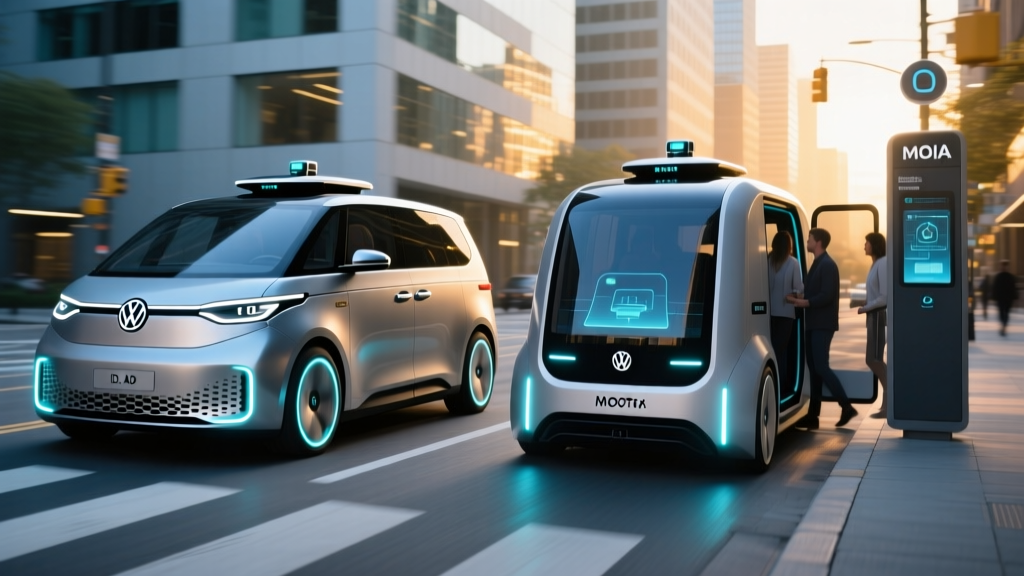
Volkswagen's path to autonomous driving doesn't look like Tesla's camera-only vision or Waymo's geofenced Phoenix suburbs. Instead, the VW self-driving car strategy routes through a boxy, retro-styled electric van — the ID. Buzz AD — and a ride-hailing subsidiary called MOIA. As of 2026, this robotaxi effort is live in limited European cities, with U.S. ambitions still in the testing phase. If you've been searching for what Volkswagen actually offers in autonomous mobility today, here's the data-driven breakdown.
What Level of Autonomy Does the VW Self-Driving Car Actually Have?
Before discussing where you can ride, we need to establish what the vehicle can and cannot do on its own. The ID. Buzz AD is engineered for SAE Level 4 autonomy — but only within tightly defined operational design domains (ODDs). That's a critical distinction.
SAE Automation Levels — What They Mean for VW:
- Level 2 (Driver Assist): The vehicle handles steering and acceleration, but the driver must remain engaged at all times. This is what Tesla Autopilot, FSD (Supervised), and VW's own Travel Assist offer in consumer vehicles.
- Level 3 (Conditional Automation): The car drives itself under specific conditions, and the driver can disengage but must be ready to resume control when prompted. Mercedes-Benz DRIVE PILOT is the primary example.
- Level 4 (High Automation): The vehicle operates without a human driver entirely, but only within a geofenced area under defined conditions. This is the ID. Buzz AD's target for robotaxi service.
- Level 5 (Full Automation): No geographic or weather restrictions. No production vehicle achieves this today.
The consumer ID. Buzz you can buy at a dealership is a Level 2 vehicle with Travel Assist — lane centering, adaptive cruise, and semi-automated lane changes on highways. The ID. Buzz AD (Autonomous Driving) variant is an entirely different machine, built exclusively for fleet operators and robotaxi services. You cannot purchase one for personal use.
Where Can You Use VW's Robotaxi Service Right Now?
MOIA, Volkswagen's mobility subsidiary, operates the ID. Buzz AD in commercial ride-hailing service in Hamburg, Germany, with driverless operations having launched in phases beginning in 2025. A second European deployment in Oslo, Norway, through a partnership with local operator Vy, entered limited service in late 2025.
| City | Status (2026) | Operator | Service Area | Hours |
|---|---|---|---|---|
| Hamburg, Germany | Commercial (driverless) | MOIA | ~120 km² geofenced zone covering central districts | 6 AM – midnight |
| Oslo, Norway | Limited commercial | MOIA / Vy | ~45 km² pilot zone | Daylight hours, fair weather |
| Munich, Germany | Testing (safety driver) | MOIA | Designated test corridors | Not public |
| United States | No announced timeline | N/A | N/A | N/A |
If you're in the U.S. and searching for a VW self-driving car to hail, the honest answer is: there is no available service. Volkswagen Group has not announced a U.S. robotaxi deployment timeline. The company's autonomous efforts remain Europe-focused, where regulatory frameworks under the EU's Automated Driving Act and Germany's Act on Autonomous Driving (in force since 2021) provide clearer legal pathways than the patchwork of U.S. state regulations.
The ID. Buzz AD Technology Stack: Lidar, Cameras, and Redundancy
The ID. Buzz AD doesn't rely on a single sensor philosophy. Unlike Tesla's camera-only approach or Waymo's heavily lidar-dependent stack, the VW robotaxi uses a multi-modal sensor fusion system developed in partnership with Mobileye and Volkswagen's own CARIAD software division.
Key Sensor and Compute Components:
- Lidar: Multiple solid-state lidar units providing 360° point-cloud mapping up to ~200 meters, essential for depth perception and object classification in complex urban scenes.
- Cameras: 11 high-resolution cameras covering surround view, traffic light detection, and lane marking recognition.
- Radar: Long-range and short-range radar arrays for velocity detection and adverse-weather redundancy.
- Ultrasonic sensors: Near-field obstacle detection for low-speed maneuvering and docking.
- HD Maps: Centimeter-precision pre-mapped routes within the geofenced ODD, continuously updated via fleet data.
- Compute: Mobileye EyeQ Ultra system-on-chip, delivering ~176 TOPS (trillions of operations per second) for real-time perception and planning.
- Redundancy: Dual-redundant braking, steering, and power systems so a single-point failure doesn't strand the vehicle in traffic.
This sensor-rich approach gives the ID. Buzz AD an edge in European urban environments, where narrow streets, mixed traffic (cars, bikes, trams, pedestrians), and unpredictable weather demand overlapping perception layers. The trade-off is cost: each ID. Buzz AD unit is estimated at well over $150,000 in sensor and compute hardware alone, making it viable only for high-utilization fleet operations.
How Safe Is VW's Robotaxi? Real-World Data
Safety is where robotaxi claims face the harshest scrutiny. MOIA and Volkswagen have published limited but concrete operational data from the Hamburg deployment.
MOIA ID. Buzz AD Safety Metrics (Hamburg, through Q4 2025):
- Total autonomous miles driven: ~1.2 million miles (combined testing and commercial operation)
- Disengagement rate: Approximately 0.8 disengagements per 1,000 miles during driverless commercial service (a disengagement being any instance where remote assistance or system-initiated pull-over occurred)
- At-fault collisions: 0 reported at-fault incidents during driverless commercial operation
- Total collisions: 2 minor contact incidents during the safety-driver testing phase (both low-speed, no injuries, attributed to other road users)
Sources: NHTSA standing general orders for ADS incident reporting; MOIA operational disclosures.
For context, Waymo's U.S. fleet reports disengagement rates between 0.1 and 0.5 per 1,000 miles depending on city complexity, across over 30 million driverless miles. VW's MOIA operation is roughly an order of magnitude smaller in scale, so direct comparison requires caution — smaller fleets naturally show higher variance. The Hamburg ODD is also comparatively well-structured: wide boulevards, clear lane markings, and less chaotic traffic than, say, downtown Mumbai or central Rome.
Germany's Federal Ministry for Digital and Transport (BMDT) oversees technical approval for Level 4 operations under the country's autonomous driving law, which mandates continuous data recording, remote supervision capability, and defined ODD parameters.
Pricing: MOIA Robotaxi vs. Uber and Traditional Rideshare
MOIA operates on a ride-pooling model rather than single-passenger hails — closer to Uber Pool or a micro-transit shuttle than a private UberX ride. This affects both pricing and convenience.
| Service | Base Fare | Per-km Rate | Avg. 5 km Ride | Pooling | Wait Time |
|---|---|---|---|---|---|
| MOIA (Hamburg) | €1.50 | €0.90/km | €6.00–€8.50 | Yes (up to 6 passengers) | 3–8 min |
| UberX (Hamburg) | €2.00 | €1.20/km | €8.00–€11.00 | No | 2–5 min |
| Uber Pool (Hamburg) | €1.50 | €0.85/km | €5.75–€7.50 | Yes (2–3 passengers) | 4–10 min |
| FREE NOW (Hamburg taxi) | €3.50 | €2.10/km | €14.00–€17.00 | No | 3–7 min |
MOIA's pricing is competitive with pooled rideshare and significantly cheaper than traditional taxis. The trade-off is that routes aren't fully customizable — the system optimizes for multi-passenger efficiency, so your trip may include brief detours to pick up or drop off other riders within the geofenced zone. For a point-A-to-point-B private ride, UberX remains faster and more direct, though 20–40% more expensive.
In the U.S. market, should VW eventually launch a robotaxi service, pricing would need to compete with Waymo One (currently operating in Phoenix, San Francisco, Los Angeles, and Austin), which charges rates comparable to UberX for single-rider trips and offers pooling discounts in select markets.
Current Limitations: Where the VW Self-Driving Car Cannot Go
Level 4 autonomy is powerful but bounded. The ID. Buzz AD operates under strict constraints that define where, when, and how it can function.
Operational Limitations of the ID. Buzz AD Robotaxi:
- Geofencing: The vehicle cannot operate outside its pre-mapped ODD. If a passenger requests a destination beyond the geofence, the ride is declined or routed to the nearest boundary point.
- Weather restrictions: Heavy rain, snow, fog reducing visibility below sensor thresholds, and icy road conditions trigger service suspension. The Oslo deployment, for instance, operates only in daylight and fair conditions during winter months.
- Construction zones: Unmapped road changes, temporary barriers, and lane shifts not reflected in HD maps require remote operator intervention or route recalculation, sometimes causing delays or trip cancellations.
- Night operation: Hamburg service currently runs 6 AM to midnight. While the sensor stack technically supports nighttime driving, the ODD approval from German regulators restricts hours pending further safety validation.
- No highway driving: The current ODD covers urban and suburban roads up to ~60 km/h (37 mph). Autobahn-speed operation is not part of the approved service envelope.
- Edge cases: Emergency vehicles, unusual road obstructions, aggressive human drivers, and complex multi-leg intersections may trigger a conservative response — pulling over safely and requesting remote guidance.
- Accessibility: While the ID. Buzz AD's low floor and sliding door accommodate wheelchairs, the autonomous docking and ramp deployment system still requires validation in all curb configurations within the geofence.
These limitations aren't unique to VW — every Level 4 robotaxi operates under similar ODD constraints. Waymo's Phoenix service, for instance, suspends operations during heavy monsoon rain. Cruise's San Francisco deployment (now paused and relaunched under restricted conditions after a 2023 pedestrian incident) faced similar geofencing and weather boundaries.
The Regulatory Landscape: Who Approves VW's Robotaxi?
Autonomous vehicle regulation remains fragmented globally, and VW's Europe-first strategy reflects the relative clarity of EU and German frameworks compared to U.S. regulatory uncertainty.
Germany: The Act on Autonomous Driving (Gesetz zum autonomen Fahren), effective since 2021, provides a national legal framework for Level 4 motor vehicle operation in defined areas. The Kraftfahrt-Bundesamt (KBA) — Germany's Federal Motor Transport Authority — handles technical type approval, while state-level authorities grant operational permits for specific geofenced zones. MOIA's Hamburg service holds both.
European Union: The EU's Automated Driving Regulation, adopted in phases from 2022–2025, establishes harmonized type-approval standards for ADS-equipped vehicles sold or operated across member states. This gives VW a pathway to scale MOIA service to additional EU cities without negotiating individual national frameworks from scratch.
United States: No federal ADS operational standard exists. Regulation falls to individual states — California (DMV and CPUC permits), Arizona (minimal oversight), Texas, Nevada, and others each maintain distinct rules. VW Group has not applied for any U.S. state ADS testing or deployment permits as of early 2026. The company's U.S. autonomous R&D is channeled through CARIAD and partnerships, but a commercial robotaxi launch stateside has no confirmed timeline.
Consumer VW Vehicles vs. the Robotaxi: What You Can Actually Buy
It's worth clearly separating what's available to consumers from what's fleet-only. If you walk into a VW dealership in 2026, the most advanced driver-assist system you can purchase is Travel Assist with swarm data, available on the ID.4, ID.7, and ID. Buzz (consumer variant).
This is a Level 2 system. It combines adaptive cruise control, lane centering, and predictive speed adjustment based on map data and traffic sign recognition. On divided highways, it supports semi-automated lane changes when the driver confirms with a turn-signal tap. The driver must keep hands on the wheel (or demonstrate attentiveness via capacitive sensing) and eyes on the road at all times.
This is not self-driving. It's competent highway driver-assist, comparable to Toyota Safety Sense 3.0 or Honda Sensing, but less aggressive in its automation claims than Tesla's FSD (Supervised). VW deliberately avoids marketing its consumer ADAS as "autonomous" — a position reinforced by the company's experience with the 2023–2024 industry-wide scrutiny of misleading autonomy marketing.
Frequently Asked Questions About VW's Self-Driving Car
Can I buy a VW ID. Buzz AD for personal use?
No. The ID. Buzz AD is built exclusively for fleet and robotaxi operators. The consumer ID. Buzz, available at U.S. and European dealerships, is a Level 2 driver-assist vehicle with no autonomous capability. The AD variant includes sensor hardware, compute platforms, and redundant systems not homologated for private ownership.
Is the VW self-driving car truly self-driving or just driver-assist?
The ID. Buzz AD robotaxi in MOIA service is SAE Level 4 — genuinely driverless within its geofenced operational area, with no human behind the wheel. The consumer ID. Buzz and other VW models with Travel Assist are Level 2 — the driver must remain engaged. These are fundamentally different systems.
When will VW launch a robotaxi in the United States?
Volkswagen has not announced a U.S. robotaxi launch date. The company's autonomous driving strategy is currently concentrated in European markets where regulatory frameworks are established. Any U.S. deployment would require state-by-state permitting and significant geofence mapping investment.
How does VW's robotaxi compare to Waymo?
Waymo operates at significantly larger scale — over 30 million driverless miles across four U.S. cities vs. MOIA's ~1.2 million miles in Hamburg and Oslo. Waymo uses a more lidar-heavy sensor stack and operates in more complex urban environments. VW's advantage is integration with a major OEM's manufacturing and fleet management infrastructure, plus a purpose-built vehicle (ID. Buzz AD) rather than a retrofitted consumer car.
What happens if the VW robotaxi encounters a situation it can't handle?
The ID. Buzz AD is designed to enter a "minimal risk condition" — it signals, pulls to a safe stop, and connects to a remote operations center where a human operator can assess the situation and either guide the vehicle through the scenario or dispatch roadside assistance. The vehicle does not simply stop in a travel lane.
Does the ID. Buzz AD robotaxi use VW's MEB platform?
Yes. The ID. Buzz AD rides on the same MEB (Modular Electric Drive Matrix) platform as the consumer ID. Buzz, with a 91 kWh usable battery (NMC chemistry), rear-wheel drive, and approximately 200 miles of range under robotaxi operating conditions (frequent stops, lower average speeds, continuous sensor and compute power draw). The added sensor and compute hardware increases vehicle weight and parasitic energy consumption, reducing range compared to the consumer variant's EPA-equivalent estimates.