Volkswagen has spent years teasing an autonomous shuttle and robotaxi future, most visibly through the ID. Buzz AD — the self-driving variant of its retro-styled electric van. But as of early 2026, the question remains: can you actually hail a VW robotaxi today? The short answer is no. What exists is a limited commercial pilot program in Germany, a technology partnership with Mobileye, and a roadmap that targets broader deployment later this decade. Here's what's real, what's announced, and what buyers and riders should actually expect.
What Is the VW Robotaxi Program, Exactly?
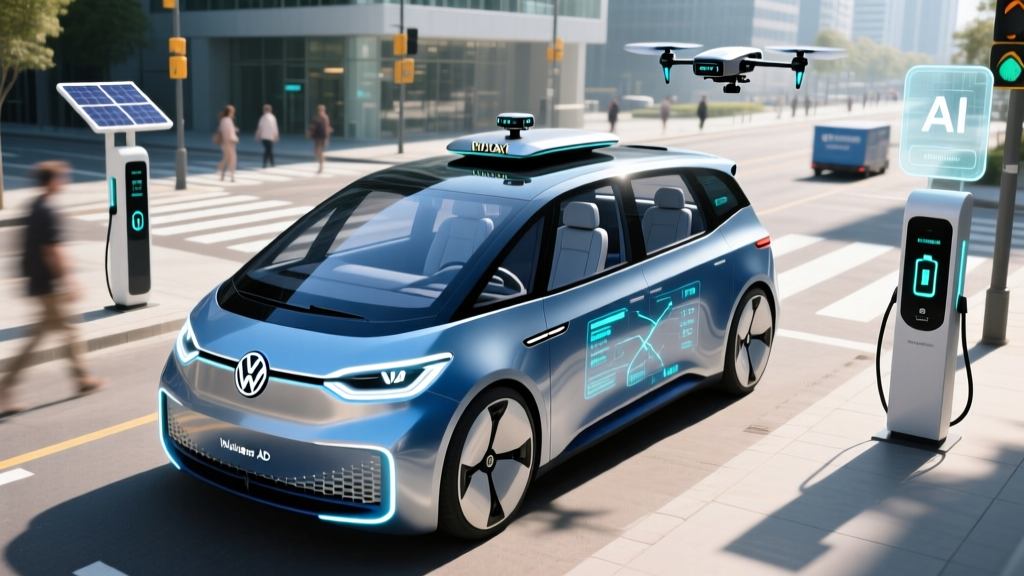
Volkswagen's autonomous vehicle ambitions flow primarily through VW Autonomous Mobility (VWAM), a subsidiary created to develop Level 4 self-driving systems for ride-hailing and shuttle applications. The flagship vehicle is the ID. Buzz AD, a fully electric van based on VW's MEB platform, retrofitted with a dense sensor suite developed in partnership with Mobileye. Unlike consumer-facing driver-assist systems you can buy today, this program targets driverless commercial operations — no human behind the wheel.
The ID. Buzz AD is designed for SAE Level 4 operation — fully autonomous within a defined operational design domain (ODD), with no driver attention required. This is fundamentally different from Level 2 systems like Tesla Autopilot, GM Super Cruise, or Ford BlueCruise, which require continuous driver supervision. Level 4 means the vehicle handles all driving tasks within its approved area, and if it encounters a scenario it cannot handle, it executes a minimal-risk maneuver (pulling over safely) without human intervention.
Where Can You Use a VW Robotaxi Right Now?
The honest answer: you can't hail one in the United States. VW's robotaxi pilot has been concentrated in Hamburg, Germany, where the ID. Buzz AD began limited commercial testing with the ride-hailing partner MOIA (a VW Group subsidiary) in late 2025. This is a restricted pilot — invited users, pre-mapped routes, and a safety operator present in early phases.
| City | Country | Status | Operator | Public Access |
|---|---|---|---|---|
| Hamburg | Germany | Limited pilot (since late 2025) | MOIA | Invite-only |
| Munich | Germany | Testing / mapping | VWAM | Not public |
| U.S. cities | USA | No announced timeline | — | Not available |
VW has not announced a U.S. deployment timeline. If you're searching for a VW robotaxi experience stateside, the closest comparable services are Waymo One (operating in Phoenix, San Francisco, Los Angeles, and Austin) and, in limited form, Cruise's restarted supervised operations.
The Technology Stack: Mobileye SuperVision and Sensor Fusion
The ID. Buzz AD doesn't rely on a single sensor modality. Instead, VW and Mobileye have built a redundant, multi-sensor perception system — a deliberate contrast to Tesla's camera-only FSD approach.
ID. Buzz AD Sensor Suite (Announced Configuration)
- LiDAR: Multiple solid-state units providing 360° 3D point-cloud mapping out to ~200 meters. Critical for depth perception without relying on ambient light.
- Cameras: 11+ cameras covering surround-view, traffic-light detection, and long-range forward perception. Powered by Mobileye's EyeQ6 chipset.
- Radar: 5 units for all-weather object detection and velocity measurement, particularly useful in rain and fog where LiDAR and cameras degrade.
- HD Maps: Pre-scanned centimeter-accurate maps of every operational route. The vehicle localizes itself within this map in real time.
- Redundant Compute: Dual Mobileye EyeQ6 chips running in parallel, with a failover architecture that can bring the vehicle to a safe stop if one system faults.
This sensor-fusion approach — LiDAR + cameras + radar + HD maps — is the same philosophy used by Waymo and Zoox. It's more expensive per vehicle than camera-only, but offers redundancy that regulators and commercial operators consider essential for true driverless operation. The trade-off is cost: outfitting a single ID. Buzz AD with this hardware suite likely adds $50,000–$100,000+ over the base vehicle cost, making fleet economics dependent on high utilization rates.
ID. Buzz AD: Vehicle Specs at a Glance
| Attribute | Specification |
|---|---|
| Platform | VW MEB (Modular Electric Drive) |
| Battery (usable) | ~77 kWh (NMC chemistry) |
| EPA Range (est.) | ~200–230 mi (final EPA TBD; WLTP ~260 mi) |
| DC Fast Charge (peak) | 170 kW (10–80% in ~30 min) |
| Level 2 AC Charge | 11 kW onboard charger |
| Motor / Drivetrain | Rear-mounted, 282 hp / 280 lb-ft, RWD |
| 0–60 mph | ~8.0 sec (estimated, AD variant heavier) |
| Seating (robotaxi config) | 4–5 passengers (no driver seat required in L4) |
| Autonomy Level | SAE Level 4 (geo-fenced) |
| AV Hardware Partner | Mobileye (EyeQ6 + SuperVision) |
Real-world range note: The added weight of the sensor suite, compute hardware, and cooling systems reduces efficiency compared to the standard ID. Buzz. In stop-and-go urban robotaxi duty with frequent HVAC use, expect effective range closer to 160–180 miles before needing a charge. For a fleet operator running two shifts per day with a midday top-up, this is workable but requires depot charging infrastructure.
How Much Would a VW Robotaxi Ride Cost?
Because the MOIA pilot in Hamburg is invite-only and subsidized, there's no published per-ride price for a VW robotaxi yet. However, we can estimate based on VW's stated goals and the economics of competing services.
| Service | Base Fare | Per-Mile Rate | 5-Mile Trip Estimate |
|---|---|---|---|
| UberX (U.S. avg) | $2.50 | $1.30/mi | ~$12–$15 |
| Waymo One (Phoenix/SF) | $3.00 | $1.20/mi | ~$11–$14 |
| VW/MOIA Robotaxi (projected) | €2.00 (~$2.20) | €1.10/mi (~$1.20) | ~$10–$13 |
VW has stated publicly that the goal is to price robotaxi rides at or slightly below conventional rideshare, using the elimination of driver compensation (typically 60–70% of a rideshare fare) to offset the higher vehicle hardware cost. Whether that math works at scale depends on fleet utilization, maintenance costs for the sensor suite, and remote-assistance staffing ratios. Industry analysts estimate a robotaxi needs 18+ hours/day of revenue-generating operation to achieve profitability — a bar no operator has consistently cleared as of 2026.
Safety Record: What the Data Shows
Because VW's robotaxi program is still in limited pilot, there is no large-scale public safety dataset comparable to Waymo's millions of driverless miles. Here's what is known:
- Miles driven (Hamburg pilot): VWAM has not published a cumulative mileage figure. Industry estimates suggest low hundreds of thousands of miles across the test fleet as of early 2026.
- Disengagement rate: Not publicly reported. For context, California DMV disengagement reports — which apply to Waymo, Cruise, and Zoox but not VW's German operations — show industry-leading systems averaging one human takeover per 5,000–30,000 miles.
- Reported collisions: None publicly attributed to the ID. Buzz AD pilot as of publication.
- Safety operator: Early-phase Hamburg testing includes a trained safety rider, meaning the vehicle is not yet operating in a fully driverless capacity during this pilot.
For comparison, NHTSA requires U.S. operators to report crashes involving ADS-equipped vehicles. Waymo has published data showing its fleet's involvement in contact events at a rate lower than human benchmarks in comparable urban environments, though direct comparison remains methodologically debated.
The absence of published safety data isn't necessarily a red flag — it reflects the program's early stage. But it does mean that claims about VW robotaxi safety cannot be verified the way Waymo's or even Cruise's can through public regulatory filings.
Current Limitations and No-Go Scenarios
What the VW Robotaxi Cannot Do (as of 2026)
- Geofenced only: The ID. Buzz AD operates exclusively on pre-mapped urban routes. It cannot handle rural roads, highways outside its ODD, or any area not scanned in centimeter-level HD maps.
- Severe weather: Heavy snow, ice accumulation on sensors, and dense fog exceed the system's operational design domain. Hamburg's relatively mild climate was chosen partly for this reason.
- Construction zones: Unmapped lane closures, temporary barriers, and flaggers require remote-assistance intervention or the vehicle will execute a safe pullover.
- No highway merging: The current ODD is urban, low-to-moderate speed (under 50 mph / 80 km/h). Autobahn-speed operation is not part of the pilot.
- Not available to the public: Outside the invite-only MOIA pilot in Hamburg, no one can hail this vehicle.
- No U.S. presence: There is no announced timeline for American deployment. Regulatory approval, mapping, and partnership requirements make a U.S. launch a multi-year undertaking at minimum.
The Regulatory Landscape
Autonomous vehicle regulation varies dramatically by jurisdiction, and VW's home market of Germany is actually one of the more permissive environments for Level 4 operations.
In 2021, Germany passed the Act on Autonomous Driving, creating a federal framework allowing Level 4 vehicles in defined operational areas with oversight from the Kraftfahrt-Bundesamt (KBA, the federal motor transport authority). This is a significant advantage: unlike the U.S., where AV regulation is a patchwork of state-level rules (with the NHTSA handling vehicle safety standards but states controlling operational permits), Germany offers a single national approval pathway.
For U.S. deployment, VW would need to navigate:
- State-level AV permits: California (CPUC + DMV), Arizona (minimal regulation, hence Waymo's Phoenix base), Texas, and Nevada each have different requirements.
- Federal motor vehicle safety standards (FMVSS): A vehicle without a steering wheel or pedals requires an NHTSA exemption, which has been difficult to obtain at scale.
- Insurance and liability: The shift from driver liability to manufacturer/operator liability remains legally unsettled in most U.S. states.
How VW Compares to Waymo, Cruise, and Zoox
| Operator | Vehicle | SAE Level | Live U.S. Cities | Public Access | Reported Miles (Driverless) |
|---|---|---|---|---|---|
| Waymo | Jaguar I-PACE / Zeekr | Level 4 | Phoenix, SF, LA, Austin | Yes (app-based) | 10M+ (cumulative) |
| Cruise | Chevrolet Bolt EV / Origin | Level 4 | Limited restart (Phoenix, Dallas) | Limited | 5M+ (pre-pause) |
| Zoox | Zoox purpose-built | Level 4 | Las Vegas, SF (testing) | Employee-only | Not disclosed |
| VW / MOIA | ID. Buzz AD | Level 4 | None | No (Hamburg invite-only) | Not disclosed |
VW is roughly 3–4 years behind Waymo in terms of deployed driverless miles and public accessibility. The ID. Buzz AD's advantage, if it reaches scale, is vehicle form factor: a spacious, accessible van is better suited for wheelchair users, groups, and airport runs than a sedan. But reaching scale is the hard part, and VW's track record on software execution (see: the Cariad delays that pushed back multiple VW Group EV launches) gives reason for skepticism about aggressive timelines.
Is This Truly Self-Driving or Just Driver-Assist?
This is the most important distinction in the entire autonomous vehicle space, and VW's positioning is clear: the ID. Buzz AD is designed for SAE Level 4 driverless operation, not Level 2 driver-assist. When the system is engaged within its approved ODD, there is no expectation of human supervision — the vehicle is responsible for all driving tasks and all failure management.
This is categorically different from:
- Tesla FSD (Supervised): Level 2. Driver must remain attentive and is legally responsible.
- GM Super Cruise / Ford BlueCruise: Level 2. Hands-free on mapped highways, but eyes-on and driver-responsible.
- Mercedes Drive Pilot (U.S.): Level 3, limited to specific highway conditions under 40 mph. Driver can disengage attention but must be ready to resume within seconds.
However — and this is critical — the ID. Buzz AD has not yet demonstrated sustained driverless operation at commercial scale. The Hamburg pilot includes safety operators. The step from "safety operator present" to "truly no one in the driver's seat, running 20 hours a day across a city" is enormous, and it's the step that has taken Waymo over a decade and billions of dollars to accomplish.
Frequently Asked Questions
Can I ride in a VW robotaxi in the United States?
No. As of early 2026, VW has no robotaxi service in the U.S. The only active pilot is an invite-only MOIA program in Hamburg, Germany. For a publicly accessible robotaxi in the U.S., Waymo One in Phoenix, San Francisco, Los Angeles, and Austin is currently the primary option.
When will VW launch a public robotaxi service?
VW has not committed to a specific date for broad public availability. The company has referenced "later this decade" for scaled operations, which could mean 2028–2030. Given VW Group's history of software-related delays, independent analysts recommend skepticism toward any timeline before 2029 for meaningful public access outside Germany.
How much will a VW robotaxi ride cost compared to Uber?
VW's stated target is pricing at or slightly below conventional rideshare (Uber/Lyft). Based on the MOIA pilot structure and industry economics, a 5-mile urban trip would likely cost $10–$13, comparable to UberX. However, final pricing will depend on market, utilization rates, and local regulatory requirements.
Is the ID. Buzz AD available for consumers to purchase?
No. The ID. Buzz AD is a commercial fleet vehicle designed for robotaxi operators, not individual buyers. The standard ID. Buzz (without the autonomous driving hardware) is available for purchase in the U.S. starting around $59,995 MSRP, with an EPA-estimated range of approximately 231–234 miles, a 77 kWh usable battery (NMC), and 170 kW peak DC fast charging. It includes Level 2 driver-assist features (Travel Assist) but is not autonomous.
What happens if the VW robotaxi encounters a situation it can't handle?
The ID. Buzz AD is designed to execute a minimal-risk maneuver — typically pulling to the side of the road and stopping — if it encounters a scenario outside its capability. Additionally, VW's system includes a remote-assistance option where a human operator can provide guidance (though not direct remote driving) to help the vehicle resolve complex situations like unmapped construction zones.
How does VW's robotaxi technology compare to Tesla's FSD?
They are fundamentally different categories. Tesla FSD (Supervised) is a Level 2 driver-assist system that requires the driver to remain attentive and legally responsible at all times. It uses cameras only — no LiDAR or radar. The VW ID. Buzz AD targets Level 4 driverless operation within geofenced areas, using LiDAR, cameras, radar, and HD maps. Comparing them is like comparing a commercial airline autopilot to a driver-assist feature in a private car — different automation levels, different responsibility models, different deployment approaches.