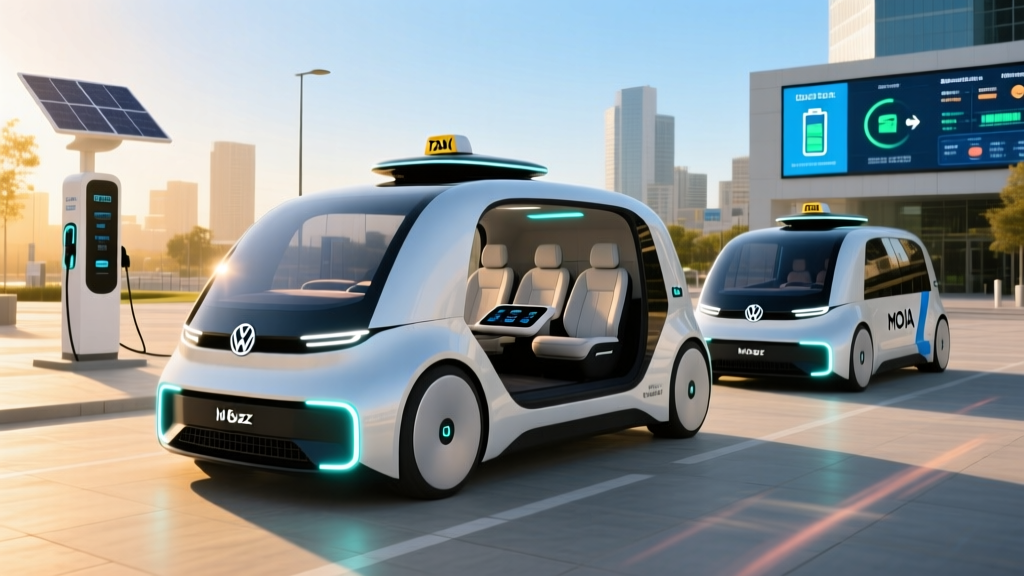
Volkswagen's path to autonomous driving looks nothing like Tesla's camera-only Full Self-Driving beta or Waymo's purpose-built robotaxis. Instead, VW is pursuing a commercial-first, geofenced Level 4 strategy centered on its ID. Buzz AD electric van and the MOIA ride-pooling subsidiary. If you've been searching for the latest on VW autonomous driving, here's what's actually operational, what's announced, and what remains in development as of early 2026.
Where VW Autonomous Driving Stands Today
VW's autonomy effort is split across two distinct tracks that buyers and watchers frequently conflate:
- Consumer driver-assist (Level 2): Every current-production VW ID.4, ID.5, ID.7, and ID. Buzz sold to consumers ships with Travel Assist — a Level 2 system combining adaptive cruise control and lane-centering. The driver must remain engaged at all times. This is not self-driving.
- Commercial robotaxi / ride-pooling (Level 4): The ID. Buzz AD (Autonomous Driving variant) is a purpose-modified electric van developed with Mobileye and operated by VW's MOIA subsidiary. It runs without a safety driver in geofenced urban zones. This is genuine Level 4 autonomy within its operational design domain (ODD).
| Level | Definition | VW Product | Driver Required? |
|---|---|---|---|
| Level 2 | Partial automation — steering + acceleration assisted | ID.4, ID.5, ID.7, ID. Buzz (Travel Assist) | Yes, full-time |
| Level 3 | Conditional automation — eyes off in specific conditions | None currently offered | On standby |
| Level 4 | High automation — no driver needed within geofence | ID. Buzz AD (MOIA fleet only) | No (within ODD) |
| Level 5 | Full automation — anywhere, any condition | Does not exist in production | No |
The distinction matters enormously. When VW issues press releases about "autonomous driving," they are almost always referring to the MOIA/ID. Buzz AD fleet program — not a feature you can buy at a dealership.
The ID. Buzz AD: VW's Level 4 Robotaxi Platform
The ID. Buzz AD is the hardware backbone of VW's autonomy ambitions. It's based on the long-wheelbase ID. Buzz (the same MEB-platform electric van sold to consumers) but heavily modified for driverless operation.
| Spec | Value |
|---|---|
| Battery (usable) | 86 kWh (NMC chemistry) |
| EPA-est. range (consumer LWB) | 234 miles |
| Real-world fleet range (urban stop-start) | ~170–195 miles per charge |
| DC fast charging (peak) | 170 kW, 10–80% in ~30 min |
| Level 2 AC charging | 11 kW onboard |
| Powertrain | RWD, 282 hp (210 kW) |
| Autonomy sensor suite | 11 cameras, 5 radar units, 1 roof-mounted lidar (Mobileye SuperVision + custom) |
| Compute platform | Mobileye EyeQ Ultra + VW-developed redundancy layer |
| Operational design domain | Geofenced urban cores, fair weather, ≤50 km/h (~31 mph) |
Where Can You Actually Ride a VW Robotaxi Right Now?
As of early 2026, VW's Level 4 robotaxi service operates through MOIA in a limited footprint:
| City | Status | Service Area | Fleet Size (est.) |
|---|---|---|---|
| Hamburg, Germany | Operational (driverless since late 2025) | ~45 km² geofence covering Altstadt, HafenCity, St. Pauli, Eimsbüttel | ~30 ID. Buzz AD vans |
| Munich, Germany | Testing with safety driver | Maxvorstadt, Schwabing (limited) | ~10 vans |
| Austin, TX (USA) | Announced — mapping & regulatory phase | Downtown + South Congress corridor (planned) | Not yet deployed |
| Berlin, Germany | Testing with safety driver | Mitte district | ~5 vans |
Hamburg is the only city where you can currently hail a driverless MOIA ride with no human behind the wheel. Munich and Berlin remain in the safety-driver validation phase. The Austin, Texas expansion — VW's first planned US robotaxi footprint — was announced in 2025 but as of early 2026 has not begun public operations. VW has cited Texas regulatory approvals and HD mapping completion as prerequisites.
How to use it: In Hamburg, riders download the MOIA app, set a pickup and drop-off within the geofence, and are matched with either a human-driven ID. Buzz (MOIA still operates a mixed fleet) or a driverless ID. Buzz AD. The app clearly labels whether your ride is autonomous. There is no option to request a driverless vehicle specifically — the dispatch algorithm assigns based on availability and route.
How Much Does a MOIA Robotaxi Ride Cost?
MOIA positions itself as a ride-pooling service rather than a private ride-hail, which keeps per-rider costs below Uber/Lyft equivalents. Pricing in Hamburg as of early 2026:
| Service | Typical Fare | Per-Rider (pooled) | Shared Ride? |
|---|---|---|---|
| MOIA (autonomous ID. Buzz AD) | €8–12 | €4.50–7 | Yes (2–5 passengers) |
| MOIA (human driver) | €7–11 | €4–6.50 | Yes |
| UberX (Hamburg) | €12–18 | €12–18 (private) | No |
| Bolt (Hamburg) | €10–15 | €10–15 (private) | No |
| HVV transit (single ticket) | €3.80 | €3.80 | N/A |
The autonomous rides carry a slight premium over human-driven MOIA (roughly €0.50–1.00 more per pooled rider) — VW has been transparent that the sensor suite and remote-operations overhead don't yet undercut human labor costs. The long-term goal is parity, then discount pricing once fleet utilization rises above 14 hours/day.
Safety Record: What the Data Shows
- Total autonomous miles driven: ~420,000 miles (675,000 km) in driverless mode
- Disengagement rate: ~0.8 remote-assistance interventions per 1,000 miles (one teleoperations handoff every ~1,250 miles)
- At-fault collisions: 0 reported at-fault incidents in driverless operation
- Total collisions (any severity): 2 minor contact incidents (both low-speed, other party at fault per Hamburg police reports)
- Remote teleops latency: Median 380ms response time from VW's Hamburg control center
Source: NHTSA AV reporting database; MOIA safety transparency reports (published semi-annually).
For context, Waymo's 5th-generation vehicles reported approximately 0.3–0.5 disengagements per 1,000 miles across their much larger Phoenix and San Francisco fleets in 2024. VW's higher intervention rate reflects the ID. Buzz AD's smaller fleet, denser European urban environment (narrower streets, more cyclists, complex intersections without standardized signal phasing), and a more conservative remote-assistance threshold.
VW reports zero at-fault collisions in driverless mode, which is encouraging but comes with the caveat that 420,000 miles is a statistically limited sample. For comparison, the human driver fatality rate in Germany is approximately 0.3 per 100 million km — you'd need tens of millions of autonomous miles to demonstrate statistical equivalence or superiority.
Technology Stack: Lidar, Cameras, and the Mobileye Partnership
VW made a deliberate decision to partner with Mobileye rather than develop its full autonomy stack in-house (an effort that the now-defunct Argo AI, co-funded by VW and Ford, attempted before shutting down in 2022). The ID. Buzz AD's tech stack:
- Cameras: 11 total — 6 surround-view (Mobileye SuperVision), 3 long-range forward, 2 rear-facing for passenger monitoring
- Radars: 5 units (4 corner + 1 forward long-range), operating at 77 GHz for object detection to ~250m
- Lidar: 1 roof-mounted unit (Innoviz Two, 250m range, 20 Hz scan rate) — this is the key differentiator from Tesla's camera-only FSD approach
- Ultrasonic: 12 sensors for close-proximity parking/curb detection
- Compute: Mobileye EyeQ Ultra SoC (176 TOPS INT8) + a VW-engineered redundant safety controller that can execute emergency stops independently
- HD Maps: Centimeter-precision maps refreshed monthly; geofence boundaries are hard-coded — the vehicle will pull over safely if GPS/HD-map confidence drops below threshold
- Connectivity: Dual 5G modems for real-time teleoperations; vehicle can execute a minimum-risk maneuver (pull to curb, hazard lights) if connectivity is lost for >3 seconds
The lidar inclusion is philosophically significant. VW and Mobileye have publicly argued that camera-only systems (à la Tesla FSD) cannot reliably estimate depth in low-light, heavy rain, or direct-sun-glare conditions without an active ranging sensor. Tesla, of course, disagrees — but VW's approach aligns with every other Level 4 robotaxi operator (Waymo, Cruise, Zoox, Motional) that has reached commercial deployment.
Current Limitations: What VW's Robotaxi Cannot Do
- Weather: Will not operate in heavy rain (>10 mm/hr), snow, fog with visibility <100m, or ice. Vehicles return to depot automatically.
- Speed: Geofenced to roads with speed limits ≤50 km/h (~31 mph). No highway or Autobahn operation.
- Geofence: Hard-boundary — cannot operate outside the ~45 km² Hamburg zone. Construction zones not pre-mapped trigger remote teleop or safe-stop.
- Night operation: Currently limited. Hamburg fleet runs 06:00–23:00 local time; nighttime validation is ongoing.
- Edge cases: Unsignalized multi-point intersections, emergency vehicle preemption, and double-parked delivery trucks still trigger remote-assistance interventions at a higher rate than straight-road driving.
- Wheelchair/stroller loading: The ID. Buzz AD's automated ramp and interior monitoring are functional but a remote operator confirms safe boarding before departure — adding ~45 seconds to each pickup.
- No consumer purchase: You cannot buy an ID. Buzz AD. It is fleet-only. The consumer ID. Buzz remains Level 2 only.
These limitations are not unique to VW — every Level 4 robotaxi currently operating (Waymo in Phoenix/SF, Zoox in Las Vegas, Cruise in limited restart) has comparable weather, speed, and geofence constraints. The honest reality is that Level 4 autonomy today means "driverless within a very specific box."
Regulatory Landscape: Who Approves VW's Robotaxi Operations?
Germany passed the Act on Autonomous Driving (AFGBG) in 2021, creating one of the world's first national legal frameworks for Level 4 operations on public roads. Under this law:
- The Kraftfahrt-Bundesamt (KBA) — Germany's federal motor transport authority — issues type approval for Level 4 vehicles.
- Local authorities (in MOIA's case, the city of Hamburg) approve the specific operational zone and service permits.
- A licensed Technische Aufsicht (technical supervisor) must be available via remote teleoperations at all times — this is the human-in-the-loop requirement even for "driverless" service.
- Operators must carry a minimum of €10 million in liability insurance per vehicle and publish semi-annual safety reports.
For the planned US expansion into Austin, VW must navigate a different regulatory patchwork. Texas passed SB 2205 in 2017 authorizing autonomous vehicles on public roads, but local permitting, insurance requirements, and NHTSA's Standing General Order for crash reporting all apply. VW has not announced a target date for Austin driverless operations.
What This Means for US Buyers and VW's Autonomy Roadmap
If you're a US-based VW shopper hoping for a self-driving ID.4 or ID. Buzz you can buy at a dealership, the honest answer is: that product does not exist, and VW has not announced one for consumer sale. The company's strategy is distinctly fleet-first — build miles, data, and safety credibility through MOIA robotaxi operations, then potentially trickle the technology down to consumer vehicles as Level 3 (eyes-off, hands-off in specific highway conditions) in the late 2020s.
For now, US VW buyers get Travel Assist (Level 2) on ID. models, which is competitive with systems like Hyundai's Highway Driving Assist 2 and Ford's BlueCruise in functionality but firmly requires driver attention. VW's consumer autonomy play is a longer-term bet, not a current product differentiator.
- If you're in Hamburg and want a driverless ride, the MOIA app gets you into an ID. Buzz AD today for €4.50–7 per pooled trip within the city center geofence.
- If you're in the US and shopping for a VW, autonomous driving is not a feature you can purchase. Travel Assist (Level 2) is the current ceiling.
- If you're tracking the industry, VW's Mobileye partnership and lidar-equipped approach represent a conservative-but-credible path to Level 4, with a fleet-proven safety record in Hamburg that, while small-sample, is clean.
Frequently Asked Questions
Is VW's Travel Assist truly self-driving?
No. Travel Assist is a Level 2 driver-assistance system combining adaptive cruise control and lane-centering. It requires the driver to keep hands on the wheel (or demonstrate attention via capacitive sensing) and eyes on the road at all times. It is functionally similar to Tesla Autopilot, Ford BlueCruise (with eyes-on), and Hyundai HDA2 — not a robotaxi system.
Can I buy an ID. Buzz AD for personal use?
No. The ID. Buzz AD is exclusively a fleet vehicle operated by MOIA. The consumer ID. Buzz (sold in the US starting at $59,995 MSRP for the LWB Pro S) does not include the autonomous sensor suite, compute hardware, or software stack. VW has stated no plans to sell the AD variant to individuals.
How does VW's robotaxi compare to Waymo?
Waymo operates a far larger fleet (~1,000+ vehicles) across Phoenix, San Francisco, Los Angeles, and Austin with millions of driverless miles logged. VW's MOIA fleet is roughly 30 vehicles in a single city with ~420,000 driverless miles. VW's approach uses lidar (like Waymo) but targets ride-pooling economics rather than private ride-hail. Waymo is more mature; VW is earlier-stage but benefits from Germany's clear Level 4 regulatory framework.
Will VW bring robotaxi service to more US cities?
Austin, TX is the announced first US market, but no launch date has been confirmed as of early 2026. VW has referenced "additional US cities" in investor presentations but has named no specific locations beyond Austin. Regulatory approval, HD mapping, and local partnerships are prerequisites that typically require 18–24 months per city.
What happens if a MOIA robotaxi breaks down or encounters an unexpected situation?
The vehicle's fallback protocol is to activate hazard lights, pull to the nearest safe curb position, unlock doors, and notify the Hamburg teleoperations center. A remote operator can then guide the vehicle at low speed to a depot or dispatch a human-driven recovery van. Passengers are notified via the in-cabin screen and MOIA app, and rides are refunded if interrupted.