If you've searched for "Volvo self driving" hoping to find a car that drives itself while you nap in the back seat, let's clear that up immediately: Volvo does not currently sell or operate a self-driving vehicle. What Volvo does offer is one of the most sensor-rich Level 2 driver-assistance suites on the market, centered around the flagship EX90 SUV with its roof-mounted lidar. That's an important distinction — and one that matters enormously for your safety expectations, legal liability, and purchase decision.
This guide breaks down exactly what Volvo's current autonomous-capable technology can do, where it falls short of true self-driving, and how it compares to actual Level 4 robotaxi services like Waymo that are operating without anyone behind the wheel.
Volvo's Autonomy Level: SAE Level 2, Not Level 4
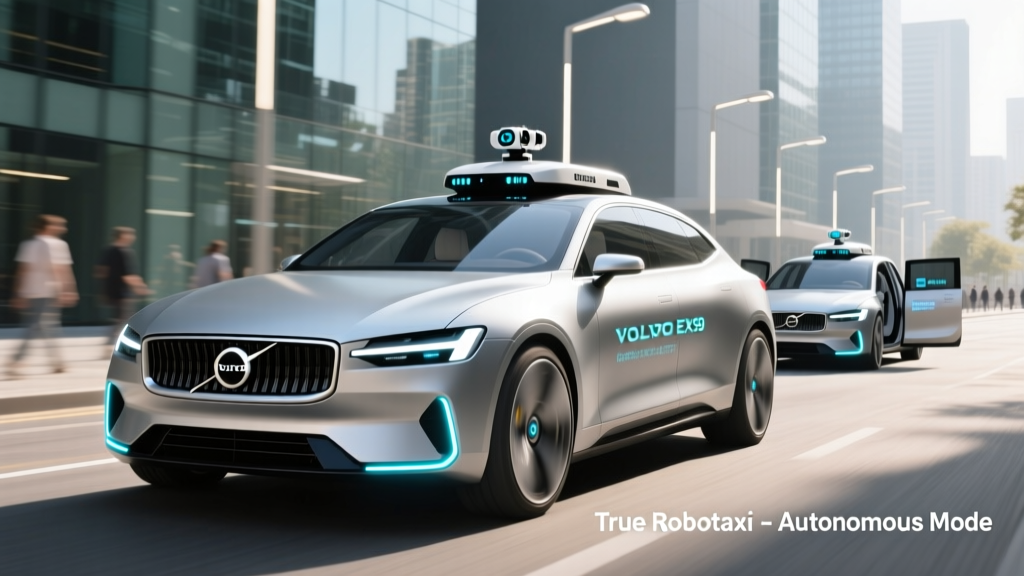
Volvo's Pilot Assist (and the enhanced version in the EX90 with lidar) is classified as SAE Level 2 — partial driving automation. The system can control steering, acceleration, and braking under specific conditions, but the driver must remain fully attentive, hands on or near the wheel, and ready to take over at any moment. This is fundamentally different from Level 4 robotaxis (Waymo, Zoox) that operate without a human driver entirely.
Volvo has never marketed any of its production vehicles as self-driving. The company's approach has been cautious and incremental, emphasizing safety over hype. The EX90, which began deliveries in late 2024 as a 2025 model and continues for 2026, represents Volvo's most advanced ADAS platform to date — but it remains a driver-assistance system, not an autonomous vehicle.
Volvo EX90 Pilot Assist: Technology Stack Breakdown
The 2026 Volvo EX90 carries a sensor suite that is among the most comprehensive in any consumer vehicle sold today. Here's what's on board:
| Sensor | Quantity (EX90) | Function |
|---|---|---|
| Luminar Iris Lidar | 1 (roof-mounted) | 3D point-cloud mapping up to ~250 m; object detection in low-light conditions where cameras struggle |
| Cameras | 8 | Surround-view perception, lane detection, traffic sign recognition, pedestrian/cyclist classification |
| Radars | 5 | Long- and short-range object detection, adaptive cruise control, blind-spot monitoring |
| Ultrasonic Sensors | 12 | Near-field obstacle detection for parking and low-speed maneuvering |
| Driver Monitoring Camera | 2 (interior) | Eye-gaze tracking and attention monitoring; alerts driver if eyes leave road |
The Luminar lidar is the headline hardware. Unlike the camera-only approach Tesla uses for Autopilot and FSD (Supervised), Volvo pairs lidar with cameras and radar for sensor redundancy. Lidar actively emits laser pulses and measures their return time, creating a real-time 3D map of the environment independent of ambient lighting. This gives the EX90 an advantage in nighttime highway driving, fog, and situations where camera contrast is poor.
However, more sensors do not equal higher autonomy. The software stack — Volvo's "Core Compute" architecture built on NVIDIA DRIVE Orin chips processing sensor fusion — still operates within Level 2 guardrails. The system will not make unprotected left turns across traffic, navigate unmapped construction zones independently, or drive without a licensed, attentive operator in the seat.
What Volvo Pilot Assist Actually Does (and Doesn't Do)
On compatible highways with clear lane markings, Volvo's Pilot Assist delivers competent Level 2 functionality:
- Adaptive cruise control with stop-and-go in traffic, maintaining set following distance
- Lane centering that actively steers to keep the vehicle centered, not just lane-departure warning
- Automatic emergency braking with pedestrian, cyclist, and large-animal detection
- Run-off-road protection — a Volvo-specific safety feature that prepares the cabin if the vehicle leaves the roadway
- Intersection auto-brake that can stop the vehicle if it detects an oncoming car while turning left
- Drive without a licensed, attentive human in the driver's seat
- Navigate to an arbitrary destination without steering input from the driver
- Handle unmapped roads, severe weather (heavy snow, flooding), or complex construction zones autonomously
- Operate as a robotaxi — there is no "summon" or driverless mode
- Remove driver liability — you are legally responsible for the vehicle at all times
The dual interior cameras monitoring driver attention are a critical safety feature but also a constant reminder: this system expects you to be driving, even when it's assisting. If the system detects your eyes are off the road for too long, it will issue escalating alerts and eventually bring the vehicle to a controlled stop with hazard lights activated.
How Volvo Compares to Actual Level 4 Robotaxi Services
To put Volvo's Level 2 technology in context, here's how it compares to the Level 4 robotaxi services that genuinely operate without a driver:
| Attribute | Volvo EX90 Pilot Assist | Waymo One (Robotaxi) |
|---|---|---|
| SAE Level | Level 2 (driver required) | Level 4 (no driver, geofenced) |
| Driver Required? | Yes — always | No |
| Where Available | Anywhere you can drive the EX90 | Phoenix, San Francisco, Los Angeles, Austin (expanding) |
| Geofenced? | No | Yes — approved service areas only |
| Lidar | 1x Luminar Iris | 5+ custom lidar units per vehicle |
| Cost to Consumer | ~$80,000–$87,000 MSRP (vehicle purchase) | Per-ride pricing, comparable to Uber/Lyft |
| Legal Liability | Driver | Waymo (operator) |
| Weather Handling | Driver adapts; system may limit features | Service may pause in heavy rain/fog |
The fundamental difference is one of responsibility. When you ride in a Waymo, the company assumes full liability for the driving task within its operational design domain. When you engage Pilot Assist in a Volvo EX90, you remain the legal driver. If something goes wrong — a missed obstacle, an unexpected road condition, a system disengagement — the responsibility falls on you.
Volvo's Stated Path Toward Higher Autonomy
Volvo has been transparent about a long-term roadmap toward higher levels of autonomy, but the company has consistently avoided aggressive timelines. Key milestones include:
- LiDAR-equipped EX90 (current): The hardware is "autonomy-ready" — Volvo has stated the sensor suite is designed to support future over-the-air software upgrades that could enable higher levels of automation on highways. As of early 2026, no such Level 3 or Level 4 update has been released.
- Unsupervised autonomous driving (announced concept): Volvo has discussed a future "unsupervised" autonomous driving mode for highway use, potentially allowing drivers to disengage on specific mapped freeways. This has not been deployed to any production vehicle, and no timeline has been confirmed.
- Robotaxi ambitions: Unlike Tesla (which has announced a Cybercab concept) or Mercedes-Benz (which offers Level 3 Drive Pilot in limited German and Nevada markets), Volvo has not announced a consumer robotaxi service or a Level 3 production system for the US market.
Volvo's caution reflects a broader industry reality: the gap between Level 2 and Level 3 is not merely technical — it's legal and liability-related. At Level 3, the manufacturer assumes responsibility for driving in defined conditions. Most automakers, including Volvo, have been reluctant to cross that threshold in the United States due to the regulatory fragmentation across 50 states and the potential exposure from edge-case failures.
Safety Data: What We Know
Volvo's Pilot Assist and related safety systems contribute to the brand's strong crash-avoidance record. The Insurance Institute for Highway Safety (IIHS) has consistently awarded Volvo models Top Safety Pick+ ratings when equipped with their full ADAS suite. However, IIHS and NHTSA do not publish comparative data on Level 2 intervention rates by manufacturer — there is no standardized public metric for how often Pilot Assist disengages or requires driver takeover versus competitors.
For Level 4 robotaxi safety data (Waymo's published millions of driverless miles), see our separate robotaxi safety analysis. The comparison is not apples-to-apples: Waymo operates in geofenced, mapped urban areas without a driver; Volvo's Level 2 system operates everywhere with the driver as the fallback.
Volvo has historically cited internal data suggesting that vehicles equipped with their City Safety automatic emergency braking system reduce rear-end collisions by approximately 40–50%. The EX90's expanded sensor suite — particularly the lidar's ability to detect stationary and partially obscured objects at highway speeds — is expected to improve on these figures, but peer-reviewed, independent real-world data for the EX90 specifically was not yet available as of early 2026.
Where Volvo's Self-Driving Tech Stands: Current Limitations
Understanding what the system cannot do is as important as understanding what it can. These are the real-world constraints Volvo EX90 owners should expect:
- Heavy precipitation: Lidar performance degrades in heavy rain, snow, and fog. While lidar handles light precipitation better than cameras alone, the system may issue alerts and reduce functionality in severe conditions — requiring the driver to take full control.
- Construction zones: Temporary lane shifts, barrel-marked lanes, and missing pavement markings can confuse lane-centering systems. Pilot Assist may disengage unexpectedly in active construction areas.
- Unmapped or rural roads: Without clear lane markings and high-definition map data, lane centering becomes unreliable. The system defaults to basic adaptive cruise control.
- Complex urban intersections: Unprotected left turns, multi-lane roundabouts, and interactions with pedestrians in uncontrolled crosswalks require full driver engagement. The system assists with braking but does not autonomously navigate these scenarios.
- Driver monitoring strictness: The dual-camera attention system is intentionally strict. Drivers who frequently glance at phones or look away will receive rapid escalation of warnings. Some users find this intrusive; Volvo considers it essential for Level 2 safety.
- Software maturity: As a relatively new platform, the EX90's Core Compute architecture has received multiple OTA updates addressing initial bugs. Early adopters have reported occasional phantom braking events and lane-centering oscillation, which Volvo has addressed through successive patches — a pattern common to all modern ADAS platforms.
Pricing: Volvo EX90 and the Cost of Advanced ADAS
The 2026 Volvo EX90 starts at approximately $80,195 MSRP for the Twin Motor Core trim and climbs to around $87,245 for the Twin Motor Performance Ultra. The Luminar lidar sensor is standard on all trims — Volvo does not gate its most important safety hardware behind a subscription or higher trim level, which is a notable contrast to some competitors.
Pilot Assist functionality is included with the vehicle. Unlike Tesla's FSD (Supervised), which carries an additional $8,000 purchase price or $99/month subscription, Volvo bundles its driver-assistance features into the base vehicle price. There is currently no paid "unlock" for higher autonomy levels, because no higher autonomy level is offered.
Regarding federal tax credits: the EX90 is assembled in Ridgeville, South Carolina, but the §30D new clean vehicle credit has strict battery component and critical mineral sourcing requirements under current IRS rules. Eligibility for the full $7,500 credit depends on the specific battery supply chain for your model year and your personal income (capped at $300,000 AGI for joint filers, $150,000 for single filers). The MSRP cap for SUVs is $80,000, meaning some EX90 trims may exceed the threshold. Always verify current eligibility with a tax professional before purchasing.
Frequently Asked Questions
Is Volvo's Pilot Assist truly self-driving?
No. Volvo Pilot Assist is an SAE Level 2 driver-assistance system. It can steer, accelerate, and brake under highway conditions, but a licensed, attentive driver must remain in the seat and monitor the road at all times. It is not a robotaxi and does not offer any driverless capability.
Does the Volvo EX90 have lidar, and does it make the car self-driving?
Yes, the EX90 has a roof-mounted Luminar Iris lidar sensor as standard equipment. However, lidar is a perception sensor — it improves the system's ability to detect objects but does not change the SAE automation level. The EX90 remains Level 2 regardless of its sensor sophistication.
Will Volvo ever offer Level 3 or Level 4 autonomy?
Volvo has indicated that the EX90's hardware is designed to support future higher-autonomy features via over-the-air updates. However, as of early 2026, no Level 3 or Level 4 feature has been announced with a confirmed release date or regulatory approval for the US market. Any such feature would require state-by-state regulatory clearance and extensive validation.
How does Volvo's ADAS compare to Tesla FSD?
Both are SAE Level 2 systems requiring driver supervision. Volvo's approach uses lidar + cameras + radar for sensor redundancy, while Tesla relies on cameras only. Tesla's FSD (Supervised) attempts more complex urban navigation (turns, stop signs) but has drawn more scrutiny from NHTSA regarding safety investigations. Volvo's Pilot Assist is more conservative — it does not attempt complex urban routing, which reduces some failure modes but offers less hands-free convenience.
Can I use Volvo Pilot Assist on any road?
Pilot Assist's adaptive cruise control works on most roads. However, lane-centering assist performs best on well-marked divided highways. On rural roads, unmapped streets, or roads with faded markings, the system may not provide reliable lane centering and will alert you to take over steering.
Where can I ride in an actual self-driving car today?
True Level 4 robotaxi services (no driver) are currently available through Waymo One in Phoenix, San Francisco, Los Angeles, and Austin, with limited expansion ongoing. Cruise suspended operations in late 2023 and has not fully relaunched driverless service as of 2026. Volvo does not operate a robotaxi service.
The Bottom Line on Volvo Self-Driving
Volvo builds some of the safest, most sensor-equipped vehicles on the road, and the EX90 with its standard lidar is arguably the most hardware-capable Level 2 vehicle you can buy. But "self-driving" it is not. The term is a misnomer when applied to any consumer vehicle currently sold in the United States, including those from Tesla, Mercedes-Benz, and GM.
If you want a premium electric SUV with best-in-class driver-assistance hardware, strong safety credentials, and a conservative approach that prioritizes keeping you engaged rather than promising autonomy it can't deliver, the EX90 is a compelling choice. If you're looking for a car that drives itself, that technology exists today only in geofenced robotaxi services operated by Waymo — not in any vehicle you can purchase and take home.