If you've searched for a Volkswagen autonomous car expecting to summon a driverless ride today, the reality requires some unpacking. Volkswagen's autonomy strategy operates on two distinct tracks: a Level 2 driver-assistance system available now in production vehicles like the ID.7 and ID.4, and a Level 4 robotaxi effort pursued through its mobility subsidiary MOIA and a partnership with Mobileye. Conflating these two is the most common mistake in coverage of VW's self-driving ambitions.
This guide separates what you can buy and drive today from what's still in pilot deployment, with exact specifications, availability maps, safety data, and the regulatory context shaping VW's timeline.
Two Tracks: Level 2 Driver-Assist vs. Level 4 Robotaxi
Before examining specific VW systems, the SAE automation framework matters. Volkswagen sells Level 2 cars. It does not sell Level 4 cars. The robotaxi service it's developing through MOIA operates at Level 4 — but only within tightly controlled geofenced zones and only in pilot form as of early 2026.
| Level | Name | Driver Role | VW Product |
|---|---|---|---|
| Level 0 | No Automation | Full control | — |
| Level 1 | Driver Assistance | Hands on wheel, full attention | Basic cruise control (older models) |
| Level 2 | Partial Automation | Must supervise at all times | ID.4 / ID.7 Travel Assist |
| Level 3 | Conditional Automation | Can disengage in limited conditions | Not offered by VW |
| Level 4 | High Automation | No driver needed in geofenced area | MOIA robotaxi (pilot only) |
| Level 5 | Full Automation | No driver needed anywhere | Does not exist commercially |
The distinction is non-negotiable: VW's Travel Assist with lane centering and adaptive cruise is a Level 2 system. You remain the driver. You are liable. Your hands must be on or near the wheel, and your eyes on the road. MOIA's robotaxi, when operational in its pilot zones, is a Level 4 system — no human driver inside the vehicle, but only within a pre-mapped service area under approved conditions.
VW Travel Assist: The Autonomous Car You Can Actually Buy
The closest thing to a Volkswagen autonomous car available at a dealership today is the IQ.DRIVE Travel Assist suite, standard or available across the 2025–2026 ID.4, ID.7, and ID. Buzz lineup.
What Travel Assist Does
- Adaptive Cruise Control (ACC): Maintains set speed and following distance, including stop-and-go traffic down to 0 mph.
- Lane Centering: Active steering input to keep the vehicle centered in marked lanes.
- Speed Sign Recognition: Camera-based detection that can auto-adjust cruise speed.
- Predictive Cruise: Uses navigation data to slow for upcoming curves, roundabouts, and speed limits.
- Emergency Assist: If the driver is unresponsive, the vehicle can brake to a stop with hazard lights activated.
What Travel Assist Does NOT Do
⚠️ This is not self-driving. Travel Assist cannot navigate intersections, respond to traffic lights, handle construction zones autonomously, or operate without a fully attentive driver. Lane markings must be clearly visible. The system disengages in heavy rain, snow, or faded road markings. You are driving; the car is assisting.
Specs: 2026 Volkswagen ID.7 with Travel Assist
| EPA Range | ~300 mi (Pro S, RWD) |
| Battery | 86 kWh usable, NMC chemistry |
| Max DC Fast Charge | 200 kW (10–80% in ~26 min) |
| Level 2 Charge Rate | 11 kW AC onboard |
| Horsepower | 282 hp (RWD) / 335 hp (AWD) |
| 0–60 mph | 6.5 sec (RWD) |
| Base MSRP | ~$52,000 (before incentives) |
| ADAS Hardware | 1 front radar, 1 front camera, 4 surround cameras, 8 ultrasonic sensors |
| Automation Level | SAE Level 2 |
Real-world highway range with Travel Assist active: expect approximately 250–270 miles at 70 mph in moderate temperatures, dropping to roughly 210–230 miles in sub-40°F conditions. The heat pump on the ID.7 helps, but cold-weather battery chemistry losses are unavoidable.
MOIA Robotaxi: VW's Level 4 Play
Volkswagen's genuine robotaxi ambitions run through MOIA, the VW Group's ride-pooling subsidiary headquartered in Hamburg, Germany. MOIA began as a human-driven ride-pooling service and has been evolving toward full autonomy through a technology partnership with Mobileye, the Intel-owned ADAS and autonomous driving chipmaker.
The Technology Stack
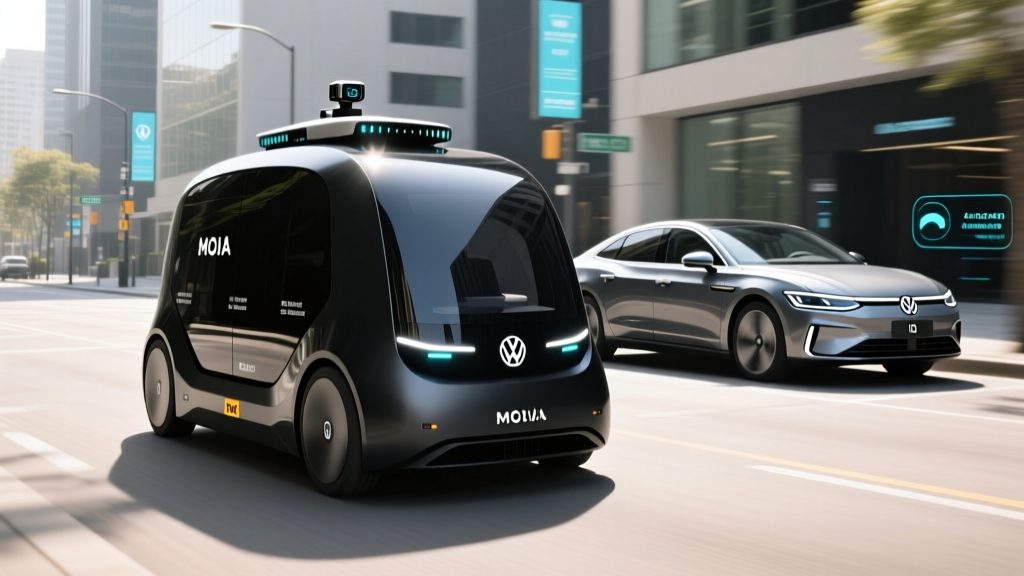
Vehicle Platform: MOIA's purpose-built electric shuttle — the MOIA +6 — is a 6-passenger EV designed from the ground up for ride-pooling, built on VW's MEB platform.
Autonomy Hardware (Mobileye Drive):
- 11 cameras (surround view, long-range forward, intersection monitoring)
- 3 lidar units (roof-mounted, providing 360° 3D point cloud)
- 6 radar units (short- and long-range object detection)
- Mobileye EyeQ6 system-on-chip for real-time sensor fusion
- Redundant compute, steering, and braking systems for driverless operation
Mapping: Mobileye's REM (Road Experience Management) crowd-sourced HD mapping, supplemented by MOIA's own geofenced route mapping in pilot cities.
Notably, this is a lidar-plus-camera approach — contrasting sharply with Tesla's camera-only FSD architecture. VW and Mobileye have publicly stated that lidar redundancy is essential for Level 4 safety certification.
Service Availability: Where Can You Ride?
| City | Status | Service Area | Driver in Vehicle? |
|---|---|---|---|
| Hamburg, Germany | Active pilot (limited) | Designated routes in HafenCity and city center (~12 km² geofence) | Safety driver present in most vehicles; select driverless runs under permit |
| Munich, Germany | Testing / pre-commercial | Limited corridor testing | Safety driver |
| Austin, TX (USA) | Announced / pre-deployment | Not yet public service | Safety driver (testing phase) |
| Tel Aviv, Israel | Technology development | Mobileye R&D testing zone | Safety driver |
Where can I use this robotaxi service right now? The honest answer: you cannot hail a fully driverless MOIA robotaxi as a paying customer anywhere in the world as of early 2026. Hamburg has the most advanced pilot, but it remains limited to invited users, specific routes, and often includes a safety driver. Public commercial launch has been targeted for the late 2020s, but VW has not committed to a firm date.
Safety Record: What the Data Shows
Important context: Because MOIA's Level 4 robotaxi service is still in pilot phase, there is no large-scale public safety dataset comparable to Waymo's published figures (which report over 7 million driverless miles in Phoenix, San Francisco, and Los Angeles as of 2025). VW and MOIA have not published comprehensive intervention-rate data for their pilot operations.
What we do know:
- MOIA's human-driven ride-pooling fleet in Hamburg and Hanover has completed over 10 million trips since 2018, providing a deep operational dataset on urban ride-pooling logistics.
- The NHTSA Standing General Order requires all entities testing or deploying automated driving systems in the U.S. to report crashes. Any MOIA incidents during U.S. testing in Austin would appear in this database.
- Mobileye's REM mapping technology underpins ADAS systems in over 170 million vehicles globally, giving the autonomy stack substantial real-world validation at the perception layer, even if Level 4 deployment is nascent.
- VW's IIHS-rated vehicles (including the ID.4, which earned Top Safety Pick+ in prior model years) provide a strong passive-safety baseline for the MEB platform on which the MOIA shuttle is built.
Safety Comparison: Robotaxi vs. Human Drivers
Industry-wide, Level 4 robotaxi operators (primarily Waymo) have reported lower at-fault crash rates per million miles than human benchmarks. However, direct comparison is complicated by geofencing (robotaxis avoid the most dangerous roads), weather restrictions, and differing reporting standards. VW has not yet published equivalent data for MOIA's autonomous operations, making safety comparisons premature for this specific platform.
Pricing: Robotaxi vs. Rideshare
Because MOIA's robotaxi service is not yet commercially available to the general public, there is no published per-ride price. However, we can estimate based on MOIA's existing human-driven ride-pooling pricing in Hamburg and industry robotaxi benchmarks:
| Service | Base Fare (est.) | Per-Mile Rate | Avg. 5-Mile Trip | Pooling Discount |
|---|---|---|---|---|
| MOIA (human-driven, Hamburg) | €4.00 | €1.20/mi | ~€10 (~$11) | Yes — shared rides ~20% cheaper |
| UberX (U.S. avg.) | $3.50 | $1.75/mi | ~$12–$15 | UberX Share: ~15% off |
| Lyft (U.S. avg.) | $3.25 | $1.60/mi | ~$11–$14 | Shared: ~15% off |
| Waymo One (Phoenix/SF) | $3.00 | $1.50/mi | ~$10–$13 | No pooling currently |
| MOIA Robotaxi (projected) | €3.50–€4.50 | €1.00–€1.30/mi | ~€9–€11 (~$10–$12) | Pooling core to model |
MOIA's business model is explicitly built on ride-pooling, not solo rides. The cost advantage comes from matching multiple passengers heading in similar directions — reducing per-passenger cost to potentially below standard rideshare rates. VW has stated that the economics of driverless operation (removing driver compensation, which is roughly 60–70% of rideshare costs) should allow competitive pricing once at scale.
Regulatory Landscape: Who Approves Robotaxi Operations?
Autonomous vehicle regulation is fragmented across jurisdictions, and this directly affects where and when VW can deploy MOIA robotaxis:
Germany
Germany passed the Act on Autonomous Driving (July 2021), creating a legal framework for Level 4 vehicles in defined operational areas. The Kraftfahrt-Bundesamt (KBA) — Germany's federal motor transport authority — oversees type approval. This is the most permissive major European regulatory environment for robotaxi deployment and explains why Hamburg is MOIA's lead pilot city.
United States
Regulation is state-level:
- California (CPUC + DMV): Requires both a DMV deployment permit and a CPUC passenger service permit. Waymo and Cruise have operated under these; Cruise's permit was suspended in October 2023 following a San Francisco incident.
- Texas: Lighter-touch regulation, no state-level permit required for testing with a safety driver. Austin's open regulatory posture is likely why VW selected it for U.S. testing.
- Federal (NHTSA): Sets vehicle safety standards (FMVSS) but does not currently approve or ban ADS operations. The Standing General Order mandates crash reporting.
VW has not announced a timeline for filing CPUC or other U.S. deployment permits. Austin testing appears to be pre-permit, safety-driver-only operations.
Current Limitations of VW's Autonomous Systems
Travel Assist (Level 2 — ID.4 / ID.7)
- No traffic light recognition or response — the car will not stop for a red light autonomously.
- No intersection handling — turns, merges, and roundabouts are fully manual.
- Lane marking dependency — system degrades or disengages with faded, snow-covered, or absent lane markings.
- Weather limitations — heavy rain, fog, and snow impair camera and radar performance.
- Construction zones — temporary lane configurations frequently confuse the system.
- Driver monitoring required — capacitive steering wheel demands periodic touch input; inattention triggers escalating warnings and eventual Emergency Assist stop.
MOIA Robotaxi (Level 4 — Pilot Phase)
- Geofenced only — cannot operate outside pre-mapped zones (~12 km² in Hamburg).
- Weather restrictions — likely suspended or degraded in heavy rain, snow, or dense fog (specific thresholds not published).
- No highway operation — urban speeds only in current pilot configuration.
- Limited hours — pilot operations may not run 24/7; specific hours not publicly disclosed.
- Not commercially available — cannot be hailed via app by the general public.
- Edge cases — unusual road configurations, emergency vehicles, and erratic pedestrians still represent scenarios where the system may execute a minimal-risk maneuver (controlled stop) rather than navigate through.
Is This Truly Self-Driving or Driver-Assist?
The answer depends entirely on which VW product you're discussing:
Volkswagen ID.4, ID.7, ID. Buzz with Travel Assist: These are driver-assist vehicles. SAE Level 2. The human is the driver. Marketing language like "semi-autonomous" is misleading — the legal and operational reality is that you are driving with assistance. This is comparable to Tesla Autopilot, Ford BlueCruise, or GM Super Cruise in automation level, though each system has different operational design domains.
MOIA Robotaxi (Mobileye Drive): This is designed as a true self-driving system — SAE Level 4 — within its geofenced operational area. No human driver is needed. However, it exists today only in pilot form with restricted access. It is not a product you can purchase or a service you can hail. Calling VW an "autonomous car company" based on MOIA's pilot is premature; calling it a company without autonomous ambitions ignores a multi-hundred-million-euro investment.
Timeline: When Will VW's Robotaxi Be Publicly Available?
Volkswagen and Mobileye have indicated a target of commercial robotaxi services by the end of the decade (approximately 2028–2030). This is consistent with the broader industry timeline but should be treated as aspirational. Key milestones to watch:
- 2026: Continued safety-driver testing in Hamburg, Munich, and Austin. Possible expansion of driverless test runs under Hamburg's Level 4 permit framework.
- 2027–2028: Potential limited commercial launch in Hamburg if regulatory approval and safety validation are met.
- 2029–2030: Possible expansion to additional German and European cities. U.S. commercial deployment remains speculative and dependent on state-level permitting.
VW has not announced a consumer vehicle with Level 3 or Level 4 capability. Unlike Mercedes-Benz (which offers Level 3 DRIVE PILOT in Germany and Nevada for the S-Class and EQS), VW has not pursued a conditional-autonomy consumer product. The company's autonomy strategy is fleet-based, not individual-ownership-based.
Frequently Asked Questions
Can I buy a Volkswagen autonomous car in 2026?
No. You can buy a Volkswagen with Level 2 driver-assistance (Travel Assist) in the ID.4, ID.7, and ID. Buzz. This is not autonomous driving — it requires your full attention and supervision. VW does not sell a Level 3, 4, or 5 vehicle to consumers.
Is VW's Travel Assist as advanced as Tesla's FSD?
Both are Level 2 systems requiring driver supervision. Tesla's FSD (Supervised) has broader operational capability (intersection navigation, traffic light response, city street turns) but remains Level 2 with the driver fully responsible. VW's Travel Assist is more conservative — primarily highway and well-marked road focused, with no traffic light or intersection automation. Neither is self-driving.
Where is the MOIA robotaxi available to the public?
It is not available to the general public anywhere as of early 2026. Hamburg has the most advanced pilot, but access is limited. Austin, TX testing is in early stages with safety drivers. No commercial ride-hailing is active.
How much will a MOIA robotaxi ride cost?
No public pricing exists yet. Based on MOIA's existing human-driven service in Hamburg and industry benchmarks, expect roughly $10–$12 for a 5-mile pooled trip — competitive with or slightly below Uber/Lyft, with the pooling model central to the cost structure.
Does VW use lidar or cameras for autonomy?
For the MOIA robotaxi (Level 4), VW uses both — 11 cameras, 3 lidar units, and 6 radar units via the Mobileye Drive system. For consumer Travel Assist (Level 2), VW uses cameras and radar only, with no lidar.
What happens if the MOIA robotaxi encounters a situation it can't handle?
Level 4 systems are designed to execute a minimal-risk maneuver — typically a controlled pullover and stop — when they encounter scenarios outside their operational design domain. The vehicle does not hand off to a passenger (there is no driver). Remote assistance from a operations center may be available, though VW has not detailed MOIA's remote operations architecture publicly.
Is Volkswagen's autonomous car effort behind competitors?
In Level 4 robotaxi deployment, VW/MOIA is behind Waymo (commercially operating in Phoenix, SF, LA) and roughly alongside other OEM-backed efforts like GM/Cruise (rebuilding after its 2023 suspension). In consumer Level 2 ADAS, VW's Travel Assist is competitive but not class-leading compared to Ford BlueCruise or GM Super Cruise, which offer hands-free operation on pre-mapped highways. VW has not pursued Level 3 consumer deployment like Mercedes-Benz.