What Does a Zoox Robotaxi Ride Cost in Las Vegas?
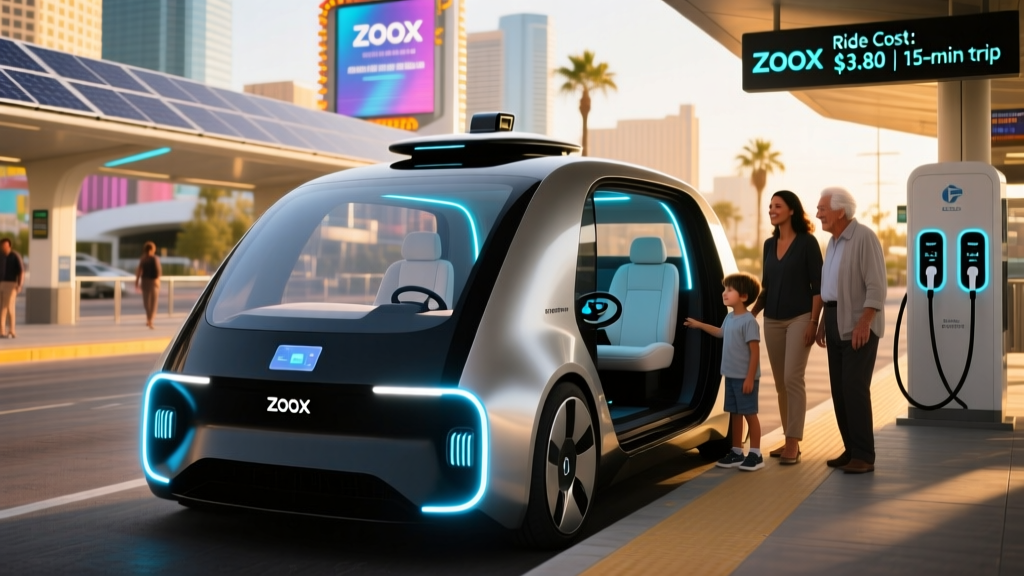
Amazon-backed Zoox has been testing and gradually expanding its purpose-built, bidirectional robotaxi in Las Vegas, making it one of a handful of cities where true driverless rides are available to the public. If you have been searching for the Vegas Zoox price, the short answer is that Zoox has largely offered rides at no direct cost to passengers during its phased public rollout — but that pricing model is shifting as the service matures toward a commercial fare structure in 2026.
This guide breaks down exactly what to expect when riding a Zoox in Las Vegas: current pricing and promotional access, where the service operates, how safety data stacks up, and what the vehicle's technology can and cannot do today.
Zoox operates at SAE Level 4 autonomy — meaning the vehicle handles all driving tasks within a defined operational design domain (geofenced area, specific conditions) with no human driver present or required. This is fundamentally different from Level 2 systems like Tesla Autopilot or GM Super Cruise, which require continuous driver supervision. In a Zoox robotaxi, there is no steering wheel, no pedals, and no driver's seat.
Where Can You Ride a Zoox Robotaxi Right Now?
Zoox's commercial ride-hail operations are concentrated in a handful of US metro areas, with Las Vegas being a primary testing and early-access city. Here is the current operational footprint as of early 2026:
| City | Status | Service Area | Access |
|---|---|---|---|
| Las Vegas, NV | Active — rider program | Las Vegas Strip corridor, parts of downtown | Invite/waitlist via Zoox app |
| Foster City, CA | Active — employee/invite | San Francisco Peninsula geofence | Limited waitlist |
| San Francisco, CA | Testing / limited rides | Select neighborhoods | Restricted access |
In Las Vegas, Zoox has focused its geofence on the high-traffic Strip corridor — the stretch connecting major resorts from roughly Mandalay Bay northward through the Convention Center area, with some routes extending toward downtown. The geofence is not the entire metro area; you cannot hail a Zoox to the airport (Harry Reid International) or to suburban Henderson. Pick-up and drop-off points are designated locations within the operational zone.
Access is not yet fully open. Prospective riders in Vegas need to join the Zoox waitlist through the Zoox ride page and receive an invitation before they can request rides through the app.
Vegas Zoox Price: How It Compares to Uber and Lyft
During its initial public rider programs in Las Vegas, Zoox has offered rides at no charge to invited participants. This is a deliberate strategy: Zoox is collecting rider-experience feedback, validating its service model, and building public familiarity before switching to a paid fare structure.
As Zoox moves toward full commercial operation, industry analysts and statements from the company suggest pricing will be competitive with existing rideshare options — likely undercutting Uber and Lyft on comparable Strip routes to build ridership. Here is how a typical Vegas Strip trip breaks down:
| Service | Typical Strip Trip (3-5 mi) | Surge Potential | Driver Tips |
|---|---|---|---|
| Zoox (current) | $0 (promotional/free rides) | N/A | Not applicable (no driver) |
| Zoox (projected commercial) | ~$8–$14 est. | Likely lower than rideshare | Not applicable |
| UberX (Vegas Strip) | $12–$22 | 1.5x–3x during peak | Expected ($2–$5) |
| Lyft (Vegas Strip) | $11–$20 | Prime Time pricing | Expected ($2–$5) |
The long-term economic advantage of robotaxis like Zoox is the elimination of driver compensation, which typically accounts for 60–75% of a rideshare fare. Zoox's projected commercial pricing aims to pass some of that savings to riders while the company scales its fleet. However, exact per-mile or per-trip fares for Vegas have not been officially published as of this writing — check the Zoox website for the latest fare announcements.
Zoox Vehicle and Technology Stack
The Zoox robotaxi is not a retrofitted production car. It is a purpose-built, symmetrical vehicle designed from the ground up for autonomous ride-hailing. Key hardware and technology specifications:
Sensor Suite
- LiDAR: Multiple solid-state and spinning LiDAR units providing 360-degree, high-resolution 3D point clouds out to 150+ meters
- Cameras: A redundant array of high-dynamic-range cameras covering all directions for object classification, traffic-light recognition, and lane detection
- Radar: Forward and surround radar for velocity detection and operation in rain or fog where LiDAR and cameras degrade
- Ultrasonic sensors: Close-range detection for low-speed maneuvering and curb alignment
Computing and Software
- Custom onboard compute platform with redundant processing channels
- HD mapping of the geofenced area, continuously updated
- Machine-learning perception stack fusing LiDAR, camera, and radar data in real time
- Planning and prediction models trained on millions of miles of urban driving data
Vehicle Design
- Bidirectional: drives equally well forward and backward (no designated "front")
- Four-wheel steering for tight urban turns and parallel-pull-ups
- Carriage-style seating: two bench seats facing each other, up to 4 passengers
- No steering wheel, pedals, or mirrors — fully Level 4 architecture
- Battery-electric powertrain (exact kWh capacity not publicly disclosed; estimated 70–80 kWh usable based on vehicle class)
The sensor-redundancy approach (LiDAR + cameras + radar) contrasts with Tesla's camera-only strategy for its FSD (Supervised) system. Zoox's multi-modal sensor fusion is the industry-standard approach for Level 4 robotaxis — NHTSA has noted that redundant sensing is critical for safe operation in edge cases like construction zones or occluded pedestrians.
Safety Record: What the Data Shows
Robotaxi safety is the most scrutinized question in autonomous driving. Here is what is publicly known about Zoox's safety performance:
- Total autonomous miles driven: Zoox has logged hundreds of thousands of driverless miles across its test fleet in Las Vegas, Foster City, and San Francisco, though exact cumulative figures are not published as frequently as competitors like Waymo.
- Disengagement rate: California DMV disengagement reports (required for all AV testers in the state) have shown Zoox's intervention rate trending downward year-over-year, though direct comparison with Waymo's published figures is complicated by different operational domains.
- At-fault collisions: As of early 2026, Zoox has not been involved in any reported serious-injury or fatal collisions during driverless operations. Minor low-speed contact incidents during testing have been reported to the California DMV as required.
- Regulatory standing: Zoox holds active testing permits in California and Nevada. The company received a NHTSA exemption for its purpose-built vehicle, which lacks traditional manual controls (steering wheel, mirrors), allowing it to operate legally without those components.
For context, IIHS research and NHTSA crash data show that human drivers cause approximately 94% of crashes, with distraction, impairment, and fatigue as leading factors. Robotaxis eliminate those specific risks but introduce new failure modes — sensor degradation, software edge cases, and connectivity loss — that are still being characterized at scale.
Zoox's safety approach includes a remote-assistance model: if the vehicle encounters a scenario it cannot resolve autonomously (e.g., an unmapped road closure), it can pull over safely and request remote guidance from a human operations team. The remote operator does not "drive" the vehicle in real time but can authorize a pre-planned maneuver or reroute.
Current Limitations: What Zoox Cannot Do
Level 4 autonomy is powerful but bounded. Here are the real-world constraints of riding a Zoox in Vegas today:
Operational Limitations
- Geofence boundaries: The vehicle will not travel outside its mapped operational zone. You cannot request a ride to areas beyond the Strip/downtown corridor.
- Weather constraints: Heavy rain, dust storms (common in Vegas monsoon season), or extreme heat events may trigger service pauses or reduced operating hours. LiDAR and camera performance degrades in heavy precipitation.
- Speed limits: Zoox currently operates on surface streets at speeds up to approximately 45 mph. It does not enter freeways or highways.
- No airport service: Harry Reid International Airport is outside the current geofence. Use Uber, Lyft, or the monorail for airport transfers.
- Wait times: Fleet size is still limited. During peak evening hours on the Strip, wait times for a Zoox may exceed those for Uber/Lyft.
- Accessibility: Zoox's carriage-style design includes wheelchair-accessible variants, but availability of accessible vehicles is limited. Confirm via the app before planning a trip requiring accommodation.
- No stops en route: Unlike a human-driven rideshare, you cannot ask the vehicle to make an unscheduled stop (e.g., at a convenience store). The route is planned point-to-point.
- Construction zones: While Zoox handles many construction scenarios, major unmapped road reconfigurations can cause the vehicle to pull over and wait for remote assistance, adding time to your trip.
Regulatory Landscape: Who Approves Robotaxi Operations?
Robotaxi deployment in the United States involves a patchwork of federal and state approvals:
- Federal (NHTSA): Sets vehicle safety standards (FMVSS). Zoox received a special exemption to operate its purpose-built vehicle without a steering wheel, rearview mirrors, and other traditional controls that FMVSS normally requires.
- Nevada (DMV & PUCN): Nevada was one of the first states to authorize autonomous vehicle testing and deployment. Zoox operates under Nevada's AV regulatory framework, which requires permits, insurance, and incident reporting. The Nevada DMV oversees AV testing permits.
- California (DMV & CPUC): For operations in Foster City and San Francisco, Zoox holds permits from the California DMV (testing) and the California Public Utilities Commission (CPUC), which regulates commercial passenger service. California requires annual disengagement reports and collision reporting within 10 days.
- Local jurisdictions: City and county authorities (e.g., Clark County for the Las Vegas Strip) coordinate on road-access permissions and may impose operational restrictions during major events like CES or New Year's Eve.
How to Request a Zoox Ride in Las Vegas
- Download the Zoox app (available on iOS and Android) or visit the Zoox ride-signup page.
- Join the waitlist for Las Vegas. Access is currently invitation-based — you will receive a notification when your account is activated.
- Set your pickup and drop-off within the geofenced zone. The app shows the operational boundary and designated stop locations.
- Confirm your ride. The app provides an estimated wait time and vehicle identification (license plate, vehicle number).
- Board the vehicle. The Zoox pulls up to your designated stop. Doors unlock automatically when the vehicle is safely stopped. There is no driver to greet you — just step in, buckle up, and the vehicle departs.
- In-ride experience. Interior screens display the vehicle's perception of its surroundings (detected cars, pedestrians, traffic lights). You can control climate and music. An emergency stop button is accessible but intended for true emergencies only.
- Arrive and exit. The vehicle stops at your destination, doors unlock, and the ride is complete. During the promotional period, no payment is required.
Frequently Asked Questions
Is Zoox really self-driving, or is there a hidden driver?
Zoox is genuinely self-driving — SAE Level 4. There is no human driver in the vehicle, no steering wheel, and no pedals. The vehicle handles all driving tasks within its geofenced zone. This is categorically different from Level 2 driver-assist systems like Tesla Autopilot or Ford BlueCruise, where a human must remain attentive and ready to take over at all times.
How much does a Zoox ride cost in Vegas in 2026?
During the current promotional rider program, Zoox rides in Las Vegas are offered at no charge to invited participants. Once Zoox transitions to full commercial fare-based service, pricing is expected to be competitive with or below Uber/Lyft rates for comparable Strip trips (estimated $8–$14 for a typical 3–5 mile ride). Exact commercial fares have not been officially published.
Can I hail a Zoox from anywhere in Las Vegas?
No. Zoox operates within a geofenced zone covering the Las Vegas Strip corridor and parts of downtown. Rides to the airport, suburban areas, and locations outside the mapped zone are not available. The app clearly shows the service boundary.
How safe are Zoox robotaxis compared to human-driven rideshare?
Zoox has not reported any serious-injury or fatal collisions during driverless operations as of early 2026. The vehicle uses redundant LiDAR, camera, and radar sensors and is designed to pull over safely rather than attempt a maneuver it cannot complete with high confidence. NHTSA data shows human drivers cause approximately 94% of crashes due to distraction, impairment, or fatigue — risks that a Level 4 robotaxi eliminates. However, robotaxis introduce different failure modes (sensor limitations, software edge cases) that are still being evaluated at scale.
What happens if the Zoox encounters something it cannot handle?
If the vehicle encounters an unresolvable scenario — such as an unmapped construction zone or an unusual road obstruction — it will pull over to a safe location and contact a remote operations team for guidance. The remote operator can authorize a pre-planned alternate route or maneuver but does not directly steer the vehicle in real time. In the worst case, the vehicle remains stopped until the situation clears or roadside assistance is dispatched.
Does Zoox operate at night and in bad weather?
Zoox operates during evening and nighttime hours on the Strip, where its LiDAR and camera systems are designed to function in artificial lighting. However, heavy rain, monsoon-season dust storms, or extreme weather events may cause temporary service suspensions. The sensor suite performs best in clear, dry conditions typical of Las Vegas most of the year.
How is Zoox different from Waymo?
Both are Level 4 robotaxis, but they differ in vehicle design and market approach. Waymo uses a modified production vehicle (Jaguar I-PACE) with a retrofit sensor suite and has a larger operational footprint in Phoenix and San Francisco with paid commercial service. Zoox uses a purpose-built, symmetrical vehicle with no manual controls and is earlier in its commercial rollout. Waymo's pricing in Phoenix and SF typically ranges from comparable to slightly above Uber/Lyft for equivalent trips.