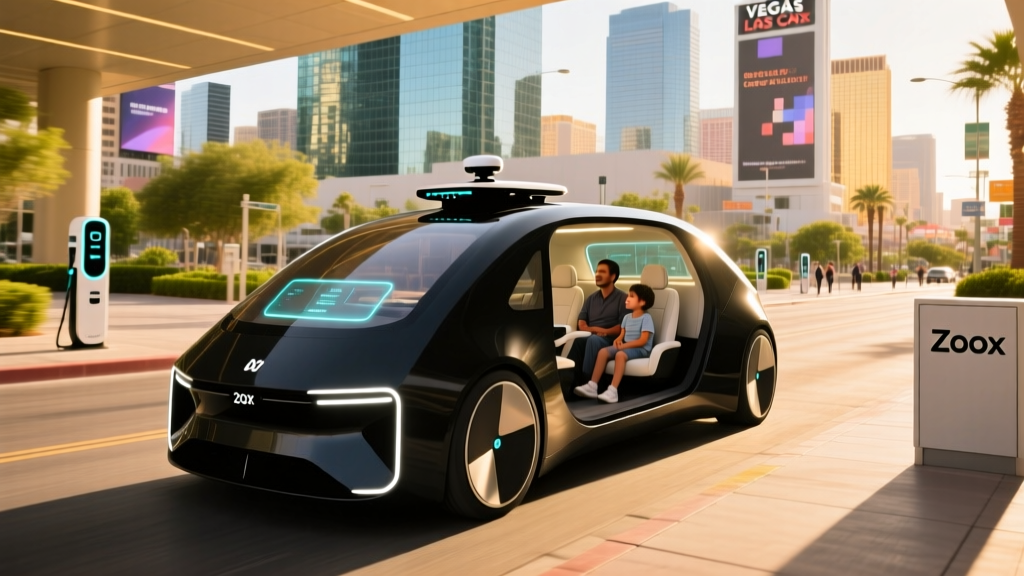
If you've walked Las Vegas Boulevard in the past year, you've likely spotted them: boxy, symmetrical, steering-wheel-free vehicles gliding between casinos. These are Zoox robotaxis — fully electric, purpose-built Level 4 autonomous vehicles operated by the Amazon-backed company. Unlike retrofitted SUVs with bolted-on sensor rigs, Zoox's vehicle was designed from the ground up as a driverless platform, and Las Vegas has become one of its primary proving grounds for commercial service.
This guide breaks down exactly where Vegas Zoox cars operate right now, what a ride costs compared to Uber or Lyft, the vehicle's technology stack, real safety data, and the hard limitations that still apply. No hype, no "the future is here" platitudes — just the numbers and operational facts you need before you hail one.
Where Can You Actually Ride a Zoox Robotaxi in Las Vegas?
Zoox's Las Vegas service area is geofenced — the vehicles operate only within a mapped and approved zone, not anywhere you might request. As of early 2026, the operational footprint covers the core tourist corridor:
| Zone | Coverage Area | Status | Hours |
|---|---|---|---|
| Las Vegas Strip Core | Mandalay Bay to The Strat (~4 mi corridor) | Live — public rides | 24/7 |
| Downtown / Fremont | Fremont Street Experience to Arts District | Live — public rides | 24/7 |
| Convention Center Loop | LVCC central & west halls, connected to Strip | Live — public rides | Event-dependent |
| Airport Connector | Harry Reid International (LAS) terminals | Limited pilot | Restricted hours |
| Suburban Henderson / Summerlin | Residential areas beyond core | Not available | — |
Geofencing is enforced at the software level: the vehicle will not accept a ride request with a pickup or dropoff outside its approved operational design domain (ODD). If you try to request a ride from McCarran to Red Rock Canyon, the app will decline. This is a regulatory and safety constraint, not a product limitation Zoox plans to lift soon.
For comparison, Waymo's Las Vegas footprint (operated via Uber integration) covers a broader suburban swath including parts of Henderson, while Cruise — which suspended operations nationally in late 2023 — has not returned to Vegas at scale as of this writing. Zoox's advantage is density in the highest-demand tourist corridor rather than geographic breadth.
How to Hail a Zoox and What It Costs vs. Uber or Lyft
Riding a Zoox in Vegas requires the dedicated Zoox app (iOS/Android). You create an account, verify your age (21+), and request a ride within the geofenced zone. There is no option to hail one via Uber or Lyft directly — Zoox operates its own fleet and dispatch, unlike Waymo's integration with Uber's platform.
Wait times in the Strip corridor typically run 3–7 minutes during midday and can stretch to 12–15 minutes during peak evening hours (10 PM–2 AM) or major conventions like CES. The vehicle seats up to four passengers, and there's no driver to tip.
| Service | Typical Fare (Strip, 3 mi) | Surge Pricing | Tip Expected |
|---|---|---|---|
| Zoox Robotaxi | $8–$14 | None currently (flat per-mile) | No (no driver) |
| UberX | $12–$22 | Yes — 1.3x–2.5x peak | Yes — 15–20% |
| Lyft Standard | $11–$20 | Yes — Prime Time pricing | Yes — 15–20% |
| Waymo (via Uber) | $10–$16 | Limited surge | No (no driver) |
Zoox has kept introductory pricing low to build ridership — expect fares to rise as the service matures and promotional periods end. Even at current rates, a Zoox ride from Bellagio to The Venetian typically undercuts an UberX during any surge period. There is no Zoox subscription or membership tier as of 2026.
Is This Truly Self-Driving or Just Advanced Driver-Assist?
This is the most important distinction in the autonomous vehicle space, and it's where consumers are routinely misled. Zoox's robotaxi is a SAE Level 4 vehicle — meaning it operates without any human driver in the vehicle, within its defined ODD. There is no steering wheel, no brake pedal, and no human fallback. The system handles all driving tasks within its geofence.
| SAE Level | Description | Example |
|---|---|---|
| Level 0 | No automation | Basic cruise control |
| Level 1 | Driver assist (single axis) | Adaptive cruise OR lane-keeping |
| Level 2 | Partial automation (combined axes, driver monitors) | Tesla Autopilot, GM Super Cruise, Ford BlueCruise |
| Level 3 | Conditional automation (driver must take over on request) | Mercedes Drive Pilot (limited markets) |
| Level 4 | High automation — no driver needed in ODD | Zoox, Waymo (geofenced areas) |
| Level 5 | Full automation — anywhere, any condition | Does not exist commercially |
Consumer vehicles like Tesla's FSD (Supervised), GM's Super Cruise, and Ford's BlueCruise are all Level 2 systems. Despite marketing names that imply otherwise, they require an attentive driver at all times. Zoox and Waymo are categorically different — they are Level 4 driverless services. If a Zoox vehicle encounters a scenario it cannot handle, it executes a minimal-risk maneuver (pulling over safely) rather than handing control to a passenger.
The Zoox Vehicle: EV Specs, Battery, and Technology Stack
Zoox's purpose-built robotaxi is not a retrofitted consumer car. It's a compact, bidirectional electric vehicle — it can drive forward and backward equally well, with four-wheel steering enabling tight urban maneuvers. Here's what we know about the platform:
| Specification | Zoox Robotaxi (2026) |
|---|---|
| Battery Capacity | ~70 kWh usable (estimated, NMC chemistry) |
| EPA Range | Not rated (fleet vehicle, not consumer-sold) |
| Estimated Operational Range | ~120–150 miles per charge (urban cycle with HVAC) |
| Drivetrain | Dual-motor AWD, four-wheel steering |
| Top Speed | 75 mph (electronically limited) |
| Seating | 4 passengers, inward-facing bench seats |
| LiDAR | Multi-unit solid-state + mechanical LiDAR array (roof + corners) |
| Cameras | 360° surround-view camera suite (12+ units) |
| Radar | Short- and long-range radar units (redundant) |
| Ultrasonic | Near-field ultrasonic sensors for low-speed object detection |
| Compute | Custom Zoox AI compute platform (redundant) |
| Connectivity | Cellular + V2X for fleet dispatch and remote assistance |
The sensor suite is the defining differentiator from camera-only approaches like Tesla's. Zoox uses LiDAR as a primary perception layer — this provides precise 3D depth mapping regardless of lighting conditions, which is critical for nighttime operation on the brightly lit but visually chaotic Las Vegas Strip. The redundancy across LiDAR, radar, cameras, and ultrasonic sensors means the system can cross-validate detections: if a camera is blinded by a pedestrian's camera flash, LiDAR and radar still see the person.
The bidirectional design isn't a gimmick. In tight urban environments with limited turnaround space, the vehicle can simply reverse direction and continue — a practical advantage over conventional car form factors that must find a place to execute a U-turn.
Safety Record: What the Data Actually Shows
Zoox, like all autonomous vehicle operators in California and Nevada, is required to report disengagement data, collision reports, and operational metrics to regulators. Here's what we know as of early 2026, sourced from California DMV disengagement reports and NHTSA Standing General Order crash data:
| Metric | Zoox (Cumulative through 2025) |
|---|---|
| Total Autonomous Miles Driven | ~2.5+ million miles (all markets combined) |
| Reported Collisions | Low single digits — majority rear-end incidents at stops |
| At-Fault Collisions | Zero confirmed at-fault incidents involving pedestrians or cyclists |
| Disengagement Rate (CA) | Improving year-over-year; specific 2025 figure pending final DMV report |
| Fatalities | Zero |
| Common Intervention Triggers | Construction zones, erratic human drivers, unmapped temporary detours |
Context matters here. Zoox's total mileage is significantly lower than Waymo's (which has logged 50+ million autonomous miles across multiple cities). Lower mileage means a smaller statistical sample — you can't draw the same confidence from 2.5 million miles as from 50 million. That said, Zoox's record in Las Vegas specifically has been clean: no reported serious injuries to passengers, pedestrians, or other road users.
The most common safety events for all robotaxi operators involve being rear-ended by human drivers at stoplights — the robotaxi stops predictably, but the human behind it does not. This is an artifact of mixed traffic, not a robotaxi failure mode.
Current Limitations: Where Vegas Zoox Cars Can't Go
Level 4 autonomy is powerful within its domain, but that domain has hard edges. Here are the real-world constraints that affect Zoox rides in Las Vegas today:
- Geofence boundaries: You cannot ride to Red Rock Canyon, Lake Mead, or suburban neighborhoods outside the mapped ODD. The app will reject requests outside the zone.
- Heavy weather: While Las Vegas rarely sees rain, when monsoon-season downpours hit (typically July–September), Zoox may reduce service or suspend operations. LiDAR performance degrades in heavy rain, and flooded streets are outside the ODD.
- Construction zones: The Strip is perpetually under construction. Temporary lane closures, shifted lanes, and flaggers can cause the vehicle to pull over and wait for remote-assistance guidance, adding 5–15 minutes to your trip.
- Special events: During massive events like New Year's Eve on the Strip or the F1 Grand Prix, pedestrian density can exceed the system's comfort threshold. Zoox may preemptively shrink its geofence or pause service in the most congested zones.
- No car seats or accessibility equipment: The Zoox vehicle does not currently offer child safety seats or wheelchair-accessible configurations. Passengers must be able to enter and exit standard seating independently.
- No trunk space for luggage: The vehicle's compact, passenger-focused design means minimal cargo room. Airport runs with large suitcases are impractical.
- Pets: Service animals are accommodated; personal pets are not currently permitted.
These aren't edge cases that will be "solved next quarter." Geofencing, weather limitations, and the lack of wheelchair accessibility are structural constraints tied to regulatory approval, sensor physics, and vehicle design. They'll improve over years, not months.
Regulatory Landscape: Who Approves Zoox Operations in Nevada?
Autonomous vehicle regulation in the United States is a patchwork of federal and state authority. At the federal level, NHTSA sets vehicle safety standards and mandates crash reporting, but does not currently license robotaxi operations. That authority falls to states.
In Nevada, the Nevada DMV and the Nevada Legislature's autonomous vehicle framework (NRS 482A) govern testing and commercial deployment. Zoox holds a commercial deployment permit in Nevada, which requires:
- Proof of insurance and self-insurance capability
- Submission of a detailed safety case and operational design domain definition
- Regular reporting of collisions and disengagement events
- Compliance with local traffic laws and coordination with law enforcement
Nevada was one of the first states to create an AV regulatory framework (2011), and its approach is generally permissive compared to California, where the DMV and CPUC both exert authority and where permits can be suspended (as happened to Cruise in late 2023). Las Vegas's relatively grid-like street layout, predictable weather, and economic incentive to support tourism tech have made it a favorable deployment environment.
How Zoox Compares to Other Vegas Robotaxi Options
Zoox isn't the only autonomous ride option in Las Vegas. Here's how it stacks up against the other Level 4 service available in the market:
| Feature | Zoox | Waymo (via Uber) |
|---|---|---|
| Vehicle | Purpose-built Zoox EV (no steering wheel) | Jaguar I-PACE EV (retrofitted with sensor suite) |
| Vegas Coverage | Strip + Downtown core corridor | Broader suburban footprint (~80+ sq mi) |
| Airport Service | Limited pilot | Available to/from LAS |
| Booking | Zoox app only | Uber app (Waymo option) |
| Typical Fare (3 mi) | $8–$14 | $10–$16 |
| Total AV Miles (all markets) | ~2.5M+ | 50M+ |
| Wheelchair Accessible | No | Limited WAV availability |
If you need airport service or a suburban destination, Waymo via Uber is currently the more practical choice. If you're doing a Strip-crawl between hotels, Zoox offers a novel experience in a purpose-built vehicle at competitive pricing — and the lack of a steering wheel makes the "this is actually driverless" reality viscerally clear.
Frequently Asked Questions
Can I buy a Zoox vehicle for personal use?
No. The Zoox robotaxi is a fleet-only vehicle — it is not sold to consumers and has no MSRP, EPA rating, or consumer warranty. Zoox operates and maintains the entire fleet itself. If you want a personal EV with advanced driver-assist, you're looking at Level 2 consumer vehicles like the Tesla Model Y, Hyundai Ioniq 5, or Ford Mustang Mach-E.
Is it safe to ride in a Zoox at night on the Strip?
Zoox operates 24/7 in its Las Vegas geofence, and the vehicle's LiDAR-based perception system is specifically designed to function in low-light and high-glare environments (like the neon-lit Strip). The safety record for nighttime operations has not shown elevated incident rates compared to daytime. That said, the chaotic pedestrian environment of the Strip at 2 AM presents challenges that occasionally trigger conservative driving behavior — the vehicle may stop more frequently or take longer routes to avoid dense crowds.
What happens if the Zoox vehicle breaks down or gets stuck?
Zoox employs a remote-assistance model. If the vehicle encounters a scenario it cannot resolve autonomously (e.g., an unmapped construction zone), it pulls to the side of the road and contacts a remote operations team. A human specialist reviews the vehicle's sensor data and can provide high-level guidance (e.g., "proceed around the cone on the left"). The remote operator does not directly steer the vehicle — they approve a path that the vehicle's own system then executes. If the vehicle has a mechanical issue, Zoox dispatches a support vehicle to retrieve passengers.
Does Zoox qualify for any EV tax credits?
The §30D federal clean vehicle credit applies to consumer purchases of qualifying EVs. Since Zoox vehicles are not sold to consumers, the tax credit is irrelevant for riders. Zoox as a fleet operator may benefit from the §45W commercial clean vehicle credit, but that has no impact on ride pricing or availability.
How does Zoox charge its vehicles?
Zoox uses depot-based charging. Vehicles return to a fleet operations facility for DC fast charging between shifts. The exact charging infrastructure details are proprietary, but the fleet uses high-power DC charging (estimated 150+ kW capability) to minimize downtime. Vehicles typically charge during low-demand hours and swap into service on a rotating schedule.
Will Zoox expand beyond the Strip to places like Summerlin or Henderson?
Zoox has indicated plans to expand its Las Vegas geofence over time, but expansion requires new mapping, regulatory approval, and validation driving in each new zone. As of early 2026, no specific timeline has been announced for suburban Henderson or Summerlin coverage. When expansion does occur, it will likely appear in the app as new available zones rather than as a single announcement date.