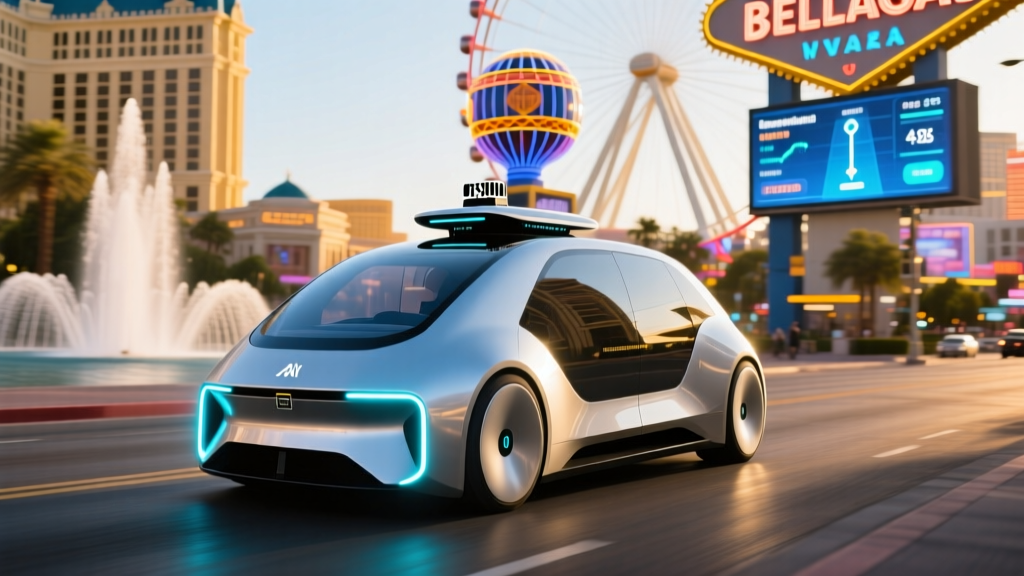
If you have searched for a Vegas self-driving taxi hoping to hail a driverless pod from McCarran to the Bellagio, the short answer in early 2026 is: you cannot yet do that the way you would in Phoenix or San Francisco. Las Vegas is not a live, city-wide robotaxi market, but it is one of the most important testing and limited-deployment grounds in the United States. Motional (the Hyundai-Aptiv joint venture) has operated Level 4 Hyundai Ioniq 5 robotaxis on a bounded section of the Strip and downtown since 2023, Zoox has been testing its purpose-built bidirectional vehicle on public roads since 2024, and Waymo has signaled Las Vegas as a priority expansion city. None of these equate to an open, Uber-style hail-anywhere service today.
This guide cuts through the hype and tells you exactly which robotaxi services you can actually ride in Las Vegas right now, what they cost, how safe the data says they are, and what is still on the horizon.
Is a Vegas Self-Driving Taxi Truly Self-Driving or Just Driver-Assist?
This is the single most important distinction to make before you step into any autonomous vehicle. Consumer cars sold to you — a Tesla on FSD (Supervised), a GM with Super Cruise, a Ford with BlueCruise — are SAE Level 2 driver-assist systems. A human must remain engaged, eyes on the road or ready to take over, and is legally responsible for every mile. Robotaxis like Waymo's Jaguar I-PACE and Zoox's Gen 3 vehicle are SAE Level 4: no human driver in the loop, within a defined operational design domain (ODD). If the system cannot handle a situation, it performs a minimal-risk maneuver (pulls over safely) rather than handing control to a passenger.
SAE Automation Levels — What They Actually Mean
| Level | Name | Who Drives | Example |
|---|---|---|---|
| 0 | No Automation | Human | Any conventional car |
| 1 | Driver Assistance | Human (system assists steering OR speed) | Adaptive cruise control |
| 2 | Partial Automation | Human (must supervise) | Tesla Autopilot/FSD, Super Cruise, BlueCruise |
| 3 | Conditional Automation | System (human must take over on request) | Mercedes Drive Pilot (limited markets, ≤40 mph) |
| 4 | High Automation | System (within geofenced ODD, no human needed) | Waymo, Zoox, Motional robotaxis |
| 5 | Full Automation | System (anywhere, any condition) | Does not exist commercially |
A Vegas self-driving taxi operating today is either Level 4 (rider-only, geofenced) or a Level 2 vehicle with a safety driver behind the wheel during testing. There is no Level 5 robotaxi anywhere in the world.
Where Can I Actually Use a Robotaxi in Las Vegas Right Now?
Las Vegas is unusual because several operators are present, but almost none offer open, on-demand rides to the general public the way Waymo does in Phoenix and San Francisco. Here is the current status as of early 2026:
| Operator | Vegas Status (2026) | Vehicle | How to Ride |
|---|---|---|---|
| Motional (Hyundai + Aptiv) | Limited public rides via Lyft; bounded Strip/downtown ODD | Hyundai Ioniq 5 robotaxi (Level 4) | Lyft app, when matched in geofence |
| Zoox (Amazon) | Public-road testing; limited invite-only rider program | Zoox Gen 3 bidirectional pod (Level 4) | Zoox app (invite-only waitlist) |
| Waymo (Alphabet) | Mapping and testing; not yet a live commercial market | Jaguar I-PACE / next-gen Geely (Level 4) | Not available in Vegas yet |
| Cruise (GM) | Suspended operations since Oct 2023; no Vegas return announced | Chevrolet Bolt EV / Origin | Not available |
Sources: operator press releases, NHTSA AV resources, Nevada Department of Motor Vehicles AV testing permits.
The practical upshot: if you are visiting Las Vegas and want a robotaxi experience, your best bet is to check the Lyft app while on or near the Strip and see if a Motional Ioniq 5 is matched to your trip. Availability is not guaranteed — Lyft may dispatch a conventional driver instead — and the geofence is limited to a defined corridor covering parts of the Strip, the Convention Center, and downtown Fremont Street. You cannot currently hail a robotaxi from the airport, to suburban Henderson, or on long highway runs.
How Much Does a Vegas Robotaxi Cost vs Uber or Lyft?
Robotaxi pricing is not yet a free market; it is set by operators trying to build ridership while covering enormous R&D costs. Based on published fares in Waymo's live markets and Motional's Lyft integration in Las Vegas, here is how pricing compares for a representative 3.5-mile Strip-to-downtown trip:
| Service | Typical Fare (3.5 mi) | Surge Behavior | Tips |
|---|---|---|---|
| Motional via Lyft (robotaxi) | $10–$18 (often promotional) | Generally no surge; limited supply | No driver to tip |
| Lyft / UberX (human driver) | $12–$22 | Surge pricing during events, weekends | $2–$5 tip expected |
| Waymo (Phoenix/SF reference) | $10–$20 | Modest demand pricing | No driver to tip |
| Waymo (Vegas) | Not yet available | — | — |
Two things work in the rider's favor. First, robotaxi operators aggressively discount early rides to build familiarity — Motional and Waymo have both run "first ride free" or heavily subsidized promotions. Second, there is no driver to tip, which typically knocks 15–20% off the effective cost versus a human-driven rideshare. The trade-off is availability: you may wait longer or not be matched at all during peak convention or weekend hours, when human rideshare is plentiful but surge-priced.
How Safe Are Robotaxis — What Does the Real Data Show?
Safety is the right question to ask, and the answer requires separating miles of operation from headline incidents. According to California DMV disengagement reports and NHTSA standing general orders, Level 4 robotaxis from Waymo have logged tens of millions of fully driverless miles across Phoenix, San Francisco, Los Angeles, and Austin. The most comprehensive independent analysis to date, from the Insurance Institute for Highway Safety (IIHS) and university researchers, found that Waymo's driverless vehicles were involved in property-damage-at-fault crashes at roughly 70–80% lower rates than comparable human-driven vehicles in the same cities, and injury-related claims were lower still — though sample sizes remain in the low millions of miles, not billions.
Robotaxi Safety Snapshot
- Waymo driverless miles (cumulative): >30 million fully autonomous miles as of 2025 reporting.
- At-fault property-damage crash rate: approximately 0.3–0.4 per million miles, vs ~1.5–2.0 per million for human baselines (IIHS/HLDI analysis).
- Disengagements: declining year over year; Waymo reports fewer than 1 per 10,000 miles in mature markets.
- Serious incidents: a small number of low-speed collisions with pedestrians and first-responder vehicles have been reported to NHTSA; Cruise's Oct 2023 San Francisco pedestrian-drag incident led to its California permit suspension and national pullback.
- Motional (Vegas): no publicly reported serious injury incidents on its Strip ODD through early 2026; operating with a safety driver in many trips.
Context: a robotaxi's safety record must be compared to human drivers in the same dense urban environment, not to an idealized "zero incident" standard. Humans in U.S. cities average roughly 1.5–2.0 police-reported crashes per million miles.
For Las Vegas specifically, the relevant comparison is the Strip and downtown corridor — heavy pedestrian traffic, jaywalking, construction zones, and event-driven congestion. Motional's decision to keep a safety driver in many Vegas Ioniq 5 runs (rather than full driverless) reflects the difficulty of this environment, not a failure of the technology broadly.
What Technology Makes a Vegas Robotaxi Work?
Every Level 4 robotaxi on Las Vegas streets relies on a redundant sensor stack, not a single camera. The technology choices differ by operator, but the architecture is converging:
Typical Level 4 Robotaxi Sensor Stack
- LiDAR (primary 3D perception): multiple roof- and bumper-mounted units generating a real-time point cloud out to 200–300 meters. Works in darkness and most weather. Suppliers: Hesai, Luminar, Innoviz, Waymo's in-house "Laser Bear Honeycomb."
- Cameras (classification and color): 8–12 high-resolution cameras for traffic-light state, signage, lane markings, and object classification. Tesla's FSD is the outlier, using cameras only; no Level 4 robotaxi operator has followed that approach.
- Radar (redundancy and velocity): 4–6 imaging radars for long-range object detection and direct velocity measurement, especially in rain or fog where LiDAR degrades.
- HD maps + localization: centimeter-accurate pre-built maps fused with real-time GNSS and IMU data. Geofencing restricts operation to mapped, approved ODDs.
- Compute: trunk-mounted NVIDIA DRIVE Orin or custom ASIC clusters running 200–500+ TOPS of inference, with redundant power and braking paths.
The "geofence" is what makes Level 4 tractable today: the vehicle only operates where it has been exhaustively mapped and validated. Step outside that boundary and the system will not engage.
For Vegas, the geofence matters enormously. The Strip is a mapped, relatively predictable corridor, but the moment a robotaxi would need to navigate an unmapped construction detour or a temporary event-closure reroute, it is outside its ODD. This is why operators expand geofences slowly, block by block.
Who Regulates Self-Driving Taxis in Las Vegas?
Robotaxi regulation in the United States is a layered patchwork, and Nevada is one of the more permissive states for testing and deployment:
- Federal (NHTSA): sets vehicle safety standards (FMVSS) and requires incident reporting via standing general order. NHTSA does not currently "approve" robotaxi operations — it investigates crashes and can issue recalls.
- State of Nevada: Nevada DMV issues Autonomous Vehicle Testing and Deployment permits. Operators must carry $5M+ liability insurance, submit safety plans, and report disengagements and collisions. Nevada law (NRS 482A) explicitly allows driverless operation with a permit.
- Local (Clark County / City of Las Vegas): local jurisdictions can impose additional operational restrictions, particularly around the Strip corridor and event zones.
- California comparison: California's CPUC and DMV jointly regulate robotaxis, which is why Cruise's permit was suspended there in 2023. Nevada's framework is less adversarial but still permit-based.
For a rider, the practical implication is that any robotaxi you can legally hail in Las Vegas has been permitted by the Nevada DMV and is subject to state incident-reporting requirements. Unpermitted "self-driving" rides do not exist in the commercial market.
Current Limitations You Will Hit With a Vegas Robotaxi
- Geofence boundaries: you cannot hail a robotaxi from Harry Reid International Airport, to suburban Summerlin or Henderson, or on long highway stretches. Service is confined to a bounded Strip/downtown ODD.
- No-go scenarios: heavy rain (rare in Vegas but real during monsoon season), dense smoke from regional wildfires, or unmapped construction detours will cause the vehicle to pull over or refuse the trip.
- Availability, not on-demand: fleet sizes in Vegas are measured in dozens of vehicles, not thousands. Expect longer wait times or no match at all during CES, F1, March Madness, or New Year's Eve.
- No highway driving: current Vegas robotaxi ODDs are surface-street only. A trip from the Strip to Lake Mead or Red Rock Canyon is not possible.
- Luggage and accessibility: Motional's Ioniq 5 and Zoox's pod have limited trunk/cabin space compared to an Uber XL. Wheelchair-accessible robotaxis are not yet deployed at scale in Vegas.
- No eating, smoking, or pets: all operators enforce cabin rules via interior cameras; violations can end your ride and result in fees.
- Edge cases: jaywalking crowds on the Strip, erratic human drivers, and temporary event barricades remain the hardest scenarios. Expect conservative, sometimes slow, driving behavior.
These limitations are not unique to Vegas — they describe the current state of Level 4 robotaxis everywhere. The difference is that Vegas's tourism-heavy, pedestrian-dense environment makes them more visible than in Phoenix's suburban sprawl.
When Will Waymo and Others Fully Launch in Las Vegas?
Waymo has publicly listed Las Vegas as a future expansion market, and its mapping vehicles have been active on Strip-adjacent streets since 2024. Based on the typical Waymo rollout pattern — mapping → employee-only rides → invite-only public → open commercial service — a full open-access Waymo launch in Vegas is plausible in the 2026–2027 window but not confirmed. Zoox has similarly signaled Vegas interest, tied to its purpose-built Gen 3 vehicle's production ramp. Motional, after a 2024 restructuring, has scaled back its Lyft-based public rides and is focused on a next-generation platform with Hyundai; its Vegas footprint may shrink before it grows.
The honest forecast: by late 2026 or 2027, a visitor to Las Vegas will likely be able to hail a Waymo or Zoox robotaxi on the Strip through a mainstream app. A true airport-to-hotel robotaxi, or service that covers the broader metro area, is years further out and depends on regulatory approval for highway ODDs.
FAQ: Vegas Self-Driving Taxi
Can I hail a driverless taxi on the Las Vegas Strip today?
Sometimes, yes — via the Lyft app, which may match you with a Motional Hyundai Ioniq 5 robotaxi inside its geofence. It is not guaranteed, and many matches still include a safety driver. Waymo and Zoox are not yet open to the general public in Vegas.
How much does a Vegas robotaxi cost compared to Uber?
On comparable 3–4 mile Strip trips, robotaxi fares through Lyft are typically $10–$18, often with promotional discounts and no tip required. Uber/Lyft with a human driver runs $12–$22 plus tip, with surge pricing during events. Robotaxis are cost-competitive when available, but availability is the bottleneck.
Are Vegas robotaxis safe?
Available data from IIHS, NHTSA, and operator reports shows Level 4 robotaxis (primarily Waymo) have lower at-fault crash rates per million miles than human drivers in the same cities. Motional's Vegas operations have not produced publicly reported serious injury incidents through early 2026. Sample sizes are still in the tens of millions of miles, not billions.
Why can't I take a robotaxi to the Las Vegas airport?
Harry Reid International Airport is outside the current geofenced operational design domains of every robotaxi operator in Vegas. Airport access requires highway driving, regulatory agreements with the airport authority, and dedicated pickup infrastructure — none of which are in place yet.
Is Tesla's FSD the same as a Vegas robotaxi?
No. Tesla FSD (Supervised) is an SAE Level 2 driver-assist system requiring a licensed, attentive human driver who is legally responsible for the vehicle. A Motional, Waymo, or Zoox robotaxi is SAE Level 4 — no human driver in the loop, within a defined geofence. They are fundamentally different categories of technology and regulation.
Will robotaxis replace Uber and Lyft in Las Vegas?
Not in the near term. Robotaxis will complement human rideshare, initially covering dense, well-mapped corridors like the Strip while human drivers handle suburbs, highways, airports, and peak-demand events. A full replacement of human drivers in a market like Las Vegas is a decade-plus horizon, dependent on technology, regulation, and labor dynamics.