Las Vegas has become one of the most active testing and deployment grounds for autonomous ride-hailing in the United States. If you've searched for a Vegas driverless car and wondered whether you can actually hail one today — and how the experience compares to Uber or Lyft — this guide breaks down the real operational landscape, pricing, safety records, and limitations as of 2026.
Two major players currently operate or are actively deploying driverless taxi service on the Strip and surrounding areas: Waymo (Alphabet/Google) and Zoox (Amazon). A third, Motional (Hyundai/Aptiv joint venture), has conducted extensive testing in Las Vegas but has scaled back its commercial timeline. Here's what you need to know before you tap "request ride."
What "Driverless" Actually Means: SAE Automation Levels
Before booking a ride, it's critical to understand what level of autonomy you're getting. Consumer vehicles like Teslas with FSD (Supervised) or GM vehicles with Super Cruise are not driverless — they are SAE Level 2 systems that require continuous driver attention. Robotaxis operating in Las Vegas are a fundamentally different category.
| Level | Name | Who Drives | Example |
|---|---|---|---|
| Level 0 | No Automation | Human | Basic cruise control |
| Level 1 | Driver Assistance | Human + system assists steering OR speed | Adaptive cruise control |
| Level 2 | Partial Automation | Human must supervise at all times | Tesla Autopilot, GM Super Cruise, Ford BlueCruise |
| Level 3 | Conditional Automation | System drives in limited conditions; human must take over on request | Mercedes DRIVE PILOT (limited markets) |
| Level 4 | High Automation | System drives fully within its operational domain — no human needed | Waymo One, Zoox (geofenced areas) |
| Level 5 | Full Automation | System drives everywhere, all conditions | Does not exist commercially |
Key takeaway: Vegas robotaxis from Waymo and Zoox are SAE Level 4 — fully driverless within their geofenced service areas. There is no human behind the wheel, and no steering wheel in the Zoox vehicle at all. This is categorically different from any consumer car you can buy.
Where Can You Hail a Driverless Car in Las Vegas Right Now?
Service availability in Las Vegas is expanding but remains geofenced to specific corridors. You cannot summon a robotaxi to every address in the metro area — coverage is concentrated around high-demand tourist and commercial zones.
| Provider | Vehicle | Service Area | Status | How to Book |
|---|---|---|---|---|
| Waymo | Jaguar I-PACE (5th-gen sensor suite) | Las Vegas Strip corridor, Harry Reid International Airport (LAS), downtown Fremont St., portions of Summerlin | Commercial service — Waymo One app | Waymo One app (iOS/Android) |
| Zoox | Zoox purpose-built carriage (no steering wheel) | Las Vegas Strip (resort corridor), limited downtown coverage | Commercial service — invite/early access via Zoox app | Zoox app (limited rollout, waitlist may apply) |
| Motional | Hyundai IONIQ 5 robotaxi | Las Vegas (testing zones) | Testing with safety driver — no public commercial rides as of 2026 | N/A |
Waymo has the broader footprint. Its Las Vegas service area covers the major resort corridor from Mandalay Bay north through downtown, plus airport pickups. Waymo launched in Las Vegas following its successful deployments in Phoenix, San Francisco, Los Angeles, and Austin. You can open the Waymo One app, enter your destination, and if it falls within the geofence, a driverless Jaguar I-PACE will arrive — no human in the front seat.
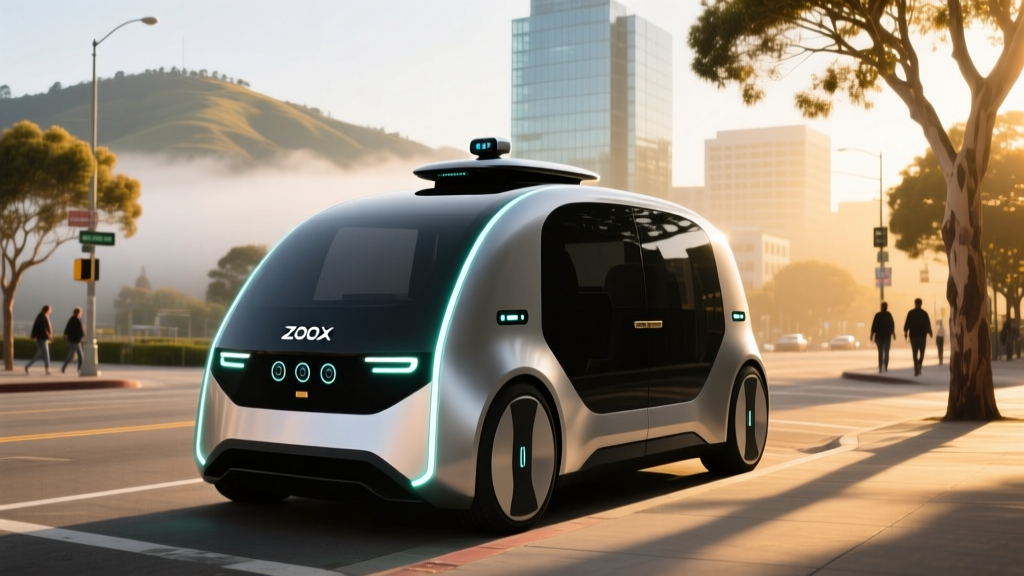
Zoox operates its distinctive bidirectional, carriage-style vehicle (which has no steering wheel, pedals, or mirrors) on the Strip. Zoox began offering rides to members of the public in Las Vegas through its app, though access has been more limited than Waymo's. Zoox's vehicle is purpose-built for autonomy — it can drive equally well in either direction and features four-wheel steering for tight urban maneuvers.
How Much Does a Vegas Robotaxi Cost vs. Uber and Lyft?
Pricing is one of the most common questions, and the answer may surprise you: robotaxis are generally priced to compete directly with rideshare, not at a premium.
| Service | Estimated Fare | Surge Pricing? | Tipping | Notes |
|---|---|---|---|---|
| Waymo One | $12–$18 | Dynamic pricing, but generally less volatile than Uber surge | Optional in-app tip | Pricing comparable to UberX; promos for new riders |
| Zoox | $10–$16 | Limited data; early access pricing may be subsidized | Optional in-app tip | Smaller service area may limit availability |
| UberX | $13–$22 | Yes — can spike 1.5–3x during peak | Expected (15–20%) | Widest availability across Vegas metro |
| Lyft Standard | $12–$20 | Yes — Prime Time pricing | Expected (15–20%) | Comparable to UberX |
Fares are estimates based on publicly reported pricing and rider reports. Actual costs vary by time of day, demand, and exact route. Robotaxi fares do not include a tip expectation, which can make the effective cost lower than rideshare even when base fares are similar.
The total cost advantage of a robotaxi becomes clearer when you factor in tipping. A $15 UberX ride with a 20% tip lands at $18, while a $15 Waymo ride with no tip expectation stays at $15. Waymo and Zoox do not require or prompt for tips, though both apps allow optional gratuities.
How Safe Are Vegas Robotaxis? The Real Data
Safety is the most scrutinized aspect of autonomous vehicles, and it deserves a data-driven answer — not marketing claims or anecdotal fear. Both Waymo and Zoox report safety metrics to regulators, and independent analyses have been published.
Waymo Safety Record (through 2025)
- Over 10 million fully driverless miles completed across all markets (Phoenix, SF, LA, Austin, Las Vegas) as of late 2025, per Waymo's published safety data.
- 75% fewer police-reported crashes compared to human benchmarks in equivalent urban driving environments, according to a study by the Insurance Institute for Highway Safety (IIHS) and Waymo's own actuarial analysis.
- 85% reduction in injury-causing crash involvement versus human drivers in the same geographies.
- Most incidents involving Waymo vehicles are minor, low-speed contacts (parking lot scrapes, being rear-ended at stoplights) — consistent with or better than human driver rates.
Zoox Safety Record
- Zoox has logged millions of autonomous miles in Las Vegas and Foster City, CA, though it publishes less granular public data than Waymo.
- Zoox's purpose-built vehicle includes redundant braking, steering, and computing systems — if one system fails, a backup takes over without human intervention.
- No publicly reported serious injuries attributed to Zoox's autonomous operation as of early 2026.
Context: The Cruise Incident (2023)
Any honest safety discussion must address the October 2023 Cruise robotaxi incident in San Francisco, where a pedestrian was dragged after being thrown into the path of a Cruise vehicle by a human-driven car. That incident led to Cruise's California permit suspension by the DMV and eventual shutdown of the service by GM in 2024. It also prompted NHTSA investigations and tighter regulatory scrutiny industry-wide. The incident underscored that while robotaxis have strong aggregate safety records, edge cases remain a challenge, and regulatory oversight matters.
The data consistently shows that Level 4 robotaxis, in their geofenced domains, have crash rates at or below those of attentive human drivers. However, "at or below" is not "zero risk" — and the types of failures (unusual edge cases) differ from typical human errors (distraction, impairment).
Under the Hood: Robotaxi Technology Stack
The vehicles picking you up on the Las Vegas Strip are rolling sensor platforms. Understanding what's on the roof and behind the panels helps explain both the capabilities and the limitations.
Waymo (5th-Generation Jaguar I-PACE)
| Sensor Type | Count | Function |
|---|---|---|
| LiDAR (custom spinning + solid-state) | 5+ units | 360° 3D point cloud, object detection to ~500m |
| Cameras | 29 cameras | Traffic light state, signage, lane markings, pedestrian intent |
| Radar | 6 units | Velocity detection, all-weather object tracking |
| External audio receivers | Multiple | Detect sirens, horns, emergency vehicles |
Zoox (Purpose-Built Carriage)
| Sensor Type | Count | Function |
|---|---|---|
| LiDAR | Multiple (integrated into body) | 360° perception, redundant coverage with no blind spots |
| Cameras | Multiple arrays | Full surround visual perception |
| Radar | Multiple units | Velocity and distance, weather resilience |
| Redundant compute | Dual independent systems | If primary compute fails, backup maintains safe operation |
A critical distinction: both Waymo and Zoox use LiDAR + cameras + radar sensor fusion. This contrasts with Tesla's camera-only approach for its consumer FSD (Supervised) system. In the robotaxi context, LiDAR provides a hardware-redundant depth map that doesn't depend on lighting conditions — a meaningful advantage for nighttime Strip operations where neon, headlights, and shadows create visually chaotic environments.
Both systems also rely on HD mapping and geofencing. The vehicles operate only within pre-mapped corridors where every lane, intersection, and traffic signal has been cataloged at centimeter-level precision. This is why you can't summon a Waymo to a random suburban cul-de-sac in Henderson — the vehicle simply won't operate outside its validated domain.
Regulatory Landscape: Who Approves Robotaxis in Nevada?
Autonomous vehicle operations in Las Vegas are governed by a layered regulatory framework:
- Nevada state law (NRS 482A) was among the first in the U.S. to authorize autonomous vehicle testing and operation. The Nevada DMV issues autonomous vehicle testing and deployment permits.
- Nevada Department of Transportation (NDOT) oversees roadway infrastructure compatibility and can restrict operations on specific routes.
- NHTSA (federal) sets vehicle safety standards and investigates incidents. NHTSA's Standing General Order requires all Level 4 operators to report crashes involving their autonomous systems.
- Clark County and City of Las Vegas manage local permitting, including pickup/dropoff zones on the Strip and at Harry Reid International Airport.
Waymo holds active commercial deployment permits in Nevada. Zoox has operated under Nevada's autonomous vehicle framework since its early testing phases. The regulatory environment in Nevada is generally considered favorable to AV deployment — the state was a first mover and has maintained a permissive but oversight-driven approach, in contrast to states like California where the DMV and CPUC have imposed stricter permitting requirements following the Cruise incident.
Current Limitations: What a Vegas Robotaxi Cannot Do
Robotaxis are impressive within their domain, but that domain has hard boundaries. Here are the limitations you'll encounter in practice:
⚠ Operational Limitations
- Geofence boundaries: You cannot ride a robotaxi from the Strip to Red Rock Canyon, Lake Mead, or most residential suburbs. If your destination falls outside the mapped service area, the app will not let you book the ride.
- Weather restrictions: While Las Vegas is mostly dry, heavy rain or flash-flood conditions can cause Waymo and Zoox to suspend service. Their sensors perform well in light rain but degrade in heavy precipitation. Snow and ice (rare in Vegas but possible in winter) would ground the fleet entirely.
- Construction zones: Major roadwork that changes lane configurations can confuse HD-map-based systems. Expect longer routes or service pauses near active construction corridors.
- No highway driving (Zoox): Zoox's carriage-style vehicle is designed for urban speeds (up to ~75 mph capability but typically operates below 45 mph). It does not operate on freeways. Waymo's I-PACE can handle highway segments within its geofence.
- Pickup/dropoff precision: Robotaxis pull to designated or safe curbside locations — they won't pull into a hotel valet lane, a parking garage, or a private driveway. You'll walk to the car, not the other way around.
- Accessibility: Waymo's Jaguar I-PACE requires passengers to enter a standard SUV. Zoox's carriage is designed with level-floor entry for wheelchair accessibility, but availability of wheelchair-accessible vehicles is limited. Neither service currently accommodates car seats for small children.
- No food or drink, no smoking: Both services enforce strict interior cleanliness policies. Damage or mess fees apply.
- Passenger limits: Waymo seats up to 3 passengers (front seat is blocked off). Zoox seats 4 passengers (two facing forward, two facing backward).
These limitations are not theoretical — they directly affect your ride experience. If you're planning a trip from a Strip hotel to the airport at 2 AM after a rainstorm, a robotaxi may not be available, and you'll need a rideshare backup plan.
The Ride Experience: What to Expect
For first-time riders, the experience is surprisingly mundane — which is arguably the point. Here's the typical flow:
- Request: Open the Waymo One or Zoox app, enter your destination. The app confirms whether the trip is within the service area and provides an estimated fare and wait time (typically 3–8 minutes on the Strip).
- Arrival: The vehicle pulls to a safe curb location. The app shows a photo of the car and its license plate. For Waymo, you tap a "start ride" button on the roof screen or in the app to unlock the doors.
- In-ride: The interior screen shows the vehicle's perception of the world — pedestrians, other cars, lane markings, traffic lights rendered in real time. You can adjust the climate control and music. There is no driver to talk to.
- Arrival: The vehicle pulls over safely, and the doors unlock. You exit, and the vehicle drives away to its next passenger or a staging area.
The driving itself is deliberate and conservative. Robotaxis obey speed limits, come to complete stops at stop signs (no "California rolls"), and yield generously to pedestrians. Some riders find the driving style overly cautious — the car may pause at a four-way stop longer than a human would, or brake earlier than expected for a yellow light. This conservatism is intentional: the optimization target is safety, not speed.
Frequently Asked Questions
Is a Vegas driverless car truly self-driving, or is there a human monitoring remotely?
The vehicles are fully autonomous (SAE Level 4) within their geofenced areas — there is no human in the car, and no remote joystick operator driving the vehicle in real time. However, both Waymo and Zoox employ remote fleet-assist teams that can be consulted if the vehicle encounters an unusual situation (e.g., a road completely blocked by an unexpected obstacle). The remote team does not "drive" the car but can help the system understand the scene and choose a safe path. Think of it as on-call technical support, not remote control.
Can I use a Vegas driverless car to go to the airport?
Yes — Waymo One includes Harry Reid International Airport (LAS) in its service area. You can request a ride from the Strip to the airport or from the airport to a destination within the geofence. Look for designated robotaxi pickup zones at the airport; the app will guide you to the correct spot.
Are robotaxis available 24/7 on the Las Vegas Strip?
Waymo operates in Las Vegas around the clock, though wait times may be longer during very late-night or early-morning hours when fleet density is lower. Zoox's hours may be more limited during its early access phase. During major events (CES, New Year's Eve, Super Bowl weekend), demand can outstrip supply, and you should expect longer wait times or temporary service unavailability.
What happens if the robotaxi breaks down or gets into an accident during my ride?
Both Waymo and Zoox vehicles have redundant systems (dual braking, dual steering, dual compute). If a component fails, the vehicle is designed to pull over safely and contact the fleet-operations center. In the event of a collision, the vehicle stops, contacts emergency services if needed, and a support team is dispatched. You can also reach a live support agent at any time via the in-vehicle screen or app.
Do I need a special app or account to ride?
Yes. Download the Waymo One app (available on iOS and Android) or the Zoox app. You'll need to create an account, add a payment method, and agree to the rider terms. Waymo One is widely available; Zoox may require joining a waitlist depending on current access levels.
How do Vegas robotaxi prices compare to a taxi from the airport?
A traditional taxi from Harry Reid Airport to a mid-Strip hotel typically costs $25–$35 (metered, plus tip). A Waymo for the same route generally falls in the $15–$22 range, making it a meaningful savings — especially since there's no tip expectation. However, taxi availability is immediate at the airport taxi stand, while a robotaxi may require a short wait and a walk to a designated pickup zone.
Sources: Waymo Safety Report, NHTSA Automated Vehicle Safety, Insurance Institute for Highway Safety (IIHS), Nevada DMV Autonomous Vehicle Program. Pricing data reflects publicly reported fares and rider reports as of early 2026; actual fares may vary.