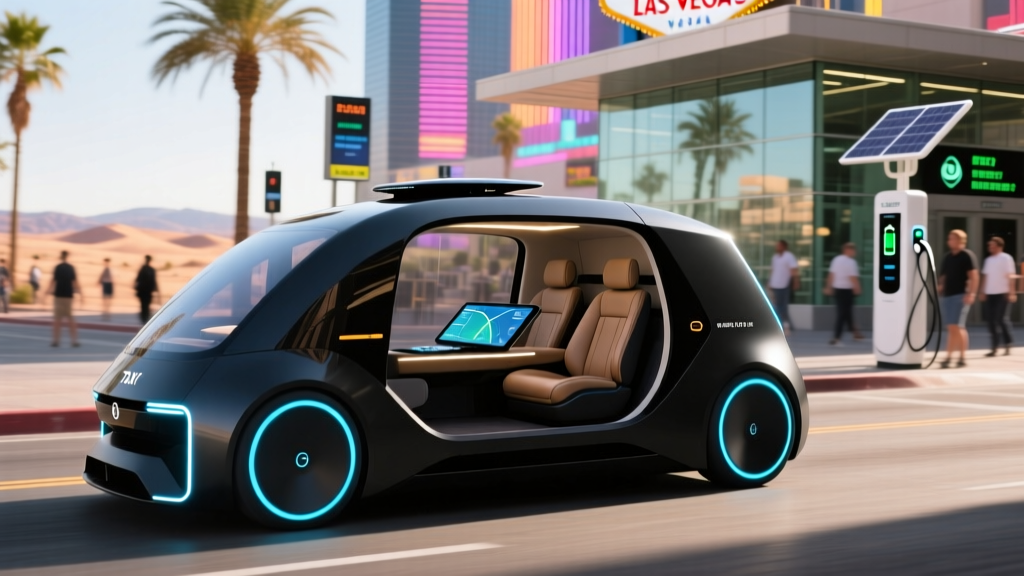
Las Vegas has become one of the most active testing grounds for autonomous vehicles in the United States. Between the Strip's dense pedestrian traffic, 24-hour road activity, and Nevada's permissive regulatory framework, the city attracts multiple robotaxi operators simultaneously. If you've searched for vegas autonomous cars and wondered whether you can actually hail a driverless ride today — and what that experience involves — this guide breaks down exactly what's available, what it costs, and what the safety data shows.
What Level of Autonomy Are Vegas Robotaxis?
The robotaxis operating in Las Vegas — including Waymo's fifth-generation vehicles and Motional's Hyundai Ioniq 5-based platform — are SAE Level 4. This means the vehicle handles all driving tasks within a defined operational design domain (ODD) with no human driver required. There is no steering wheel interaction, no "driver must remain engaged" caveat.
This is fundamentally different from Tesla's FSD (Supervised), GM's Super Cruise, or Ford's BlueCruise, which are SAE Level 2 systems requiring continuous driver attention. Consumer Level 2 systems assist; Level 4 robotaxis replace the driver entirely — but only within their geofenced service area.
| Level | Name | Who Drives | Example |
|---|---|---|---|
| Level 2 | Partial Automation | Human (must supervise) | Tesla Autopilot/FSD, BlueCruise, Super Cruise |
| Level 3 | Conditional Automation | System (human on standby) | Mercedes Drive Pilot (limited markets) |
| Level 4 | High Automation | System (no human needed in ODD) | Waymo, Motional, Zoox robotaxis |
| Level 5 | Full Automation | System (all conditions, everywhere) | Does not exist commercially |
Where Can I Use Robotaxi Services in Las Vegas Right Now?
As of early 2026, two primary robotaxi operators serve Las Vegas, each with distinct coverage areas and access models.
| Operator | Vehicle Platform | Coverage Area | Access Method | Hours |
|---|---|---|---|---|
| Waymo | Jaguar I-PACE (Gen 5) | Strip corridor, Downtown, Convention Center, portions of Summerlin | Waymo One app | 24/7 |
| Motional | Hyundai Ioniq 5 Robotaxi | Strip corridor (resort pickups/dropoffs), Harry Reid Airport route | Uber app (Motional option), Lyft app | Limited hours (~7am–1am) |
Waymo's Las Vegas footprint expanded throughout 2025, moving beyond initial Strip-only service to include downtown Fremont Street and suburban corridors. Motional, the Hyundai-Aptiv joint venture, operates a narrower but strategically placed network focused on high-volume resort destinations and airport transfers.
Important caveat: Neither service covers the entirety of the Las Vegas metropolitan area. Suburban Henderson, North Las Vegas, and Red Rock Canyon remain outside current geofences. If your trip origin or destination falls outside the ODD, the app will not allow you to book.
How Much Does a Vegas Robotaxi Cost vs Uber and Lyft?
Pricing for autonomous rides in Las Vegas is competitive with standard rideshare, though surge dynamics differ. Robotaxis don't surge based on driver scarcity (there's no human driver to incentivize), but they do implement demand-based pricing during peak hours.
| Service | Base Fare (off-peak) | Peak/Surge Range | Tip Expected? |
|---|---|---|---|
| Waymo One | $12–$18 | $18–$28 | No (optional in-app) |
| Motional (via Uber) | $14–$20 | $20–$32 | No |
| UberX | $11–$16 | $22–$45 | Yes (15–20% typical) |
| Lyft Standard | $10–$15 | $20–$40 | Yes (15–20% typical) |
On a total-cost basis, robotaxis often undercut rideshare during high-surge events (New Year's Eve, major conventions) because their pricing algorithms are less aggressive. During off-peak weekday afternoons, a standard UberX may be $2–$4 cheaper — but factor in the zero-tip expectation and the consistency of autonomous vehicle arrival times, and the gap narrows significantly.
Waymo periodically offers promotional credits for new users in new markets. Check the Waymo One app for current Las Vegas onboarding offers.
How Safe Are Vegas Autonomous Cars? The Real Data
- Over 30 million fully driverless miles completed across all markets
- Fatal crash involvement rate: lower than human benchmarks per NHTSA comparative data
- Injury-causing crash rate: approximately 85% lower than human drivers in comparable urban environments (per Waymo's published safety case, peer-reviewed methodology)
- Police-reported contact rate: roughly 5.5 per million miles vs. human baseline of ~14 per million miles (property-damage-only included)
Motional's Las Vegas fleet has logged over 2 million autonomous miles in the city as of late 2025, with zero reported at-fault collisions involving injury. The company's earlier Ioniq 5 robotaxi deployment in Las Vegas (2022–2023) served over 100,000 rides with safety operators before transitioning to fully driverless service.
Context matters: robotaxis operate under conservative driving profiles. They do not exceed speed limits, they yield aggressively at unprotected left turns, and they pull over (perform a "minimal risk condition" stop) when sensor confidence drops below threshold. This means most incidents involving robotaxis are rear-end collisions caused by human drivers — not at-fault events by the autonomous system.
The NHTSA Standing General Order requires all Level 4 operators to report crashes involving their vehicles, providing a transparency layer that human-driver crashes do not have. This makes robotaxi safety data more scrutinized — and more complete — than conventional driving statistics.
Under the Hood: What Sensors and Tech Power Vegas Robotaxis?
Unlike Tesla's camera-only approach (used in its Level 2 FSD system), every commercial robotaxi in Las Vegas relies on a multi-sensor fusion stack combining lidar, radar, and cameras. Here's how the hardware breaks down:
Waymo Gen 5 (Jaguar I-PACE)
- Lidar: 5 custom Waymo units (roof-mounted + perimeter), providing 360° 3D point clouds at up to 500m range
- Cameras: 29 high-resolution cameras covering all sightlines, including dedicated traffic-light and signal-reading optics
- Radar: 6 imaging radar units for velocity detection in rain/fog where lidar degrades
- Compute: Custom Waymo AI inference hardware, ~500 TOPS equivalent
- HD Maps: Centimeter-precision pre-mapped routes, updated continuously
Motional (Hyundai Ioniq 5 Robotaxi)
- Lidar: Roof-mounted array plus corner-mounted short-range units (supplied by Aptiv)
- Cameras: 12+ surround-view cameras with dedicated perception and localization functions
- Radar: 5 forward and corner radars for object velocity tracking
- Compute: Aptiv satellite architecture with redundant compute domains
- HD Maps: Pre-mapped ODD with real-time change detection
The reliance on lidar is the key differentiator from consumer ADAS. Lidar provides depth perception independent of lighting conditions — critical for Las Vegas, where nighttime neon, tunnel transitions, and harsh midday sun create challenging contrast environments that camera-only systems struggle with at Level 4 confidence thresholds.
Regulatory Framework: Who Approves Robotaxis in Nevada?
Nevada was the first U.S. state to pass autonomous vehicle legislation (AB 511, 2011), and its regulatory framework remains one of the most permissive in the country. Here's how oversight works:
- Nevada DMV: Issues autonomous vehicle testing and deployment permits. Operators must demonstrate insurance coverage ($5M minimum liability), pass a technology evaluation, and maintain incident reporting.
- Nevada Legislature: Sets statutory boundaries — Nevada law explicitly allows fully driverless operation (no safety operator required) for permitted entities.
- NHTSA (Federal): Oversees vehicle safety standards (FMVSS). Current FMVSS rules assume a human driver (steering wheel, mirrors), requiring operators like Zoox to petition for exemptions for purpose-built vehicles without manual controls.
- City of Las Vegas / Clark County:Manage local road access, curb pickup/dropoff zones, and coordination with first responders for stalled-vehicle protocols.
Nevada does not require a separate human "safety driver" in the vehicle for Level 4 deployment — unlike California, where DMV and CPUC permits impose additional reporting and operational restrictions. This regulatory environment is a significant reason why Las Vegas attracts robotaxi investment.
Current Limitations: What Vegas Robotaxis Cannot Do
Level 4 autonomy is powerful but bounded. Here are the real-world constraints you'll encounter:
- Geofence boundaries: Trips outside the mapped ODD are blocked. You cannot ride a robotaxi to Red Rock Canyon, Lake Mead, or most of Henderson.
- Heavy rain/monsoon: Las Vegas summer monsoons can trigger service suspension. Lidar scattering in heavy precipitation reduces sensor confidence below operational thresholds.
- Construction zones: Unmapped lane closures or temporary traffic patterns may cause the vehicle to stop and request remote assistance, adding 5–15 minutes to your trip.
- Parking structures: Most robotaxis cannot navigate multi-level parking garages. Pickups and dropoffs occur at curb-level designated zones only.
- Large events: During extreme crowd events (NYE on the Strip, Super Bowl week), portions of the geofence may be suspended due to pedestrian density exceeding system design parameters.
- No highway merging (limited): Some routes avoid high-speed limited-access highways. Check your specific route in-app — airport runs may use surface streets instead of I-15.
- Wheelchair/accessibility: Current Waymo Jaguar I-PACE vehicles are not wheelchair-accessible. Motional's Ioniq 5 platform has the same limitation. Zoox's purpose-built vehicle (when deployed) is designed for ADA compliance but is not yet in Vegas service.
The honest framing: robotaxis excel at predictable, well-mapped urban corridors — exactly what the Strip and downtown represent. They are not a replacement for renting a car if your itinerary includes day trips, off-road destinations, or areas outside the service boundary.
Practical Tips for Riding a Vegas Robotaxi
- Download the app before your trip. Waymo One requires account setup, payment method, and identity verification. Do this at home — not standing on the Strip at midnight.
- Check the service area map. Both Waymo and Motional display their live geofence in-app. Your hotel may or may not be inside it.
- Use designated pickup zones. Resorts along the Strip have specific robotaxi pickup points (usually at rideshare areas, not the main porte-cochère).
- Expect a brief "system check" pause. When you enter, the vehicle may take 10–20 seconds to confirm door closure, seatbelt status, and route before moving.
- There's a screen for route visualization. Both Waymo and Motional provide in-cabin displays showing what the vehicle "sees" — pedestrians, other cars, traffic signals — in real time.
- Support is one button away. Both platforms offer an in-vehicle "help" button connecting you to a remote assistance agent within seconds.
Frequently Asked Questions
Is Tesla's FSD available as a robotaxi in Las Vegas?
No. Tesla's Full Self-Driving (Supervised) is an SAE Level 2 driver-assistance system. The driver must remain attentive and is legally responsible for the vehicle at all times. Tesla has announced a robotaxi service concept, but as of 2026, no commercially available driverless Tesla ride-hailing service exists in Las Vegas or any other city. Only Waymo and Motional currently operate true Level 4 robotaxi services in the Las Vegas market.
Can I ride a robotaxi from the Las Vegas airport to my Strip hotel?
Yes, Motional offers Harry Reid International Airport (LAS) to Strip resort service through the Uber app. Waymo's airport coverage depends on your specific terminal and destination — check the Waymo One app for live availability. Both services use designated rideshare pickup areas at the airport.
What happens if the robotaxi gets confused or stuck?
The vehicle performs a "minimal risk condition" maneuver — typically pulling to the curb and stopping safely. A remote assistance operator connects within seconds via the in-vehicle system and can either guide the vehicle through the situation or dispatch a support team. You are never stranded without communication.
Are robotaxis cheaper than renting a car for a Vegas trip?
It depends on your itinerary. If you're staying on the Strip and downtown for 3–4 days with occasional rides, robotaxis (combined with walking and the monorail) will likely cost less than a rental car plus resort parking fees ($18–$25/night at most properties). If you plan to visit Hoover Dam, Valley of Fire, or other outlying areas, you'll need a rental — robotaxis cannot reach those destinations.
How do Vegas robotaxis handle the extreme summer heat?
The vehicles are engineered for Las Vegas operating temperatures (up to 120°F+ ambient). Sensor suites include thermal management systems to prevent lidar and compute overheating. Cabin climate control runs continuously. Heat is not a service-limiting factor — monsoon rain is a more common disruption than temperature.
Do I need a special license or membership to ride?
No. You need only a smartphone, the relevant app (Waymo One, Uber, or Lyft), a valid payment method, and to be at least 18 years old. No driver's license is required to be a passenger in a Level 4 robotaxi. Waymo One requires identity verification during signup.
Sources: NHTSA Automated Vehicles Safety, IIHS Autonomous Vehicle Research, Waymo Safety Case publications, Motional operational disclosures.