What You're Actually Getting With Full Self-Driving
If you've been browsing listings for a used Tesla with FSD for sale, you've likely noticed a wide price gap between otherwise identical cars. Some sellers treat Full Self-Driving (FSD) as a $10,000+ value-add; others barely mention it. Before you pay a premium, you need to understand exactly what FSD is, what it isn't, and how Tesla's transfer policies affect whether that capability actually comes with the car.
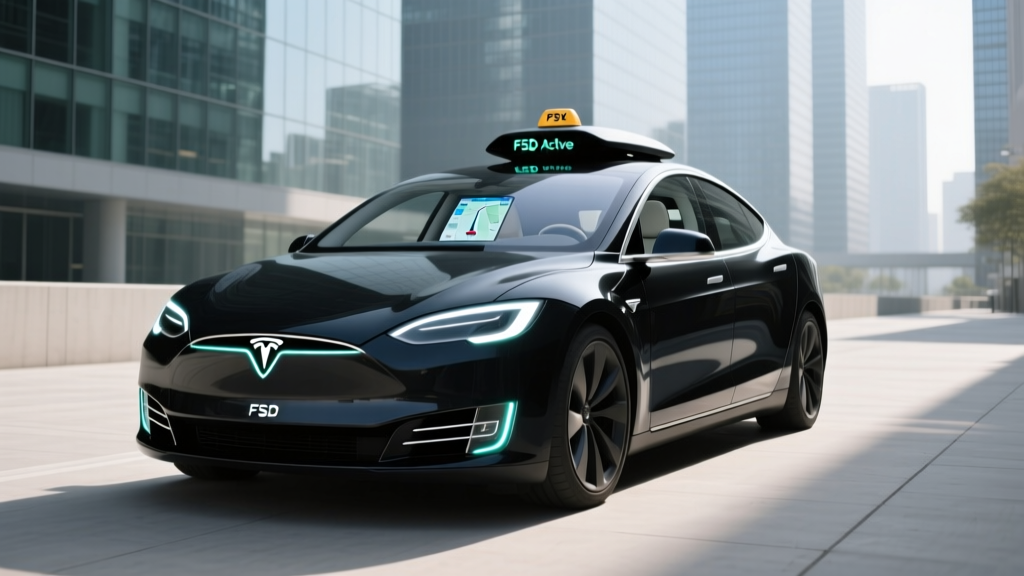
FSD — officially branded by Tesla in 2026 as FSD (Supervised) — is an advanced driver-assistance suite that builds on Tesla's standard Autopilot. It adds features like automatic lane changes, navigation-guided on-ramp-to-off-ramp highway driving, traffic light and stop sign recognition, and the ability to navigate some city streets with turn suggestions. It does this using Tesla's vision-only hardware stack: typically 8 surround cameras (on HW4/AI5-equipped vehicles) with no radar or ultrasonic sensors on current-production and recent used models.
FSD (Supervised) is classified as SAE Level 2 automation. That means the system provides combined steering and acceleration/braking assistance, but the driver must remain fully engaged — hands on the wheel (or applying periodic torque), eyes on the road, and ready to intervene at any moment. It is not autonomous driving. Tesla's own documentation and the NHTSA make this clear: you are the driver, and you bear full legal responsibility.
How FSD Works Technically: Cameras, Neural Nets, and Hardware Generations
Since late 2022, Tesla has used a vision-only approach called Tesla Vision, dropping radar and ultrasonic sensors entirely. FSD relies on neural networks processing camera feeds in real time to detect lanes, vehicles, pedestrians, traffic controls, and road geometry. The onboard computer — Hardware 4 (HW4, also called AI4) on vehicles built from roughly March 2023 onward, or the newer AI5 hardware on 2025+ models — handles this inference.
This matters enormously on the used market. Older Model 3 and Model Y vehicles (2019–early 2023) may still have HW3 computers. While Tesla has pushed FSD updates to HW3, the processing headroom is tighter, and some advanced features arrive on HW4/AI5 first. If you're evaluating a used Tesla, check the vehicle's hardware generation in Controls → Software → Additional Vehicle Information.
| Feature | Autopilot (Standard) | FSD (Supervised) |
|---|---|---|
| Traffic-Aware Cruise Control | Yes | Yes |
| Autosteer (lane centering) | Yes (highway) | Yes (highway + city) |
| Auto Lane Change | No | Yes |
| Navigate on Autopilot (on/off-ramp) | No | Yes |
| Traffic Light & Stop Sign Control | No | Yes |
| City Street Turn Navigation | No | Yes |
| Smart Summon (parking lot) | No | Yes |
| SAE Level | Level 2 | Level 2 |
Does FSD Transfer When You Buy a Used Tesla?
This is the single most important question for anyone shopping a used Tesla with FSD for sale, and the answer has shifted over time. Historically, Tesla only allowed FSD transfers in limited promotional windows (for example, brief periods in 2023 and 2024 where FSD transferred to new owners if the car was purchased directly from Tesla or transferred between family members). As of 2026, Tesla's general policy is:
- FSD purchased outright (a one-time license) stays tied to the original owner and the original vehicle. It does not automatically transfer to a new buyer on the private market.
- Tesla's used inventory from Tesla.com sometimes includes vehicles where FSD is bundled, but this varies by listing and is explicitly noted on the vehicle page. Don't assume it's included — read the window sticker equivalent.
- Private-party sales generally do not include FSD transfer. The seller may have paid $8,000–$12,000 for FSD, but that investment typically does not pass to you.
- FSD subscriptions are non-transferable entirely — they're tied to the original Tesla account.
Always verify FSD status directly in the car before purchase. Go to Controls → Software and look for "Full Self-Driving Capability" or "Full Self-Driving (Supervised)" listed as active. A seller's claim is not sufficient — confirm it on-screen.
Even if a used Tesla shows FSD as active at the time of sale, Tesla can and has removed FSD capability from vehicles that changed ownership outside of approved transfer programs. Before wiring money, confirm in writing (ideally with a Tesla Service Center) that the FSD license will remain active after the ownership transfer.
FSD Cost: One-Time Purchase vs. Subscription in 2026
Tesla has shifted FSD pricing several times. As of early 2026, the structure is:
| Option | Cost | Notes |
|---|---|---|
| One-Time Purchase | $8,000 | Price has fluctuated; was $12,000 (2022), $15,000 (2023 peak), then reduced. Tied to vehicle + original owner. |
| Monthly Subscription | $99/month | Cancel anytime. Non-transferable. Only available to original vehicle owner. |
| Included at Purchase | $0 extra | Only on select Tesla Certified Pre-Owned listings where explicitly noted. |
If you're buying a used Tesla without FSD and want to add it, you'll pay the current $8,000 one-time fee or subscribe at $99/month through your Tesla account after taking ownership. The subscription option makes FSD accessible for road trips or seasonal use without a large upfront commitment.
Real-World Capabilities and Honest Limitations
FSD (Supervised) in 2026 is capable, but it is not flawless. Here's what you can realistically expect based on extensive real-world use across Model 3, Model Y, Model S, and Model X platforms:
What It Does Well
- Highway driving: On well-marked interstates, FSD handles lane keeping, speed adjustment, and navigation-guided lane changes competently. On-ramp-to-off-ramp transitions are generally smooth.
- Traffic management: Stop-and-go traffic is handled well, reducing driver fatigue significantly.
- City navigation: The system can follow turn-by-turn routes on surface streets, handle many intersections, and respond to traffic lights and stop signs.
Where It Struggles
- Construction zones: Barrel lines, temporary lane shifts, and missing lane markings frequently confuse the system. Expect to take over.
- Heavy rain and snow: Vision-only systems degrade in poor visibility. FSD will issue a takeover request or disable itself when cameras are obscured.
- Unprotected left turns: Complex multi-lane intersections with oncoming traffic remain an edge case where FSD may hesitate or make overly conservative decisions.
- Faded or conflicting lane markings: Old construction markings, sun-bleached paint, or road patches can cause phantom lane detection.
- Rural roads: Narrow, unmarked country roads with no shoulder are not FSD's strong suit.
On the IIHS ratings and NHTSA safety pages, no Level 2 system has been rated as a substitute for an attentive driver. Tesla's own quarterly safety reports show that Autopilot-engaged miles have a lower crash rate than the U.S. average, but these figures are heavily skewed toward controlled highway conditions and do not account for the selection bias of drivers who engage the system.
How FSD Compares to Competing Systems
| System | Brand | Hands-Free? | Highway | City Streets | Cost |
|---|---|---|---|---|---|
| FSD (Supervised) | Tesla | No (torque monitoring) | Yes | Yes | $8,000 or $99/mo |
| Super Cruise | GM (Cadillac/Chevy) | Yes (eye-tracking, mapped roads) | Yes | No | Included or ~$2,200 |
| BlueCruise | Ford/Lincoln | Yes (eye-tracking, mapped roads) | Yes | No | $2,100 or $75/mo |
| Autopilot | Tesla | No | Yes | No | Standard (included) |
| ProPILOT Assist 2.0 | Nissan | Yes (mapped highways) | Yes | No | Included on select trims |
The key differentiator: Tesla's FSD attempts both highway and city driving on virtually any road, while GM's Super Cruise and Ford's BlueCruise offer true hands-free driving but only on pre-mapped limited-access highways (~750,000+ miles of mapped roads in North America). If your priority is hands-off highway cruising, Super Cruise and BlueCruise are arguably more comfortable because you don't need to apply steering torque. If you want the broadest route coverage, FSD is unmatched — but you must stay hands-on.
Models and Trims: Which Used Teslas Can Have FSD?
FSD is available across the entire Tesla lineup, but hardware generation affects the experience:
- Model 3 (2018+): HW2.5 and HW3 cars can run FSD, but HW4 (2023+ refresh, "Highland") offers better camera resolution and processing. The 2024+ Highland Model 3 Long Range AWD starts at $47,740 new; used 2023 examples range from $28,000–$38,000 depending on mileage.
- Model Y (2020+): Same HW3/HW4 split. The 2025 Juniper refresh brought updated hardware. Used 2022–2023 Model Y Long Range examples typically list between $30,000–$42,000.
- Model S / Model X (2021+ refresh): All come with HW4. Used Plaid models command a premium but offer the best FSD hardware and 405-mile EPA range (Model S Long Range).
- Cybertruck (2024+): AI5 hardware, FSD available. Used listings are still sparse and carry depreciation uncertainty.
Standard Autopilot is included on every Tesla. FSD is always an add-on — no trim level includes it by default unless a previous owner purchased it or Tesla bundled it on a specific CPO listing.
Your Pre-Purchase Checklist for a Used Tesla With FSD
Before committing to a used Tesla with FSD for sale, run through these verification steps:
- Check FSD status in-car: Navigate to Controls → Software and confirm "Full Self-Driving Capability" is listed as active — not "FSD Trial" or "None."
- Verify hardware generation: In the same Software menu, confirm HW4 or AI5 if possible. HW3 works but is older.
- Ask the seller about transfer eligibility: Was FSD purchased outright or subscribed? Has Tesla confirmed transferability for this specific VIN?
- Test-drive with FSD engaged: Activate Autosteer and Navigate on Autopilot on a highway stretch. Observe lane-change behavior and system confidence.
- Check camera condition: Inspect all camera lenses (front pillar cameras, rear-view, front-facing) for cracks, delamination, or moisture.
- Review service history: Any camera or computer replacements should be documented through Tesla Service.
- Confirm no salvage title: Tesla disables FSD on salvage-title vehicles, even if it was previously purchased.
Frequently Asked Questions
Is a used Tesla with FSD actually self-driving?
No. FSD (Supervised) is an SAE Level 2 driver-assist system. You must keep your hands on the steering wheel (or apply periodic torque), monitor the road at all times, and be prepared to take over instantly. You are legally the driver. Only Level 4 robotaxi services like Waymo operate without a driver engaged.
How much does FSD cost if I buy a used Tesla without it?
As of 2026, you can purchase FSD for a one-time fee of $8,000 or subscribe for $99/month through your Tesla account. Subscription is a practical option if you only need FSD for occasional road trips or want to evaluate it before committing.
Will FSD transfer to me if I buy from a private seller?
Generally, no. Tesla's standard policy does not allow FSD to transfer between private-party owners. Some Tesla Certified Pre-Owned vehicles include FSD, but this is explicitly stated on the listing. Always verify FSD status in the car's software menu before purchasing.
Does FSD work in bad weather?
FSD uses cameras only (no radar or lidar). Heavy rain, snow, fog, and direct sun glare can degrade performance. The system will alert you and may disengage when camera visibility drops. Plan to take over in these conditions.
Is FSD worth the premium on a used Tesla?
It depends on your commute and driving patterns. If you drive 50+ highway miles daily or frequently navigate unfamiliar city streets, FSD reduces fatigue meaningfully. If your driving is mostly short suburban trips, standard Autopilot (included free) handles adaptive cruise and lane centering well enough. The $99/month subscription lets you test the value before committing $8,000.
What hardware should I look for in a used Tesla?
Prioritize HW4 (AI4) or AI5 hardware, found on vehicles built from roughly March 2023 onward. These offer higher-resolution cameras and faster processing. HW3 vehicles still run FSD but may receive fewer advanced features over time. Check hardware version in Controls → Software → Additional Vehicle Information.
The used Tesla market offers genuine value, but FSD is the variable most likely to create confusion and overpayment. Verify the license, understand the hardware, and test the system on roads you'll actually drive. The technology is impressive — within its limits — but the smartest purchase is one where you know exactly what you're getting and what you're not.