The Used Self-Driving Tesla Promise vs. Reality
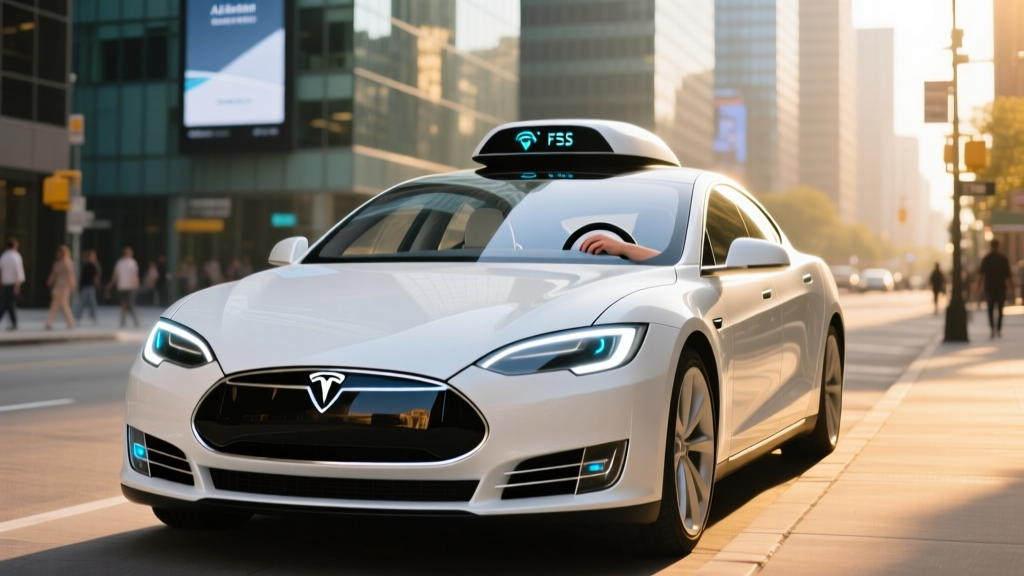
Search marketplace listings and you'll find thousands of used Tesla Model 3 and Model Y vehicles advertised with "Full Self-Driving" — often at a $5,000 to $10,000 premium over identical cars without the package. The marketing language is intoxicating: buy a used self-driving Tesla and let the car handle your commute. But before you wire the money, you need to understand exactly what you're getting, what you're not getting, and whether that premium is justified.
Here's the essential truth: Tesla's Full Self-Driving (Supervised) is an SAE Level 2 driver-assistance system. It is not a robotaxi. It cannot drive itself without your active supervision. And the gap between Level 2 and true Level 4 autonomy (what Waymo operates in select cities) is not a software update away — it's a fundamental architectural and regulatory chasm.
| Level | Name | Driver Role | Example |
|---|---|---|---|
| Level 0 | No Automation | Full control | Basic cruise control |
| Level 1 | Driver Assistance | Hands on wheel, full attention | Tesla Autopilot (base) |
| Level 2 | Partial Automation | Must supervise at all times | Tesla FSD (Supervised), GM Super Cruise, Ford BlueCruise |
| Level 3 | Conditional Automation | Can disengage in limited conditions | Mercedes DRIVE PILOT (approved in NV/CA, ≤40 mph) |
| Level 4 | High Automation | No driver needed in geofenced area | Waymo, Zoox (robotaxi services) |
| Level 5 | Full Automation | No driver needed anywhere | Does not exist commercially |
Source: SAE International J3016
What Tesla FSD (Supervised) Actually Does in 2026
Tesla's Full Self-Driving (Supervised) package — which Tesla rebranded from "FSD Beta" in 2024 — provides advanced driver-assistance features that go meaningfully beyond basic Autopilot. On a used Tesla equipped with FSD, you can expect:
- Navigate on Autopilot: Automatic highway lane changes, on-ramp to off-ramp navigation, and speed adjustment based on traffic and road conditions
- Auto Lane Change: The vehicle initiates lane changes when it determines a faster lane is available (driver must confirm or can set to automatic)
- Autosteer on City Streets: Traffic light and stop sign recognition, left and right turns at intersections, and navigation through urban environments
- Smart Summon: The car navigates a parking lot to come to you (at low speed, short distances)
- Autopark: Parallel and perpendicular parking assist
What it does not do: drive you to a destination while you sleep, read your phone, or close your eyes. The "Supervised" in the name is not marketing decoration — it is a legal and functional requirement. You are the driver. You are liable. And Tesla's driver-monitoring camera will nag you if your eyes wander.
The Technology Stack: Camera-Only vs. the Lidar Competition
Understanding the tech under the hood matters when evaluating a used self-driving Tesla, because Tesla's approach is philosophically different from every other automaker pursuing advanced autonomy.
- Sensors: 8 cameras (HW4) or 11 cameras (AI5, introduced late 2025) providing 360° vision
- Radar: Removed from production vehicles starting 2022 (some early HW3 cars retain it)
- Ultrasonics: Removed from new production starting late 2022; replaced with Tesla Vision proximity estimation
- Compute: HW4: dual FSD chips at ~300 TOPS combined; AI5: single custom chip at ~2,000+ TOPS (announced specs)
- Approach: End-to-end neural network trained on fleet video data — no lidar, no HD maps, no geofencing
Competitor approach (Waymo, Zoox, Mercedes Level 3): Lidar + radar + camera fusion, HD pre-mapped routes, geofenced operational design domains (ODDs).
The camera-only approach means FSD works on any road without pre-mapping — a genuine advantage in coverage. But it also means the system can struggle in conditions where cameras degrade: heavy rain, fog, direct sun glare, and poorly marked construction zones. Lidar-equipped systems like Waymo's have a range and depth-perception advantage in these edge cases, though they're limited to pre-mapped geofenced areas.
Hardware Matters: Which Used Tesla FSD Cars Are Worth Buying
Not all used Teslas with FSD are created equal. The hardware generation determines the ceiling of FSD capability, and this is where many used-car buyers get burned.
| Hardware | Years | Compute | FSD Capability in 2026 | Used Market Impact |
|---|---|---|---|---|
| HW2.5 | 2017–2019 | ~144 TOPS | Limited; may not receive all future FSD updates | Avoid FSD premium |
| HW3 (FSD Computer) | 2019–2023 | ~288 TOPS | Full current FSD (Supervised) support | Acceptable, but aging |
| HW4 (AI4) | 2023–2025 | ~300 TOPS | Full FSD support, higher-res cameras | Best value for used FSD |
| AI5 | 2025+ | ~2,000+ TOPS | Next-gen FSD; few used examples yet | Premium pricing |
Buyer's rule: If you're paying an FSD premium on a used Tesla, insist on HW4 (AI4) or newer. You can verify this in the vehicle's Software menu under "Additional Vehicle Information." HW3 vehicles still run current FSD, but Tesla's compute demands have been climbing with each neural-net update, and HW3's long-term support is not guaranteed.
Is FSD Transferable on a Used Tesla?
This is the single most important financial question for used self-driving Tesla buyers, and the answer has shifted multiple times:
- Original owner purchased FSD outright ($8,000–$15,000 depending on year): FSD transfers with the vehicle to subsequent owners. This is the scenario where a used FSD Tesla makes financial sense.
- Original owner had FSD via monthly subscription ($99/month as of 2025): The subscription does not transfer. You'll need to purchase FSD or start your own subscription.
- Tesla's transfer policy exceptions: Tesla has periodically run promotions allowing FSD transfers to new Tesla purchases by the original owner, which strips FSD from the trade-in. Always verify FSD status in the Tesla app before finalizing a used purchase.
Verify FSD ownership by checking the Tesla app vehicle details or having the seller show the "Autopilot" settings screen — it will display "Full Self-Driving (Supervised)" if the package is active and owned on that VIN.
Safety Data: What We Actually Know About FSD
Tesla publishes quarterly safety reports, but they aggregate Autopilot and FSD data together and measure miles per accident rather than disengagement rates — making direct comparison to Waymo's public safety data difficult. Here's what the available data shows:
- Tesla Q4 2025 Safety Report: 1 accident per 5.94 million miles driven on Autopilot/FSD vs. 1 per 0.74 million miles without — but this aggregates highway Autopilot (lower-risk) with city-street FSD
- NHTSA Standing General Order data: Tesla reported 736 crashes involving Autopilot/FSD between July 2021 and the most recent reporting period — more than any other manufacturer, though Tesla also has the largest ADAS-equipped fleet
- Insurance Institute for Highway Safety (IIHS): Has not rated FSD specifically; rates Tesla's basic Autopilot as "acceptable" in their partial-automation evaluation, noting driver monitoring concerns
- California DMV disengagement reports: Tesla does not file these because FSD is classified as Level 2 (not a Level 3+ test permit), making direct comparison to Waymo's ~1 disengagement per 15,000–20,000 miles impossible
Sources: NHTSA AV Safety Data, IIHS Tesla Ratings
The honest assessment: FSD is remarkably capable in routine driving scenarios — highway commuting, suburban errands, well-marked city streets. But "remarkably capable" is not "safe enough to zone out." NHTSA has investigated multiple crashes where FSD-equipped Teslas collided with stationary emergency vehicles, a known limitation of vision-only systems. You remain the safety net.
FSD vs. Actual Robotaxi Services: The Fundamental Difference
If you're shopping for a used self-driving Tesla because you want to avoid driving, you should understand what true Level 4 robotaxi services actually offer — and where they operate:
| Service | SAE Level | Operational Cities (2026) | Availability | Cost |
|---|---|---|---|---|
| Waymo One | Level 4 | Phoenix, San Francisco, Los Angeles, Austin | Open to public via app | Comparable to Uber/Lyft |
| Zoox | Level 4 | Las Vegas, Foster City (limited expansion) | Invite-only / limited public | Free during pilot phases |
| Tesla FSD | Level 2 | Any road (no geofence) | You must drive/supervise | You own the car |
| Cruise | Level 4 | Suspended operations (post-2023 incident); limited re-entry testing | Not publicly available | N/A |
The tradeoff is clear: Waymo genuinely drives you without a human behind the wheel, but only in four cities, on pre-mapped roads, and you pay per ride. Tesla FSD goes anywhere roads exist, but you are the driver — legally, functionally, and morally.
What to Check Before Buying a Used Tesla With FSD
If you've decided the FSD premium is worth it on a used Tesla, here's your verification checklist:
- Confirm FSD ownership (not subscription): Have the seller show the Autopilot settings menu. It must read "Full Self-Driving (Supervised)" — not "FSD Subscription" or just "Enhanced Autopilot."
- Verify hardware generation: Settings → Software → Additional Vehicle Information → look for "FSD Computer" (HW3), "Hardware 4" (HW4/AI4), or "AI5." Avoid paying FSD premiums on HW2.5.
- Check the FSD transfer status: Contact Tesla support with the VIN to confirm FSD has not been transferred off the vehicle by the original owner.
- Review the vehicle's FSD safety score: If the seller used FSD regularly, their Tesla app will show a Safety Score history. Low scores don't affect FSD functionality, but high mileage on FSD indicates the system was regularly exercised.
- Inspect camera hardware: HW4 vehicles have higher-resolution cameras with different lens housings. Verify all 8 cameras produce clean, clear feeds on the visualization screen.
- Battery health: FSD has no bearing on battery degradation, but any used Tesla purchase demands a battery health check. Request the vehicle's rated range at 100% SoC and compare to the original EPA figure (Model 3 LR: 358 mi EPA; expect 320–340 mi at 50,000 miles if well-maintained).
The Financial Calculation: Is the FSD Premium Justified?
As of early 2026, Tesla sells FSD (Supervised) for $8,000 as a one-time purchase or $99/month. On the used market, FSD-equipped Teslas command a premium that varies widely:
| Scenario | Typical FSD Premium (Used) | Value Assessment |
|---|---|---|
| HW2.5 vehicle (2017–2019) | $2,000–$4,000 | Poor — limited future support likely |
| HW3 vehicle (2019–2022) | $3,000–$5,000 | Marginal — functional now, uncertain long-term |
| HW4 vehicle (2023–2025) | $4,000–$7,000 | Reasonable — full current and near-future support |
| AI5 vehicle (2025+) | $6,000–$8,000 | Near new-car pricing; consider subscription instead |
The pragmatic take: If the FSD premium on a used HW4 Tesla is $5,000 or less, you're getting the system at a discount versus buying new. Above that, consider whether Tesla's $99/month subscription makes more sense on a vehicle without FSD — you'll pay $5,940 over five years, but you're not locked into a system that may or may not achieve its full promise.
Frequently Asked Questions
Is a used self-driving Tesla actually self-driving?
No. Tesla's Full Self-Driving (Supervised) is an SAE Level 2 driver-assistance system. It handles steering, acceleration, braking, lane changes, and intersection navigation — but you must remain fully engaged, hands near the wheel, and eyes on the road. You are legally and functionally the driver at all times.
Can I use Tesla FSD as a robotaxi to earn money?
Not currently. Tesla has discussed a "Robotaxi" network concept, but as of 2026, no Tesla owner can legally operate their personal vehicle as a driverless rideshare car. FSD requires a supervising driver, and no jurisdiction has approved Tesla vehicles for unsupervised commercial passenger service.
Does FSD improve over time on a used Tesla?
Yes — Tesla pushes over-the-air FSD updates regularly, and HW4/AI4 vehicles receive the full latest versions. However, improvement pace and feature additions are not guaranteed. Tesla has a history of revising timelines for capabilities like "unsupervised" operation.
What happens if I get into an accident while using FSD?
You are liable. Because FSD is a Level 2 system, the driver bears full legal responsibility for all vehicle actions. Your insurance covers the incident. Tesla's position — stated in their owner's manual and FSD terms — is that the driver must intervene at all times. NHTSA investigations into FSD crashes have not resulted in findings of manufacturer liability as of early 2026.
Should I buy a used Tesla with FSD or subscribe to FSD instead?
If you find a used HW4 Tesla with owned FSD at a $5,000-or-less premium, buying the FSD-equipped car is the better deal. If the premium exceeds $6,000–$7,000, consider buying a non-FSD Tesla and subscribing at $99/month — you get the same software with no long-term commitment, and you can cancel if FSD doesn't meet your expectations.