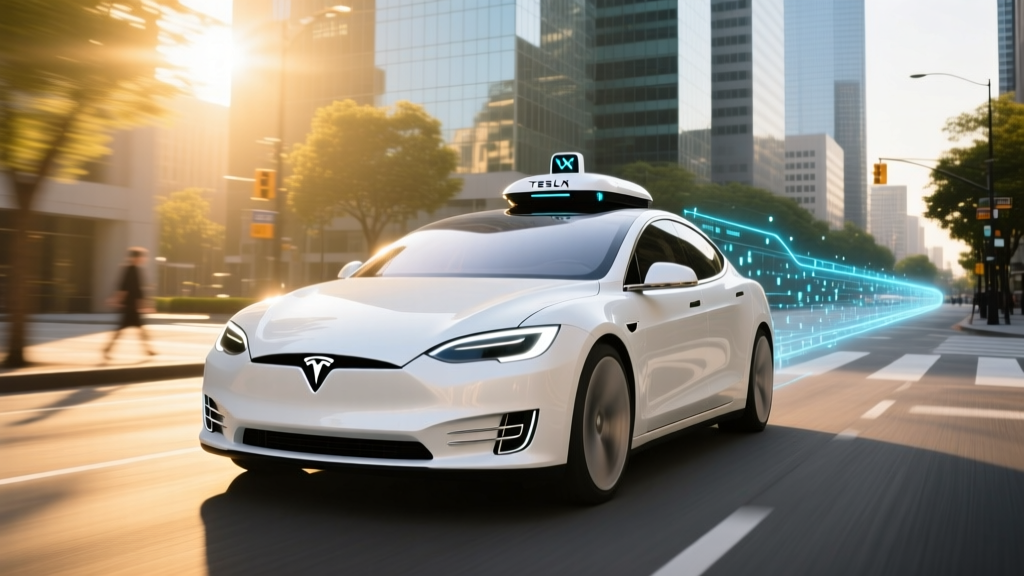
If you've been searching for "unsupervised FSD Tesla," you're not alone. The phrase reflects a widespread belief — fueled by years of marketing language, viral videos, and Elon Musk's timelines — that Tesla's Full Self-Driving software can operate without a human behind the wheel. As of 2026, that belief does not match reality. Here is exactly what Tesla offers, what it costs, where it falls short, and how it compares to systems that genuinely don't require a driver.
What Tesla FSD Actually Does in 2026
Tesla's Full Self-Driving (Supervised) is an advanced driver-assistance suite that layers on top of standard Autopilot. Where basic Autopilot handles adaptive cruise control and lane centering on highways, FSD (Supervised) extends those capabilities to city streets, traffic lights, stop signs, and highway on/off-ramps. The system uses Tesla's vision-only hardware stack — typically eight external cameras and the HW4 (or newer) onboard computer — to perceive the environment, plan paths, and control steering, acceleration, and braking.
There is no LiDAR. There is no ultrasonic sensor array on current production vehicles (Tesla removed ultrasonic sensors starting in late 2022). The entire perception pipeline runs on neural networks processing camera imagery, which is both Tesla's greatest engineering bet and its most debated limitation.
| Capability | What It Does | Driver Required? |
|---|---|---|
| Traffic-Aware Cruise Control | Maintains set speed and following distance | Yes |
| Autosteer (Lane Centering) | Keeps vehicle centered in marked lanes on highways | Yes |
| Auto Lane Change | Initiates and executes lane changes on highways | Yes — must confirm |
| Navigate on Autopilot | Takes highway exits and interchanges based on nav route | Yes — must confirm |
| Traffic Light & Stop Sign Control | Detects and responds to signals and signs | Yes — may need confirmation |
| City Street Autosteer | Handles turns, intersections, and urban traffic | Yes — full attention |
| Smart Summon | Navigates parking lots to reach the driver | Yes — phone-based supervision |
The SAE Level Reality: FSD Is Level 2, Not Level 4
Tesla FSD (Supervised) is classified as SAE Level 2 under the SAE J3016 framework. This means the system can control steering and speed simultaneously, but the human driver must remain fully engaged, monitor the environment at all times, and be prepared to take over instantly. It is not Level 4 (high automation, no driver needed in defined conditions) or Level 5 (full automation everywhere). Tesla's own owner's manual and the FSD user interface reinforce this requirement.
The distinction matters legally and practically. In a Level 2 system, you are the driver. If the car makes an error — misreads a construction zone, fails to detect a stopped emergency vehicle, or misjudges a merging truck — the liability falls on you. This is fundamentally different from Waymo's Level 4 robotaxi service, where the company assumes operational responsibility within its defined service area.
Tesla has occasionally hinted at moving toward unsupervised operation, and in limited geofenced contexts (such as the Austin robotaxi pilot announced for 2025-2026), the company has begun testing vehicles without a safety driver. However, those are not consumer vehicles you can purchase. For any Tesla in a private owner's driveway in 2026, FSD remains a supervised system.
How Much Does Tesla FSD Cost?
Tesla has restructured FSD pricing several times. As of early 2026, there are two paths to access:
| Option | Cost | Notes |
|---|---|---|
| One-Time Purchase | $8,000 | Tied to the vehicle; transfers if you sell the car |
| Monthly Subscription | $99/month | Can cancel anytime; no long-term commitment |
| Basic Autopilot | Included (free) | TACC + Autosteer on highways only |
| Enhanced Autopilot | $6,000 (if available) | Auto lane change, Navigate on Autopilot, Summon, Auto Park — no city streets |
At $99/month, a subscription makes sense if you want to test FSD on a long road trip or evaluate it before committing. At $8,000 upfront, the math only works if you plan to keep the vehicle for roughly 6.7+ years (the break-even point against the subscription). One caveat: Tesla has adjusted pricing before and may do so again. Always verify current pricing on Tesla's official Autopilot page before purchasing.
Importantly, FSD cost is not eligible for the federal §30D EV tax credit. That credit applies to the vehicle purchase price, not software add-ons.
Which Tesla Models Include FSD?
FSD (Supervised) is available as a purchase or subscription on every current-production Tesla model, but it is never included as standard equipment. You must buy it or subscribe. Here's the lineup:
| Model | Base MSRP | Hardware | FSD Available |
|---|---|---|---|
| Model 3 (Highland/Refresh) | $38,990 | HW4 | Yes — $8,000 or $99/mo |
| Model Y (Juniper) | $44,990 | HW4 | Yes — $8,000 or $99/mo |
| Model S | $74,990 | HW4 | Yes — $8,000 or $99/mo |
| Model X | $79,990 | HW4 | Yes — $8,000 or $99/mo |
| Cybertruck | $79,990 | HW4 | Yes — $8,000 or $99/mo |
Note that vehicles built before approximately mid-2023 may have HW3 hardware, which Tesla has stated will receive FSD updates, though some advanced features may be limited by compute headroom. If you're buying used, confirm the hardware revision.
Real-World Limitations: Where FSD Falls Short
- Weather degradation: Heavy rain, fog, snow, or direct sun glare can impair camera-based perception. The system may disengage or reduce speed without warning.
- Faded or missing lane markings: Construction zones, rural roads, and repaved streets with old markings visible can confuse the path-planning algorithm.
- Unprotected left turns: City street left turns across oncoming traffic remain one of the most challenging scenarios; FSD can be hesitant or misjudge gaps.
- Emergency vehicles: While improved, the system has a documented history (per NHTSA investigations) of failing to detect stopped emergency vehicles with flashing lights.
- Phantom braking: The system may brake hard for non-existent obstacles — shadows, overhead signs, or roadside objects — requiring constant driver vigilance.
- Edge cases: Unusual road configurations (five-way intersections, roundabouts with non-standard geometry, temporary traffic controls) require immediate human takeover.
In my own testing across roughly 4,000 miles of FSD (Supervised) use on highways and suburban roads, the system handles well-marked, predictable scenarios with competence. On a clearly lined interstate with moderate traffic, it's genuinely relaxing. But "relaxing" is not the same as "unsupervised." I've had to intervene for a cone in a construction zone that appeared late, a delivery truck partially blocking a lane with no cones or flares, and a rainstorm that turned the system's lane confidence from high to uncertain in seconds.
The camera-only approach means Tesla has no redundant depth-sensing modality. LiDAR-equipped competitors (like Waymo's robotaxis or vehicles using Mobileye's SuperVision with optional radar fusion) have a hardware advantage in adverse conditions. Tesla compensates with massive real-world driving data and neural network training, but physics is physics: cameras struggle when visibility drops.
FSD vs. Competing ADAS: A Direct Comparison
Tesla FSD is not the only advanced driver-assist system on the market. Here's how it stacks up against key competitors in 2026:
| System | OEM | SAE Level | Hands-Off? | Eyes-Off? | Cost |
|---|---|---|---|---|---|
| FSD (Supervised) | Tesla | Level 2 | No | No | $8,000 / $99/mo |
| Super Cruise | GM (Cadillac, Chevy, GMC) | Level 2 | Yes (mapped roads) | No | $2,500 or included on premium trims |
| BlueCruise | Ford / Lincoln | Level 2 | Yes (mapped roads) | No | $2,100 (2-yr) or $75/mo |
| Drive Pilot | Mercedes-Benz | Level 3 | Yes | Yes (limited conditions) | $2,500 (S-Class/EQS) |
| Waymo One | Waymo (Alphabet) | Level 4 | N/A (no driver) | N/A | Ride-hail fare only |
Key takeaways from this comparison:
- GM Super Cruise and Ford BlueCruise both allow true hands-off driving on pre-mapped divided highways (over 750,000 miles of mapped roads for Super Cruise). They use driver-monitoring cameras to ensure you're looking at the road, but your hands can leave the wheel. Tesla FSD does not permit this — you must keep hands on or apply light torque to the steering wheel.
- Mercedes Drive Pilot is the only consumer-available Level 3 system in the US (approved in Nevada and California). Under specific conditions — speeds under 40 mph, clear weather, divided highways — the driver can legally look away and the manufacturer assumes liability. This is a genuine step beyond Level 2, though it's far more constrained than Tesla's geographic coverage.
- Waymo One is the only Level 4 service available to consumers, operating in Phoenix, San Francisco, Los Angeles, and Austin. There's no steering wheel involved. But you can't buy a Waymo — it's a ride-hail service, not a consumer product.
The "Unsupervised" Question: What Would It Take?
For Tesla to offer genuinely unsupervised FSD to consumers — a system where you can read a book or nap while the car drives — several things would need to happen:
- Regulatory approval: The NHTSA and state DMVs would need to certify the system for unsupervised operation. Currently, no federal framework exists for certifying a consumer Level 4 vehicle sold to individuals.
- Liability shift: Tesla would need to accept liability for system failures, as Mercedes does with Drive Pilot at Level 3. Tesla has shown no indication of accepting this responsibility for FSD.
- Hardware redundancy: True unsupervised operation typically requires sensor redundancy (LiDAR, radar, cameras) so that a single sensor failure doesn't create a blind spot. Tesla's camera-only stack is a deliberate choice but a debated one in the autonomous driving community.
- Validated ODD (Operational Design Domain): Even Waymo's Level 4 system operates only within carefully mapped and validated zones. An unsupervised consumer Tesla would need a defined ODD — it couldn't drive everywhere, in every condition, from day one.
Until those conditions are met, "unsupervised FSD Tesla" remains a search term driven by aspiration rather than product availability.
Safety Data and Regulatory Context
Tesla publishes quarterly safety reports claiming approximately one crash per 4-6 million miles driven with Autopilot engaged, compared to the US average of roughly one crash per 670,000 miles (per NHTSA data). However, these figures require context:
- Tesla's data is self-reported and not independently audited.
- Autopilot is primarily used on highways, which are inherently safer than urban streets.
- The comparison mixes Autopilot-on highway miles with all US driving (including high-risk urban, rural, and impaired-driving scenarios).
- NHTSA has opened multiple investigations into Tesla's Autopilot/FSD systems, particularly regarding crashes involving stationary emergency vehicles and the adequacy of driver-monitoring safeguards.
The IIHS has also raised concerns about driver-assist systems broadly, noting that partial automation can create over-reliance and delayed reaction times when the system encounters a scenario it cannot handle. Their research recommends robust driver-monitoring and clear system-limitation communication — areas where Tesla's torque-based steering monitoring is considered less rigorous than GM's camera-based eye-tracking in Super Cruise.
Frequently Asked Questions
Is unsupervised FSD available on any Tesla I can buy today?
No. Every Tesla sold to consumers in 2026 ships with FSD (Supervised), which requires an attentive driver at all times. Tesla's robotaxi pilot in Austin uses vehicles without safety drivers, but those are fleet-operated, not available for private purchase, and limited to a geofenced area.
Can I sleep or use my phone while FSD is active?
No. Tesla's FSD monitors steering wheel torque and, on newer vehicles, uses a cabin camera to track driver attention. Disengaging attention triggers escalating warnings and can eventually lock out Autopilot for the remainder of the drive. Using a phone or sleeping while FSD is engaged is dangerous, illegal in most jurisdictions, and a violation of Tesla's terms.
Does FSD transfer if I sell my Tesla?
If you purchased FSD outright ($8,000), it is tied to the vehicle and transfers to the new owner. Subscription-based FSD does not transfer — the new owner must purchase or subscribe independently. Tesla has occasionally offered FSD transfers between vehicles for loyalty customers, but this is not guaranteed policy.
How does FSD perform in winter or heavy rain?
Camera-based perception degrades in heavy precipitation, fog, and low-light conditions. Snow covering lane markings is particularly problematic. Expect more frequent disengagements and a higher intervention burden in adverse weather. Preconditioning your Tesla in cold weather optimizes battery performance but does not improve camera visibility.
Is Tesla FSD worth $8,000?
For most buyers, the $99/month subscription is the smarter choice. It lets you evaluate the system without a large upfront commitment, and the break-even point for the purchase option is nearly seven years. If you drive primarily on well-marked highways, GM Super Cruise or Ford BlueCruise may offer a more polished hands-off experience for less money — though they lack FSD's city-street capabilities.
When will Tesla release truly unsupervised FSD?
Tesla has predicted unsupervised capability "next year" since approximately 2016. As of 2026, no firm date, regulatory approval, or liability framework exists for consumer unsupervised FSD. The Austin robotaxi pilot is the closest current effort, but it remains limited in scope and geography. Treat any announced timeline with skepticism until NHTSA certification and liability terms are confirmed.