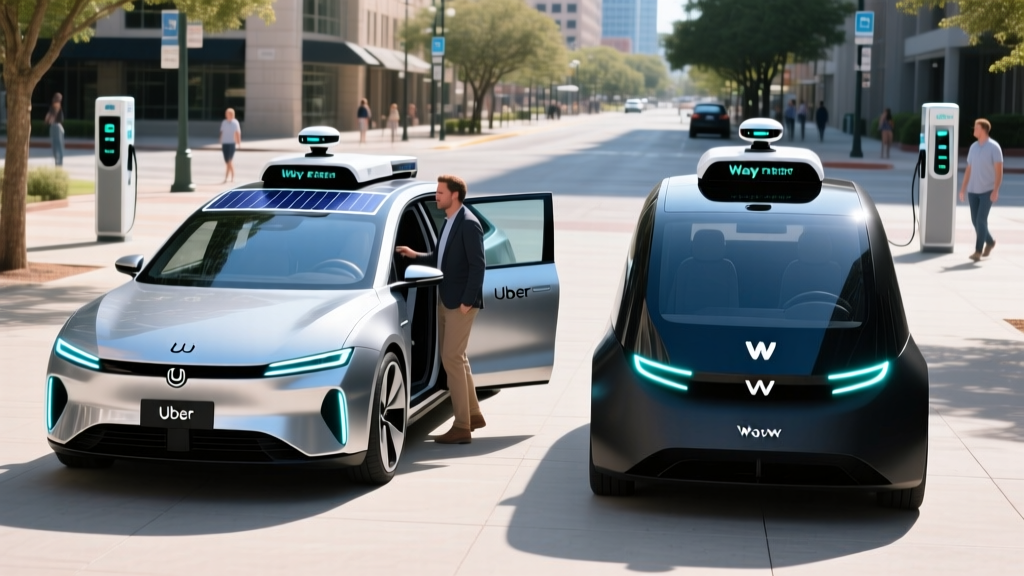
If you have opened a rideshare app in Austin recently, you may have noticed something new in the vehicle options: a car with no driver. Waymo's fully driverless robotaxis have been operating across significant portions of the city, while Uber continues to integrate autonomous vehicle (AV) partners into its platform. For riders trying to decide between hailing a human-driven Uber or summoning a Waymo robotaxi, the choice now comes down to coverage, cost, and comfort with the technology.
This guide breaks down exactly what is available in Austin right now, what the real safety data shows, and how pricing compares to traditional rideshare — no hype, just the numbers you need to decide.
Where Can You Actually Ride a Robotaxi in Austin?
As of early 2026, Waymo is the only company operating a fully driverless commercial robotaxi service in Austin at meaningful scale. The company launched its Austin service area in 2024 and has progressively expanded its geofence throughout 2025 and into 2026.
| Service | Type | SAE Level | Austin Status | Approx. Coverage Area |
|---|---|---|---|---|
| Waymo One | Robotaxi (driverless) | Level 4 | Live, expanding | ~80+ sq mi across Central, South, East Austin, airport route |
| Uber (human driver) | Rideshare | N/A | Live, full metro | Entire Austin metro area |
| Uber + AV partner | Autonomous rides | Level 4 | Limited pilot | Select zones via AV partner integration |
| Cruise | Robotaxi (driverless) | Level 4 | Not operating (suspended) | N/A — GM shut down Cruise operations in 2024 |
| Zoox | Robotaxi (driverless) | Level 4 | Testing only | Not available for public rides |
Waymo's Austin geofence covers a substantial portion of the urban core, including downtown, South Congress, East Austin, the Domain, and routes to Austin-Bergstrom International Airport (AUS). However, it does not cover every suburb — areas like Round Rock, Cedar Park, and Pflugerville remain outside the service boundary. If your origin or destination falls outside the geofence, the Waymo app will simply tell you the ride is unavailable.
Uber's approach is different. While Uber has partnered with AV companies (including Waymo itself in select markets) to offer autonomous rides through its app, the volume of driverless rides available through Uber in Austin remains limited compared to booking directly through the Waymo One app. For most Austin riders seeking a guaranteed robotaxi experience, Waymo One is the direct path.
SAE Automation Levels: What "Self-Driving" Actually Means Here
A critical distinction that gets blurred in headlines is the difference between the driver-assist features in consumer cars and what Waymo operates in Austin. They are fundamentally different categories of automation.
| SAE Level | Name | Who Drives? | Examples |
|---|---|---|---|
| Level 0 | No automation | Human | Basic cruise control |
| Level 1 | Driver assistance | Human (one feature assisted) | Adaptive cruise OR lane-keep |
| Level 2 | Partial automation | Human (must supervise constantly) | Tesla Autopilot, FSD Supervised, GM Super Cruise, Ford BlueCruise |
| Level 3 | Conditional automation | System (human must take over on request) | Mercedes Drive Pilot (limited conditions, ~40 mph) |
| Level 4 | High automation | System (no human needed in defined area) | Waymo One, Zoox — within geofenced service areas |
| Level 5 | Full automation | System (everywhere, all conditions) | Does not exist commercially |
Key takeaway: Waymo's Austin robotaxis are SAE Level 4 — fully driverless within their geofenced service area, with no human behind the wheel and no expectation that a passenger will intervene. This is categorically different from Tesla's FSD Supervised or any Level 2 system, where the human driver remains legally and practically responsible at all times.
Level 4 means the vehicle handles all driving tasks — navigation, lane changes, traffic signals, pedestrian detection, construction zones — without human input, but only within its approved operational design domain (ODD). Step outside that geofence, or encounter conditions outside the ODD (like severe weather), and the system is designed to pull over safely rather than hand control to a passenger.
How Much Does a Waymo Ride Cost vs. Uber in Austin?
Pricing is where many riders expect robotaxis to be either dramatically cheaper or prohibitively expensive. The reality in Austin falls somewhere in between, and it varies by time of day, distance, and demand.
| Metric | Waymo One | UberX (Human Driver) | Uber Comfort |
|---|---|---|---|
| Base fare | ~$2.50 | ~$2.00 | ~$2.75 |
| Per-mile rate | ~$1.25–$1.50 | ~$1.00–$1.30 | ~$1.40–$1.70 |
| Per-minute rate | ~$0.25 | ~$0.20 | ~$0.30 |
| 5-mile trip (typical) | $10–$14 | $8–$12 | $12–$16 |
| Airport run (12 mi from downtown) | $22–$30 | $18–$26 | $26–$35 |
| Surge pricing | Rare / limited | Common during peak | Common during peak |
| Tipping | Not expected (no driver) | Expected ($2–$5+) | Expected ($2–$5+) |
A few practical observations from real rides in Austin:
- Off-peak trips are often comparable. A midday ride from South Congress to the Domain might cost $12 on Waymo and $10 on UberX — close enough that the novelty and consistency of a robotaxi tips the scale for many riders.
- Peak-hour Uber surges can make Waymo cheaper. During SXSW, ACL Festival, or Friday evening bar crowds, Uber surge multipliers (1.5x–2.5x) can push a $12 ride to $25+, while Waymo pricing has remained more stable.
- No tipping on Waymo. This saves $2–$5 per ride, which adds up for frequent users.
- Waymo occasionally offers promotional credits. New users in Austin have reported $5–$10 ride credits, though these are not always available.
To book a Waymo ride in Austin, download the Waymo One app (available on iOS and Android), enter your pickup and dropoff locations, and confirm the ride. The app shows the exact vehicle (a white Jaguar I-PACE with Waymo branding and a rooftop sensor array), its license plate, and its approach in real time. You unlock the doors via the app when the vehicle arrives.
How Safe Are Robotaxis? The Real Austin Data
Safety is the single most important question for anyone considering a driverless ride. Let's look at what the data actually shows, rather than anecdotal viral videos.
Waymo safety data (as reported to NHTSA and in peer-reviewed studies):
- Total autonomous miles driven (all markets): Over 30 million fully driverless miles completed as of late 2025, with Austin, Phoenix, San Francisco, and Los Angeles as primary markets.
- Injury-related crash rate: Waymo's NHTSA-reported data and a study published by the Insurance Institute for Highway Safety (IIHS) found that Waymo vehicles were involved in injury-causing crashes at a rate approximately 85% lower than the human-driven benchmark in comparable urban environments.
- Police-reported crashes: Waymo vehicles were involved in property-damage-only crashes at a rate roughly 57% lower than human drivers in the same geographies.
- Contactless incidents: The vast majority of Waymo-involved crashes in public reports were low-speed, rear-end or side-swipe incidents where another human-driven vehicle struck the Waymo — not the other way around.
In Austin specifically, Waymo's operations have not generated the volume of high-profile incidents seen in San Francisco during Cruise's 2023 operations (which ultimately led to Cruise's suspension and shutdown). Austin's road layout — wider streets, more grid-pattern roads, less dense pedestrian traffic than SF's Tenderloin district — has been more favorable to AV operations.
That said, robotaxis are not immune to incidents. Waymo vehicles have been documented in Austin:
- Stopping unexpectedly in travel lanes when encountering ambiguous construction-zone signage
- Taking overly conservative routes that add time to trips
- Occasionally struggling with temporary lane closures during infrastructure projects on I-35 and MoPac
These are inconveniences rather than safety failures, but they matter for riders on a schedule.
Under the Hood: Waymo's Sensor Stack and Technology
Understanding why Waymo can operate without a driver — while Tesla's FSD Supervised still requires one — comes down to fundamentally different technology approaches.
| Sensor Type | Count (Jaguar I-PACE) | Purpose |
|---|---|---|
| LiDAR | 5 units | 360° 3D point cloud, object detection to 500m+, works in darkness |
| Cameras | 29 units | Traffic light state, sign reading, lane markings, pedestrian intent |
| Radar | 6 units | Velocity measurement of moving objects, redundancy in rain/fog |
| Audio sensors | External microphones | Detect sirens from emergency vehicles |
| HD maps | Pre-mapped geofence | Centimeter-level road geometry, lane topology, speed limits |
Waymo's approach is sensor-fusion-heavy and map-dependent. The vehicle knows the exact geometry of every lane, intersection, and crosswalk within its Austin geofence before it ever drives there. The real-time sensors (LiDAR, cameras, radar) then detect dynamic objects — other cars, pedestrians, cyclists, debris — and the planning algorithm decides how to navigate.
This contrasts sharply with Tesla's camera-only, no-HD-map approach for FSD Supervised (Level 2). Tesla's system must infer road geometry in real time from camera data alone, which is why it still requires an attentive human driver as a fallback. Waymo's map-dependent approach is more constrained geographically but far more robust within its operating area.
The Jaguar I-PACE vehicles used in Austin are equipped with Waymo's 6th-generation "Driver" hardware, which features improved LiDAR range and resolution over earlier generations, better low-light camera performance, and a more compact rooftop sensor housing. The vehicle's electric powertrain (90 kWh battery, ~234-mile EPA range) is well-suited to robotaxi duty: quiet, zero tailpipe emissions, and lower per-mile energy cost than a gas-powered fleet vehicle.
Regulatory Framework: Who Approves Robotaxi Operations in Austin?
Robotaxi operations in Texas are governed by a layered regulatory structure:
- State level: Texas passed autonomous vehicle legislation (SB 2205, effective 2017) that explicitly permits the operation of fully autonomous vehicles on public roads without a human driver, provided the vehicle is registered, insured, and compliant with all traffic laws. Texas does not require a special state-issued AV operating permit the way California does through its DMV and CPUC.
- City level: The City of Austin and CapArea Rural Transportation Service (CARTS) coordinate with AV operators on pickup/dropoff zones, curb management, and integration with public transit. Austin's relatively AV-friendly regulatory environment is one reason Waymo chose it as an early expansion market.
- Federal level: NHTSA sets vehicle safety standards (FMVSS) and requires AV operators to report crashes involving automated driving systems. NHTSA's Standing General Order (2021, updated subsequently) mandates that any Level 2+ or Level 3-5 crash be reported within 24 hours if it involves injury, towing, or airbag deployment.
Unlike California, where the DMV issues testing permits and the CPUC issues commercial deployment permits, Texas's regulatory framework is lighter-touch. This has made Austin an attractive market for AV expansion, though it also means less public transparency around operational data compared to California's detailed quarterly disengagement reports.
Current Limitations: Where Robotaxis Still Fall Short
For all their capability, Waymo robotaxis in Austin have real constraints that riders should understand before booking:
- Geofence boundaries: If your trip crosses outside the approved service area, it is simply unavailable. Suburbs like Round Rock, Leander, and Buda are not covered. You cannot take a Waymo to the Hill Country or to nearby cities.
- Weather limitations: While Austin rarely sees snow, heavy rain and flooding events (common during spring storms) can cause Waymo to restrict or suspend service. The system is designed to pull over safely if sensor confidence drops below threshold.
- Construction zones: Major, long-term construction (like the ongoing I-35 Capital Express project) can confuse the HD map data. Waymo vehicles may take detours or, in rare cases, stop and wait for remote assistance.
- No multi-stop trips: Unlike Uber, you cannot add a stop along the way. It is point A to point B only.
- Limited vehicle options: You get a Jaguar I-PACE. There is no "Waymo XL" for groups larger than 3 passengers, and no option to request a specific vehicle type.
- Wait times: Outside peak service density areas, wait times can reach 10–15 minutes, compared to 3–5 minutes for Uber in the same zone.
- No car seats: Waymo vehicles do not provide child safety seats, and Texas law requires them for children under 8. Families with young children must use traditional rideshare or bring their own seat (which is impractical).
- Accessibility: Waymo has been working on wheelchair-accessible vehicle (WAV) options, but availability in Austin remains limited compared to Uber WAV.
The Bottom Line: Should You Choose Waymo or Uber in Austin?
Choose Waymo One if:
- Your trip is within the geofence (central, south, east Austin, airport)
- You are riding during peak hours when Uber surge pricing spikes
- You value a consistent, calm driving style with no driver conversation
- You are curious about experiencing Level 4 autonomy firsthand
Choose Uber if:
- Your trip goes to suburbs or areas outside Waymo's geofence
- You need a larger vehicle (UberXL) or a specific ride type
- You are traveling with young children who need car seats
- You need multi-stop trips or are riding in heavy rain when Waymo may suspend service
- Wait time is critical and you need a ride in under 5 minutes
For most Austin riders in 2026, the practical answer is to keep both apps installed. Waymo offers a genuinely impressive driverless experience within its coverage zone at competitive pricing, while Uber remains the more flexible, universally available option. The two services are increasingly complementary rather than purely competitive — and Uber's ongoing partnerships with AV companies suggest that eventually, the distinction between "ordering an Uber" and "ordering a robotaxi" will disappear entirely.
Frequently Asked Questions
Is Waymo truly self-driving, or is there a remote human operator?
Waymo's vehicles are fully autonomous (SAE Level 4) within their geofence. There is no human driver in the car and no remote joystick control. However, Waymo does employ remote assistance: if the vehicle encounters an ambiguous situation (an unusual construction setup, for example), it can pause and request guidance from a remote operator who helps the system understand the scene. The remote operator does not "drive" the car — they provide contextual information that the vehicle's planning system then acts on.
How much does a typical Waymo ride cost in Austin?
Most rides within central Austin fall in the $10–$18 range for trips of 3–8 miles. Airport runs from downtown typically cost $22–$30. Pricing is generally comparable to UberX off-peak and often cheaper than Uber during surge periods. There is no tipping.
Can I use Uber to order a Waymo robotaxi?
Uber and Waymo announced a partnership to integrate Waymo rides into the Uber app in select markets. Availability through Uber in Austin has been limited and may not be consistently available. For the most reliable access, book directly through the Waymo One app.
What happens if a Waymo gets into an accident?
Waymo vehicles carry commercial insurance that covers passengers and third parties. In the event of a collision, the vehicle is designed to pull over safely, contact emergency services if needed, and connect the rider to Waymo support. NHTSA requires all AV crash reporting, and crash data is publicly accessible.
Is it safe to ride alone in a Waymo at night?
Waymo operates 24/7 in Austin. The vehicle's LiDAR and camera systems perform well at night — LiDAR is not dependent on visible light. Many riders report feeling safer in a robotaxi at night than with an unfamiliar human driver, since there is no risk of driver impairment, distraction, or uncomfortable interactions. In-vehicle cameras record the cabin for safety and incident review.
Does Waymo work in Austin rain?
Light to moderate rain: yes, Waymo operates normally. Heavy downpours, flash flooding, or conditions that significantly reduce sensor confidence may cause service restrictions or suspension in affected areas. Austin's spring storm season can occasionally trigger these limitations.