Toyota's Autonomous Driving: What Actually Exists Today
Search for "self-driving Toyota" and you'll find a tangle of marketing terms, demo videos, and speculative headlines. The short answer to whether Toyota has self-driving cars depends entirely on what you mean by "self-driving." Toyota sells vehicles with advanced driver-assistance systems that require your full attention. It also invests heavily in Level 4 robotaxi research through its Woven by Toyota subsidiary. These are fundamentally different things, and confusing them can have dangerous consequences.
This guide separates what you can buy at a Toyota dealership today from what's being tested on closed routes, using SAE International's automation framework and verified data from NHTSA, Toyota's official disclosures, and independent safety reporting.
| Level | Name | Who Drives | Toyota Example |
|---|---|---|---|
| Level 0 | No Automation | Human | Older models without ADAS |
| Level 1 | Driver Assistance | Human (system assists steering OR speed) | Dynamic Radar Cruise Control |
| Level 2 | Partial Automation | Human (must supervise at all times) | Toyota Safety Sense 3.0 / Toyota Teammate |
| Level 3 | Conditional Automation | System (in limited conditions, human on standby) | Not available in US consumer vehicles |
| Level 4 | High Automation | System (no human needed in geofenced area) | Woven by Toyota robotaxi prototypes (testing only) |
| Level 5 | Full Automation | System (anywhere, any condition) | Does not exist commercially anywhere |
Source: SAE International J3016 standard. Toyota's consumer vehicles sold in the US are Level 2 maximum.
Toyota Safety Sense and Teammate Advanced Drive: Level 2, Not Self-Driving
The most advanced driver-assistance technology you can buy in a Toyota today is Toyota Teammate Advanced Drive, available on select 2025-2026 models including the Lexus RX and certain Toyota Crown trims. This system combines adaptive cruise control, lane-centering, and automated lane changes into a hands-on-wheel (or in limited highway conditions, hands-off but eyes-on) experience.
Standard Toyota Safety Sense 3.0 (TSS 3.0), found across most 2026 Toyota models, provides:
- Pre-Collision System with Pedestrian Detection (PCS w/PD)
- Full-Speed Range Dynamic Radar Cruise Control (DRCC)
- Lane Departure Alert with Steering Assist (LDA w/SA)
- Lane Tracing Assist (LTA)
- Road Sign Assist (RSA)
- Automatic High Beams (AHB)
- Proactive Driving Assist (PDA) — gentle braking/steering to maintain distance
These are genuinely useful features that reduce fatigue and can intervene in emergencies. They are not autonomous driving. The driver remains legally and practically responsible for the vehicle at all times.
Toyota Teammate Advanced Drive is an SAE Level 2 system. Despite marketing terms like "advanced drive" or "teammate," you must remain alert, keep your eyes on the road, and be prepared to take over instantly. The system will issue escalating warnings if it detects inattention, eventually bringing the vehicle to a controlled stop if you don't respond. This is not comparable to a Waymo or Zoox robotaxi where no human driver is present.
Woven by Toyota: The Level 4 Robotaxi Program
Toyota's actual self-driving ambitions live inside Woven by Toyota (formerly Woven Planet Holdings), a subsidiary focused on autonomous driving software, mobility platforms, and the "Woven City" test community near Mount Fuji. Woven's approach to Level 4 autonomy differs significantly from competitors like Waymo.
Technology Stack
Woven by Toyota's autonomous driving platform uses a multi-sensor fusion approach:
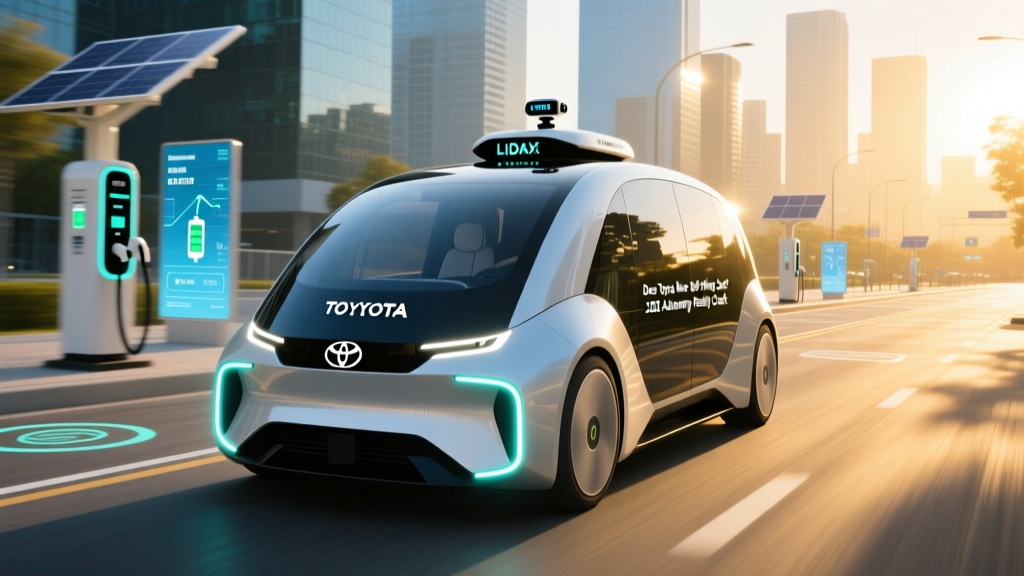
- LiDAR: Multiple solid-state and mechanical LiDAR units for 360° depth mapping
- Cameras: High-resolution surround-view cameras for object classification and signage
- Radar: Long-range and short-range radar for redundancy in adverse weather
- HD Mapping: Proprietary high-definition maps with centimeter-level accuracy, continuously updated via fleet data
- AI Perception Stack: Proprietary neural networks trained on Toyota's global fleet data — Toyota claims access to anonymized driving data from millions of vehicles worldwide through its connected services
This sensor-heavy approach contrasts with Tesla's camera-only FSD architecture and aligns more closely with Waymo and Cruise. The redundancy is designed for safety but adds cost, making consumer deployment more challenging than driver-assist systems.
Testing and Development Status
As of early 2026, Woven by Toyota's Level 4 prototype vehicles have been testing primarily on Japanese roads and within the Woven City test environment. Toyota has demonstrated autonomous taxi services in limited pilots — notably a partnership with Japanese taxi operators in Tokyo's Odaiba district — but these remain invitation-only or geographically constrained trials.
In the United States, Toyota has not launched a commercial robotaxi service. Woven by Toyota maintains engineering offices in California and conducts highway testing, but there is no publicly accessible ride-hailing service comparable to Waymo's operations in Phoenix, San Francisco, or Los Angeles.
Where Can You Actually Ride in a Toyota Robotaxi?
The honest answer: as a member of the general public, you cannot currently hail a driverless Toyota robotaxi anywhere in the world. Here's the current availability landscape:
| Location | Status | Access | Details |
|---|---|---|---|
| Tokyo, Japan (Odaiba) | Limited pilot | Invitation/approved participants | Geofenced urban route with safety operator |
| Woven City, Susono, Japan | Active testing | Woven City residents and employees | Closed-community testing environment |
| US (California, Michigan) | Development testing | Not publicly available | Highway and closed-course validation |
| China (partnerships) | Research phase | Not publicly available | Collaborative R&D with local partners |
Contrast this with Waymo One, which operates commercial driverless service in Phoenix, San Francisco, Los Angeles, and expanding areas — open to any user who downloads the app. Toyota's approach has been markedly more cautious, prioritizing extensive validation over rapid public deployment.
Safety Data: What We Know About Toyota's Autonomous Systems
Toyota publishes limited public data on its Level 4 prototype safety metrics. Unlike Waymo, which has released detailed safety reports and disengagement data, Woven by Toyota's testing remains largely internal. Here's what is publicly verifiable:
- IIHS Ratings: Multiple Toyota models with TSS 3.0 have earned IIHS Top Safety Pick+ designations, with crash-avoidance systems rated "Superior" in vehicle-to-vehicle and vehicle-to-pedestrian tests (iihs.org)
- NHTSA: Toyota vehicles consistently earn 5-star overall safety ratings, though NHTSA does not separately score ADAS intervention effectiveness (nhtsa.gov/ratings)
- Standing Order 2021-01: Under NHTSA's crash-reporting mandate, Toyota has reported incidents involving Level 2 systems, consistent with the broader industry pattern that most ADAS-involved crashes occur in Level 2 systems due to the far greater number of Level 2 vehicles on the road
Note: Specific disengagement rates, miles-per-intervention, and Level 4 prototype safety metrics from Woven by Toyota have not been publicly released as of early 2026.
For context, Waymo — the industry benchmark for public safety data — reported over 7.1 million driverless miles in its 2023 safety report, with a crash rate 85% lower than human benchmarks for comparable urban driving. Toyota's Level 4 program has not published equivalent figures.
Toyota's Strategy vs. the Robotaxi Competition
Toyota's autonomous driving philosophy diverges sharply from the "deploy fast, iterate publicly" approach taken by Waymo (Alphabet) and formerly Cruise (GM). Toyota has consistently emphasized:
- Chauffeur-first, then guardian: Toyota frames autonomy as a spectrum — "chauffeur mode" (Level 4, the car drives) and "guardian mode" (Level 2+, the car enhances human driving). Consumer vehicles get Guardian; robotaxis get Chauffeur.
- Massive fleet data advantage: With roughly 10 million vehicles sold annually worldwide, Toyota argues its connected fleet provides more real-world edge-case data than any pure robotaxi startup could accumulate.
- Gradual geographic expansion: Starting in Japan's more structured driving environment before expanding to the more chaotic road networks of the US, China, and Southeast Asia.
- Safety operator presence: Current Toyota robotaxi pilots retain a safety operator, unlike Waymo's fully driverless commercial service.
| Feature | Toyota / Woven | Waymo | Tesla FSD (Supervised) |
|---|---|---|---|
| SAE Level | Level 2 (consumer) / Level 4 (testing) | Level 4 (commercial) | Level 2 (consumer) |
| Sensor Suite | LiDAR + Camera + Radar | LiDAR + Camera + Radar | Camera only |
| Geofencing | Yes (Level 4 pilots) | Yes (commercial areas) | No (any road) |
| Public Availability | Not available to public | Phoenix, SF, LA, expanding | Any Tesla buyer (supervised) |
| Safety Operator | Yes (current pilots) | No (fully driverless) | N/A (driver must supervise) |
What Toyota Owners Can Actually Use Today
If you own a 2025-2026 Toyota with Toyota Safety Sense 3.0 or Toyota Teammate Advanced Drive, here's what the technology can and cannot do in practice:
What Works Well
- Highway cruising: DRCC + LTA maintains speed, following distance, and lane position effectively on well-marked interstates. This reduces fatigue substantially on long trips.
- Traffic jams: Full-speed DRCC handles stop-and-go traffic smoothly, including complete stops and resumptions.
- Emergency intervention: Pre-Collision System reliably detects vehicles, pedestrians, and cyclists, applying automatic braking when the driver doesn't react.
- Lane change assist: Teammate Advanced Drive can execute lane changes on highways when the driver confirms with the turn signal — the system checks blind spots and adjusts speed.
Where It Falls Short
- Construction zones: Faded lane markings, shifted lanes, and temporary barriers frequently confuse the system. Expect to take over.
- Complex intersections: Unprotected left turns, multi-lane roundabouts, and unusual signal configurations are beyond the system's design intent.
- Adverse weather: Heavy rain, snow, fog, and direct sun glare can degrade camera and LiDAR performance, triggering system disengagement.
- Rural and unmapped roads: Poorly marked roads without clear lane lines will cause LTA to disengage.
Pricing: Toyota's ADAS vs. Robotaxi Rides
Since Toyota doesn't offer a commercial robotaxi service, there's no direct pricing comparison. But here's how the costs break down for the technology you can access:
| Option | Cost | What You Get |
|---|---|---|
| Toyota Safety Sense 3.0 | Standard (included in MSRP) | Level 2 ADAS on virtually all 2026 Toyotas |
| Teammate Advanced Drive | ~$5,000-$8,000 option (model-dependent) | Enhanced Level 2 with automated lane changes, hands-off highway (eyes-on) |
| Waymo One (Phoenix/SF/LA) | Comparable to Uber/Lyft ($1-$3/mile typical) | Level 4 driverless ride — no human in the driver's seat |
| Uber/Lyft (human driver) | $1.50-$4.00/mile depending on city/demand | Human-driven rideshare — baseline comparison |
The key distinction: Toyota's ADAS is something you buy as part of a vehicle you own and drive yourself. A robotaxi is a transportation service. They serve different use cases entirely.
The Road Ahead: When Might Toyota Launch a Public Robotaxi?
Toyota executives have been deliberately vague about commercial robotaxi timelines. Based on publicly available statements and industry analysis:
- Japan commercial service: Toyota has indicated a target of the mid-to-late 2020s for a commercial autonomous mobility service in Japan, likely starting in Tokyo. This would initially include safety operators.
- US commercial service: No announced timeline. Regulatory approval, mapping requirements, and validation in US driving conditions would likely add years after a Japanese launch.
- Woven City integration: Toyota's purpose-built test city near Mt. Fuji serves as a living laboratory. Autonomous shuttles and delivery robots operate within Woven City, but this is a controlled private environment — not representative of public-road deployment challenges.
Toyota's cautious approach contrasts with the aggressive expansion of Chinese robotaxi operators like Baidu Apollo Go (operating commercially in Wuhan, Beijing, and other cities) and Pony.ai. Whether Toyota's methodical validation produces a safer ultimate product — or simply cedes market position — remains an open question.
Frequently Asked Questions
Does Toyota have self-driving cars available to buy?
No. Toyota sells vehicles with Level 2 driver-assistance systems (Toyota Safety Sense 3.0 and Teammate Advanced Drive) that require the driver to remain fully engaged. These are not self-driving. No consumer vehicle sold in the US is Level 4 or Level 5 autonomous.
Where can I use a Toyota robotaxi right now?
You cannot. Toyota's Woven by Toyota subsidiary operates Level 4 prototype vehicles in limited pilots in Japan (Tokyo's Odaiba district, Woven City) with safety operators and restricted access. There is no publicly accessible Toyota robotaxi service in the US or any other market as of early 2026.
How much does Toyota Teammate Advanced Drive cost?
Teammate Advanced Drive is available as an option on select 2025-2026 models (Lexus RX, Toyota Crown) at an estimated $5,000-$8,000 depending on the trim and package. Toyota Safety Sense 3.0 is standard equipment on virtually all new Toyota vehicles at no additional cost.
Is Toyota Teammate Advanced Drive the same as Tesla Autopilot or FSD?
They occupy the same SAE Level 2 category, but the philosophies differ. Toyota Teammate uses LiDAR, cameras, and radar together and is more conservative in its operational design domain. Tesla FSD (Supervised) relies on cameras only and operates on a wider variety of roads. Both require full driver attention at all times. Neither is self-driving.
How safe are Toyota's driver-assistance systems?
Toyota Safety Sense has contributed to strong IIHS and NHTSA safety ratings across Toyota's lineup. The Pre-Collision System is rated "Superior" by IIHS for crash prevention. However, Level 2 systems can and do fail — NHTSA's crash-reporting data includes incidents involving Toyota ADAS. The driver remains responsible for safe operation.
Will Toyota ever make a fully self-driving car?
Toyota is developing Level 4 autonomous technology through Woven by Toyota, but has not announced a timeline for a commercially available self-driving consumer vehicle. Their stated approach is gradual deployment starting with geofenced mobility services in Japan before expanding. Level 5 full autonomy (any road, any condition, no human needed) does not exist from any manufacturer and is not expected in the near term.
What's the difference between Toyota's approach and Waymo's?
Waymo operates commercial Level 4 robotaxi services today (Phoenix, San Francisco, Los Angeles) with no human driver present. Toyota's Level 4 program is still in testing with safety operators and limited public access. Toyota focuses on enhancing human driving (Level 2 Guardian mode) for consumer vehicles while developing robotaxi capability separately. Waymo skipped consumer vehicles entirely to focus on robotaxi service.