Toyota's approach to self-driving technology diverges sharply from the robotaxi arms race led by Waymo and Cruise. Rather than deploying commercial Level 4 services across US cities, Toyota — through its Woven by Toyota subsidiary — has pursued a methodical, closed-campus strategy centered on its Woven City testbed at the base of Mt. Fuji, while continuing to refine its consumer-facing Toyota Safety Sense and Teammate driver-assistance suites. If you're researching Toyota autonomous driving, the honest answer in 2026 is that Toyota has no public robotaxi fleet operating on US roads. What it does have is one of the most data-rich Level 4 testing environments in the world, a growing portfolio of sensor-fusion patents, and a clear-eyed philosophy that Level 2 driver-assist is where the company's near-term revenue lives.
This guide breaks down exactly where Toyota stands on autonomous driving, what's available to consumers today, where its Level 4 program operates, and how its technology and safety record compare to dedicated robotaxi operators.
SAE Automation Levels: Where Toyota Actually Sits
Before parsing Toyota's autonomous driving roadmap, the SAE International J3016 framework needs to be crystal clear. Marketing materials routinely blur these boundaries, and the distinction between Level 2 and Level 4 is the difference between a car that helps you steer and one that has no steering wheel.
| SAE Level | Name | Driver Role | Toyota Status (2026) |
|---|---|---|---|
| Level 0 | No Automation | Full control | Legacy models |
| Level 1 | Driver Assistance | Hands on wheel, supervises | TSS 3.0 (lane centering OR adaptive cruise) |
| Level 2 | Partial Automation | Hands on wheel, full supervision | TSS 3.0 + Toyota Teammate (current production) |
| Level 3 | Conditional Automation | Eyes off in specific conditions | Not commercially deployed |
| Level 4 | High Automation | No driver needed in geofenced area | Woven City trials only (closed campus) |
| Level 5 | Full Automation | No driver, anywhere | Does not exist commercially anywhere |
Woven City: Toyota's Level 4 Living Laboratory
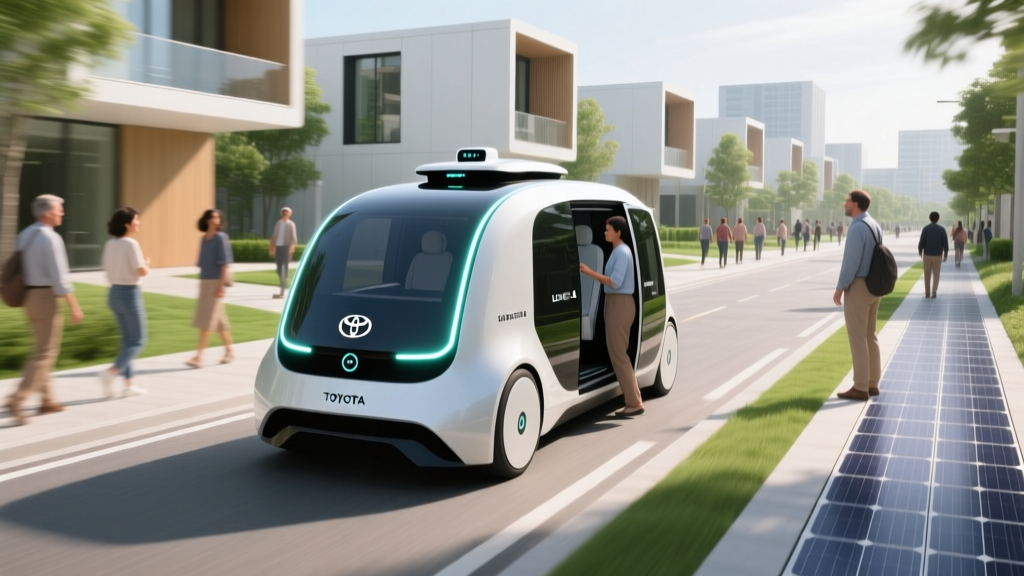
Woven City, a purpose-built 175-acre smart city in Susono, Shizuoka Prefecture, Japan, is the physical home of Toyota's Level 4 autonomous driving research. Construction began in 2021, and by 2026 the campus hosts approximately 250 residents — Toyota employees, researchers, and their families — alongside a fleet of autonomous shuttles, delivery robots, and sensor-equipped test vehicles operating on its streets.
Where Can I Use This Robotaxi Service Right Now?
The direct answer: you cannot. Woven City is not open to the public. It is a private research campus, not a commercial ride-hailing service. Unlike Waymo One in Phoenix, San Francisco, and Los Angeles, or Cruise's former operations, Toyota has made no announcements about launching a paid robotaxi service on public roads in any country as of 2026.
| Location | Type | Public Access | SAE Level | Status |
|---|---|---|---|---|
| Woven City, Susono, Japan | Closed-campus trials | No (residents/researchers only) | Level 4 | Active |
| Tokyo public roads (select routes) | R&D testing | No (test vehicles with safety drivers) | Level 3-4 testing | Active |
| United States | None | N/A | N/A | No operations |
| Europe | None | N/A | N/A | No operations |
Toyota's strategy is fundamentally different from Waymo's. Where Alphabet's robotaxi arm prioritizes scaling commercial operations, Toyota has stated repeatedly that its autonomy research serves two goals: improving consumer vehicle safety (Level 2) and building a technology platform that could eventually support mobility services in aging societies — particularly Japan, where rural populations face severe transit gaps.
Toyota's Autonomous Tech Stack: Sensors, Software, and Philosophy
Woven by Toyota — the software and AI subsidiary formed by merging the Toyota Research Institute-Advanced Development (TRI-AD), Toyota Connected, and other digital units — has built a technology stack that differs in meaningful ways from both Tesla's camera-only approach and Waymo's lidar-heavy architecture.
Sensor Fusion Approach
Toyota's Level 4 test vehicles employ a sensor-fusion stack combining:
- Lidar — for high-resolution 3D mapping and object detection at range
- Millimeter-wave radar — for all-weather velocity and distance measurement
- Camera arrays — for lane detection, traffic-sign recognition, and semantic understanding
- HD maps — pre-built centimeter-accurate maps of the operating domain
- GPS/IMU — for localization within the mapped environment
This multi-sensor redundancy stands in contrast to Tesla's vision-only FSD (Supervised) system, which removed radar and ultrasonic sensors starting in 2022. Toyota's position, articulated by TRI CEO Gill Pratt, is that no single sensor modality is sufficient for safety-critical applications, and that redundancy across sensing types provides defense against individual sensor failure modes — fog defeating cameras, rain scattering lidar, etc.
Guardian vs. Chauffeur: The Dual-Mode Philosophy
Toyota Research Institute has long described its autonomy work through two conceptual modes:
- Guardian mode — the human drives; the system monitors and intervenes only to prevent crashes (essentially an advanced Level 2 safety net)
- Chauffeur mode — the system drives; the human is a passenger (Level 4)
Guardian mode is what has filtered down into production vehicles as Toyota Safety Sense and Teammate. Chauffeur mode remains in the Woven City research phase. The data collected from millions of miles of Guardian-mode driving in consumer vehicles feeds back into Chauffeur-mode training — a flywheel Toyota argues gives it a data-collection advantage over companies that rely solely on purpose-built test fleets.
Consumer ADAS: Toyota Safety Sense 3.0 and Teammate
For the 2026 model year, Toyota's production vehicles feature Toyota Safety Sense 3.0 (TSS 3.0), the latest iteration of the company's Level 2 driver-assistance suite. On higher-end models (Lexus LS, RX, and select Toyota trims), Toyota Teammate adds hands-free driving on divided highways under specific conditions — but always with driver monitoring required.
| Feature | TSS 3.0 | Teammate (Advanced Drive) |
|---|---|---|
| Pre-Collision System (PCS) w/ pedestrian detection | ✓ | ✓ |
| Full-Speed Dynamic Radar Cruise Control | ✓ | ✓ |
| Lane Departure Alert w/ Steering Assist | ✓ | ✓ |
| Lane Tracing Assist (centering) | ✓ | ✓ |
| Road Sign Assist | ✓ | ✓ |
| Proactive Driving Assist (gentle braking/steering) | ✓ | ✓ |
| Hands-free highway driving (eyes on road) | ✗ | ✓ (select models, mapped highways) |
| Automatic lane change (with turn-signal confirmation) | ✗ | ✓ (Lexus) |
| Driver monitoring camera | ✗ | ✓ |
| SAE Level | Level 2 | Level 2 |
Safety Data: What the Numbers Show
Toyota's Level 4 safety record is difficult to benchmark against Waymo or Cruise because Toyota does not operate a commercial fleet accumulating millions of public-road miles. The Woven City campus is small, controlled, and low-speed. However, we can look at two data categories: Toyota's production ADAS safety outcomes and the broader context of Level 4 robotaxi safety for comparison.
According to IIHS research, vehicles equipped with Toyota Safety Sense have shown reductions in front-to-rear crash rates of approximately 50% compared to identical models without the system. The NHTSA has not issued any standing general orders specific to Toyota Level 4 operations, as none exist in the United States.
Robotaxi Safety: The Industry Context
To understand where Toyota's caution comes from, consider what happened to the broader robotaxi sector between 2023 and 2025:
- Cruise — suspended all operations in October 2023 after a pedestrian-dragging incident in San Francisco; GM pulled funding in late 2024, effectively ending the program
- Waymo — continued expanding (Phoenix, SF, LA, Austin by 2026) with a reported serious-injury crash rate approximately 85% lower than human benchmarks over 7.1+ million fully autonomous miles, per its published safety data
- Motional (Hyundai/Aptiv) — scaled back significantly, pausing commercial operations in 2024
Toyota's decision to keep Level 4 confined to Woven City — rather than rushing into commercial deployment — looks less like timidity and more like strategic patience given the industry's turbulence. The company has the financial reserves to wait until the regulatory and technological landscape stabilizes.
Regulatory Landscape: Who Approves Autonomous Operations?
Toyota's autonomous driving activities navigate a fragmented regulatory environment that varies significantly by jurisdiction:
Japan
Japan's Ministry of Land, Infrastructure, Transport and Tourism (MLIT) has been comparatively progressive on autonomous driving legislation. In 2023, Japan became one of the first nations to legally permit Level 3 conditional automation on public roads (limited to the Honda Legend in specific traffic-jam scenarios). Toyota's Level 4 testing on public roads around Susono and Tokyo operates under MLIT-issued test permits that require a safety operator, data-logging, and incident reporting.
United States
In the US, autonomous vehicle regulation is split between federal and state authority:
- NHTSA (federal) — sets vehicle safety standards (FMVSS) and requires crash reporting through its Standing General Order for vehicles with Level 2+ and above ADAS. NHTSA does not "approve" robotaxi services but can investigate and issue recalls.
- State DMVs/CPUCs — individual states authorize commercial robotaxi operations. California's DMV issues testing permits; the CPUC authorizes commercial passenger service. Arizona, Texas, and Nevada have their own frameworks. Toyota has no Level 4 testing or commercial permits in any US state.
Europe
The EU's General Safety Regulation (GSR) and UNECE regulations govern ADAS and automation. Level 3 operations are permitted under UNECE R157 (ALKS) in specific low-speed scenarios, but no Level 4 commercial robotaxi services operate in Europe as of 2026.
Current Limitations: What Toyota's Autonomy Cannot Do
Whether you're evaluating Toyota's production Level 2 systems or its Level 4 research, these are the hard boundaries as of 2026:
- No public robotaxi service anywhere — you cannot hail a driverless Toyota in any city worldwide
- Woven City is a closed campus — its ~175 acres of roads are not representative of complex urban environments like downtown Tokyo or Manhattan
- Weather limitations — Toyota's sensor-fusion stack, like all current Level 4 systems, faces degraded performance in heavy rain, snow, and fog; Woven City's mild climate does not stress-test these edge cases
- HD map dependency — Chauffeur-mode vehicles require pre-mapped routes; they cannot navigate unmapped roads or adapt to sudden construction-zone changes without updated maps
- Teammate geofencing — Toyota's production hands-free system works only on pre-mapped divided highways; it disengages on surface streets, in construction zones, and in unmapped areas
- No Level 3 deployment — unlike Honda (Legend) and Mercedes-Benz (Drive Pilot), Toyota has not commercially deployed any Level 3 system where the driver can legally look away
- Edge-case handling — unprotected left turns across traffic, emergency-vehicle interactions, and informal road-user communication (eye contact with pedestrians) remain unsolved challenges industry-wide
Toyota vs. Waymo vs. Tesla: Comparing Autonomous Strategies
| Attribute | Toyota (Woven) | Waymo (Alphabet) | Tesla (FSD Supervised) |
|---|---|---|---|
| Consumer ADAS | TSS 3.0 / Teammate (Level 2) | None (no consumer product) | FSD Supervised (Level 2) |
| Level 4 robotaxi | Woven City only (closed campus) | Phoenix, SF, LA, Austin (commercial) | None (announced future service) |
| Sensor approach | Lidar + radar + camera + HD maps | Lidar + radar + camera + HD maps | Camera-only (vision) |
| Public-road Level 4 miles | Limited (Japan test permits) | 10M+ fully autonomous | 0 (all miles are Level 2 supervised) |
| Commercial revenue from autonomy | None | Yes (paid rides in 4 cities) | None (FSD is driver-assist, not robotaxi) |
| Regulatory approvals (commercial) | None | CA DMV/CPUC, AZ, TX, NV | None |
| Estimated total investment | ~$3B+ (Woven by Toyota) | ~$30B+ (Waymo/Alphabet) | Undisclosed (part of R&D budget) |
What's Next: Toyota's Autonomy Roadmap Signals
Toyota has not published a firm timeline for commercial Level 4 deployment. However, several signals indicate where the program is heading:
- Woven City expansion — Phase 2 construction is expected to expand the campus population to 2,000+ residents, increasing the complexity and volume of autonomous vehicle interactions
- Arene OS — Woven by Toyota is developing Arene, a vehicle operating system designed to serve as the software backbone for future autonomous and connected Toyota vehicles. Arene is positioned as a potential platform competitor to Android Automotive
- Partnership model — Toyota may ultimately license its Level 4 stack to mobility-service operators (ride-hailing, shuttle services) rather than operating its own fleet, consistent with its historical approach of building platforms rather than running service businesses
- Aging-society use case — Japan's demographics (29% of the population is 65+) create a specific, urgent demand for autonomous mobility in rural areas where public transit is contracting. Toyota has explicitly cited this as a primary motivation for its autonomy investment
Frequently Asked Questions
Is Toyota Teammate truly self-driving?
No. Toyota Teammate is an SAE Level 2 driver-assistance system. It can center the vehicle in a lane, manage speed, and perform lane changes on mapped highways — but the driver must remain attentive and ready to take over at any moment. A driver-monitoring camera enforces this requirement.
Where can I ride in a Toyota robotaxi?
Nowhere, as of 2026. Toyota's Level 4 autonomous vehicles operate exclusively within the Woven City campus in Susono, Japan, which is not open to the public. There is no Toyota robotaxi service comparable to Waymo One in any city worldwide.
How does Toyota's autonomous tech compare to Tesla FSD?
They are fundamentally different approaches. Tesla FSD (Supervised) uses cameras only and claims broad geographic capability but remains Level 2. Toyota's Level 4 research uses lidar, radar, cameras, and HD maps in a geofenced environment. Neither is "self-driving" for consumers — both require human supervision in their current production forms.
Will Toyota launch a robotaxi service in the US?
Toyota has not announced any plans for a US robotaxi service. The company's autonomy strategy appears focused on Japanese domestic mobility needs and gradual technology maturation within Woven City. Any future commercial deployment would likely begin in Japan before expanding internationally.
How safe are Toyota's driver-assistance systems?
Toyota Safety Sense has demonstrated meaningful crash-reduction benefits. IIHS data shows approximately 50% reduction in front-to-rear crashes for TSS-equipped vehicles. However, no Level 2 system eliminates crash risk, and the driver remains responsible for vehicle operation at all times. NHTSA's ADAS reporting portal tracks incidents across all manufacturers.
What about Toyota's partnership with autonomous driving startups?
Toyota has made strategic investments in the autonomy space, including an early stake in Pony.ai (a Chinese Level 4 robotaxi company) and the formation of Woven by Toyota from multiple subsidiaries. However, these investments have not translated into commercially available Toyota-branded robotaxi services outside of the Woven City campus.
Sources: SAE International (J3016), NHTSA Standing General Order data, IIHS crash-reduction research, Woven by Toyota official disclosures, Toyota Motor Corporation press materials. Tax-credit and regulatory information reflects 2026 rules and is subject to change. Consult official sources for current details.