Toyota has never been first to market with flashy autonomy demos. While Waymo runs paying riders in Phoenix and San Francisco, and Tesla pushes its Full Self-Driving software to millions of consumer vehicles, Toyota's autonomous car strategy has played out largely behind the scenes—through its Woven by Toyota subsidiary, a prototype-heavy R&D pipeline, and the living laboratory known as Woven City at the foot of Mount Fuji. If you've been searching for a Toyota autonomous car you can summon today, the honest answer is: you can't. But Toyota's multi-layered approach to autonomy—spanning Level 2 driver-assist in production vehicles, Level 3 in limited contexts, and Level 4 research prototypes—is one of the most methodical in the industry. Here's exactly where things stand as of 2026.
SAE Automation Levels: Where Toyota's Systems Actually Sit
The most common mistake in autonomy coverage is conflating a Level 2 driver-assist system with a Level 4 robotaxi. Toyota's current production vehicles use Toyota Safety Sense 3.0 (TSS 3.0), which bundles adaptive cruise control, lane-centering, and automated emergency braking. This is firmly SAE Level 2—the driver must remain engaged, hands on or near the wheel, eyes on the road at all times. It is not self-driving.
| Level | Name | Driver Role | Toyota Example |
|---|---|---|---|
| Level 0 | No Automation | Full control | Older vehicles, no ADAS |
| Level 1 | Driver Assistance | Hands on wheel, feet on pedals | Basic cruise control |
| Level 2 | Partial Automation | Supervises; hands near wheel | TSS 3.0 (current production) |
| Level 3 | Conditional Automation | Eyes off in specific conditions | Lexus LS Teammate (Japan, traffic-jam) |
| Level 4 | High Automation | No driver needed in geofence | Woven Planet prototypes (testing) |
| Level 5 | Full Automation | No driver, anywhere | Does not exist commercially |
Source: SAE International J3016
The critical distinction: no Toyota or Lexus vehicle sold in the United States is self-driving. The Lexus LS equipped with the Teammate Advanced Drive system achieved a form of Level 3 in Japan—allowing eyes-off driving in low-speed traffic jams on highways—but this remains restricted to Japanese-market vehicles under specific regulatory approval. In the U.S., Teammate functions as a Level 2 system with hands-on requirements.
Woven by Toyota: The Autonomy Engine Behind the Scenes
In 2023, Toyota consolidated its autonomous-driving and software efforts under Woven by Toyota (formerly Woven Planet Holdings), a subsidiary headquartered in Tokyo with engineering hubs in Silicon Valley and London. Woven is responsible for two major initiatives:
- Arene OS: Toyota's proprietary vehicle operating system, designed to unify software across the Toyota and Lexus lineup. Arene is intended to be the foundation for over-the-air updates, advanced ADAS features, and eventually higher-level autonomy. As of 2026, Arene is being deployed incrementally in newer Toyota models, starting with infotainment and vehicle-control integration.
- Level 4 R&D: Woven continues to test Level 4 prototype vehicles on public roads in Japan and in controlled environments. These prototypes use a sensor-heavy stack (detailed below) and are not available to consumers.
Toyota's approach differs fundamentally from Tesla's camera-centric, ship-to-consumers-and-iterate strategy. Toyota and Woven have consistently emphasized a safety-first, validation-heavy path—testing extensively in simulation and closed courses before any public-road deployment. This means fewer flashy demos but also fewer public incidents.
Toyota's Autonomous Tech Stack: Lidar, Cameras, and Redundancy
| Sensor Type | Role | Detail |
|---|---|---|
| Lidar (multiple units) | 3D point-cloud mapping, object detection at range | Roof- and bumper-mounted; ~200m+ range |
| Cameras (surround-view) | Lane detection, traffic-sign recognition, classification | 8+ cameras, high dynamic range |
| Radar (long- and short-range) | Velocity detection, adverse-weather object tracking | Complements lidar in rain/fog |
| HD Maps + GNSS/IMU | Centimeter-level localization within geofence | Pre-mapped routes required |
| Redundant compute | Fail-safe decision-making | Dual-domain controllers; safe-stop fallback |
This sensor-fusion approach stands in contrast to Tesla's camera-only (Tesla Vision) system and aligns more closely with Waymo's multi-sensor stack. The trade-off is cost and complexity: a lidar-equipped Level 4 vehicle adds tens of thousands of dollars in hardware, making it viable for fleet-operated robotaxis but not consumer vehicles at current pricing. Toyota has signaled it is investing in next-generation, lower-cost lidar to eventually bridge this gap.
For production consumer vehicles, Toyota Safety Sense 3.0 uses a more modest suite: a forward-facing camera, a millimeter-wave radar unit, and in some models, corner radars for blind-spot and rear-cross-traffic functions. This hardware supports Level 2 features like lane-tracing assist, dynamic radar cruise control, and proactive driving assist (which gently decelerates for curves or slower traffic ahead).
Woven City: Toyota's Living Laboratory for Autonomy
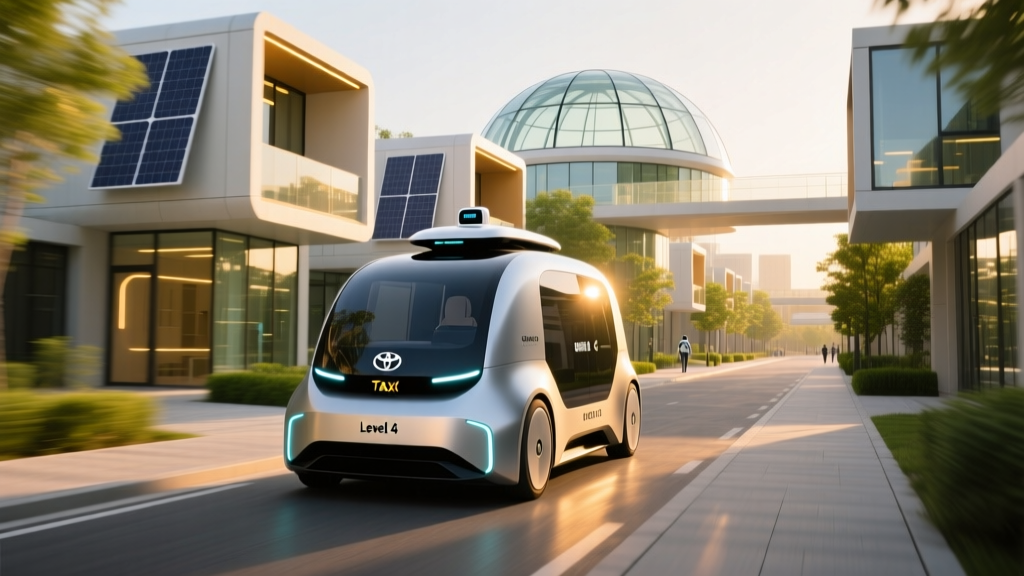
Perhaps the most distinctive element of Toyota's autonomy strategy is Woven City, a purpose-built prototype city near Susono, Japan, at the base of Mount Fuji. Announced in 2020 and with initial construction phases completed by 2024–2025, Woven City is designed as a testing ground where autonomous vehicles, robotics, smart-home systems, and hydrogen infrastructure coexist with real residents.
Key facts about Woven City as of 2026:
- Scale: ~175 acres on the former site of a Toyota factory, with initial capacity for ~360 residents (employees, researchers, families)
- Vehicle testing: The e-Palette autonomous shuttle and other Woven prototype vehicles operate on dedicated and shared roadways within the city
- Infrastructure: Roads are embedded with sensors; buildings use hydrogen fuel cells for power; a dedicated logistics network operates underground for deliveries
- Purpose: Generate real-world data on how autonomous vehicles interact with pedestrians, cyclists, and mixed traffic in a controlled-but-authentic environment
Woven City is not a commercial robotaxi service. It's a research campus. But it gives Toyota something Waymo and Cruise don't have: a controlled environment where edge cases can be systematically explored before public deployment. Data from Woven City feeds directly into Arene OS development and Level 4 validation.
Service Availability: Where Can You Actually Ride a Toyota Autonomous Vehicle?
As of 2026, there is no publicly available Toyota or Woven robotaxi service operating in any city worldwide. Toyota's Level 4 prototypes are in closed testing. The Lexus Teammate Advanced Drive (Level 3, traffic-jam only) is available only in Japan on the Lexus LS. In the U.S., all Toyota and Lexus vehicles with TSS 3.0 operate at Level 2—driver supervision required at all times.
| Service | SAE Level | Public Availability | U.S. Cities |
|---|---|---|---|
| Waymo One | Level 4 | Open to public (app-based) | Phoenix, San Francisco, Los Angeles |
| Cruise (GM) | Level 4 | Limited/suspended in some markets | Phoenix (limited); SF suspended |
| Zoox (Amazon) | Level 4 | Limited employee/invite rides | Las Vegas, Foster City (testing) |
| Tesla FSD (Supervised) | Level 2 | Consumer purchase (driver required) | Nationwide (all states) |
| Toyota/Woven | Level 4 (R&D) | Not publicly available | None (testing in Japan only) |
If you're looking for a robotaxi ride today, Waymo One is the only scaled, publicly accessible Level 4 service in the United States. Toyota is not competing in this space yet.
Safety Record and Validation Approach
Because Toyota's Level 4 prototypes are not in commercial service, there is no public safety record to evaluate in the way we can assess Waymo's NHTSA-reported incident data or Tesla's FSD engagement statistics. What Toyota has disclosed is a testing methodology that emphasizes:
- Simulation-first validation: Woven by Toyota claims to run billions of simulated miles before deploying any software update to physical prototypes. This mirrors Waymo's approach of using simulation to cover edge cases that would take millions of real-world miles to encounter.
- Closed-course testing: Extensive validation at Toyota's Higashi-Fuji test ground and within Woven City before any public-road operation.
- Conservative geofencing: Prototype Level 4 vehicles operate only on pre-mapped routes under favorable conditions.
For production vehicles, Toyota Safety Sense has a strong real-world record. The Insurance Institute for Highway Safety (IIHS) has consistently awarded Toyota and Lexus models Top Safety Pick ratings, with TSS's pre-collision system and lane-departure alert contributing to high crash-avoidance scores.
- Pre-Collision System with Pedestrian Detection (PCS w/PD)
- Full-Speed Range Dynamic Radar Cruise Control (DRCC)
- Lane Departure Alert with Steering Assist (LDA w/SA)
- Lane Tracing Assist (LTA)
- Automatic High Beams (AHB)
- Road Sign Assist (RSA)
- Proactive Driving Assist (PDA) — gentle deceleration for curves, intersections
All features require active driver supervision. See Toyota Safety Sense for model-specific availability.
Current Limitations of Toyota's Autonomous Systems
Understanding what Toyota's systems cannot do is as important as understanding what they can:
- No public robotaxi service: Woven's Level 4 prototypes are in testing only. There is no app, no fare structure, and no ride-hailing integration.
- TSS 3.0 is Level 2 only: Lane Tracing Assist and Dynamic Radar Cruise Control require hands on or near the wheel. The system will issue alerts and can bring the vehicle to a stop if the driver is unresponsive, but it does not drive itself.
- No hands-off highway driving in the U.S.: Unlike GM's Super Cruise or Ford's BlueCruise (which allow hands-off on pre-mapped divided highways), Toyota does not currently offer a hands-off Level 2+ system in the U.S. market.
- Weather sensitivity: TSS camera and radar performance degrades in heavy rain, snow, fog, and direct low-sun glare. The owner's manual specifies these as conditions where the driver must take full control.
- No urban autonomous navigation: TSS does not navigate intersections, make turns, or respond to traffic lights autonomously. It is a lane-keeping and speed-maintenance system.
- Lexus Teammate (Level 3) is Japan-only: The eyes-off, traffic-jam-capable system on the Lexus LS is approved only under Japanese regulations and operates only below ~40 km/h on congested highways.
Pricing and Ownership Context: What Toyota Autonomy Costs Today
Since there is no Toyota robotaxi to price against Uber or Waymo, the relevant cost question is: what does Toyota's driver-assist technology cost on a new vehicle?
Toyota Safety Sense 3.0 is standard equipment on virtually every new Toyota and Lexus sold in the U.S. There is no additional subscription or package cost. This is a significant differentiator from competitors:
| System | SAE Level | Cost to Consumer | Subscription? |
|---|---|---|---|
| Toyota Safety Sense 3.0 | Level 2 | Included (standard) | No |
| Tesla FSD (Supervised) | Level 2 | $8,000 one-time or $99/mo | Optional |
| GM Super Cruise | Level 2 (hands-off) | $2,200–$2,500 (trim-dependent) | Free for 3 yrs, then ~$25/mo |
| Ford BlueCruise | Level 2 (hands-off) | $2,100 (package) or $75/mo | Yes, after trial |
| Waymo One (robotaxi) | Level 4 | Per-ride fare (comparable to Uber) | Per ride |
Toyota's decision to bundle TSS at no extra cost means every new Toyota buyer gets competent Level 2 ADAS without a subscription paywall—a consumer-friendly approach that also means Toyota doesn't generate recurring ADAS revenue the way Tesla and GM do.
The Road Ahead: What to Expect From Toyota Autonomy
Toyota has not announced a timeline for a commercial robotaxi service or a consumer Level 3/4 vehicle in the U.S. What the company has signaled:
- Arene OS expansion: The Arene operating system will underpin all future Toyota and Lexus vehicles, enabling more sophisticated over-the-air ADAS improvements. Expect incremental upgrades to TSS capabilities (intersection assist, more advanced pedestrian prediction) delivered via software.
- Woven City data integration: Insights from Woven City's mixed-traffic testing will feed into Level 4 algorithms, but commercial deployment is likely years away.
- Partnership approach: Toyota has historically preferred to develop autonomy in-house (via Woven) rather than acquire or partner with an existing robotaxi operator. This gives it full control but means a slower path to market compared to Waymo (Alphabet) or Cruise (GM).
- Hybrid and hydrogen fleet testing: Toyota is uniquely exploring autonomy on vehicles with diverse powertrains, including hydrogen fuel-cell prototypes at Woven City—relevant for future commercial fleet applications.
Frequently Asked Questions
Where can I use a Toyota autonomous car service right now?
You cannot. As of 2026, Toyota does not operate a public robotaxi service anywhere in the world. Its Level 4 prototypes, developed by Woven by Toyota, are in closed testing in Japan. In the U.S., all Toyota and Lexus vehicles with Toyota Safety Sense are Level 2—requiring full driver engagement.
Is Toyota Safety Sense self-driving?
No. TSS 3.0 is an SAE Level 2 driver-assist system. It provides adaptive cruise control, lane-centering, and automatic emergency braking, but the driver must keep hands near the steering wheel and eyes on the road at all times. It does not navigate turns, intersections, or traffic signals autonomously.
How does Toyota's autonomy strategy compare to Tesla's?
Fundamentally different approaches. Tesla ships its FSD (Supervised) software to consumer vehicles and iterates via real-world fleet data—this is a Level 2 system that requires driver supervision. Toyota's Woven subsidiary uses a simulation-heavy, lidar-equipped, safety-first methodology for Level 4 development, with no consumer-facing product yet. Tesla's system is available today (for a fee); Toyota's is still in research.
How does Toyota's autonomy compare to Waymo?
Waymo operates a commercial Level 4 robotaxi service (Waymo One) in Phoenix, San Francisco, and Los Angeles—no driver present. Toyota has no comparable public service. Waymo is years ahead in commercial deployment; Toyota is investing in a longer-term, validation-heavy approach with its Arene OS and Woven City test environment.
Will Toyota release a self-driving car?
Toyota has not announced a date for a consumer Level 4 or Level 5 vehicle. The Lexus LS in Japan offers limited Level 3 capability (eyes-off in traffic jams below ~25 mph), but this is not available in the U.S. market. Any future Level 4 product is likely to debut as a fleet-operated service rather than a personal vehicle.
What is Woven City and can I visit?
Woven City is Toyota's purpose-built prototype city near Susono, Japan, designed to test autonomous vehicles, robotics, and smart infrastructure with real residents. It is a research campus, not a tourist destination. Access is restricted to invited residents, researchers, and Toyota employees.
Does Toyota use lidar in its cars?
Current production Toyota and Lexus vehicles sold in the U.S. use camera and radar sensors for Toyota Safety Sense—they do not include lidar. Woven's Level 4 research prototypes use multi-unit lidar arrays, but this hardware is not in any consumer vehicle.
Sources: SAE International J3016, Toyota Safety Sense, IIHS, NHTSA, Woven by Toyota official disclosures. Tax credit and regulatory information reflects 2026 rules; consult a tax professional for personal eligibility.