Tesla's FSD V14.1: The Latest Update Explained
Tesla released Full Self-Driving (Supervised) V14.1 to its fleet in early 2026, bringing refinements to its neural-network-based driving stack. The update improves intersection handling, reduces phantom braking events, and expands the system's ability to navigate unmapped rural roads. But with Tesla's Cybercab robotaxi ambitions looming and the term "robotaxi" appearing in press coverage, buyers and owners need clarity on what V14.1 actually delivers—and what it does not.
This article examines Tesla V14.1 FSD robotaxi features through the lens of real-world capability, SAE automation classification, safety data, and how the system stacks up against true driverless services currently operating in the US.
SAE Automation Level: Where FSD V14.1 Sits
Tesla's Full Self-Driving (Supervised), including V14.1, is classified as SAE Level 2 driver-assistance. This means the system can manage steering, acceleration, and braking simultaneously, but the human driver must remain fully engaged, monitor the road at all times, and be prepared to take over instantly. This is fundamentally different from SAE Level 4 robotaxi services like Waymo, which operate without a human driver in defined geofenced areas.
What's New in FSD V14.1: Feature Breakdown
Tesla's V14.1 release notes and early owner reports highlight several incremental improvements over V13.x:
- End-to-end neural network refinement: The single-stack architecture introduced in V12 has been further trained on expanded fleet data, reducing intervention frequency on complex urban routes.
- Improved unprotected left turns: V14.1 shows better gap-selection judgment at uncontrolled intersections, a historically weak area for camera-only systems.
- Rural road navigation: Enhanced lane-line detection and shoulder recognition on roads without clear markings or signage.
- Phantom braking reduction: Tesla reports a measurable decrease in unnecessary deceleration events triggered by overpass shadows or roadside objects.
- Parking lot traversal: More confident navigation through complex parking structures and surface lots, including multi-level garages.
These are meaningful quality-of-life improvements for drivers using FSD on their daily commutes. However, none of them change the fundamental classification: this remains a supervised system.
Tesla's Robotaxi Ambitions vs. Current Reality
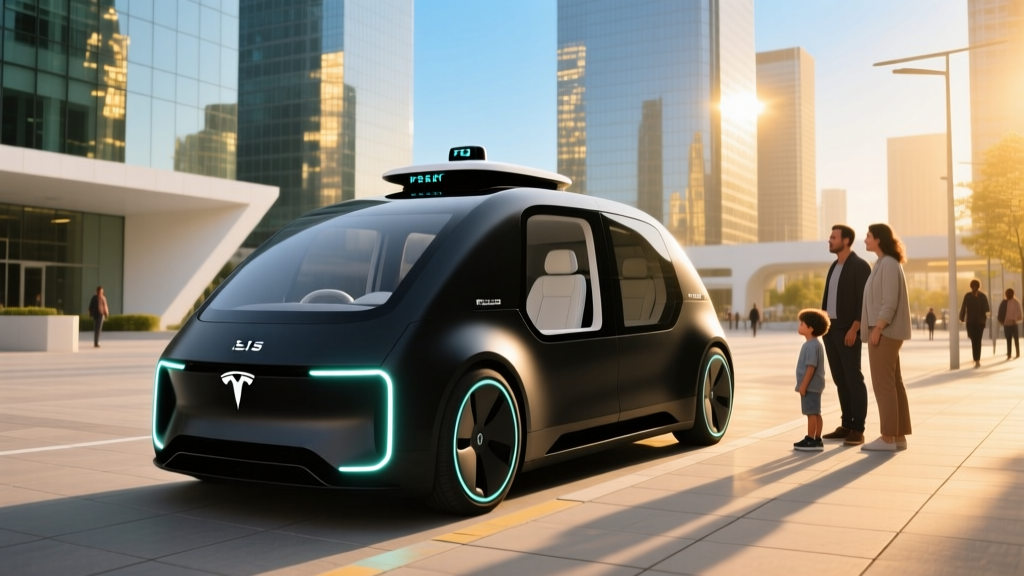
Tesla unveiled its purpose-built Cybercab concept in late 2024, a two-passenger vehicle with no steering wheel or pedals, designed explicitly for autonomous ride-hailing. Tesla has stated ambitions to launch unsupervised robotaxi service in select markets, but as of mid-2026, no Tesla vehicle is operating as a commercial driverless robotaxi anywhere in the United States.
The distinction matters for two reasons:
- Regulatory approval: Operating a vehicle without a human driver on public roads requires specific state-level permits and, in some cases, federal exemptions from NHTSA for vehicles lacking traditional controls. Tesla has not yet received these approvals for commercial service.
- Technology validation: True Level 4 robotaxi operators like Waymo have logged millions of driverless miles with defined operational design domains (ODDs). Tesla's supervised miles, while vast in aggregate, do not represent unsupervised commercial operation.
What FSD V14.1 Does NOT Do
- Drive without human supervision—the driver must remain attentive and hands-ready at all times
- Operate as a commercial ride-hailing service—you cannot hail a Tesla robotaxi today
- Function reliably in heavy rain, snow, fog, or conditions that obscure cameras
- Navigate construction zones with temporary lane configurations consistently
- Handle all edge cases: emergency vehicles, unusual road debris, or non-standard traffic control
Technology Stack: Camera-Only vs. Multi-Sensor Fusion
Tesla's approach to autonomy is philosophically distinct from competitors. Here's how the stacks compare:
| Feature | Tesla FSD V14.1 | Waymo (6th Gen) | Zoox |
|---|---|---|---|
| Primary sensors | 8 cameras (vision only) | LiDAR + cameras + radar | LiDAR + cameras + radar |
| HD mapping | No (real-time perception) | Yes (geofenced areas) | Yes (geofenced areas) |
| Geofencing | No (nationwide deployment) | Yes (defined ODDs) | Yes (defined ODDs) |
| Redundancy | Camera-only, dual compute | Multi-sensor, triple compute | Multi-sensor, redundant systems |
| Weather tolerance | Limited (camera obstruction) | Moderate (LiDAR penetration) | Moderate (LiDAR penetration) |
| SAE Level (current) | Level 2 (supervised) | Level 4 (driverless) | Level 4 (driverless) |
Tesla's vision-only philosophy argues that cameras, paired with sufficiently advanced neural networks, can replicate human driving without LiDAR's cost and complexity. Critics, including NHTSA investigators and independent safety researchers, point out that camera-only systems face inherent limitations in depth perception, low-light conditions, and adverse weather—scenarios where LiDAR provides reliable spatial data regardless of illumination.
Safety Data: What the Numbers Show
Evaluating FSD safety requires distinguishing between two data sets: Tesla's supervised fleet data and unsupervised robotaxi safety records.
Tesla FSD Supervised Safety Data
Tesla publishes quarterly safety reports. In Q4 2025, Tesla reported one crash per 4.7 million miles driven with FSD engaged, compared to one crash per 1.6 million miles without FSD. However, these figures require context:
- Engagement bias: Drivers tend to activate FSD on highways and familiar routes—lower-risk environments—and disengage in complex urban scenarios.
- Reporting methodology: Tesla's data relies on automatic crash detection and may not capture all incidents, particularly minor ones.
- Supervision requirement: Because a human driver is present and legally responsible, intervention rates (not just crashes) are the more relevant metric—and Tesla does not publish these.
Waymo's Driverless Safety Record (for Comparison)
Waymo, operating Level 4 driverless vehicles in Phoenix, San Francisco, Los Angeles, and Austin, has published peer-reviewed safety data. A 2025 study in partnership with insurance and safety researchers found that Waymo vehicles had 85% fewer police-reported crashes per million miles compared to human benchmark data in the same geographies. Waymo has logged over 50 million fully autonomous miles as of early 2026.
The critical difference: Waymo's data represents unsupervised operation with no human fallback, making direct comparison to Tesla's supervised system methodologically challenging.
Where Can You Actually Use a Robotaxi Today?
If you're looking to hail a truly driverless ride in 2026, here's where services are live:
| Service | Cities (2026) | SAE Level | Availability |
|---|---|---|---|
| Waymo One | Phoenix, San Francisco, Los Angeles, Austin | Level 4 | 24/7 in defined geofences |
| Zoox | Limited areas: Las Vegas, Foster City (CA) | Level 4 | Employee/invite-only, expanding |
| Cruise | Operations paused/restructured post-2023 incidents | Level 4 | Limited testing, no commercial service |
| Tesla (FSD) | Nationwide (supervised) | Level 2 | Personal vehicles only, not ride-hailing |
Tesla does not currently operate a robotaxi network. FSD V14.1 is available to Tesla owners who have purchased the FSD package ($8,000 one-time or $99/month subscription as of 2026), but the vehicle requires a licensed driver in the seat at all times. Tesla has discussed future peer-to-peer ride-hailing concepts, but these remain speculative and face significant regulatory and liability hurdles.
Pricing: FSD Subscription vs. Robotaxi Rides
For Tesla owners evaluating whether FSD V14.1 is worth the cost, here's how it compares to actual robotaxi and rideshare pricing:
| Service | Cost Structure | Typical Per-Ride Cost (5-mile trip) | Driver Present? |
|---|---|---|---|
| Tesla FSD (subscription) | $99/month | $0 incremental (own vehicle) | Yes (you drive) |
| Tesla FSD (purchase) | $8,000 one-time | $0 incremental (own vehicle) | Yes (you drive) |
| Waymo One | Per-ride pricing | $12–$18 (varies by demand) | No (driverless) |
| Uber/Lyft | Per-ride pricing | $10–$16 (varies by demand) | Yes (human driver) |
FSD is a driver-assist feature for your own vehicle—not a ride-hailing service. The value proposition is reduced driver fatigue on commutes and long trips, not transportation-as-a-service. If you're seeking a driverless taxi experience today, Waymo One is the only scaled commercial option in the US.
Regulatory Landscape: Who Approves Robotaxi Operations?
Autonomous vehicle deployment in the US involves overlapping jurisdiction:
- State level: States like California (CPUC and DMV), Arizona, and Texas have established permitting frameworks for testing and commercial deployment. California requires both a DMV testing permit and a CPUC commercial deployment permit.
- Federal level: NHTSA sets vehicle safety standards. Vehicles without steering wheels or pedals (like Tesla's Cybercab concept) require exemptions from Federal Motor Vehicle Safety Standards (FMVSS), which NHTSA grants on a case-by-case basis.
- Local level: Cities negotiate operating agreements, define geofences, and establish response protocols for incidents.
Tesla has not applied for or received commercial robotaxi permits in any US jurisdiction as of mid-2026. Any future deployment would require navigating this multi-layered approval process, a timeline measured in years, not months.
Current Limitations of FSD V14.1
Even with V14.1's improvements, Tesla FSD faces real-world constraints that owners should understand:
- Weather vulnerability: Heavy rain, snow, fog, or even direct sun glare can degrade camera performance, triggering system disengagement or reduced confidence.
- Construction zones: Temporary lane shifts, cone configurations, and flagger directions remain challenging. Drivers must be prepared to take over immediately.
- Edge-case handling: Unusual scenarios—a stopped truck partially blocking a lane, a pedestrian behaving unpredictably, or emergency vehicles approaching from unexpected directions—still require human judgment.
- Mapping gaps: While Tesla does not rely on HD maps, the system performs less confidently on roads it has limited training data for, particularly newly constructed or recently modified roads.
- Legal liability: The driver remains legally responsible for all vehicle operation. In the event of a crash with FSD engaged, the driver—not Tesla—is liable.
FAQ: Tesla FSD V14.1 and Robotaxi Questions
Is Tesla FSD V14.1 truly self-driving?
No. FSD V14.1 is SAE Level 2 driver-assistance, requiring continuous human supervision. The "Full Self-Driving" name is a product label, not a technical classification. The driver must remain alert, hands-ready, and legally responsible at all times.
Where can I use a Tesla robotaxi right now?
You cannot. Tesla does not operate a commercial robotaxi service anywhere. FSD is a feature for Tesla owners driving their own vehicles with supervision. Waymo One is the only scaled driverless ride-hailing service in the US, available in Phoenix, San Francisco, Los Angeles, and Austin.
How much does Tesla FSD cost in 2026?
FSD is available as a $8,000 one-time purchase or a $99/month subscription. This gives you supervised driver-assistance on your personal Tesla—not ride-hailing service.
How safe is FSD V14.1 compared to human driving?
Tesla's data suggests fewer crashes per million miles with FSD engaged, but this data has engagement-bias limitations and does not account for intervention rates. Independent, peer-reviewed comparisons are limited. Waymo's unsupervised Level 4 data shows significant safety improvements over human benchmarks in the same geographies.
When will Tesla launch a real robotaxi service?
Tesla has announced ambitions for unsupervised robotaxi deployment, but no firm date, regulatory approval, or commercial service exists as of 2026. Timelines for full autonomy have historically slipped, and regulatory approval is a multi-year process. Treat any specific date with skepticism until permits are formally granted.
Can I use FSD in bad weather?
Tesla explicitly warns that FSD performance degrades in rain, snow, fog, and other conditions that obscure cameras. The system may disengage or request immediate driver takeover. In adverse weather, treat FSD as unavailable and drive manually.