If you have followed Tesla's Full Self-Driving development over the past several years, you have likely encountered a familiar pattern: a bold timeline announcement, followed by a quiet revision, followed by another bold timeline. As of 2026, the question "when will Tesla have unsupervised FSD" remains one of the most searched and debated topics in the EV space — and the honest answer requires separating marketing language from engineering reality, regulatory approvals, and verifiable safety data.
This guide cuts through the noise. We examine what Tesla's current FSD (Supervised) system actually does in 2026, the SAE automation level it occupies, the technical and regulatory hurdles standing between Level 2 and true unsupervised driving, and how Tesla's approach compares to robotaxi operators who have already launched driverless commercial services.
What Tesla FSD (Supervised) Actually Does in 2026
Tesla's current driver-assistance suite ships under two names: Basic Autopilot (standard on all new Tesla vehicles) and Full Self-Driving (Supervised), available as an add-on. Despite the "Full Self-Driving" branding, the system remains a Level 2 driver-assist feature under the SAE J3016 framework. The driver must remain attentive, keep hands on or near the steering wheel, and be prepared to take over at any moment.
Tesla FSD (Supervised) operates at SAE Level 2. The system can manage steering, acceleration, and braking simultaneously under certain conditions, but the human driver is the fallback. The system does NOT monitor its own performance boundaries reliably enough to remove the driver from the loop. Only Level 4 systems — like Waymo's geofenced robotaxi service — operate without a human driver.
In practice, FSD (Supervised) in 2026 handles the following tasks on public roads:
| Capability | How It Works | Reliability |
|---|---|---|
| Highway lane-keeping & lane changes | Vision-only (camera array) with neural-net path planning | Strong on well-marked divided highways |
| Navigate on Autopilot (on-ramp to off-ramp) | Automatic navigation-guided lane changes and interchange routing | Occasional missed exits or aggressive merges |
| Traffic light and stop sign recognition | Camera-based detection with automated stop-and-go | Improved but can misread obscured or non-standard signs |
| City street navigation | End-to-end neural network handles turns, cross-traffic, pedestrians | Variable — strong in mapped urban areas, weaker in complex construction zones |
| Smart Summon / parking lot navigation | Low-speed autonomous movement in parking lots via app | Limited to line-of-sight; cautious and slow |
| Automatic parking | Parallel and perpendicular parking assist | Functional but slower than manual parking |
The Sensor Architecture: Vision-Only vs. Multi-Sensor Fusion
One of the most consequential decisions Tesla made was abandoning radar and ultrasonic sensors in favor of a pure vision-only approach, branded as "Tesla Vision." The current 2026 Tesla fleet relies on a camera array — typically 8 cameras providing 360-degree coverage — processed by the HW4 (Hardware 4) computer running custom neural-network inference chips.
This is a fundamentally different philosophy from competitors. Waymo's Level 4 robotaxis use a sensor fusion stack combining LiDAR, radar, and cameras. Mobileye's SuperVision and GM's Super Cruise also incorporate radar alongside cameras. The vision-only approach offers advantages in cost and scalability but introduces specific weaknesses:
- Low-visibility conditions: Heavy rain, fog, snow, and direct sun glare can degrade camera performance where radar and LiDAR would maintain object detection.
- Depth perception: Stereo vision and neural-net depth estimation have improved dramatically but still lack the centimeter-level precision of LiDAR at long range.
- Edge cases: Unusual objects (overturned trucks, road debris, animals) that fall outside training data distributions remain a challenge for any perception system, but redundancy from multiple sensor types provides a safety net that vision-only lacks.
Why Unsupervised FSD Hasn't Arrived: The Technical and Regulatory Gap
Tesla CEO Elon Musk has predicted unsupervised FSD capability "next year" in various forms since approximately 2016. As of 2026, the system remains supervised. Understanding why requires examining three distinct barriers:
1. The Long Tail of Edge Cases
Neural-network-based driving systems excel at common scenarios — highway cruising, standard intersections, predictable traffic. The challenge lies in the "long tail": rare but safety-critical events that occur infrequently across millions of miles. Examples include a child chasing a ball into the road at dusk, a partially obscured stop sign behind tree branches, an emergency vehicle parked at an unusual angle, or road-surface conditions that change traction without visual warning.
Each of these scenarios requires the system to either handle the situation correctly or recognize its own uncertainty and execute a safe fallback — pulling over, stopping, or alerting the driver with enough time to intervene. Achieving this reliability across every possible combination of conditions is the central unsolved problem in moving from Level 2 to Level 4.
2. Regulatory Approval Is Not a Single Gate
There is no single federal "self-driving approval" in the United States. The National Highway Traffic Safety Administration (NHTSA) sets safety standards and investigates incidents, but does not currently have a formal certification pathway for consumer Level 4 vehicles. Instead, regulation is fragmented:
- State-level approval: California (DMV and CPUC), Arizona, Texas, and Nevada have created frameworks for testing and commercial deployment of autonomous vehicles, but each state's requirements differ.
- NHTSA Standing General Order: Requires manufacturers to report crashes involving Level 2+ and automated driving systems, creating an incident database but not a pre-market approval process.
- FMVSS compliance: Federal Motor Vehicle Safety Standards were written assuming a human driver. Vehicles without steering wheels or pedals (like Waymo's custom vehicle or the Tesla Cybercab concept) require exemptions or regulatory updates.
Tesla has not submitted a formal application for unsupervised operation in any U.S. jurisdiction as of early 2026. The company has announced plans for a robotaxi service using the Tesla platform, but timelines remain preliminary and unconfirmed by regulators.
3. The Supervision Handoff Problem
Removing driver supervision is not simply a matter of improving the driving algorithm. It requires solving the "handoff problem" — the transition from machine control to human control when the system encounters a situation it cannot handle. Research consistently shows that humans are poor monitors of automation: when a driver has been disengaged for extended periods, their reaction time to a sudden takeover request is significantly degraded. This is why Level 3 systems (conditional automation, where the driver can disengage but must be available) have been so difficult to deploy safely, and why most of the industry has either stayed at Level 2 or jumped directly to Level 4 (no human in the loop at all).
- It does NOT drive the car without a responsible, attentive driver in the driver's seat.
- It does NOT handle all weather conditions — heavy rain, snow, and fog degrade performance.
- It does NOT guarantee correct responses to construction zones, emergency vehicles, or unmapped road changes.
- It does NOT qualify as "autonomous" or "self-driving" under any regulatory or SAE definition.
- It does NOT absolve the driver of legal responsibility for the vehicle's operation.
Cost Breakdown: FSD Purchase vs. Subscription in 2026
Tesla offers FSD (Supervised) through two pricing models. The one-time purchase price has fluctuated significantly over the years — ranging from $5,000 to $15,000 — while the monthly subscription has been adjusted to broaden adoption.
| Option | Price (2026) | Notes |
|---|---|---|
| FSD (Supervised) — One-Time Purchase | $8,000 | Tied to vehicle; transferability between Teslas has varied by policy year |
| FSD (Supervised) — Monthly Subscription | $99/month | Cancel anytime; no long-term commitment |
| Basic Autopilot (included) | $0 (standard) | Traffic-aware cruise control + autosteer on marked lanes |
| Enhanced Autopilot (if offered) | $6,000 | Adds Navigate on Autopilot, auto lane change, autopark, summon — availability varies |
Breakeven analysis: At $99/month, the subscription reaches the $8,000 purchase price at approximately 81 months (6 years, 9 months). If you plan to keep your Tesla longer than that and use FSD regularly, the purchase is the better financial choice. If you are uncertain about long-term ownership or want to evaluate the feature, the subscription carries far less risk.
How Tesla FSD Compares to Competing Systems
Tesla is not the only automaker offering advanced driver-assistance, and it is certainly not the only company pursuing unsupervised driving. Here is how the major systems compare on capability, supervision requirements, and cost:
| System | SAE Level | Hands-Off? | Eyes-Off? | Where Available | Cost |
|---|---|---|---|---|---|
| Tesla FSD (Supervised) | Level 2 | Partial (torque monitoring) | No — camera monitors gaze | All roads (city + highway) | $8,000 or $99/mo |
| GM Super Cruise | Level 2 | Yes (on mapped roads) | No — driver monitoring camera | 400,000+ mi of mapped highways | Included or $2,500 add-on (varies by model) |
| Ford BlueCruise | Level 2 | Yes (on mapped Blue Zones) | No — driver monitoring camera | 130,000+ mi of divided highways | $2,100 or $75/mo subscription |
| Mercedes Drive Pilot | Level 3 | Yes | Yes (under 40 mph, specific conditions) | Approved highways in NV and CA | $2,500/year subscription (S-Class/EQS) |
| Waymo (robotaxi) | Level 4 | N/A — no driver | N/A — no driver | Geofenced areas: Phoenix, SF, LA, Austin | Per-ride pricing (ride-hail model) |
The critical distinction: Mercedes Drive Pilot is the only consumer system with a Level 3 certification in the U.S., meaning the manufacturer accepts liability during approved operation — but only under very narrow conditions (highway traffic jams under 40 mph on mapped roads). Waymo operates at Level 4 but is a ride-hail service, not a consumer vehicle you can purchase.
Tesla's Robotaxi Ambitions: The Cybercab and Beyond
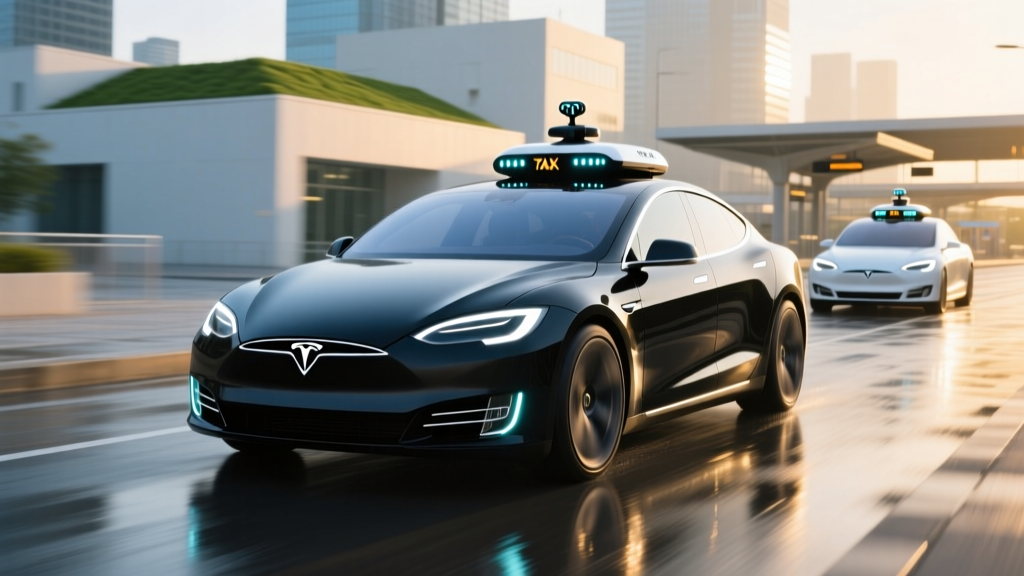
Tesla has announced a dedicated robotaxi vehicle — referred to as the "Cybercab" — designed without a steering wheel or pedals, which would inherently require unsupervised (Level 4) capability. As of 2026, this vehicle remains in the announced/preliminary stage. Production timelines have been stated as early as late 2026, but no regulatory approval for driverless operation on public roads has been secured.
For Tesla to operate an unsupervised fleet, the company would need to:
- Demonstrate safety performance exceeding human drivers to state and federal regulators — not just in aggregate statistics, but in specific operational design domains (ODDs).
- Obtain state-level permits for driverless testing and commercial deployment, similar to the permits Waymo holds from the California DMV and CPUC.
- Resolve liability frameworks: When no human driver is present, the manufacturer or operator assumes full liability. This requires insurance structures, incident-response protocols, and regulatory agreements that Tesla has not yet publicly detailed.
- Address the FMVSS exemption process for a vehicle without traditional driver controls.
Waymo, by contrast, has accumulated over 30 million driverless miles across multiple cities and has worked through each of these regulatory steps incrementally over more than a decade. Tesla's approach of attempting to transition from a supervised consumer system to an unsupervised fleet represents a fundamentally different — and unproven — path.
Models and Trims: Where FSD Is Available
FSD (Supervised) is available across Tesla's entire 2026 consumer lineup as an optional add-on. It is not standard on any trim. Basic Autopilot (traffic-aware cruise control and autosteer) is standard equipment on all new Tesla vehicles.
- Model 3 (all trims, including Long Range and Performance) — FSD optional
- Model Y (all trims, including Long Range, Performance, and the refreshed Juniper generation) — FSD optional
- Model S (Long Range and Plaid) — FSD optional
- Model X (Long Range and Plaid) — FSD optional
- Cybertruck (AWD, Cyberbeast) — FSD optional
All vehicles require the HW4 computer, which has been standard in production since 2023. Older vehicles with HW3 received a limited FSD experience, and Tesla has offered hardware upgrades for qualifying vehicles, though availability and cost have varied.
The Realistic Timeline: What the Evidence Suggests
Based on publicly available data, regulatory filings (or lack thereof), and the current state of the technology, here is a candid assessment of the unsupervised FSD timeline:
- Limited geofenced robotaxi pilot (2026–2027): Tesla may begin supervised or semi-supervised robotaxi testing in select cities, similar to early Waymo programs. This would likely be invitation-only, geofenced, and under close monitoring.
- Broader unsupervised consumer deployment (2028–2030+): Widespread removal of the supervision requirement across Tesla's consumer fleet would require demonstrated safety data at scale, regulatory approval in multiple states, and resolution of the sensor-architecture debate (vision-only vs. fusion). This timeline assumes no major regulatory breakthroughs or safety incidents that could delay approval.
- Full Level 4 consumer vehicle (unknown): A Tesla vehicle that can be purchased and operated without any driver supervision on arbitrary roads remains a long-term aspiration rather than a near-term product.
These projections are based on the pace of regulatory approvals, the complexity of the remaining technical challenges, and comparisons with Waymo's timeline (founded as the Google Self-Driving Car Project in 2009, launched its first commercial driverless service in 2020 — an 11-year development cycle for geofenced Level 4 operation).
Frequently Asked Questions
Is Tesla FSD actually self-driving?
No. Tesla FSD (Supervised) is an SAE Level 2 driver-assistance system. The driver must remain attentive, monitor the road, and be prepared to take over at any time. The "Full Self-Driving" name is a product branding choice, not a technical or regulatory classification. Tesla itself appends "(Supervised)" to the name to acknowledge this requirement.
How much does Tesla FSD cost in 2026?
FSD (Supervised) costs $8,000 as a one-time purchase or $99 per month as a subscription. Basic Autopilot, which includes traffic-aware cruise control and autosteer, is included standard on all new Tesla vehicles.
Has any Tesla vehicle received regulatory approval for unsupervised driving?
No. As of 2026, no Tesla vehicle has received approval from NHTSA, any state DMV, or any other regulatory body for unsupervised (Level 3 or Level 4) operation on public roads. Mercedes-Benz Drive Pilot holds the only consumer Level 3 certification in the U.S., limited to specific highway conditions under 40 mph in Nevada and California.
Why hasn't Tesla achieved unsupervised FSD despite years of promises?
Three primary factors: (1) the "long tail" of rare edge cases that neural networks struggle to handle reliably without human fallback, (2) the absence of a clear federal regulatory pathway for consumer Level 4 vehicles, and (3) the inherent difficulty of the vision-only sensor approach in adverse weather and low-visibility conditions. These are engineering and regulatory challenges, not simply software-update problems.
Can I sleep or use my phone while FSD is active?
No. Tesla's cabin camera monitors driver attention, and the system will issue escalating alerts — visual, audible, and eventually disabling Autopilot for the remainder of the drive — if it detects inattention. Using FSD while impaired, sleeping, or not in the driver's seat is dangerous, illegal, and has resulted in serious crashes and criminal charges.
How does Tesla's approach compare to Waymo?
Waymo uses a multi-sensor fusion stack (LiDAR, radar, cameras) and operates at Level 4 within tightly geofenced areas that have been extensively mapped and validated. Tesla uses a vision-only approach and aims for broad geographic coverage with a supervised Level 2 system, with the long-term goal of removing supervision. Waymo has been commercially operational since 2020; Tesla's unsupervised system has not yet received regulatory approval.