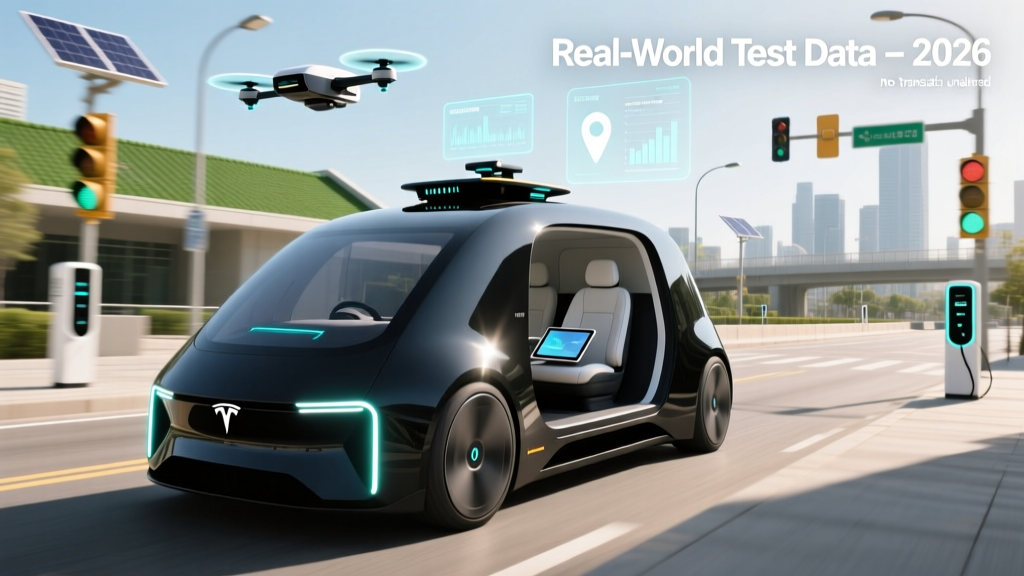
Tesla's Full Self-Driving (Supervised) system has long been a North America-first affair, with international owners receiving only basic Autopilot and limited Enhanced Autopilot features. That gap may finally be closing. Recent reports and regulatory filings indicate Tesla plans bringing simplified FSD software to older international vehicles — a move that could unlock more advanced driver-assistance features for Model 3 and Model Y owners across Europe, Asia, and other markets. But "simplified" is the operative word. This isn't the full vision-only FSD stack that US owners experience; it's a pared-down version shaped by regional regulations, older hardware constraints, and Tesla's ongoing pivot to camera-only perception.
Here's a precise breakdown of what this software entails, which vehicles qualify, what it can and cannot do, and how it compares to competing Level 2 systems in 2026.
What Simplified FSD Actually Is — and Isn't
Tesla's FSD (Supervised) software in the United States handles city streets, stop signs, traffic lights, lane changes, and highway on-ramps to off-ramps — all under continuous driver supervision. The simplified international variant strips several of these capabilities to comply with stricter European UNECE regulations and similar frameworks in markets like Australia, South Korea, and Japan.
Based on regulatory submissions and Tesla's software release notes, the simplified FSD package for older international vehicles is expected to include:
| Feature | Simplified FSD (International) | Full FSD Supervised (US) |
|---|---|---|
| Adaptive Cruise Control | ✅ Included | ✅ Included |
| Autosteer (Lane Centering) | ✅ Included | ✅ Included |
| Auto Lane Change | ✅ (with confirmation) | ✅ (auto or confirm) |
| Navigate on Autopilot (Highway) | ✅ Limited corridors | ✅ Full highway network |
| Traffic Light & Stop Sign Control | ⚠️ Basic recognition only | ✅ Active control |
| City Street Autosteer | ❌ Not included | ✅ Included |
| Smart Summon | ❌ Not included | ✅ Included |
| Park Seek / Valet | ❌ Not included | ✅ Included (beta) |
The key omission is city-street autosteering — the feature that distinguishes FSD from conventional adaptive cruise and lane-keeping systems. European UNECE Regulation 79 currently limits the lateral force a lane-keeping system can apply and restricts hands-off operation, making Tesla's full city-street FSD non-compliant without significant modification.
Both the simplified international FSD and the full US version operate at SAE Level 2. This means the system can control steering, acceleration, and braking simultaneously, but the human driver must remain fully engaged — eyes on the road, hands available to take over immediately. Tesla's cabin camera monitors driver attention and will issue escalating warnings, eventually disabling Autosteer for the remainder of the trip if the driver is inattentive. This is not a self-driving system. No production Tesla sold anywhere in the world operates at SAE Level 3 or above.
Which Vehicles Are Eligible?
The phrase "older international vehicles" refers specifically to Teslas equipped with Hardware 3 (HW3), also known as the FSD Computer introduced in April 2019. These vehicles include:
- Model 3 (2019–2023 production, pre-Highland refresh for most markets)
- Model Y (2020–2024 production, pre-Juniper refresh)
- Model S (2019–2020, pre-Palladium refresh)
- Model X (2019–2020, pre-Palladium refresh)
HW3 uses eight surround cameras and a cabin-facing driver-monitoring camera. It lacks the higher-resolution cameras and more powerful inference chip found in Hardware 4 (HW4), which debuted in early 2023. Tesla has confirmed that HW3 vehicles will receive a dedicated software branch — the "simplified" FSD — rather than the full vision stack, which demands more computational throughput than HW3 can provide.
International owners with HW4-equipped vehicles (2023+ Model S/X, 2024+ Model 3 Highland, 2025+ Model Y Juniper) are expected to receive a more feature-complete FSD variant, pending regional regulatory approval. As of mid-2026, China has approved a version of FSD for HW4 vehicles, while European approval remains limited to the simplified tier.
How It Works Technically: Camera-Only Perception
Tesla abandoned radar and ultrasonic sensors in favor of a pure vision approach branded Tesla Vision. The simplified FSD software relies on the vehicle's eight external cameras to build a real-time 3D occupancy network — essentially a voxel-based model of the surrounding environment. Neural networks process lane markings, vehicle positions, pedestrian movements, and road geometry at roughly 36 frames per second across all cameras.
For HW3 vehicles, the camera resolution is approximately 1.2 megapixels per camera (compared to 5 MP on HW4), which limits the effective detection range to roughly 250 meters forward versus 350+ meters on HW4. This hardware constraint is one reason the simplified FSD omits city-street driving: urban environments demand faster processing of complex, close-range obstacles that HW3's lower-resolution feeds struggle to resolve at the necessary confidence threshold.
The system uses end-to-end neural network inference for planning and control — rather than hand-coded rules for every scenario, the network was trained on billions of miles of driving data to predict appropriate steering, throttle, and brake inputs given the visual input. However, the simplified version runs a narrower model scope, trained primarily on highway and limited-access road scenarios.
Cost and Availability
Pricing for the simplified FSD package varies by market, but Tesla has structured it as either a one-time purchase or a monthly subscription where local regulations permit:
| Market | One-Time Purchase | Monthly Subscription | Included Standard? |
|---|---|---|---|
| Europe (EU/UK) | €5,000–€6,000 (est.) | Not yet available | No — separate purchase |
| Australia/NZ | AUD $7,500–$9,000 (est.) | Under review | No |
| South Korea | KRW ~6,500,000 (est.) | Available | No |
| Japan | JPY ~650,000 (est.) | Under review | No |
| US (Full FSD Reference) | $8,000 | $99/month | No |
Basic Autopilot (Traffic-Aware Cruise Control + Autosteer) remains standard on all new Tesla vehicles globally. The simplified FSD is an add-on purchase, just as Full FSD is in the US. Tesla has not confirmed whether existing FSD purchase transfers will apply to the simplified version for owners who bought FSD on a vehicle that previously couldn't use it outside North America.
- Does not drive autonomously. You must keep your hands on or near the wheel and monitor the road at all times. The cabin camera enforces this.
- Limited to highway and major roads. City-street autosteering is excluded. You'll handle all surface-street driving manually.
- Struggles in adverse weather. Heavy rain, fog, snow, and direct sun glare can degrade camera performance, triggering Autosteer disengagement.
- Depends on clear lane markings. Faded, missing, or construction-zone lane markings may cause the system to disengage or make uncertain lane-keeping decisions.
- No traffic light control. The system may recognize and display traffic lights but will not autonomously stop or proceed through intersections.
- HW3 hardware ceiling. Lower camera resolution and older inference chip mean reduced object-detection range and slower edge-case processing compared to HW4.
How It Compares to Competing Level 2 Systems
The simplified FSD enters a market where several established Level 2 systems already operate in international markets. Here's how it stacks up against key competitors available in 2026:
| System | Brand | SAE Level | Highway Hands-Off? | Lane Change | City Streets | Cost |
|---|---|---|---|---|---|---|
| Simplified FSD | Tesla | Level 2 | No (supervised) | Yes (confirm) | No | ~€5,000–6,000 |
| Driving Assistant Professional | BMW | Level 2 | Yes (≤60 km/h, EU) | Yes (confirm) | No | Included or ~€2,500 pkg |
| Highway Driving Assist 2 | Hyundai/Kia | Level 2 | No | Yes (confirm) | No | Included (SEL+) |
| Super Cruise | GM/Cadillac | Level 2 | Yes (mapped highways) | Yes (auto) | No | $2,500 or included |
| ProPILOT Assist 2.0 | Nissan | Level 2 | Yes (mapped highways, JP) | Yes (confirm) | No | Included (SV+) |
| Travel Assist | Volkswagen Group | Level 2 | Yes (≤95 km/h, EU) | Yes (confirm) | No | ~€1,700 pkg |
A few distinctions matter for international buyers:
Hands-off capability: BMW, GM (Super Cruise), Nissan (ProPILOT 2.0 in Japan), and VW Group allow limited hands-off driving on mapped highways under specific speed conditions — something Tesla explicitly does not permit anywhere. Tesla's cabin camera mandates visual attention but still expects the driver to be ready to steer, meaning the system is hands-on even when it feels otherwise.
Mapping dependence: Super Cruise and ProPILOT 2.0 rely on HD maps of pre-scanned highways, which limits coverage but increases reliability within those corridors. Tesla's approach is map-light, relying on real-time vision, which offers broader geographic coverage but less predictability in edge cases.
Price premium: Tesla's simplified FSD is among the most expensive Level 2 packages on the market, even with fewer features than the US version. BMW's comparable system often costs roughly half as much, and Hyundai includes HDA2 on mid-level trims at no additional charge.
Safety Context: What the Data Shows
Tesla publishes quarterly safety reports claiming that vehicles driving on Autopilot record fewer crashes per million miles than the US average. However, these reports have drawn criticism from the National Highway Traffic Safety Administration (NHTSA) and independent researchers for comparing highway Autopilot miles (lower-risk driving environments) against all US driving miles (including higher-risk urban and nighttime driving).
NHTSA has opened and closed multiple investigations into Tesla's Autosteer and FSD systems, particularly regarding crashes involving stationary emergency vehicles. In 2024, NHTSA confirmed that Tesla's driver-monitoring system (the cabin camera) was an improvement over earlier torque-based steering monitoring but noted that drivers could still circumvent attention warnings.
For international simplified FSD, the reduced feature set arguably lowers risk: without city-street autosteering, the system avoids the most complex driving scenarios where driver over-reliance is most dangerous. Highway driving is inherently more structured and predictable.
The Insurance Institute for Highway Safety (IIHS) has consistently rated partial-automation systems as offering no proven crash-reduction benefit over attentive human driving, and in some studies found that drivers using Level 2 systems showed increased signs of attention disengagement over time. Tesla's cabin camera monitoring partially addresses this, but the fundamental risk remains: any Level 2 system requires sustained human vigilance, and human vigilance is difficult to maintain during monotonous, partially automated driving.
What This Means for International Tesla Owners
If you own a HW3-equipped Tesla outside North America, the arrival of simplified FSD represents a meaningful but bounded upgrade over basic Autopilot. You gain automated lane changes, highway navigation assist on supported corridors, and improved longitudinal control — but you do not gain the city-street capability that defines the full FSD experience in the US.
For owners considering the purchase, the decision framework is straightforward:
Buy it if: You drive long highway commutes frequently, value automated lane changes and on-ramp-to-off-ramp navigation assist, and are comfortable paying the premium for a feature set that will expand over time via OTA updates (if regulations permit).
Skip it if: Your driving is primarily city and surface-street, you expect autonomous capability (you won't get it), or you're unwilling to pay €5,000+ for a system that BMW and Hyundai offer in comparable or superior form for less money.
Wait if: You're planning to upgrade to a HW4-equipped Tesla within 12–18 months. The more capable hardware will receive a richer feature set as international regulatory approvals progress.
Frequently Asked Questions
Is Tesla's simplified FSD truly self-driving?
No. It operates at SAE Level 2, meaning it assists with steering, acceleration, and braking but requires the driver to remain fully engaged and ready to take over at any moment. The cabin camera monitors your attention and will issue warnings and eventually disable the system if you look away or fail to respond. No production Tesla is autonomous.
Will my older HW3 Tesla get the full US FSD features eventually?
Unlikely. Tesla has confirmed that HW3's computational capacity and camera resolution cannot support the full vision-based FSD stack. The simplified version is the ceiling for HW3 hardware, both in the US and internationally. Full city-street FSD requires HW4.
How much does simplified FSD cost outside the US?
Estimated pricing ranges from approximately €5,000 to €6,000 in Europe, AUD $7,500–$9,000 in Australia, and comparable amounts in other markets. Monthly subscriptions are available in some regions but not all. Basic Autopilot remains standard on all vehicles at no additional cost.
Does simplified FSD work in bad weather?
Performance degrades significantly in heavy rain, snow, fog, and direct sun glare. Because Tesla Vision relies entirely on cameras, any condition that obscures the lens or reduces visibility will cause the system to issue warnings and may disengage Autosteer. Always be prepared to take full manual control in adverse conditions.
How does this compare to BMW's Driving Assistant Professional?
BMW's system costs roughly half as much, offers limited hands-off driving at low speeds on European highways (under UNECE approval), and provides comparable lane-keeping and adaptive cruise features. Tesla's simplified FSD offers broader highway coverage via its map-light approach but costs more and does not permit any hands-off operation. For pure highway comfort at lower cost, BMW's system is competitive.
Can I transfer my FSD purchase if I sell my car?
Tesla's FSD transfer policy has changed multiple times. As of 2026, FSD purchases are generally tied to the vehicle, not the owner. Tesla has occasionally offered limited-time transfer promotions. Check Tesla's current policy in your region before making a purchase decision, and consult Tesla's official FSD support page for the latest terms.