The Tesla Robotaxi Promise vs. Today's Reality
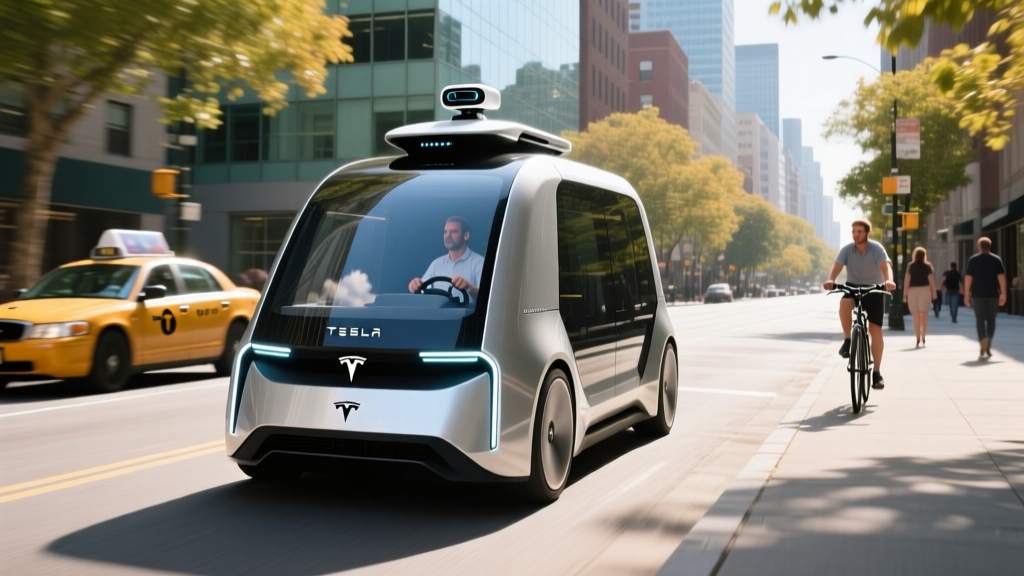
Elon Musk unveiled Tesla's purpose-built "Cybercab" concept in late 2024, promising a steering-wheel-free, pedal-free robotaxi that would undercut human-driven rideshare on cost. As of early 2026, however, no Tesla vehicle operates as a driverless robotaxi anywhere in the world. Every Tesla on the road — including those running the latest FSD (Supervised) software — remains a SAE Level 2 driver-assistance system that requires an attentive human behind the wheel.
Meanwhile, true Level 4 robotaxis from Waymo and Zoox are carrying paying passengers without drivers in select U.S. cities. If you're searching for tesla robotaxi human drivers comparisons, the honest answer is that the two categories don't yet compete head-to-head on public roads. Here's what exists, what's announced, and what the data actually shows.
SAE Automation Levels: Why the Distinction Matters
Much of the confusion around Tesla's autonomous ambitions stems from marketing language that blurs the line between driver-assist and driverless. The SAE International J3016 standard defines six levels of driving automation, and the gap between Level 2 and Level 4 is enormous — not incremental.
| Level | Name | Who Drives? | Current Examples |
|---|---|---|---|
| 0 | No Automation | Human does everything | Legacy vehicles |
| 1 | Driver Assistance | Human + one system (steering OR speed) | Adaptive cruise control |
| 2 | Partial Automation | Human supervises; system handles steering + speed | Tesla Autopilot / FSD (Supervised), GM Super Cruise, Ford BlueCruise |
| 3 | Conditional Automation | System drives in limited conditions; human on standby | Mercedes Drive Pilot (limited markets) |
| 4 | High Automation | System drives; no human needed in geofenced area | Waymo One, Zoox (pilot programs) |
| 5 | Full Automation | System drives everywhere, all conditions | Does not yet exist commercially |
Tesla's FSD (Supervised) is classified as Level 2. The driver must remain engaged, hands near the wheel (or eyes monitored via cabin camera), and ready to take over instantly. Waymo's driverless service in Phoenix, San Francisco, and Los Angeles operates at Level 4 within its approved geofence — no human driver is present or needed.
Critical distinction: Tesla's "robotaxi" announcements refer to a future service that has not launched. Any Tesla you can buy or ride in today requires a licensed, attentive human driver. Calling FSD "self-driving" is inaccurate and potentially dangerous.
Where Can You Actually Use a Robotaxi Right Now?
If you want to hail a vehicle with no human driver today, your options are limited to specific geofenced zones in a handful of cities. Tesla's Cybercab is not among them.
| Operator | SAE Level | Cities (Driverless) | Hours | Vehicle |
|---|---|---|---|---|
| Waymo One | Level 4 | Phoenix metro, San Francisco, Los Angeles (expanding to Austin) | 24/7 in Phoenix; limited hours elsewhere | Jaguar I-PACE EV, Hyundai Ioniq 5 |
| Zoox | Level 4 | Las Vegas (Strip corridor), Foster City, CA (limited pilot) | Limited hours | Zoox purpose-built carriage |
| Cruise | Level 4 | Operations suspended since late 2023; limited phased return in Phoenix/Dallas with human safety drivers | N/A | Chevrolet Bolt EV / Cruise Origin |
| Tesla (Cybercab) | Announced L4 | None — not yet in production or service | N/A | Cybercab concept (2-seat, no wheel) |
Waymo leads the market by a wide margin. As of late 2025, Waymo reported completing over 10 million paid driverless trips across its operational cities. The company uses high-definition mapping, lidar, radar, and cameras to navigate within tightly defined geofences approved by state regulators.
Technology Stack: Camera-Only vs. Multi-Sensor Fusion
Tesla's approach to autonomy is philosophically distinct from every other robotaxi developer. Understanding this divide is essential to evaluating timelines and safety claims.
Tesla: Vision-Only (Cameras + Neural Networks)
- 8 surround cameras (upgraded HW4/HW5 suite on 2024+ vehicles)
- No lidar, no radar (Tesla removed ultrasonic sensors and radar starting in 2022)
- Relies entirely on camera-based perception processed by custom FSD neural network chips
- End-to-end learning approach: neural net maps camera input to driving decisions
- Advantage: Lower hardware cost per vehicle; scales with fleet data from millions of consumer Teslas
- Risk: Camera-only perception struggles in low-visibility conditions (heavy rain, fog, direct sun glare); no redundant depth-sensing from lidar
Waymo / Zoox: Multi-Sensor Fusion (Lidar + Radar + Cameras)
- Roof-mounted lidar arrays providing 360° 3D point-cloud mapping (range ~300m)
- Short- and long-range radar for velocity detection and all-weather redundancy
- Multiple high-resolution cameras for object classification and traffic-light reading
- Pre-mapped HD routes with centimeter-level precision
- Advantage: Sensor redundancy; reliable depth perception regardless of lighting; proven in commercial service
- Risk: High per-vehicle sensor cost (estimated $100,000+ per Waymo vehicle); requires geofencing and HD mapping of each new city
Tesla's bet is that camera-only AI, trained on billions of miles of real-world fleet data, will eventually match or exceed multi-sensor systems at a fraction of the cost. As of 2026, that bet remains unproven for driverless operation. FSD (Supervised) has improved significantly in smoothness and capability, but it still requires human oversight — and NHTSA crash reporting data continues to log incidents involving Tesla's driver-assist systems.
Robotaxi Safety: What the Data Actually Shows
Safety is the most contested — and most important — question in autonomous driving. Marketing claims are easy; verified data is harder to come by.
Waymo Safety Record (Published Data)
- Over 30 million driverless miles completed as of mid-2025 (Waymo Safety Report)
- Waymo's published analysis claims a 76% reduction in injury-causing crash rates compared to human benchmarks in comparable urban environments
- Fatalities in driverless mode: 0 reported as of early 2026
- Minor contact incidents do occur — primarily low-speed sideswipes and rear-end events where the robotaxi was struck by human drivers
Tesla FSD (Supervised) Safety Context
- Tesla's quarterly safety reports cite ~1 crash per 4–5 million miles driven with FSD active, vs. the U.S. average of ~1 per 670,000 miles (NHTSA national average)
- However, these figures include supervised driving — a human is present and can intervene. This is not comparable to driverless robotaxi data
- NHTSA's Standing General Order has logged hundreds of crash reports involving Tesla vehicles operating with Autopilot or FSD engaged; the data reflects reporting requirements, not necessarily fault
- No Tesla vehicle has operated without a human driver in commercial service
The honest assessment: Waymo's Level 4 robotaxi has accumulated meaningful driverless miles with a strong — though not perfect — safety record. Tesla's FSD data is promising for a Level 2 system but cannot be compared apples-to-apples with driverless operations because the human driver remains the safety backstop.
Cost Comparison: Robotaxi Pricing vs. Uber and Lyft
Tesla's Cybercab pitch hinges on economics: Musk has projected rides costing less than $1 per mile, undercutting both human-driven rideshare and personal car ownership. But these are projections for a service that doesn't yet exist. Here's what pricing looks like today.
| Service / Mode | Cost Per Mile (Avg.) | Notes |
|---|---|---|
| Waymo One | $1.50–$2.50/mi | Comparable to UberX; surge pricing during peak demand; promos available |
| UberX / Lyft (human driver) | $1.20–$2.00/mi | Varies by city, time, and demand; driver compensation is the largest cost |
| Tesla Cybercab (projected) | $0.50–$1.00/mi (announced) | Tesla's stated target; not achievable until driverless service launches at scale |
| Personal Tesla Model Y (ownership) | $0.35–$0.55/mi | Includes electricity, insurance, depreciation, maintenance over 5 years / 75,000 mi |
Waymo's current pricing is roughly on par with UberX — sometimes slightly higher, sometimes lower depending on promotions. The robotaxi cost advantage is supposed to come from eliminating the driver (who takes ~60–70% of each rideshare fare), but Waymo's high per-vehicle sensor costs and remote-assistance infrastructure offset some of that savings.
Tesla's sub-$1/mile target depends on three things happening simultaneously: (1) achieving true Level 4 autonomy with cameras only, (2) manufacturing the Cybercab at scale, and (3) gaining regulatory approval for driverless operation in multiple jurisdictions. None of these have occurred as of early 2026.
Regulatory Landscape: Who Approves Robotaxi Operations?
Autonomous vehicle regulation in the U.S. is a patchwork of state and federal authority. There is no single federal robotaxi license — deployment is approved state by state, and sometimes city by city.
- California (CPUC + DMV): Waymo holds permits for driverless commercial service in San Francisco and Los Angeles. Cruise's permit was suspended after a 2023 incident and has been under phased reinstatement review. Tesla would need separate CPUC approval before operating any driverless service in California.
- Arizona: The most permissive regulatory environment. Waymo has operated driverless in Phoenix since 2020 with minimal state-imposed restrictions.
- Texas: Austin and other cities have been targeted for robotaxi expansion. State law allows autonomous vehicle operation with proper registration and insurance.
- Nevada: Zoox has tested on the Las Vegas Strip under a state-issued autonomous vehicle permit.
- Federal (NHTSA): NHTSA sets vehicle safety standards (FMVSS) and investigates crashes. The agency has not yet issued specific FMVSS standards for vehicles without steering wheels or pedals — a hurdle Tesla's Cybercab concept must clear before production. NHTSA can issue exemptions, but the process is case-by-case.
Tesla has not publicly disclosed applications for robotaxi operating permits in any state as of early 2026. The regulatory pathway is separate from — and in addition to — solving the technical autonomy challenge.
Current Limitations: What Robotaxis Cannot Do
Even the most advanced Level 4 robotaxis operate under significant constraints. These aren't edge cases — they define the practical boundaries of the service.
Limitations of Current Level 4 Robotaxis (Waymo, Zoox)
- Geofencing: Service is restricted to pre-mapped zones. You cannot hail a Waymo from downtown Phoenix to a rural address 40 miles outside the geofence.
- Weather: Heavy rain, snow, fog, and ice degrade sensor performance. Waymo limits or suspends service in severe weather; operations are primarily in dry, mild climates (Phoenix, LA).
- Construction zones: Unexpected lane closures, temporary barriers, and flaggers can confuse the system. Waymo may route around construction or pull over and request remote assistance.
- Complex interactions: Unprotected left turns across heavy traffic, informal hand-signals from human drivers, and off-road scenarios remain challenging.
- No intercity travel: Robotaxis are local, point-to-point services. A Phoenix-to-Sedona trip is not possible.
- Accessibility: Current Waymo vehicles (Jaguar I-PACE) require passengers to enter a standard car seat; wheelchair-accessible options are limited.
Limitations Specific to Tesla's Announced Cybercab
- Not yet in production; concept vehicle only
- No steering wheel or pedals — requires FMVSS exemption from NHTSA before sale or deployment
- Camera-only system must prove Level 4 reliability without lidar or radar redundancy
- No announced regulatory applications for driverless commercial operation
- Timeline: Tesla has suggested 2026–2027 production start, but Tesla's historical timeline accuracy for autonomy milestones has been poor ("FSD next year" promises date back to 2016)
Is This Truly Self-Driving or Just Driver-Assist?
This is the question every buyer and rider must answer before trusting the technology with their safety:
Tesla FSD (Supervised) — including the latest end-to-end neural network versions — is driver-assist, not self-driving. The human is the driver. Tesla's own owner's manual and on-screen warnings make this explicit: "You must remain attentive, keep your hands on the steering wheel, and be prepared to take over at any time." This is SAE Level 2, regardless of how capable the system feels on a well-marked highway.
Waymo One in Phoenix, San Francisco, and Los Angeles is genuinely self-driving within its geofence. There is no human in the driver's seat. The vehicle handles all driving tasks, and if it encounters a situation it cannot resolve, it pulls over safely or contacts a remote guidance operator (who advises but does not directly steer). This is SAE Level 4.
Until Tesla obtains regulatory approval for driverless operation and demonstrates Level 4 reliability without a human safety net, any comparison between "Tesla robotaxi" and "human drivers" is a comparison between a future concept and today's reality.
Frequently Asked Questions
Can I hail a Tesla robotaxi today?
No. As of early 2026, Tesla does not operate any driverless ride-hailing service. Tesla's Cybercab is an announced concept vehicle that has not entered production. All Tesla vehicles on the road require a licensed, attentive human driver.
How does Waymo's robotaxi cost compare to Uber?
Waymo One pricing is generally comparable to UberX — typically $1.50–$2.50 per mile depending on the city, time of day, and demand. In some markets, Waymo offers promotional pricing below UberX rates. The long-term expectation is that robotaxis will undercut human-driven rideshare by eliminating driver compensation, but current sensor and operations costs limit the discount.
Has a Waymo robotaxi ever been in a serious crash?
Waymo vehicles have been involved in minor incidents — primarily low-speed contacts where a human-driven vehicle struck the robotaxi. As of early 2026, Waymo has reported zero fatalities in driverless mode across over 30 million autonomous miles. The NHTSA Standing General Order database tracks all reported crashes involving ADS-equipped vehicles and is publicly searchable.
Why doesn't Tesla use lidar like Waymo?
Elon Musk has publicly called lidar a "crutch" and argued that a vision-only approach — mirroring how humans drive using eyes and a brain — will ultimately scale better and cost less. Tesla's bet is that neural network training on billions of camera miles from its consumer fleet will close the gap. Critics argue that without lidar's precise depth sensing, camera-only systems face inherent limitations in adverse lighting and weather. The debate remains unresolved for driverless applications.
When will Tesla's Cybercab actually launch?
Tesla has targeted 2026–2027 for initial Cybercab production, but the company has a well-documented history of missing autonomy-related timelines. Full Self-Driving was initially promised for 2017. Even if production begins on schedule, the vehicle still requires NHTSA FMVSS exemptions (for having no steering wheel or pedals) and state-by-state regulatory approval for driverless commercial operation. A realistic estimate for any Tesla driverless service at meaningful scale is 2028 at the earliest — and likely later.
Are robotaxis safer than human drivers?
Waymo's published data suggests its driverless vehicles have a lower injury-causing crash rate than the human benchmark in comparable urban environments. However, robotaxis currently operate in favorable conditions (mapped, dry-weather cities) and avoid the most challenging driving scenarios. A definitive nationwide comparison requires more data across more environments. What is clear: Level 4 robotaxis have demonstrated they can operate safely within their operational design domain, but that domain is narrow compared to where and when humans drive.