The 25.12.0 Software Update: What Tesla Actually Shipped
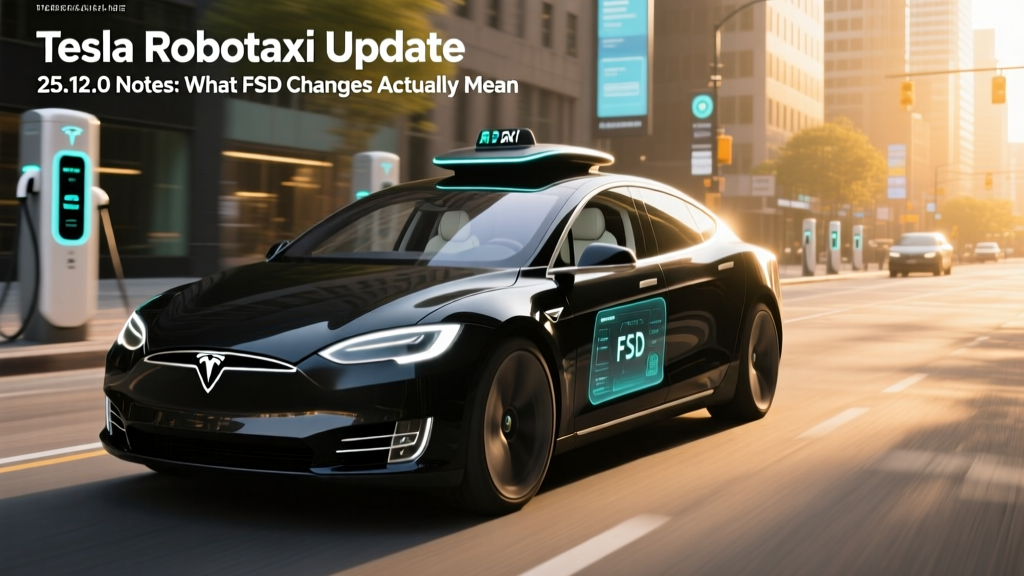
Tesla's over-the-air software update version 25.12.0 landed in late 2025 and rolled into early 2026, prompting a wave of searches for "Tesla robotaxi update 25.12.0 notes" from owners and followers trying to parse what changed. The reality is more measured than the hype: this release refines Full Self-Driving (Supervised) — Tesla's consumer Level 2 driver-assistance system — with improvements to intersection handling, lane-change decisiveness, and vision-based object classification. It does not transform any Tesla vehicle into a driverless robotaxi.
Understanding the distinction between Tesla's FSD (Supervised) software updates and actual Level 4 robotaxi services like Waymo and Zoox is the single most important thing a buyer or follower can do in 2026. The terminology overlap is deliberate, but the engineering and regulatory realities are completely different.
| Level | Definition | Example |
|---|---|---|
| Level 0 | No automation — warnings only | Backup camera beep |
| Level 1 | Single-axis assist (steering OR speed) | Adaptive cruise control |
| Level 2 | Combined steering + speed; driver must supervise at all times | Tesla FSD (Supervised), GM Super Cruise, Ford BlueCruise |
| Level 3 | Conditional automation — driver can disengage in specific scenarios | Mercedes Drive Pilot (limited markets, <40 mph) |
| Level 4 | High automation — no driver needed in defined operational domain | Waymo One, Zoox (geofenced city zones) |
| Level 5 | Full automation — any road, any condition | Does not exist commercially |
Source: SAE International J3016
Tesla's FSD (Supervised), including the 25.12.0 build, remains a Level 2 system per SAE J3016. The driver is legally and operationally responsible for the vehicle at all times. No Tesla software update has changed this classification.
What Changed in Tesla FSD Update 25.12.0
Tesla does not publish granular changelogs the way traditional software companies do, but community telemetry, owner reports, and Tesla's own release summaries point to several concrete improvements in 25.12.0:
- Intersection gap acceptance: The system now makes more confident decisions when merging into cross-traffic, reducing the hesitation that previously caused unnecessary stops at unprotected left turns.
- Lane-change path planning: Smoother trajectory generation during highway lane changes, with earlier signaling and more natural acceleration profiles.
- Vision-based object classification: Improved neural-net recognition of construction cones, temporary lane markings, and partially obscured signage — a persistent weakness in camera-only systems.
- Speed-profile smoothing: Reduced phantom braking events on highways, particularly when passing large trucks or driving under overpasses where shadow/lighting transitions previously triggered deceleration.
- Cabin camera monitoring refinement: Updated driver-attention detection thresholds for the interior camera, though hands-on-wheel or eyes-on-road requirements remain mandatory.
These are iterative improvements to a Level 2 system. They do not enable driverless operation, remove the steering wheel requirement, or expand the operational design domain (ODD) beyond what prior FSD builds supported.
Tesla's Robotaxi Ambitions vs. Today's Reality
Tesla unveiled its dedicated "Cybercab" robotaxi concept in October 2024 — a two-seat, no-steering-wheel vehicle designed for Level 4/5 autonomous ride-hailing. As of early 2026, the Cybercab remains pre-production and not available for purchase or ride-hailing use. Tesla has stated targeted production beginning in 2026, but no regulatory approval for driverless passenger service has been granted to Tesla in any U.S. jurisdiction.
This is the critical context for the 25.12.0 update: it improves the software that powers Tesla's consumer vehicles with drivers present, not a driverless taxi fleet. Tesla's approach to autonomy is camera-only (no lidar, no radar on current production vehicles since 2022), relying on end-to-end neural networks trained on fleet data. This contrasts sharply with Waymo's multi-sensor stack.
| Attribute | Tesla FSD (Supervised) | Waymo One (Level 4) |
|---|---|---|
| SAE Level | Level 2 (driver required) | Level 4 (driverless in geofence) |
| Primary Sensors | 8 cameras (vision-only) | Lidar + radar + cameras |
| HD Mapping | No (real-time vision) | Yes (pre-mapped geofence) |
| Geofencing | None (works on most roads) | Strict (approved city zones only) |
| Weather Capability | Degraded in rain/fog/snow | Lidar performs in rain; limited in heavy snow |
| Driver Required | Yes — always | No (within ODD) |
| Cost to Consumer | $8,000 one-time or $99/mo | Per-ride pricing (see below) |
Where Can You Actually Use a Robotaxi Right Now?
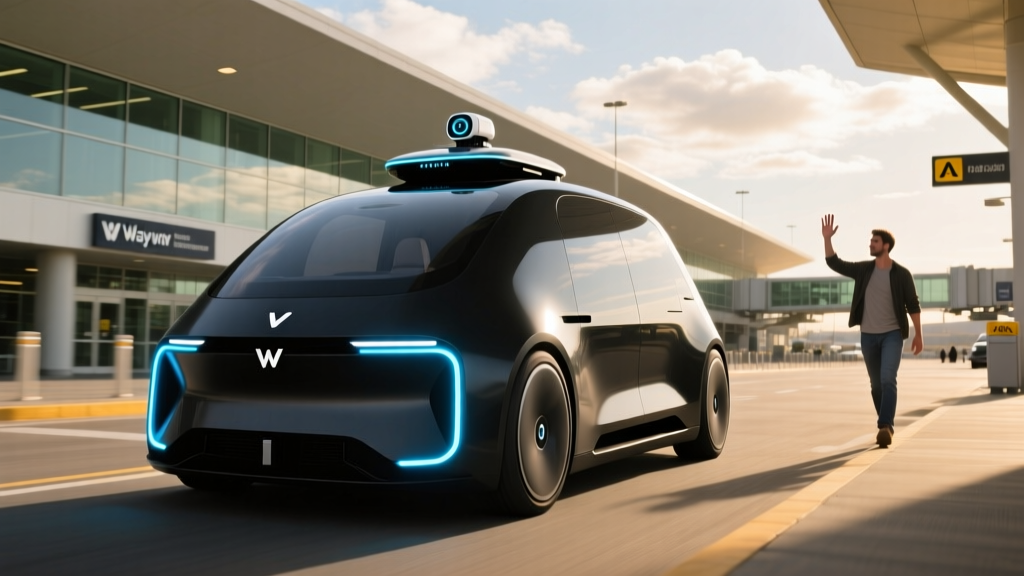
If you're looking for a vehicle with no driver that you can summon via app today, Tesla is not an option. The operational Level 4 robotaxi services in the United States as of early 2026 are:
| Service | City | Hours | Status |
|---|---|---|---|
| Waymo One | Phoenix, AZ (metro-wide) | 24/7 | Fully open, no waitlist |
| Waymo One | San Francisco, CA | 24/7 | Fully open |
| Waymo One | Los Angeles, CA | 24/7 | Fully open |
| Waymo One | Austin, TX | Limited hours | Expanding (2025 launch) |
| Zoox | Las Vegas, NV (Strip corridor) | Limited | Invite-only / pilot |
| Zoox | Foster City, CA | Limited | Employee/testing |
| Tesla | No city | — | No driverless service exists |
Sources: Waymo.com, Zoox.com, state DMV/CPUC filings
Robotaxi Pricing: How Does It Compare to Uber and Lyft?
For the services that actually operate today, pricing varies by market and time of day. Here's a representative comparison based on a 5-mile, midday ride in Phoenix (Waymo's most mature market):
| Service | Typical Fare | Per-Mile Cost | Notes |
|---|---|---|---|
| Waymo One | $12–$18 | ~$2.40–$3.60 | No surge pricing; promotional discounts common |
| UberX | $10–$16 | ~$2.00–$3.20 | Surge can push 1.5–3× |
| Lyft Standard | $10–$15 | ~$2.00–$3.00 | Prime Time surge applies |
Waymo's pricing is broadly competitive with UberX and Lyft in non-surge conditions, and crucially, Waymo does not implement surge pricing — the fare you see is the fare you pay. During peak demand periods when Uber and Lyft surge to 2× or 3×, Waymo becomes significantly cheaper. However, Waymo's availability is constrained by fleet size, and wait times in Phoenix and San Francisco can exceed 10–15 minutes during busy periods.
Tesla has suggested its future Cybercab robotaxi could offer rides at approximately $0.20 per mile (roughly $1.00 for that same 5-mile trip), but this figure is a projected target for an unreleased service with no regulatory approval. Treat it as aspirational, not actionable.
How Safe Are Robotaxis? The Real Data
- Waymo: Over 30 million paid driverless miles completed across Phoenix, San Francisco, and Los Angeles as of late 2025. Waymo's published data (peer-reviewed and submitted to NHTSA) shows a police-reported crash rate approximately 85% lower than the human benchmark for comparable urban driving, and a fatality rate of zero in driverless operations. (Waymo Safety Report)
- Cruise (GM): Suspended all operations in October 2023 after a San Francisco incident where a pedestrian was dragged by a Cruise vehicle following a collision with a human-driven car. Cruise resumed limited testing with safety drivers in 2024–2025 but has not returned to driverless commercial service. GM announced significant restructuring of Cruise operations in late 2024.
- Zoox: Limited pilot operations; no major public safety incidents reported, but total driverless miles are far lower than Waymo's.
- Tesla FSD (Supervised): Tesla reports aggregate fleet data but does not separate FSD-engaged miles from basic Autopilot miles in a way that allows direct comparison to Level 4 services. NHTSA Standing General Order data shows Tesla vehicles involved in the highest number of reported ADAS-related incidents, though this partly reflects Tesla's market share and reporting compliance. No Tesla vehicle operates without a driver.
The safety question has a definitive answer for Level 4 robotaxis (Waymo's data is robust and independently verifiable) and an ambiguous one for Level 2 systems like FSD, where the human driver remains the safety backstop and incident attribution is complex.
Current Limitations of Robotaxi and FSD Systems
Every autonomous or semi-autonomous system has a defined operational design domain (ODD) — conditions under which it can function. Here are the concrete limitations as of 2026:
Tesla FSD (Supervised) — Including 25.12.0
- Weather: Heavy rain, fog, snow, and ice degrade camera performance significantly. The system will issue a "camera visibility reduced" warning and may disengage, requiring immediate driver takeover.
- Construction zones: Temporary lane markings, cones, and flaggers remain challenging. Update 25.12.0 improved cone detection but does not reliably handle complex multi-stage construction reroutes.
- Unmapped or new roads: While FSD doesn't rely on HD maps, newly built roads or recently modified intersections can produce unpredictable behavior.
- Edge cases: Emergency vehicles stopped at odd angles, unusual road debris, pedestrians in unexpected locations, and complex multi-point turn scenarios still require driver intervention.
- No driverless operation: The system will not function without a licensed driver in the driver's seat who is monitoring the road.
Level 4 Robotaxis (Waymo, Zoox)
- Geofencing: Vehicles will not operate outside pre-mapped, regulator-approved zones. A Waymo in Phoenix cannot drive to Tucson.
- Weather restrictions: Waymo reduces operations or pulls vehicles during heavy monsoon rain or dense fog. Snow-covered roads are a hard no.
- No highway driving: Current Waymo operations are limited to surface streets (typically ≤45 mph). No freeway airport runs.
- Remote assistance: When a vehicle encounters an unmapped obstacle or ambiguous situation, it may stop and wait for a remote human operator to approve a path — causing delays.
- Accessibility: Zoox's purpose-built vehicle accommodates wheelchairs; Waymo's Jaguar I-PACE fleet has limited wheelchair accessibility.
The Regulatory Landscape: Who Approves Robotaxi Operations?
Robotaxi deployment in the United States is governed by a patchwork of state and local authorities — there is no single federal "robotaxi license."
- California: The California Public Utilities Commission (CPUC) and the California DMV jointly regulate autonomous vehicle testing and commercial deployment. Waymo holds both a DMV deployment permit and a CPUC commercial passenger carrier permit.
- Arizona: Among the most permissive states. Waymo operates under a Trade and Commerce registration with minimal state oversight. No specific autonomous vehicle permit is required beyond standard vehicle registration and insurance.
- Texas: Austin has become a key expansion market. The Texas Department of Licensing and Regulation oversees autonomous vehicle operations under a 2023 legislative framework.
- Nevada: The Nevada DMV issues autonomous vehicle testing and operation permits. Zoox operates under this framework in Las Vegas.
- Federal (NHTSA): The National Highway Traffic Safety Administration sets vehicle safety standards (FMVSS) but does not directly approve robotaxi services. NHTSA's Standing General Order requires manufacturers and operators to report crashes involving ADS and ADAS systems.
Tesla has not applied for or received commercial robotaxi operating permits in any state. Its FSD software operates under the regulatory framework for consumer driver-assistance systems, not autonomous vehicle deployment.
What the 25.12.0 Update Means for Tesla Owners
If you own a Tesla with FSD (Supervised) — whether you paid the $8,000 one-time purchase or subscribe at $99/month — update 25.12.0 is a meaningful quality-of-life improvement. The intersection handling and phantom braking reductions address two of the most frequently cited frustrations. But it does not change what FSD fundamentally is: a sophisticated Level 2 driver-assistance system that requires your full attention and legal responsibility.
For those tracking Tesla's robotaxi timeline, the relevant milestones are not software update version numbers. They are:
- Cybercab production start (targeted 2026, unconfirmed)
- NHTSA FMVSS compliance for a vehicle without a steering wheel
- State-level commercial robotaxi permit applications
- Validated Level 4 safety case with independent verification
None of these have been completed as of early 2026.
Frequently Asked Questions
Is Tesla FSD update 25.12.0 a robotaxi update?
No. Update 25.12.0 improves Tesla's Full Self-Driving (Supervised) system, which is a Level 2 driver-assistance feature for consumer vehicles. It does not enable driverless operation or create a robotaxi service. The driver must remain engaged at all times.
Where can I use a real robotaxi in 2026?
Waymo One operates commercially in Phoenix, San Francisco, Los Angeles, and Austin. Zoox runs limited pilots in Las Vegas and Foster City, CA. Tesla does not operate any robotaxi service in any city.
How much does a Waymo ride cost compared to Uber?
In non-surge conditions, Waymo fares are comparable to UberX ($12–$18 for a 5-mile trip in Phoenix). The key difference: Waymo doesn't surge, so during peak demand it becomes significantly cheaper than Uber or Lyft.
Has anyone been killed in a Waymo robotaxi?
As of late 2025, Waymo reports zero fatalities across over 30 million driverless miles. Their peer-reviewed safety data shows crash rates approximately 85% lower than human drivers in comparable urban environments.
When will Tesla's Cybercab robotaxi actually launch?
Tesla has targeted Cybercab production beginning in 2026, but no regulatory approvals for driverless passenger service exist. The timeline has shifted multiple times — Tesla originally promised a 1-million-vehicle robotaxi fleet by 2020. Treat announced dates with skepticism until state operating permits are secured.
Does FSD (Supervised) work in the rain and snow?
Performance degrades significantly in heavy rain, fog, and snow because the camera-only system loses visibility. The system may warn you and disengage. Lidar-equipped robotaxis like Waymo handle rain better but still pull out of service during severe weather.
Is Tesla FSD truly self-driving?
No. Tesla FSD (Supervised) is SAE Level 2 — a driver-assistance system. The word "Supervised" in the product name is a legal requirement reflecting that the human driver must remain attentive and is legally responsible for the vehicle's operation at all times. Only Level 4 systems like Waymo operate without a driver.