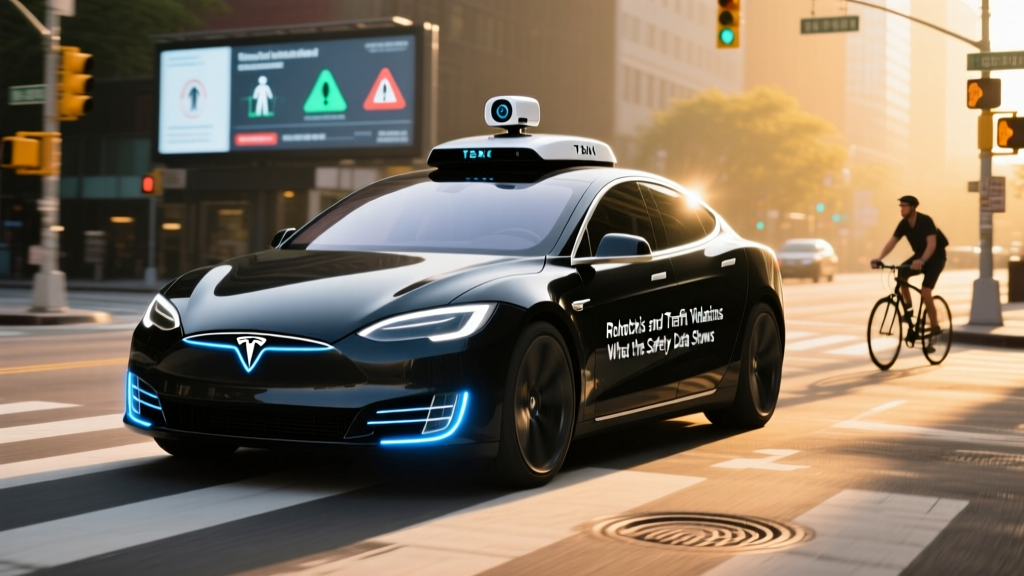
Tesla's Full Self-Driving (Supervised) system generates enormous attention — and increasingly, scrutiny. As Tesla pushes toward a dedicated robotaxi service built on its Cybercab platform, a growing question from regulators, researchers, and prospective buyers is whether the company's vision-only approach can match the safety record of sensor-fused Level 4 competitors. The phrase "Tesla robotaxis traffic violations" has surfaced in regulatory filings, NHTSA investigations, and public discourse, reflecting real incidents where Tesla vehicles operating under FSD have been cited for moving violations or involved in collisions at intersections and construction zones.
This article separates what Tesla currently offers (a Level 2 driver-assist system) from what true robotaxis deliver (Level 4 driverless service), examines the available safety and violation data, and explains what buyers and riders need to know before trusting either system on public roads.
Level 2 vs. Level 4: Why the Distinction Matters for Violations
The single most important fact about Tesla's FSD (Supervised) is that it is not a robotaxi. It is an SAE Level 2 advanced driver-assistance system. The human behind the wheel is legally the driver at all times and is responsible for every traffic violation the vehicle commits while FSD is engaged.
| Level | Name | Who Drives | Examples (2026) |
|---|---|---|---|
| Level 2 | Driver Assistance | Human (must monitor constantly) | Tesla FSD Supervised, GM Super Cruise, Ford BlueCruise |
| Level 3 | Conditional Automation | System (in narrow conditions); human on standby | Mercedes DRIVE PILOT (limited markets) |
| Level 4 | High Automation | System (within geofence); no human needed | Waymo One, Zoox |
| Level 5 | Full Automation | System (everywhere, all conditions) | Does not exist commercially |
Source: SAE International J3016
This distinction is critical when discussing traffic violations. If a Tesla Model Y running FSD Supervised rolls through a stop sign, the driver receives the citation — not Tesla. The company's terms of service explicitly place operational responsibility on the human. In contrast, when a Waymo Level 4 vehicle commits a moving violation within its operational design domain (ODD), the liability framework shifts to the operator, Waymo, and its regulatory permits.
Documented Tesla FSD Traffic Violations and NHTSA Scrutiny
Tesla's FSD system has been the subject of multiple NHTSA investigations and public reports of traffic violations. The most prominent data points include:
- NHTSA Standing General Order (SGO) data: Between July 2021 and mid-2024, Tesla reported over 700 crashes involving vehicles with Autopilot or FSD engaged. While not all involved traffic violations, a significant subset involved intersection-related incidents — failure to yield, red-light incursions, and improper lane changes. NHTSA's crash reporting portal remains the primary public source for these figures.
- California DMV reports: California's autonomous vehicle testing program requires disengagement reports. Tesla, however, has historically operated FSD under a different regulatory classification (ADAS, not autonomous testing), which means its disengagement and violation data is not captured in the same public DMV filings that Waymo and Cruise submit.
- Insurance and citation data: Multiple insurance analyses have shown Tesla vehicles with FSD engaged exhibit higher rates of certain moving violations — particularly following-distance violations and speed-limit exceedances — compared to the same vehicles driven without FSD. This is consistent with driver over-reliance on the system.
- NHTSA defect investigation (2024–ongoing): NHTSA opened a defect investigation into FSD's behavior at intersections, specifically its response to traffic signals, stop signs, and pedestrian crosswalks. As of early 2026, this investigation remains active, with NHTSA's Office of Defects Investigation continuing to collect incident reports.
| Metric | Tesla FSD (Supervised) | Waymo One (Level 4) |
|---|---|---|
| SAE Level | Level 2 (driver responsible) | Level 4 (system responsible in ODD) |
| Reported crashes with system engaged (SGO, through mid-2024) | 700+ (Autopilot/FSD combined) | ~100+ (across all Waymo markets) |
| Miles driven with system active | Billions (fleet-wide, not independently verified) | 50+ million fully driverless miles (as of late 2025) |
| Traffic violation liability | Human driver | Waymo (operator) |
| Sensor suite | Camera-only (Tesla Vision) | LiDAR + radar + cameras |
Sources: NHTSA SGO reports, Waymo safety publications, manufacturer disclosures. Figures are approximate and subject to reporting methodology differences.
Tesla Cybercab: The Announced Robotaxi That Isn't Here Yet
Tesla unveiled its dedicated Cybercab concept in late 2024 — a two-seat, steering-wheel-free vehicle designed for a future Level 4/5 robotaxi network. As of early 2026, the Cybercab remains announced and in pre-production testing. It is not available for purchase, and no public robotaxi service using Cybercabs is operational.
Key announced specifications (preliminary, subject to change):
| Spec | Cybercab (Announced/Estimated) |
|---|---|
| Target autonomy level | Level 4 (unsupervised, within ODD) |
| Sensor suite | Camera-only (Tesla Vision, next-gen HW5) |
| Battery capacity | ~50 kWh (estimated, LFP chemistry) |
| Range (EPA target) | ~250 miles (estimated) |
| Target production start | 2026–2027 (unconfirmed) |
| Estimated price (personal ownership) | Under $30,000 (announced target) |
| Robotaxi service cost | ~$0.20/mile (announced target, unverified) |
Where Can You Actually Ride in a Robotaxi Today?
If you're looking for a real robotaxi experience — no human driver, no steering wheel intervention — here is where Level 4 services operate as of early 2026:
| Service | Cities (Fully Driverless) | Hours | Vehicle |
|---|---|---|---|
| Waymo One | Phoenix, San Francisco, Los Angeles, Austin (expanding) | 24/7 in most markets | Jaguar I-PACE (6th-gen sensor suite) |
| Zoox | Las Vegas (limited), Foster City, CA (testing) | Limited hours | Zoox purpose-built carriage |
| Tesla Robotaxi Network | Not operational | N/A | Cybercab (announced) |
Waymo remains the only scaled, commercially available, fully driverless robotaxi service in the United States. To use it: download the Waymo One app, set pickup and dropoff within the service geofence, and a driverless Jaguar I-PACE arrives. Pricing is comparable to UberX/Lyft Standard — typically $1.00–$1.80 per mile depending on demand, with minimum fares around $7–$10 for short trips.
Robotaxi Pricing vs. Rideshare: What You'll Actually Pay
| Service | Cost per Mile (Avg) | 5-Mile Trip Estimate | Surge Pricing |
|---|---|---|---|
| Waymo One | $1.20–$1.80 | $10–$15 | Yes (demand-based) |
| UberX | $1.00–$2.00 | $8–$16 | Yes |
| Lyft Standard | $1.00–$1.80 | $8–$14 | Yes |
| Tesla Robotaxi (announced target) | ~$0.20 (unverified) | ~$1.00 (theoretical) | Unknown |
Tesla's stated target of $0.20 per mile for its future robotaxi service would dramatically undercut current rideshare and Waymo pricing. However, this figure is unverified, assumes no regulatory fees, minimal insurance overhead, and high fleet utilization — all of which remain speculative until the service launches and scales.
Technology Stack: Camera-Only vs. LiDAR Fusion
The technology divide between Tesla and its robotaxi competitors is fundamental and explains much of the safety and violation debate:
Tesla Vision (Camera-Only)
Tesla removed ultrasonic sensors and radar from its vehicles starting in 2022, relying entirely on a suite of 8–12 cameras feeding a neural network running on custom HW4/HW5 silicon. The system infers depth and velocity computationally rather than measuring it directly.
Waymo / Zoox (LiDAR + Radar + Cameras)
Level 4 operators use LiDAR as a primary sensor, generating precise 3D point clouds that directly measure distance to objects regardless of lighting. Radar provides velocity data in adverse weather. Cameras add semantic understanding (sign reading, signal state). This sensor fusion creates redundancy — if one modality fails, others compensate.
Why It Matters for Traffic Violations
Camera-only systems face known challenges in scenarios that commonly produce traffic violations:
- Direct sun glare: Cameras can be blinded by low-angle sun, potentially missing a red light or stop sign.
- Heavy rain/fog: Without LiDAR or radar, depth perception degrades significantly.
- Construction zones: Novel lane configurations and temporary signage challenge vision-based perception trained on standard road geometry.
- Occluded pedestrians: A pedestrian partially hidden behind a parked vehicle may not be detected until very late without LiDAR's 360° spatial awareness.
Regulatory Landscape: Who Approves Robotaxi Operations?
Robotaxi deployment in the United States is governed at the state level, not federally. The key regulatory bodies include:
- California DMV: Issues autonomous vehicle testing permits and requires annual disengagement reports. Companies must log every instance where a safety driver intervenes or the system requests takeover.
- California Public Utilities Commission (CPUC): Approves commercial robotaxi service — the actual paid rides. Waymo holds a CPUC permit for commercial driverless service in San Francisco, Los Angeles, and other markets.
- State DMVs in Arizona, Texas, Nevada: Each has its own framework. Arizona has historically been the most permissive, allowing Waymo to operate without a safety driver since 2020.
- NHTSA (Federal): Does not approve robotaxi operations but investigates safety defects, issues recalls, and collects crash data through the Standing General Order. NHTSA's SGO crash data is the most comprehensive federal source for ADAS and autonomous vehicle incident reports.
For Tesla to launch a driverless robotaxi service, it would need permits from each state's DMV and public utilities commission — a process that requires demonstrating safety equivalence to existing Level 4 operators. Tesla has not applied for or received any such permits as of early 2026.
Current Limitations: Where Robotaxis (and FSD) Cannot Operate
Both Tesla's FSD Supervised and current Level 4 robotaxis face operational boundaries that buyers and riders must understand:
| Limitation | Tesla FSD (Level 2) | Waymo (Level 4) |
|---|---|---|
| Heavy rain / snow | Degraded (camera limitations); driver must take over | Service suspended in severe weather; operates in moderate rain |
| Construction zones | Unreliable; frequent disengagements reported | May reroute or request remote assistance |
| Unmapped roads | Operates but with reduced confidence | Will not enter (geofenced out) |
| Highway driving | Designed for it; driver monitors | Limited highway segments in ODD (most trips are urban) |
| Night driving | Functional but camera noise increases | Operates 24/7 (LiDAR is lighting-independent) |
| Emergency vehicle encounters | Known failure mode; NHTSA recall addressed partial response | Trained to pull over; occasional failures documented |
Frequently Asked Questions
Where can I use a Tesla robotaxi service right now?
You cannot. Tesla does not operate a robotaxi service as of early 2026. The Cybercab is announced but not in production, and no regulatory permits for driverless Tesla service exist in any U.S. state. Tesla's FSD (Supervised) is a Level 2 driver-assist system available on Tesla vehicles — but it requires a licensed, attentive human driver at all times.
How much does a robotaxi ride cost compared to Uber or Lyft?
Waymo One, the only scaled driverless robotaxi service, charges roughly $1.20–$1.80 per mile — comparable to UberX and Lyft Standard. A typical 5-mile trip costs $10–$15. Tesla has announced a target of ~$0.20/mile for its future service, but this is unverified and the service does not yet exist.
How safe are robotaxis — what does the real data show?
Waymo reports over 50 million fully driverless miles with a collision rate significantly below human benchmarks, according to IIHS-cited analyses and Waymo's own safety publications. Most Waymo collisions are low-speed, rear-end, or sideswipe incidents caused by other human drivers — not the robotaxi. Tesla FSD's safety record is harder to quantify independently because Tesla does not publish disengagement data in the same format as California DMV-permitted testers, and NHTSA's SGO data shows hundreds of crashes involving Autopilot/FSD — though these must be contextualized against billions of fleet miles.
What are the current limitations of robotaxis?
Level 4 robotaxis like Waymo are geofenced to specific urban areas, suspend service in severe weather (heavy snow, flooding), may struggle in complex construction zones, and primarily operate on surface streets rather than highways. Tesla FSD, as a Level 2 system, has no geofence but requires constant driver supervision and has documented weaknesses in sun glare, heavy precipitation, and novel road configurations.
Is Tesla FSD truly self-driving or just driver-assist?
It is driver-assist — SAE Level 2. Despite the "Full Self-Driving" name, Tesla's own documentation and the system's operational behavior require the human driver to remain engaged, hands on or near the wheel, and eyes on the road. The driver is legally responsible for all traffic violations and collisions. Only Level 4 systems like Waymo operate without a human driver, and only within their approved operational design domains.
Who is liable if a Tesla on FSD commits a traffic violation?
The human driver. Because FSD is a Level 2 system, the person behind the wheel bears full legal responsibility for the vehicle's actions — including speeding, red-light violations, and failure to yield. This is fundamentally different from a Level 4 robotaxi, where the operator (e.g., Waymo) holds liability for violations within its service area.
The Bottom Line for EV Buyers and Prospective Riders
The conversation around Tesla robotaxis and traffic violations ultimately comes down to a clear distinction: Tesla's current FSD system places the driver — and all legal liability — in the human seat. Traffic violations committed while FSD is engaged are the driver's violations. The future Cybercab robotaxi, while promising, does not yet exist, has no regulatory approval, and relies on a camera-only sensor approach that has not been validated for unsupervised Level 4 operation by any state authority.
If you want a driverless ride today, Waymo One in Phoenix, San Francisco, Los Angeles, or Austin is your only scaled option — and its safety record, backed by 50+ million driverless miles and LiDAR sensor fusion, is the current industry benchmark. If you're a Tesla owner using FSD Supervised, treat it as what it is: a sophisticated but imperfect driver-assist system that demands your full attention and for which you bear complete legal responsibility.