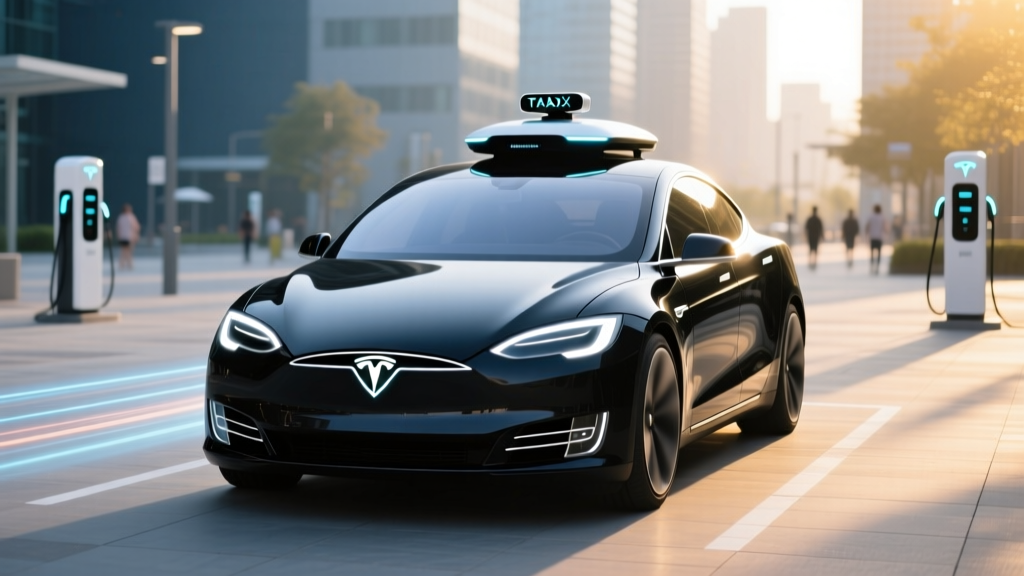
Tesla's long-promised entry into the robotaxi market has generated enormous attention — and equally enormous scrutiny. From the Cybercab unveil in late 2024 to ongoing Full Self-Driving (Supervised) beta testing across select US cities, potential riders and investors alike want to know: are Tesla's autonomous driving systems ready for unsupervised, commercial robotaxi service? The answer, based on current data and regulatory filings, requires separating marketing ambition from engineering reality.
This article examines the specific Tesla robotaxi test driving issues documented by regulators, independent testers, and Tesla's own transparency reports — and compares Tesla's approach against Level 4 robotaxi services that are already operating commercially today.
Understanding the Autonomy Gap: SAE Levels Explained
Before evaluating Tesla's robotaxi ambitions, it's critical to understand the SAE International automation framework. Tesla's currently deployed software — FSD (Supervised) — operates at SAE Level 2, meaning the human driver must remain fully engaged and responsible at all times. True robotaxi services like Waymo operate at SAE Level 4, where the system handles all driving tasks within its operational design domain (ODD) with no human backup required.
| SAE Level | Definition | Example Systems | Driver Required? |
|---|---|---|---|
| Level 2 | Partial automation — steering + acceleration assisted | Tesla FSD (Supervised), GM Super Cruise, Ford BlueCruise | Yes, fully engaged |
| Level 3 | Conditional automation — system drives in limited conditions | Mercedes DRIVE PILOT (selected markets) | Conditionally (must take over on request) |
| Level 4 | High automation — no driver needed within geofenced ODD | Waymo One, Zoox, Cruise (pre-suspension) | No (within ODD) |
| Level 5 | Full automation — any condition, any location | None currently deployed | No |
Tesla has stated its intention to launch an unsupervised robotaxi service using the Cybercab platform, but as of 2026, no Tesla vehicle has received regulatory approval for driverless commercial operation anywhere in the United States. The National Highway Traffic Safety Administration (NHTSA) and state regulators like the California DMV and CPUC have not certified Tesla's system for Level 4 service.
Tesla Robotaxi Test Driving Issues: What the Data Shows
Tesla publishes quarterly Vehicle Safety Reports, but these cover its production fleet running FSD (Supervised) with a human driver — not unsupervised robotaxi operations. To evaluate Tesla's autonomous driving capability in a robotaxi context, we must look at FSD performance data, third-party testing, and regulatory actions.
Key FSD (Supervised) Data Points
- Tesla Q4 2025 Safety Report: Tesla reported 1 crash per 5.94 million miles driven with FSD (Supervised) active — but this data includes a supervising driver who can intervene, making it not directly comparable to Level 4 robotaxi operations.
- NHTSA Standing General Order (SGO) data: Between 2021 and 2025, Tesla vehicles operating on Autopilot or FSD were involved in over 1,800 reported crashes, though this reflects the large fleet size and mandatory reporting requirements rather than a simple failure rate.
- California DMV disengagement reports: Tesla does not participate in California's autonomous vehicle testing permit program in the same way Waymo and Zoox do, meaning independent disengagement-rate comparisons are limited.
- NHTSA investigations: Multiple ongoing investigations into Autopilot/FSD behavior at emergency scenes, in low-visibility conditions, and in work-zone scenarios have resulted in recalls and software updates, but not a blanket suspension.
Specific Test Driving Issues Documented
Independent reviewers, regulatory filings, and Tesla's own release notes have highlighted several recurring issues during FSD test drives that would be critical blockers for unsupervised robotaxi service:
- Phantom braking: FSD has a documented history of unexpected deceleration on highways, particularly in overpass shadows and with oncoming traffic in adjacent lanes. NHTSA opened a formal investigation (PE 22-002) covering over 400,000 vehicles.
- Work-zone navigation: FSD struggles with temporary lane reconfigurations, orange barrels, and flagger signals — common scenarios in any urban robotaxi ODD.
- Emergency vehicle recognition: Multiple NHTSA-documented incidents involve FSD failing to yield to stationary emergency vehicles with active lights, prompting a 2023 recall affecting 2+ million vehicles.
- Unprotected left turns: FSD has shown inconsistent gap-acceptance behavior during unprotected left turns across oncoming traffic — a scenario Waymo has spent years refining with lidar-augmented perception.
- Road-edge and unpaved-surface handling: Testing has shown FSD can struggle with degraded lane markings, gravel shoulders, and construction plates, scenarios common in robotaxi service areas.
Tesla's Camera-Only Stack vs. Multi-Sensor Robotaxi Tech
The most fundamental technical differentiator between Tesla's approach and established robotaxi operators is the sensor suite. Tesla removed radar and ultrasonic sensors from its vehicles starting in 2021-2022, relying entirely on a camera-only vision system dubbed "Tesla Vision." The Cybercab concept continues this philosophy.
| Attribute | Tesla (Camera-Only) | Waymo (Multi-Sensor) | Zoox (Multi-Sensor) |
|---|---|---|---|
| Primary perception | 8 surround cameras + neural nets | Custom lidar + radar + cameras | Custom lidar + radar + cameras |
| Redundancy | Vision-only, no independent depth sensor | Overlapping sensor modalities | Overlapping sensor modalities |
| HD mapping | No pre-built HD maps (real-time) | Pre-built HD maps + real-time | Pre-built HD maps + real-time |
| Geofencing | None (runs on any road) | Strictly geofenced ODD | Strictly geofenced ODD |
| Night/low-vis performance | Limited by camera light sensitivity | Lidar active illumination | Lidar active illumination |
| Weather tolerance | Degraded in heavy rain, fog, snow | Moderate (lidar affected by heavy precipitation) | Moderate (similar lidar limits) |
Tesla's vision-only approach offers scalability advantages — cameras are cheap and the system doesn't require pre-mapping every street. However, for unsupervised robotaxi operation, the lack of sensor redundancy raises safety-case questions that regulators have not yet resolved. Waymo's lidar provides independent depth perception that doesn't rely on ambient light or texture, a critical redundancy for detecting stalled vehicles, debris, or pedestrians in darkness.
Where Can You Actually Use a Robotaxi Today?
As of 2026, Tesla does not operate a commercial robotaxi service. Tesla's Cybercab remains in pre-production, and any "robotaxi" ride today would require a supervising driver — which is, by definition, a rideshare or personal vehicle experience, not a robotaxi. Here's where true Level 4 robotaxi services are currently live:
| Service | SAE Level | Live Cities (2026) | Availability | Vehicle |
|---|---|---|---|---|
| Waymo One | Level 4 | Phoenix, San Francisco, Los Angeles, Austin | 24/7 in geofenced zones | Jaguar I-PACE, Hyundai Ioniq 5 |
| Zoox | Level 4 | Limited Las Vegas and Foster City operations | Invite-only / employee testing | Zoox purpose-built vehicle |
| Tesla (Cybercab) | Level 4 (claimed target) | Not operational | Not available | Cybercab (announced) |
| Tesla FSD (Supervised) | Level 2 | Nationwide (any Tesla with FSD) | Requires supervising driver | Model 3/Y/S/X, Cybertruck |
Waymo One has completed over 10 million paid, fully driverless trips as of early 2026, making it the only scaled robotaxi service in the US. Waymo's safety data is published and independently reviewed, providing a benchmark Tesla has yet to match in unsupervised operation.
Robotaxi Pricing: How Does It Compare to Uber and Lyft?
Since Tesla's robotaxi service is not yet operational, there is no consumer pricing to evaluate. However, we can compare current Waymo One pricing against Uber and Lyft in shared markets:
| Service | Average Cost (5-mile trip, Phoenix) | Surge Pricing? | Tipping | Wait Time |
|---|---|---|---|---|
| Waymo One | $12–$18 | Rare (limited dynamic pricing) | Not expected | 3–7 minutes |
| UberX | $11–$22 | Yes (frequent surge) | Expected (15–20%) | 2–10 minutes |
| Lyft | $10–$20 | Yes (prime-time pricing) | Expected (15–20%) | 3–12 minutes |
Tesla has claimed its future Cybercab service would cost approximately $0.20 per mile — dramatically undercutting both robotaxi and rideshare incumbents. However, this projection assumes massive fleet scale, minimal regulatory overhead, and no safety-driver costs. For context, Waymo's current pricing is roughly competitive with UberX without surge, but Waymo has invested over $30 billion in R&D and fleet operations. Independent analysts remain skeptical that Tesla's per-mile cost projections are achievable at launch scale.
Regulatory Landscape: Who Approves Robotaxi Operations?
Robotaxi deployment in the US requires a patchwork of state and federal approvals — a significant barrier Tesla must clear before any driverless service launches:
- Federal (NHTSA): Sets vehicle safety standards (FMVSS). Tesla's Cybercab, with no steering wheel or pedals, requires an FMVSS exemption — NHTSA has not yet granted one for Tesla's design.
- California (DMV + CPUC): The DMV issues autonomous vehicle testing and deployment permits. The CPUC regulates commercial passenger service. Tesla holds neither a DMV deployment permit nor a CPUC passenger-service license.
- Arizona: The most permissive regulatory environment — Waymo launched here partly because of minimal state oversight. Tesla could theoretically test here, but still needs NHTSA clearance for a steering-wheel-free vehicle.
- Texas: Allows autonomous vehicle testing with fewer restrictions, and Tesla's Gigafactory Austin provides a home-state advantage. However, Austin-specific municipal permits would still be required for commercial robotaxi service.
The California DMV's autonomous vehicle program publishes a list of all permitted operators. Tesla is notably absent from the driverless testing and deployment permit lists — a fact that underscores how far the company is from regulatory approval for unsupervised service in the nation's largest car market.
Current Limitations of Tesla's Autonomous Driving Systems
Even setting aside the regulatory gap, Tesla's current FSD (Supervised) system faces technical limitations that would need resolution before unsupervised robotaxi deployment:
- Weather degradation: Camera-only systems lose effectiveness in heavy rain, fog, snow, and direct sun glare. Tesla's owner manual explicitly warns drivers to take over in these conditions — incompatible with driverless operation.
- No geofencing: Unlike Waymo, which restricts operations to thoroughly mapped and validated zones, FSD attempts to drive anywhere. This means the system encounters scenarios it hasn't been specifically validated for, increasing edge-case risk.
- Edge-case handling: Unusual objects (overturned trucks, fallen trees, road debris), informal traffic control (construction flaggers, crossing guards), and ambiguous right-of-way situations remain challenging for vision-only systems.
- Lack of independent validation: Waymo submits to California DMV disengagement reporting and third-party safety audits. Tesla's safety claims are self-reported and have faced criticism from NHTSA and independent researchers for methodology gaps.
- No steering-wheel-free vehicle in production: The Cybercab remains a concept. Producing a vehicle without manual controls requires NHTSS FMVSS exemptions and crash-test validation that has not been completed.
- Fleet management infrastructure: Operating a robotaxi fleet requires remote assistance, vehicle cleaning and maintenance logistics, rider support, and incident response — operational capabilities Tesla has not publicly demonstrated at scale.
Is Tesla FSD Actually Self-Driving?
No. Tesla's Full Self-Driving (Supervised) is an SAE Level 2 driver-assistance system. The "(Supervised)" suffix, which Tesla added to the product name in 2024 following regulatory pressure, explicitly communicates that a licensed driver must remain alert, hands available, and prepared to take over at any moment. The system can handle highway driving, city streets, parking, and lane changes impressively well in many scenarios — but it is not a self-driving system, and the driver bears full legal responsibility for the vehicle's operation.
This distinction matters enormously for buyers. Tesla's FSD option costs $8,000 (or $99/month subscription) as of 2026. That's a significant investment in a Level 2 system that competes with GM's Super Cruise and Ford's BlueCruise — both of which also require driver supervision but cost significantly less. The naming has drawn criticism from IIHS and consumer safety advocates who argue "Full Self-Driving" misleads buyers about the system's capabilities and their legal obligations.
Frequently Asked Questions
Where can I ride in a Tesla robotaxi right now?
You can't. Tesla does not operate a commercial robotaxi service anywhere. The Cybercab is in pre-production, and Tesla has not received regulatory approval for driverless passenger service in any US jurisdiction. Tesla owners can use FSD (Supervised) nationwide, but a licensed driver must remain engaged at all times.
How much would a Tesla robotaxi ride cost?
Tesla has projected $0.20/mile for future Cybercab rides, but no pricing exists because the service isn't operational. For comparison, Waymo One currently charges roughly $2.00–$3.50/mile in Phoenix and San Francisco, which is competitive with UberX without surge pricing.
How safe are robotaxis compared to human drivers?
Waymo's published safety data (over 10 million driverless trips) shows a lower rate of police-reported crashes per million miles compared to human benchmarks in comparable urban environments. Tesla's FSD (Supervised) data shows strong safety metrics, but it includes a supervising driver — making direct comparison to Level 4 robotaxi safety invalid. No Tesla vehicle has accumulated meaningful unsupervised miles.
What are the biggest Tesla robotaxi test driving issues?
Documented issues include phantom braking on highways, poor work-zone navigation, inconsistent emergency-vehicle recognition, difficulty with unprotected left turns, and degraded performance in low-visibility weather. These are manageable with a supervising driver but would be critical safety gaps for unsupervised operation.
Will Tesla's Cybercab ever be truly self-driving?
Tesla's goal is Level 4 unsupervised operation, but achieving it requires solving the camera-only sensor limitations, obtaining FMVSS exemptions for a steering-wheel-free vehicle, securing state deployment permits, and building fleet-operations infrastructure. Industry analysts project 2027–2028 at the earliest for limited-market deployment, and that timeline assumes no major regulatory or technical setbacks.
Should I buy FSD for my Tesla?
If you value advanced driver-assist features and understand you remain the responsible driver, FSD (Supervised) offers capable highway and city driving assistance. At $8,000 or $99/month, evaluate it against the convenience it provides — not against the promise of future unsupervised capability, which carries no guaranteed timeline. The $99/month subscription is a lower-risk way to test the system before committing to a purchase.