The Teleoperations Question at the Center of Tesla's Robotaxi Ambition
When Tesla unveiled the Cybercab concept in October 2024, the company outlined a vision of unsupervised, fully autonomous ride-hailing — no steering wheel, no pedals, no driver. But as Tesla pushes toward a production robotaxi launch targeted for 2026–2027, a critical operational question has moved to the forefront: how does a camera-only vehicle handle edge cases it cannot solve on its own? The answer, according to multiple Tesla statements and patent filings, involves remote human assistance — a teleoperations model where off-site human operators intervene when the AI encounters scenarios beyond its confidence threshold.
This approach represents a fundamentally different philosophy from competitors like Waymo, which relies on onboard sensor redundancy (lidar, radar, cameras) to achieve Level 4 autonomy within geofenced areas without remote human intervention in the driving loop. Understanding the distinction matters for anyone evaluating the real-world viability, safety, and timeline of Tesla's robotaxi ambitions.
| Level | Description | Example |
|---|---|---|
| Level 2 | Driver-assist — human must supervise at all times | Tesla FSD (Supervised), GM Super Cruise, Ford BlueCruise |
| Level 3 | Conditional automation — system drives, human must take over when requested | Mercedes Drive Pilot (limited markets/conditions) |
| Level 4 | High automation — no human driver needed within operational design domain | Waymo One, Zoox (geofenced areas) |
| Level 5 | Full automation — any condition, any location (does not yet exist commercially) | None currently |
Tesla's current FSD (Supervised) is Level 2. Tesla's announced robotaxi targets Level 4/5, but regulatory approval for unsupervised operation has not been granted as of early 2026.
Where Tesla's Robotaxi Stands in 2026: Announced vs. Available
As of early 2026, Tesla has not launched a commercial robotaxi service. The Cybercab remains a pre-production concept vehicle, and Tesla's ride-hailing ambitions exist in the announced/planned category. Here is how Tesla's status compares to operational robotaxi services:
| Service | Status | Operational Cities | Autonomy Level |
|---|---|---|---|
| Waymo One | Live / Commercial | Phoenix, San Francisco, Los Angeles, Austin (expanding) | Level 4 (geofenced) |
| Zoox | Limited pilot | Las Vegas, Foster City (testing) | Level 4 (geofenced) |
| Cruise | Suspended / Restarting slowly | Limited Phoenix re-entry | Level 4 (geofenced) |
| Tesla Robotaxi | Announced / Pre-production | None (Austin pilot rumored for mid-2026) | Targets Level 4 (unapproved) |
Tesla CEO Elon Musk has stated the company aims to launch unsupervised FSD ride-hailing in Austin and potentially one other city by mid-to-late 2026, using existing Model Y and Model 3 vehicles before the Cybercab enters production. However, no regulatory body has approved Tesla for driverless commercial operations as of this writing. Any launch would require approval from state regulators (such as the California Public Utilities Commission and the California DMV, or the Texas Department of Licensing and Regulation) and potentially NHTSA clearance regarding vehicle safety standards for a vehicle without manual controls.
The Remote Human Assistance Model: How Tesla Plans to Handle Edge Cases
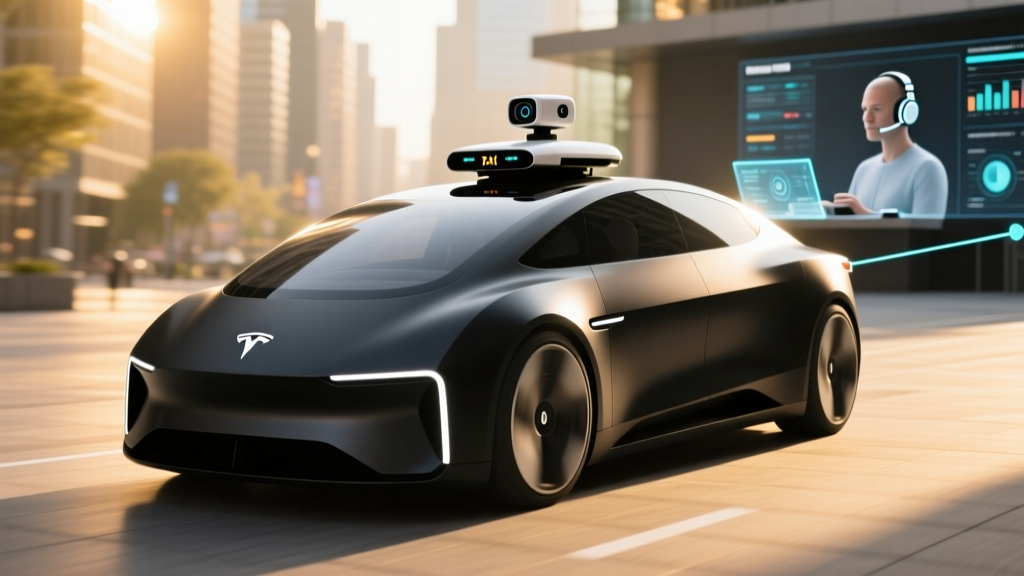
The core of Tesla's robotaxi remote human assistance concept is a teleoperations framework. When the onboard AI encounters a scenario it cannot resolve with sufficient confidence — a complex construction zone, an unusual road closure, an ambiguous traffic-control situation — the vehicle would escalate the decision to a remote human operator working from a centralized operations center.
Based on Tesla's public statements, patent filings, and job postings for "teleoperations" roles, here is how the system is expected to function:
- Sensors: Camera-only (8 cameras on production vehicles; Cybercab concept shows similar array). No lidar. No radar on newer vehicles (Tesla removed radar from Model 3/Y starting 2021 and ultrasonic sensors starting 2022, relying on Tesla Vision).
- Compute: Hardware 4 (HW4) / AI5 chip — Tesla's latest onboard inference hardware, claimed ~5x compute over HW3.
- AI Architecture: End-to-end neural network (FSD v13+), trained on fleet video data from millions of Tesla vehicles.
- Teleoperations: Remote human operators who receive escalated scenarios via cellular connection, providing high-level guidance (route decisions, go/no-go at ambiguous intersections) rather than direct real-time steering.
- Connectivity: Requires persistent cellular connection (LTE/5G) for teleops fallback and fleet telemetry.
- Geofencing: Tesla has not announced specific geofence boundaries; the stated goal is operation without geofencing (Level 5 aspiration), though initial deployment will likely be limited to mapped, validated areas.
The teleoperations model draws on a concept already proven in adjacent industries. Companies like Starsky Robotics (now defunct) and Einride have used remote operators for trucking, and the U.S. Department of Defense uses teleoperations for unmanned ground vehicles. The key question for Tesla is latency and ratio: how quickly can a remote operator assess and resolve an edge case, and how many vehicles can one operator supervise simultaneously?
Tesla has suggested a target ratio of roughly 1 remote operator per 100–500 vehicles, depending on scenario frequency. By comparison, Waymo's Level 4 approach relies on the vehicle resolving nearly all scenarios independently within its operational design domain (ODD), with remote support used primarily for customer service and route guidance rather than driving decisions.
Safety Data: What We Know About Robotaxi Incident Rates
Evaluating Tesla's robotaxi safety prospects requires examining the data from currently operating Level 4 services and Tesla's own FSD (Supervised) track record.
- Waymo: Over 30 million fully driverless miles completed as of late 2025. Waymo's published safety report claims a 85% reduction in injury-causing crash rates compared to human benchmarks in comparable urban environments.
- Cruise: Completed ~5 million driverless miles before a serious October 2023 incident in San Francisco (a pedestrian was dragged after being struck by a human-driven vehicle, then run over by a Cruise robotaxi that pulled to the curb). California DMV suspended Cruise's permit; the company has been slowly restarting with safety drivers.
- Tesla FSD (Supervised): Tesla's Q4 2025 safety report claims 1 crash per ~5.9 million miles driven on FSD, vs. the U.S. average of ~1 crash per 670,000 miles (NHTSA data). However, FSD is Level 2 — a human driver is present and responsible. These figures cannot be directly compared to driverless robotaxi data because the human serves as the safety fallback.
- NHTSA Standing General Order: Since July 2021, manufacturers must report crashes involving Level 2+ and Level 3–5 systems. Tesla has reported hundreds of incidents under this order, though most involve Level 2 Autopilot/FSD with a driver present.
The critical gap: there is no driverless safety data for Tesla's system, because Tesla has not operated vehicles without a safety driver on public roads. All Tesla FSD data reflects supervised (Level 2) operation. Whether the camera-only, neural-network approach can achieve Level 4 reliability without remote human assistance — or whether the teleoperations model can provide an adequate safety net — remains unproven at commercial scale.
Camera-Only vs. Lidar-Redundant: The Sensor Debate That Defines Tesla's Risk
Tesla's decision to pursue a camera-only perception stack is the most consequential technical bet in the autonomous vehicle industry. Every other major robotaxi operator — Waymo, Zoox, Cruise, Motional, Aurora — uses lidar as a core sensor alongside cameras and (in most cases) radar.
| Factor | Camera-Only (Tesla) | Lidar + Camera + Radar (Waymo, Zoox) |
|---|---|---|
| Depth perception | Estimated via neural networks from 2D images | Direct measurement via laser point cloud (cm-level accuracy) |
| Low-light / night | Degraded — reliant on ambient light and headlights | Lidar active day/night; unaffected by lighting |
| Heavy rain / fog | Significantly degraded — camera occlusion, glare | Lidar partially degraded; radar penetrates precipitation |
| Cost per vehicle | Low (~$1,000–2,000 camera suite) | High ($10,000–30,000+ for lidar/radar suite) |
| Scalability | High — same hardware on consumer vehicles | Lower — custom sensor arrays per vehicle |
| Redundancy | Low — single sensor modality | High — independent sensor fusion |
Tesla's argument is economic and practical: if a neural network trained on billions of miles of real-world video data can match or exceed lidar-based perception, the cost advantage enables mass deployment. The counter-argument, made by Waymo engineers and independent researchers, is that redundancy is a safety requirement, not a luxury — a camera blinded by direct sun glare or heavy rain has no fallback sensor to confirm what is ahead.
This is precisely where remote human assistance becomes critical to Tesla's model. If the camera system encounters a scenario where its perception confidence drops below a safety threshold, the teleoperations layer must either resolve the situation or safely stop the vehicle. The reliability of that handoff — and the latency of cellular connectivity in the scenario zone — directly determines the safety case.
Regulatory Hurdles: Who Approves a Tesla Robotaxi?
Deploying a commercial robotaxi in the United States requires navigating a patchwork of state and federal regulations. No single agency grants nationwide approval.
Federal (NHTSA): The National Highway Traffic Safety Administration sets Federal Motor Vehicle Safety Standards (FMVSS) that currently require features like steering wheels, mirrors, and pedals in passenger vehicles. Tesla's Cybercab concept has none of these. NHTSA would need to grant an exemption or Tesla would need to modify the vehicle to comply. NHTSA also investigates crash patterns and can issue recalls — Tesla's FSD has been subject to multiple recalls, including a February 2024 recall affecting over 2 million vehicles for insufficient driver-engagement safeguards.
State level: Each state sets its own rules for autonomous vehicle testing and deployment:
- California: Requires a DMV testing permit (with safety driver) and a CPUC deployment permit (for driverless commercial service). Waymo holds both. Tesla holds a DMV testing permit but has not applied for or received a CPUC driverless deployment permit.
- Texas: Less restrictive — no state-level permit required for testing, though local regulations may apply. Tesla's Austin headquarters makes Texas a likely first-deployment state.
- Arizona: Among the most permissive — Waymo launched commercially in Phoenix with relatively minimal state oversight.
- Nevada: Requires an autonomous vehicle license; Zoox has tested in Las Vegas under this framework.
For a teleoperations-based model, additional regulatory questions arise: What are the qualifications and licensing requirements for remote operators? What is the maximum vehicle-to-operator ratio? What happens if the cellular connection drops mid-scenario? These questions have not been answered by any U.S. regulator as of early 2026.
Pricing and Usage: How Would a Tesla Robotaxi Compare to Uber and Waymo?
Tesla has stated an aspirational cost of approximately $0.20 per mile for its robotaxi service, which would undercut both Uber/Lyft and Waymo in most markets. However, this figure is a long-term target, not a confirmed launch price.
| Service | Cost per Mile (Typical) | 5-Mile Ride (Approx.) | Availability |
|---|---|---|---|
| UberX (national avg.) | $1.50–$2.50/mi | $12–$18 | Nationwide |
| Lyft (national avg.) | $1.30–$2.20/mi | $11–$16 | Nationwide |
| Waymo One (Phoenix/SF) | $1.00–$1.80/mi | $8–$14 | Select cities |
| Tesla Robotaxi (announced target) | ~$0.20/mi (aspirational) | ~$3–$5 (projected) | Not yet available |
Tesla's projected cost advantage rests on two factors: (1) the vehicle cost is amortized across a fleet owned either by Tesla or by individual Tesla owners participating in a "Tesla Network" (an Airbnb-style model Tesla has discussed but never launched), and (2) the camera-only hardware stack is substantially cheaper than lidar-equipped robotaxis, reducing per-vehicle capital expenditure. However, the cost of teleoperations infrastructure — staffing remote operators, maintaining connectivity, building operations centers — has not been publicly quantified by Tesla and could materially affect per-mile economics, especially at low vehicle-to-operator ratios during the early deployment phase.
Current Limitations and Unresolved Challenges
Any honest assessment of Tesla's robotaxi remote human assistance model must acknowledge the significant limitations and open questions:
- No driverless operational data: Tesla has zero miles of unsupervised, driverless operation on public roads. All FSD data reflects Level 2 supervised driving with a human present.
- Camera-only weather vulnerability: Heavy rain, snow, fog, and direct sun glare degrade camera perception. No redundant lidar or radar to compensate. Remote human assistance cannot overcome physical sensor blindness in real-time driving scenarios at highway speeds.
- Cellular dependency: Teleoperations require a stable, low-latency cellular connection. Dead zones, network congestion, or infrastructure failures could leave the vehicle without its safety fallback.
- Latency in edge-case resolution: Even with 5G, round-trip latency for video transmission, human assessment, and instruction relay is estimated at 200–500ms. At 35 mph, a vehicle travels 10–25 feet during that window.
- Regulatory approval not secured: No state or federal agency has approved Tesla for driverless commercial operation. The timeline for approval is uncertain and depends on demonstrated safety data that does not yet exist.
- Operator ratio uncertainty: Tesla's suggested 1:100–500 operator-to-vehicle ratio assumes very low intervention rates. If real-world edge cases require more frequent escalation, the economics and safety case change dramatically.
- Cybercab production timeline: The Cybercab remains a concept. Tesla's history of timeline slippage (Roadster 2, Semi, Cybertruck delays) warrants skepticism about production and deployment dates.
Where Can I Use a Tesla Robotaxi Right Now?
The direct answer: nowhere. Tesla's robotaxi service is not operational in any city as of early 2026. Tesla has indicated Austin, Texas as a likely first market, potentially using existing Model 3/Y vehicles running unsupervised FSD before the Cybercab enters production. However, this remains a stated intention, not a launched service. No regulatory approval for driverless operation has been granted.
If you need a robotaxi today, Waymo One is the only fully driverless commercial service available to the public, operating in Phoenix, San Francisco, Los Angeles, and expanding into Austin. You can request a ride through the Waymo app in those cities.
Frequently Asked Questions
Is Tesla's robotaxi truly self-driving, or is it driver-assist?
Tesla's current Full Self-Driving (FSD) software is SAE Level 2 driver-assist — the human driver must remain engaged and is legally responsible for the vehicle at all times. Tesla's announced robotaxi service targets Level 4 (no driver needed within an operational area), but this capability has not been demonstrated, validated, or approved by any regulator. The teleoperations model (remote human assistance) is Tesla's proposed bridge for scenarios the AI cannot handle independently.
How does Tesla's remote human assistance differ from Waymo's approach?
Waymo's Level 4 vehicles resolve nearly all driving scenarios autonomously using a redundant sensor suite (lidar, radar, cameras). Remote support at Waymo is used primarily for customer service, route clarification, and rare edge cases — not for real-time driving decisions. Tesla's model proposes a more active teleoperations layer where remote humans may need to make driving-relevant decisions when the camera-only system encounters low-confidence scenarios. This is a fundamentally different architecture with different failure modes.
How safe are robotaxis compared to human drivers?
Waymo reports an 85% reduction in injury-causing crash rates compared to human benchmarks across 30+ million driverless miles, based on their published safety data. However, this data covers geofenced urban areas in favorable weather conditions. Tesla's FSD (Supervised) reports fewer crashes per mile than the U.S. average, but this data reflects Level 2 operation with a human driver present as a safety net. There is no apples-to-apples comparison between Tesla's system and Waymo's in driverless operation because Tesla has not operated driverless.
What happens if a Tesla robotaxi loses cellular connection?
Tesla has not publicly detailed the fallback protocol for complete cellular loss during a teleoperations-dependent scenario. The expected behavior would be for the vehicle to execute a minimal-risk maneuver (pull over and stop), but the specifics of how this works at highway speeds or in complex traffic have not been demonstrated publicly. This is one of the key safety questions regulators would need answered before approving the service.
When will Tesla's robotaxi actually launch?
Tesla has targeted mid-to-late 2026 for an initial unsupervised ride-hailing pilot, likely in Austin, Texas. Given Tesla's history of timeline delays and the unresolved regulatory and technical challenges, independent analysts broadly consider 2027–2028 a more realistic window for any meaningful commercial deployment — and even that depends on regulatory approval, which is not guaranteed.
How much would a Tesla robotaxi ride cost?
Tesla has floated a target of approximately $0.20 per mile, which would make it dramatically cheaper than Uber, Lyft, or Waymo. However, this is an aspirational long-term figure. Launch pricing has not been announced, and the cost of teleoperations infrastructure, insurance, vehicle maintenance, and regulatory compliance could push real-world pricing significantly higher than the stated target.