Tesla's entry into the robotaxi market hinges on a question the industry has debated for years: can a camera-only, end-to-end neural network handle the chaos of real-world streets without a human behind the wheel? The answer, at least for the near term, involves a fallback most consumers haven't heard about — the Tesla robotaxi remote driver, or teleoperations system, where a human operator intervenes from a control center when the AI encounters a scenario it cannot resolve autonomously.
This article breaks down how Tesla's teleoperations framework fits into its robotaxi ambitions, where the service actually operates as of mid-2026, what the safety data shows, how pricing compares to Uber and Lyft, and why the distinction between Level 2 driver-assist and Level 4 autonomy matters more than Tesla's marketing suggests.
SAE Automation Levels: Where Tesla's Robotaxi Actually Sits
Before discussing remote drivers, it's essential to place Tesla's systems on the SAE International automation scale. Tesla sells two distinct products that are frequently — and incorrectly — conflated:
| System | SAE Level | Driver Required? | Status (Mid-2026) |
|---|---|---|---|
| Autopilot | Level 2 | Yes — hands on, eyes on | Available on all new Teslas |
| FSD (Supervised) | Level 2 | Yes — must monitor at all times | Available via purchase/subscription |
| Tesla Robotaxi (Cybercab) | Level 4 (target) | No — but remote teleoperations fallback | Limited pilot; announced expansion |
How Tesla's Remote Driver (Teleoperations) System Works
Teleoperations — sometimes called remote assistance or tele-guidance — is not unique to Tesla. Waymo has used remote support since its earliest deployments, and companies like Phantom Auto, Ottopia (acquired by Waymo), and Designated Driver have built entire businesses around the concept. But Tesla's approach differs in important ways.
The Technology Stack
Tesla's robotaxi platform, centered on the purpose-built Cybercab (announced October 2024, pilot operations beginning in Austin in mid-2025), relies on:
- Vision-only perception: 8 surround cameras (upgraded to higher-resolution sensors on Cybercab vs. current Model 3/Y). No lidar, no radar (radar was removed from production vehicles starting 2021-2022).
- End-to-end neural network: Tesla's FSD v13+ architecture uses a single neural network from raw camera pixels to driving commands, replacing the older modular perception-planning-control stack.
- Custom inference hardware: HW4 (AI4) computer running at ~300+ TOPS, with redundancy for safety-critical paths.
- Cellular connectivity: Dual-SIM, multi-carrier 5G connection for real-time teleoperations fallback, with latency targets under 100ms for control commands.
- Geofencing: Operations restricted to pre-mapped ODD zones where Tesla has validated the system's performance.
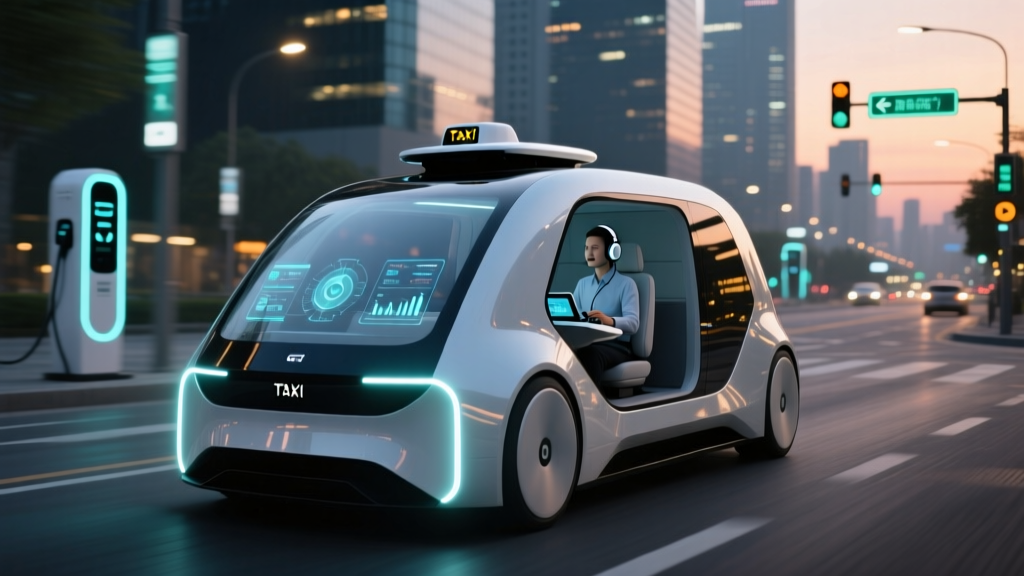
When the vehicle's confidence drops below a threshold — say, a construction zone with conflicting lane markings, an unusual road closure, or a sensor obscured by heavy rain — the system escalates to a remote teleoperator. The remote driver does not "joystick" the car in real time for extended periods. Instead, they typically provide high-level guidance: confirm a route deviation, approve a maneuver, or in rare cases, take direct control for a short segment (measured in seconds, not minutes) until the vehicle exits the ambiguous scenario.
Remote Driver Ratios and Scalability
The critical economic question for any robotaxi service is the teleoperator-to-vehicle ratio. Waymo has publicly stated ratios around 1:10 to 1:15 (one remote operator monitoring 10-15 vehicles) in mature markets. Tesla has not disclosed its ratio, but the economics of the Cybercab model — which Tesla has stated targets a cost-per-mile below $0.20 — require ratios at or above 1:15 to remain profitable without a human driver in the car.
Industry sources suggest Tesla's early Austin pilot operates at closer to 1:5 or 1:8, reflecting the system's higher intervention rate compared to Waymo's lidar-equipped fleet. As the neural network improves with fleet data, Tesla expects this ratio to climb — but this remains unproven at scale.
Where Can You Use Tesla's Robotaxi Right Now?
As of mid-2026, Tesla's robotaxi service is in a limited pilot phase, not a general public launch. Here's what's operational versus announced:
| City | Status | Notes |
|---|---|---|
| Austin, TX | Limited pilot (invite-only + waitlist) | Initial deployment zone: ~80 sq mi covering downtown, South Austin, and airport corridor. Safety driver present in early phase; driverless phase began Q1 2026 in sub-geofenced areas. |
| San Francisco / Bay Area | Announced — not yet operational | Tesla has applied for California DMV and CPUC permits. Expected late 2026 or 2027 depending on regulatory approval. |
| Los Angeles | Announced — not yet operational | No confirmed timeline. |
| Phoenix, AZ | Testing (no public service) | Internal validation fleet observed; no ride-hail permit filed. |
| Other US cities | No announced timeline | Tesla has stated a goal of "nationwide" coverage, but no specific cities or dates confirmed. |
For context, Waymo One — the market leader — operates commercial driverless service in Phoenix, San Francisco, Los Angeles, and Austin (as of 2025-2026), with millions of paid rides completed. Tesla's robotaxi service is orders of magnitude smaller in scope.
If you're in Austin and want to try the service, Tesla's robotaxi app (separate from the main Tesla app) manages ride requests. Availability is limited, wait times can exceed 20-30 minutes, and the geofence means many common destinations fall outside the service area.
Pricing: Tesla Robotaxi vs. Uber and Lyft
Tesla has stated that the Cybercab's target operating cost is under $0.20 per mile, which would translate to fares significantly below traditional rideshare. But early pilot pricing tells a different story:
| Service | Base Fare | Per-Mile Rate | Per-Minute Rate | Est. 5-Mile Trip |
|---|---|---|---|---|
| Tesla Robotaxi (pilot pricing) | $2.50 | $1.10 | $0.35 | ~$9.75 |
| Waymo One (Austin) | $2.00 | $1.25 | $0.40 | ~$10.25 |
| UberX (Austin avg.) | $2.50 | $1.35 | $0.45 | ~$11.50 |
| Lyft (Austin avg.) | $2.50 | $1.30 | $0.42 | ~$11.10 |
At pilot pricing, Tesla's robotaxi is roughly competitive with Waymo and slightly cheaper than Uber/Lyft — but not the dramatic cost disruption Elon Musk has projected. The $0.20/mile figure Tesla has cited refers to the vehicle's operating cost (electricity, depreciation, maintenance), not the consumer fare, which must also cover teleoperations staff, insurance, fleet management, software development, and regulatory compliance.
For the consumer, the practical advantage today is not price but novelty and, in some scenarios, slightly faster availability (no driver acceptance delay). Surge pricing dynamics differ too: robotaxi fares scale with demand but don't spike as aggressively as Uber's surge model, since there's no human driver incentive needed.
Safety Data: What the Numbers Actually Show
Here's what we can piece together from available sources:
Tesla FSD (Supervised) — the proxy data
Tesla's quarterly vehicle safety reports provide data on FSD (Supervised) in consumer vehicles — not robotaxi operations specifically. Tesla reports a crash rate of approximately 1 crash per 4-5 million miles with Autopilot/FSD engaged, compared to the US average of roughly 1 per 670,000 miles (NHTSA data). However, these figures are self-reported, not independently verified, and apply to highway driving with an attentive human driver — a fundamentally different scenario than driverless urban robotaxi operation.
Waymo's published benchmarks (for comparison)
Waymo's peer-reviewed safety data (published in collaboration with insurance and research partners) shows:
- ~70% reduction in at-fault injury-causing crashes vs. human benchmarks in Phoenix and San Francisco
- Over 50 million fully driverless miles completed as of early 2026
- Remote intervention rate: approximately 1 per 5,000-8,000 miles in mature markets, declining over time
Tesla robotaxi intervention rates (estimated)
Tesla has not published equivalent figures. Industry observers and early rider reports from Austin suggest intervention rates (including both vehicle-initiated stops and remote teleoperator escalations) in the range of 1 per 500-1,500 miles during the early driverless pilot — significantly higher than Waymo's mature-market rate. This is expected for a new entrant in a geofenced urban environment with a vision-only stack, and Tesla's fleet-learning approach means these rates should improve rapidly with data accumulation. But it underscores that the remote driver system is not a marginal fallback — it's an essential operational component at this stage.
Regulatory Landscape: Who Approves Robotaxi Operations?
Robotaxi deployment in the US is governed by a patchwork of state and local regulations, not a single federal framework:
- California (DMV + CPUC): The DMV issues testing and deployment permits; the California Public Utilities Commission (CPUC) regulates commercial passenger service. Waymo holds both. Tesla has applied for DMV testing permits but, as of mid-2026, does not hold a CPUC commercial deployment permit for California.
- Texas: No specific state-level robotaxi permit required for testing; Austin has been permissive. This regulatory lightness is why Tesla chose Austin for its pilot. However, Texas has no formal framework for commercial driverless passenger service either, creating legal ambiguity around liability.
- Arizona: The most permissive state for AV testing and deployment. Waymo launched its first commercial service here. Tesla is testing but has not filed for commercial ride-hail authorization.
- Federal (NHTSA): The National Highway Traffic Safety Administration sets vehicle safety standards (FMVSS) but does not currently certify autonomous driving systems. The Cybercab, designed without a steering wheel or pedals, requires an FMVSS exemption that Tesla has applied for but not yet received for mass production.
The regulatory picture matters because it determines where Tesla can legally operate and under what conditions. Unlike Waymo, which has invested years in building regulatory relationships across multiple states, Tesla's approach has been more confrontational — publicly criticizing regulators while simultaneously seeking their approvals.
Current Limitations: Where the Tesla Robotaxi Remote Driver Can't Help
Even with a teleoperations fallback, Tesla's robotaxi faces hard limitations that remote drivers cannot fully solve:
- Heavy rain and fog: Camera-only perception degrades significantly in low-visibility conditions. Without lidar or radar, the system cannot "see through" heavy precipitation. Service may be suspended during storms.
- Construction zones with non-standard signage: Temporary lane shifts, hand-held flaggers, and conflicting road markings remain high-intervention scenarios.
- Night driving in poorly lit areas: Camera performance drops in low-light conditions, particularly for pedestrian and cyclist detection at range.
- Geofence boundaries: The vehicle will not operate outside its validated ODD. If your destination is 200 feet outside the geofence, the ride ends at the boundary.
- Latency-sensitive scenarios: Remote teleoperations require cellular connectivity. In dead zones (tunnels, parking garages, rural fringe areas), the vehicle must handle situations autonomously or pull over safely.
- Complex multi-point interactions: Scenarios requiring negotiation with pedestrians (eye contact, gestures) or other human drivers (four-way stops with ambiguous right-of-way) generate frequent escalations.
- Wheelchair and mobility device accommodation: The Cybercab's design does not include a ramp or wheelchair-accessible configuration, limiting ADA compliance compared to Waymo's Pacifica-based fleet.
These limitations are not unique to Tesla — every robotaxi operator faces similar edge cases. But Tesla's camera-only approach amplifies certain vulnerabilities (particularly weather and low-light performance) that lidar-equipped competitors handle more robustly. The remote driver system mitigates some of these gaps but introduces its own constraint: every teleoperator intervention adds latency, cost, and a potential single point of failure if cellular connectivity drops.
Frequently Asked Questions
Is Tesla's robotaxi truly self-driving, or is it just driver-assist?
The robotaxi service targets SAE Level 4 — no human driver in the vehicle within its operational domain. However, it relies on remote teleoperators for edge cases. FSD (Supervised) in consumer Teslas remains Level 2, requiring an attentive human driver at all times. These are fundamentally different systems with different safety requirements and regulatory classifications.
How many remote drivers does Tesla employ for its robotaxi fleet?
Tesla has not disclosed the size of its teleoperations staff. Based on early pilot intervention rates and fleet size estimates (dozens of vehicles in Austin), the teleoperations team likely numbers in the dozens to low hundreds. As the fleet scales and the AI improves, Tesla aims to increase the vehicles-per-operator ratio, but this remains unproven at scale.
Can the remote driver take full control of the vehicle?
Yes, but only for short durations. The teleoperations system is designed for guidance and brief direct control during edge cases — not for extended remote driving. The vehicle's local autonomy handles the vast majority of driving decisions; the remote operator resolves ambiguities the AI cannot handle independently.
What happens if the cellular connection drops during a remote intervention?
The vehicle is designed to default to a safe state — typically slowing down and pulling over to the side of the road. It does not continue driving at speed without connectivity if it was in the middle of a teleoperator-guided maneuver.
How does Tesla's camera-only approach compare to Waymo's lidar-based system?
Waymo uses a sensor suite including lidar, radar, and cameras, providing redundancy and strong performance in low-visibility conditions. Tesla's vision-only approach is lower-cost per vehicle but more vulnerable to weather, lighting, and occlusion. Waymo's system has accumulated over 50 million driverless miles with published safety data; Tesla's robotaxi pilot is in early stages with limited public safety reporting.
When will Tesla's robotaxi be available in my city?
Outside of Austin's limited pilot, no US city has a confirmed Tesla robotaxi launch date. San Francisco and Los Angeles are announced targets, likely 2027 or later depending on regulatory approvals. International expansion has not been announced.
Is the Cybercab available for purchase by consumers?
No. The Cybercab is designed as a fleet-only robotaxi vehicle with no steering wheel or pedals. Tesla has indicated it may eventually offer consumer sales, but this depends on FMVSS exemptions and Level 4 certification that do not currently exist for a steering-wheel-less production vehicle. Tesla's consumer vehicles (Model 3, Model Y, Cybertruck) retain traditional controls and are not robotaxis.