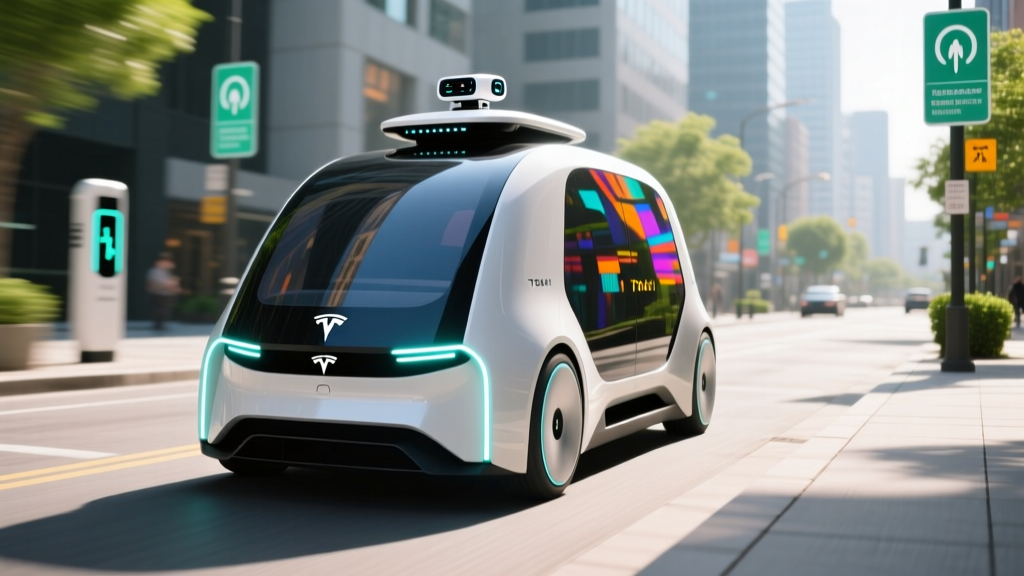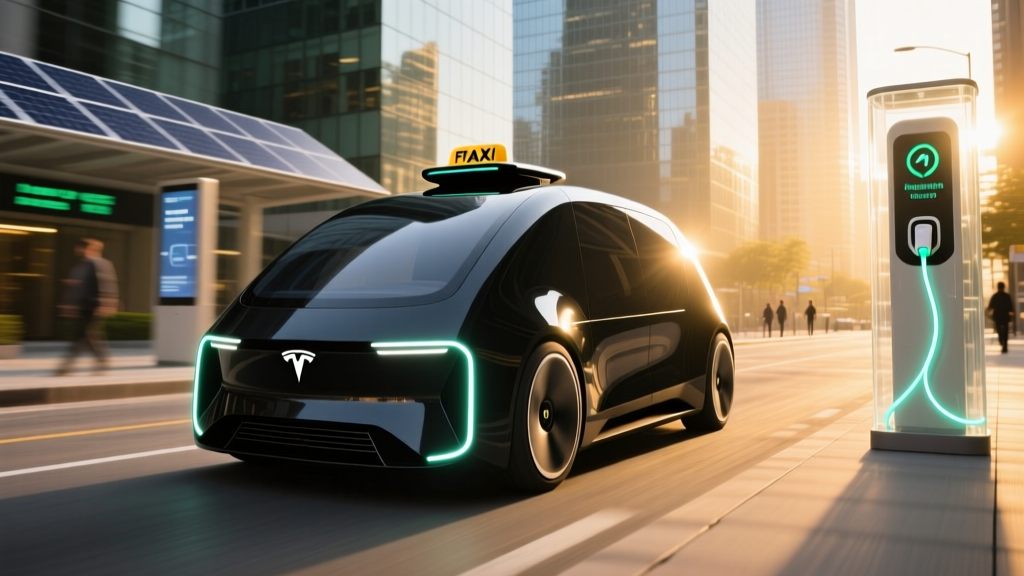
When Tesla unveiled its dedicated robotaxi concept, the promise was a camera-only, end-to-end neural network capable of Level 4 autonomy at scale. By 2026, the Tesla robotaxi program has moved from presentation slides to limited operational testing, but the critical question for prospective riders, investors, and regulators remains: what does the actual safety data say? This analysis examines the Tesla robotaxi program safety record, the technology behind it, where you can (and cannot) hail a ride, and how it stacks up against established robotaxi operators like Waymo and Zoox.
Where Does Tesla's Autonomy Level Actually Sit?
SAE Automation Level: Tesla's consumer vehicles with FSD (Supervised) operate at SAE Level 2 — the driver must remain fully engaged and responsible. Tesla's dedicated robotaxi platform, operating in geofenced service areas without a human driver, targets SAE Level 4 — no driver intervention required within its operational design domain (ODD). These are fundamentally different systems with different regulatory requirements.
The distinction matters enormously. Consumer Tesla vehicles running FSD (Supervised) require the driver to monitor the road at all times. The robotaxi program — using the purpose-built "Cybercab" platform announced in late 2024 — is designed to operate without a steering wheel or pedals within approved geofenced zones. As of early 2026, Tesla's robotaxi has been conducting limited driverless operations in controlled environments, but widespread commercial Level 4 deployment remains in early stages compared to competitors with years of fare-paying operational history.
| Level | Name | Driver Required? | Tesla System | Example Competitor |
|---|---|---|---|---|
| Level 2 | Partial Automation | Yes — full supervision | FSD (Supervised) | GM Super Cruise, Ford BlueCruise |
| Level 3 | Conditional Automation | Yes — on standby | Not deployed | Mercedes DRIVE PILOT (limited) |
| Level 4 | High Automation | No — within ODD | Robotaxi/Cybercab (targeted) | Waymo One, Zoox |
| Level 5 | Full Automation | No — anywhere | Not achieved by any OEM | N/A |
Where Can You Use Tesla's Robotaxi Right Now?
Tesla's robotaxi service availability in 2026 is extremely limited compared to established operators. The company has focused initial driverless testing and early ride-hail operations in a small number of Sun Belt cities, leveraging favorable weather, wide roads, and cooperative regulatory environments.
| Operator | Live Commercial Cities | Service Hours | Status |
|---|---|---|---|
| Waymo One | Phoenix, San Francisco, Los Angeles, Austin | 24/7 in most zones | Fully commercial, open to public |
| Zoox | Las Vegas (limited), Foster City (testing) | Limited hours | Commercial launch in progress |
| Cruise | Suspended / gradual relaunch | N/A | Post-incident phased return |
| Tesla Robotaxi | Austin (limited zone), testing in select cities | Daylight hours, restricted zones | Early limited deployment / invite-only |
Tesla's approach relies on state-level approval for driverless testing and commercial operation. Arizona and Texas have historically offered the most permissive regulatory frameworks for autonomous vehicle deployment. California, despite being Tesla's home state, requires permits from both the California DMV and the California Public Utilities Commission (CPUC) for commercial robotaxi service — a process that has slowed Tesla's in-state rollout compared to Waymo's established presence.
The Tesla Robotaxi Program Safety Record: What Data Exists
Transparency note: As of early 2026, Tesla has not published a comprehensive, independently audited robotaxi safety report comparable to Waymo's public safety data disclosures. Much of the available data comes from regulatory filings, limited company disclosures, and third-party observation. This section reflects what is publicly verifiable — not marketing claims.
Evaluating the Tesla robotaxi program safety record requires separating two data streams: the consumer FSD (Supervised) fleet data, which Tesla reports periodically, and the dedicated robotaxi platform data, which remains far more limited in volume and transparency.
FSD (Supervised) Fleet Data — Context, Not Direct Evidence
Tesla has reported that vehicles running FSD (Supervised) have accumulated billions of miles, with the company claiming an intervention rate that improves with each software version. However, FSD (Supervised) is a Level 2 system with a human driver present — this data cannot be directly equated to driverless robotaxi safety. A human driver who intervenes before a collision prevents incidents that a driverless system must handle entirely on its own.
Robotaxi-Specific Safety Metrics
For the dedicated robotaxi platform, publicly available data points as of early 2026 include:
- Total driverless miles: Significantly fewer than Waymo's 30+ million driverless miles accumulated through 2025.
- Reported at-fault collisions: No widely reported severe injury or fatality incidents involving Tesla's driverless robotaxi platform in commercial operation, though the limited mileage makes statistical comparison premature.
- Disengagement data: California DMV disengagement reports — a required filing for companies testing autonomous vehicles in the state — provide some benchmarking, though companies use different reporting methodologies that complicate direct comparison.
- NHTSA standing general order: NHTSA requires all operators of Level 2+ and Level 4 systems to report crashes within 24 hours, providing a regulatory floor for incident visibility.
Comparing Safety Records: Tesla vs. Waymo
Waymo, backed by Alphabet, has published extensive safety analyses showing its robotaxis are involved in fewer injury-causing crashes per million miles than human drivers in comparable urban environments. Waymo's fifth- and sixth-generation vehicles have operated across tens of millions of fully driverless miles with multiple sensor redundancies including lidar. Tesla's robotaxi program, with far fewer driverless miles and a camera-only approach, does not yet have comparable statistical depth to make definitive safety-per-mile claims.
Any assertion that Tesla's robotaxi is "safer than human drivers" at this stage would be statistically unsupported given the mileage gap. The honest assessment: the Tesla robotaxi program safety record is still being written, and early results are promising but insufficient for broad conclusions.
Technology Stack: Camera-Only vs. Multi-Sensor Fusion
Tesla's robotaxi relies exclusively on a vision-only (camera) sensor suite paired with end-to-end neural network processing. This is a deliberate and controversial architectural choice that distinguishes Tesla from virtually every other robotaxi operator.
| Feature | Tesla Cybercab | Waymo 6th Gen | Zoox |
|---|---|---|---|
| Cameras | Yes — primary sensor | Yes — supplemental | Yes — supplemental |
| Lidar | No | Yes — custom-built | Yes — roof-mounted array |
| Radar | No (removed from newer vehicles) | Yes | Yes |
| Ultrasonic Sensors | Yes (near-field) | Yes | Yes |
| HD Pre-mapped Routes | Minimal — relies on real-time perception | Yes — detailed HD maps | Yes — detailed HD maps |
| Processing | Custom Tesla FSD chip, end-to-end neural net | Custom compute platform | Custom compute platform |
The Camera-Only Debate
Tesla's argument is that a sufficiently advanced neural network, trained on billions of miles of real-world driving data, can match or exceed the depth perception and object detection that lidar provides — at a fraction of the hardware cost. This approach scales more cheaply across millions of vehicles.
The counterargument, supported by most robotics and autonomous systems engineers outside Tesla, is that sensor redundancy is critical for safety-critical systems. Lidar provides direct depth measurement unaffected by lighting conditions. Radar penetrates fog and rain. Camera-only systems face inherent challenges in:
- Low-light and nighttime driving: Reduced visual information compared to daytime.
- Glare and sun-angled conditions: Cameras can be temporarily blinded.
- Heavy rain, fog, and snow: Visual occlusion degrades camera performance faster than lidar or radar.
- Depth estimation at range: Stereo vision is less precise than direct lidar ranging beyond ~100 meters.
Whether Tesla's neural network approach can compensate for these physical limitations remains the central unresolved question in the Tesla robotaxi program safety record.
Pricing: Tesla Robotaxi vs. Uber and Lyft
Tesla has stated that its long-term goal is to offer robotaxi rides at a cost significantly below traditional rideshare — Elon Musk has cited figures as low as $0.20 per mile in presentations, compared to the $1.00–$2.50 per mile typical of Uber and Lyft. The economic thesis depends on eliminating the driver (the largest cost component of rideshare), achieving high vehicle utilization, and keeping hardware costs low through the camera-only approach.
| Service | Cost Per Mile (Est.) | 10-Mile Ride (Est.) | Notes |
|---|---|---|---|
| UberX / Lyft Standard | $1.20 – $2.50 | $12 – $25 | Varies by city, demand surge |
| Waymo One | $1.00 – $2.00 | $10 – $20 | Comparable to rideshare; no surge pricing |
| Tesla Robotaxi (projected target) | $0.40 – $0.80 | $4 – $8 | Early-stage pricing; long-term target lower |
| Personal vehicle (IRS rate) | $0.67 | $6.70 | 2024 IRS standard mileage rate for comparison |
In practice, early Tesla robotaxi rides have been offered at promotional or subsidized rates in limited markets. Achieving the $0.20/mile target requires massive fleet scale, minimal downtime, and regulatory approval across many jurisdictions — none of which is guaranteed. Waymo, after years of commercial operation, prices rides competitively with Uber/Lyft rather than dramatically undercutting them, suggesting the economics of robotaxi operations are more complex than hardware cost alone.
Regulatory Landscape: Who Approves Robotaxi Operations?
Robotaxi deployment in the United States is governed by a patchwork of state and local regulations — there is no single federal framework for commercial autonomous vehicle operations.
Key Regulatory Bodies
- NHTSA (federal): Sets vehicle safety standards (FMVSS) and requires crash reporting. Tesla's Cybercab, lacking a steering wheel and pedals, requires an FMVSS exemption petition — a process that adds time and uncertainty to deployment.
- State DMVs: Issue testing and deployment permits. California, Arizona, Texas, and Nevada each have different requirements.
- State Public Utilities Commissions: In states like California, the CPUC must authorize commercial passenger service — a separate approval beyond the DMV permit.
- Local municipalities: Cities can impose additional restrictions on where and when robotaxis operate, including geofencing requirements and curb-management rules.
Tesla's FMVSS exemption request for the steering-wheel-free Cybercab is a critical regulatory milestone. Without approval, the vehicle cannot legally operate on public roads without manual controls. NHTSA's automated vehicle guidance continues to evolve, but the exemption process remains case-by-case.
Current Limitations of Tesla's Robotaxi
What Tesla's robotaxi cannot do in 2026:
- Operate outside geofenced zones: Service is restricted to pre-approved areas with favorable road conditions.
- Handle severe weather: Heavy rain, snow, fog, and ice degrade camera performance — the system will pull over or refuse rides in adverse conditions.
- Navigate unmapped construction zones: Significant road changes outside training data can trigger system disengagement.
- Operate at highway speeds in mixed traffic: Initial deployments focus on lower-speed urban and suburban corridors.
- Provide wheelchair accessibility: The Cybercab's compact design and door configuration present ADA compliance challenges that have not been fully resolved.
- Handle complex multi-point turns or unpaved roads: Edge cases requiring creative problem-solving remain challenging for all robotaxi systems.
These limitations are not unique to Tesla — every robotaxi operator faces similar ODD constraints. But Tesla's camera-only approach may impose stricter weather and lighting limitations than lidar-equipped competitors like Waymo, which operates 24/7 in San Francisco and Phoenix including nighttime and light rain conditions.
Is Tesla's Robotaxi Truly Self-Driving or Driver-Assist?
This is the question that generates the most confusion, and the answer depends on which Tesla product you're discussing:
- Tesla FSD (Supervised) in consumer vehicles: SAE Level 2 driver-assist. You are the driver. You are liable. You must pay attention. This is not self-driving.
- Tesla Robotaxi / Cybercab in approved service areas: Designed for SAE Level 4 operation — no driver present, system handles all driving tasks within its ODD. This is genuinely self-driving, but only within narrow geographic and environmental boundaries.
The danger is in conflating the two. A Tesla Model Y running FSD (Supervised) on a highway is not a robotaxi. The Cybercab operating driverlessly within a geofenced Austin corridor is. Tesla's marketing has not always made this distinction as clear as regulators and safety advocates would prefer, which is why understanding the Tesla robotaxi program safety record requires careful attention to which system and which data set is being discussed.
Frequently Asked Questions
Can I hail a Tesla robotaxi today?
Only in extremely limited areas. As of early 2026, Tesla's robotaxi is available to select users in restricted geofenced zones in Austin, Texas, with additional testing in other cities. It is not broadly available to the public the way Waymo One is in Phoenix, San Francisco, and Los Angeles.
Has a Tesla robotaxi been in a serious crash?
As of early 2026, no widely reported severe injury or fatality incidents have been attributed to Tesla's driverless robotaxi platform in commercial operation. However, the total driverless mileage is far lower than Waymo's, making statistical safety comparisons premature. Consumer FSD (Supervised) vehicles — with a human driver present — have been involved in incidents documented through NHTSA's Standing General Order crash reporting.
Why doesn't Tesla use lidar like Waymo?
Tesla's engineering philosophy holds that a vision-only system, powered by massive real-world training data and end-to-end neural networks, can achieve safe autonomy at lower cost and greater scalability. Most other robotaxi operators consider lidar essential for sensor redundancy and reliable depth perception in varied lighting conditions. This remains an unresolved engineering debate.
How does Tesla's robotaxi pricing compare to Uber?
Tesla has stated long-term targets of $0.20–$0.40 per mile, significantly below Uber/Lyft's $1.20–$2.50 per mile. In practice, early rides have been offered at promotional rates. Achieving dramatically lower pricing requires massive scale, high utilization, and regulatory approval across many markets — none of which is assured.
What happens if the Tesla robotaxi encounters a situation it can't handle?
The system is designed to execute a minimal risk condition (MRC) — typically pulling over safely and stopping. Remote teleoperations support can assist with rerouting or resolving edge cases. The vehicle will not proceed if it determines the situation exceeds its operational capabilities.
Is the Tesla Cybercab federally approved?
The Cybercab, designed without a steering wheel or pedals, requires an exemption from certain Federal Motor Vehicle Safety Standards (FMVSS). Tesla has petitioned NHTSA for this exemption, and approval is a prerequisite for broad commercial deployment. The process was ongoing as of early 2026.