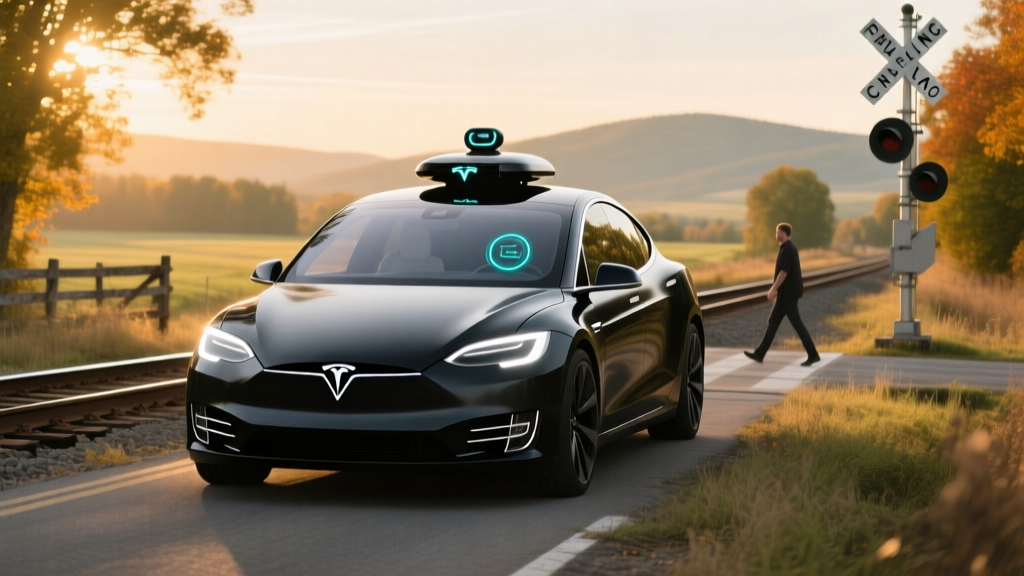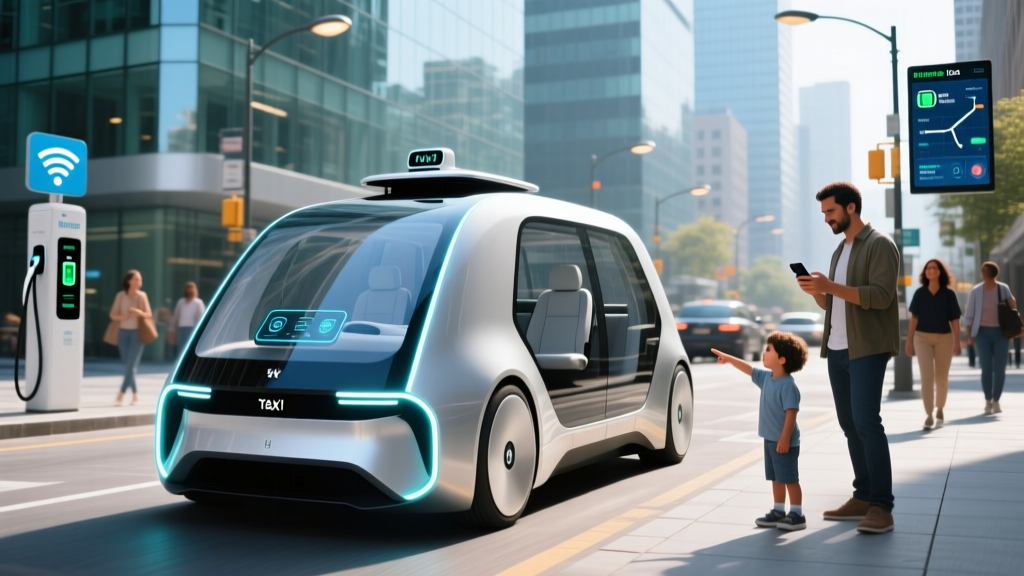
Tesla's Cybercab — the company's purpose-built, two-seat robotaxi unveiled in October 2024 — promised a radical rethinking of urban mobility: no steering wheel, no pedals, no driver, and an interior designed around the premise that you'll never need to take control. As of early 2026, Tesla has begun limited pilot operations in Austin, Texas, but the gap between the unveiling's promises and on-road reality remains significant. Here's an honest look at the Tesla robotaxi interior, the technology stack underneath it, where you can actually ride one, and how it compares to robotaxi services that are already hauling paying passengers at scale.
The Tesla Robotaxi Interior: What Tesla Has Shown
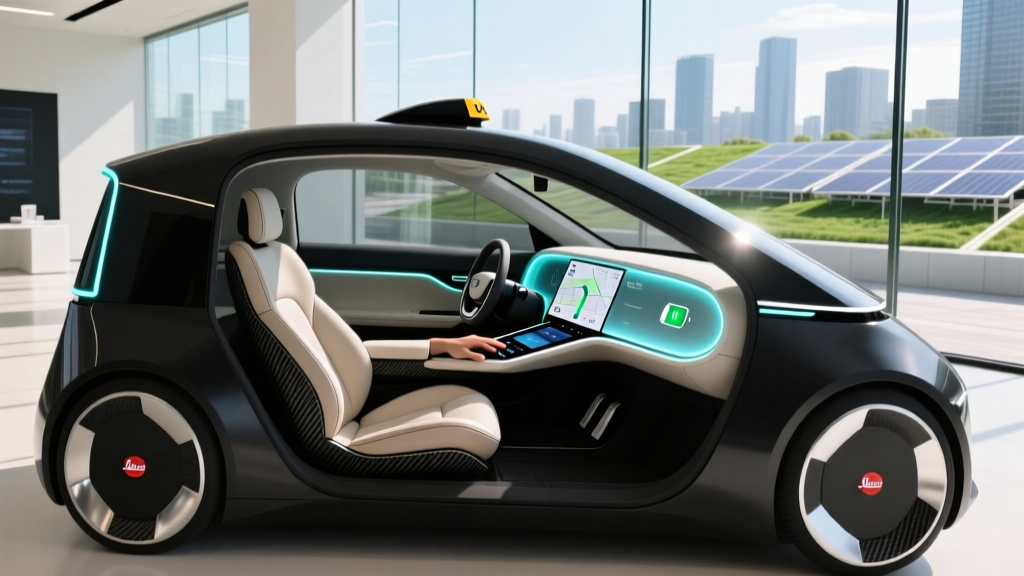
The Cybercab's cabin breaks sharply from every Tesla vehicle before it. With no steering wheel, pedals, or traditional dashboard, the interior is dominated by a single 21-inch center touchscreen, a continuous bench seat for two passengers, and ambient lighting that Tesla says adapts to ride conditions. Materials lean toward a minimalist, easy-to-clean approach: vegan leather upholstery, hard-surface flooring instead of carpet, and integrated cupholders with a small center console.
Tesla has described the cabin as a "living room on wheels," with features like climate pre-conditioning triggered when you book your ride, in-cabin entertainment streaming, and a ride-status display replacing the instrument cluster. There is no frunk; cargo space is limited to a small rear trunk area that Tesla estimates at roughly 12 cubic feet — enough for a carry-on or two grocery bags, but not airport-luggage duty.
- Seating: 2 passengers (bench seat)
- Steering wheel/pedals: None
- Display: Single 21-inch center touchscreen
- Cargo: ~12 cu ft rear trunk
- Battery: ~50 kWh (estimated, LFP chemistry)
- Range: ~200+ miles (Tesla estimate, not EPA-certified)
- Charging: Wireless inductive (no plug); ~25 kW estimated
- 0-60 mph: Not disclosed
- Target MSRP (personal ownership): Under $30,000 (announced)
- Target ride cost: ~$0.20/mile (Tesla estimate)
- Production start: Low-volume pilot, Austin TX (2025-2026)
A critical caveat: Tesla has not published EPA-certified range figures, finalized battery capacity, or released a complete technical specification sheet for the Cybercab as of this writing. The numbers above reflect Tesla's public statements and industry analysis. Treat them as preliminary.
SAE Automation Level: Where Cybercab Sits vs. Today's Teslas
This distinction matters more than any interior feature, and it's where buyer confusion runs deepest.
| Vehicle / Service | SAE Level | Driver Required? | Status (2026) |
|---|---|---|---|
| Tesla Model 3/Y/S/X with Autopilot | Level 2 | Yes — hands on, eyes on | On sale nationwide |
| Tesla FSD (Supervised) | Level 2 | Yes — full supervision required | Available as paid feature |
| Tesla Cybercab (Robotaxi) | Level 4 (target) | No — driverless in geofenced areas | Limited pilot, Austin TX |
| Waymo One (Jaguar I-PACE) | Level 4 | No — fully driverless | Commercial service, multiple cities |
| Zoox (purpose-built vehicle) | Level 4 | No — fully driverless | Limited commercial, Las Vegas / Foster City |
Where Can You Actually Ride a Tesla Robotaxi Right Now?
As of early 2026, Tesla's Cybercab robotaxi service is in a restricted pilot phase:
| City | Status | Access | Notes |
|---|---|---|---|
| Austin, TX | Active pilot | Invite-only / Tesla employees + select testers | Geofenced to specific corridors; safety steward may be present |
| San Francisco, CA | Announced (not yet public) | N/A | Regulatory approval pending with CPUC |
| Los Angeles, CA | Announced (not yet public) | N/A | Targeted for 2026-2027 expansion |
| Phoenix, AZ | Under evaluation | N/A | No confirmed timeline |
For comparison, Waymo One is commercially available to the general public in Phoenix, San Francisco, Los Angeles, and Austin — with no invitation required. You download the app, request a ride, and a driverless Jaguar I-PACE shows up. That's the benchmark Tesla is chasing.
How Much Does It Cost? Tesla Robotaxi Pricing vs. Uber, Lyft, and Waymo
Tesla CEO Elon Musk has stated a target operating cost of approximately $0.20 per mile for the Cybercab service, which would translate to roughly $2-4 for a typical 10-15 mile urban trip. That figure, however, is a long-term target and does not yet reflect real-world consumer pricing. During the Austin pilot, rides are free for invited testers.
| Service | Cost Per Mile | Typical 10-Mi Ride | Availability |
|---|---|---|---|
| Tesla Cybercab (target) | ~$0.20/mi | ~$2.00 | Pilot only (Austin) |
| Waymo One | ~$1.00-1.50/mi | ~$10-15 | Phoenix, SF, LA, Austin |
| UberX | ~$1.20-2.00/mi | ~$12-20 | Nationwide |
| Lyft | ~$1.10-1.80/mi | ~$11-18 | Nationwide |
Tesla's $0.20/mile target assumes massive fleet scale, minimal maintenance costs from the simplified vehicle design, and wireless charging infrastructure that doesn't yet exist at deployment scale. Industry analysts broadly expect real-world Tesla robotaxi pricing to land somewhere between Waymo's current rates and UberX — likely $0.60-$1.00 per mile at launch, if and when the service opens to the public. Waymo's pricing, while higher than Tesla's target, reflects the reality of operating a Level 4 fleet today: lidar-equipped vehicles, remote assistance operators, dedicated maintenance facilities, and regulatory compliance costs.
Safety Record: What the Data Actually Shows
Because Tesla's Cybercab pilot is limited and invite-only, there is no publicly available, independently verified safety dataset specific to the Tesla robotaxi. Tesla has not published miles-driven figures, disengagement rates, or incident reports for the Cybercab pilot as of this writing.
- Waymo: Over 50 million fully driverless miles completed as of late 2025. According to NHTSA incident reports and Waymo's published safety data, Waymo vehicles are involved in fewer police-reported crashes per million miles than human drivers in comparable urban environments. A Swiss Re/IIHS-partnered study found Waymo's driverless fleet had approximately 85% fewer bodily-injury claims than human benchmarks.
- Tesla FSD (Supervised, consumer vehicles): Tesla's quarterly safety reports show approximately 1 crash per 4-6 million miles driven with FSD engaged. However, FSD is a Level 2 system with a human driver responsible for supervision — these are not comparable to driverless robotaxi operations.
- Cruise (GM): Suspended operations in late 2023 after a pedestrian-dragging incident in San Francisco. Partially resumed limited testing in 2025 under stricter regulatory oversight. The incident underscored that Level 4 operations carry real edge-case risks.
- Tesla Cybercab: No public safety data available. Pilot scope too limited for statistical comparison.
Until Tesla publishes transparent safety metrics for the Cybercab — including miles driven, disengagement frequency, and incident reports filed with NHTSA's Standing General Order — any safety comparison remains speculative. Waymo's multi-year, multi-city dataset is the industry standard for robotaxi safety accountability, and Tesla has not yet matched that transparency.
Technology Stack: Camera-Only vs. Lidar — The Core Debate
The Cybercab's sensor suite is the most controversial aspect of the entire vehicle. Tesla uses a pure vision system — cameras only, no lidar, no radar, no ultrasonic sensors (in the latest hardware). The Cybercab is expected to use a refined version of Tesla's Hardware 5 (AI5) compute platform with approximately 10 cameras providing 360-degree coverage.
- Primary sensors: ~10 cameras (visible spectrum), 360° coverage
- Compute: Tesla AI5 / HW5 platform, ~2,500+ TOPS estimated
- AI approach: End-to-end neural network (vision-to-control)
- Mapping: HD map-lite; relies on real-time perception
- Geofencing: Yes — restricted to approved operational design domains
- Lidar: None
- Radar: None
- Ultrasonic sensors: None (Tesla Vision replaces USS)
This stands in direct contrast to every other operational Level 4 robotaxi service. Waymo's 6th-generation driver system uses a combination of lidar (custom-built, 360°), radar, cameras, and external audio sensors. Zoox uses a similar multi-modal stack with lidar as the primary depth-sensing layer. Cruise's vehicles (before suspension) also relied on lidar-camera-radar fusion.
The engineering argument for lidar: it provides reliable, direct depth measurement independent of lighting conditions — critical for nighttime operations, direct sun glare, fog, and scenarios where camera-only systems can struggle with distance estimation. The argument against: cost, complexity, and the belief (held by Tesla) that neural networks trained on sufficient camera data can match or exceed lidar's capabilities.
As of 2026, no camera-only system has been approved for commercial Level 4 driverless operations at scale anywhere in the world. Tesla is attempting to be the first. Whether regulators will certify a vision-only robotaxi for public use remains an open question — and one that state agencies like the California DMV, CPUC, and Texas DOT will answer on their own timelines.
Regulatory Landscape: Who Approves Robotaxi Operations?
Robotaxi deployment in the United States is governed by a patchwork of state and local authorities, not a single federal green light:
- California: The California Public Utilities Commission (CPUC) issues permits for commercial driverless passenger service. The California DMV issues testing permits. Both are required.
- Texas: No statewide robotaxi-specific permitting framework as of 2026, which is partly why Tesla chose Austin for its pilot. Local ordinances and TxDOT coordination apply.
- Arizona: Among the most permissive states for autonomous vehicle testing and deployment. Waymo has operated commercially in Phoenix since 2020.
- Federal (NHTSA): The National Highway Traffic Safety Administration sets vehicle safety standards (FMVSS) and requires incident reporting via Standing General Order, but does not "approve" robotaxi services — that authority rests with states.
Tesla's Cybercab faces a specific regulatory challenge: because it has no steering wheel or pedals, it does not comply with several existing Federal Motor Vehicle Safety Standards (FMVSS) that assume a human driver position. Tesla will need either an FMVSS exemption from NHTSA or a regulatory update to deploy the vehicle at scale. NHTSA has granted limited exemptions for vehicles without traditional controls in the past, but the process is case-by-case and not guaranteed.
Current Limitations: What the Tesla Robotaxi Cannot Do
- Geofence: Operates only within pre-mapped, approved zones — cannot handle arbitrary point-to-point routing outside its operational design domain.
- Weather: Camera-only systems face inherent challenges in heavy rain, fog, snow, and direct sun glare. Tesla has not published weather-performance data for the Cybercab.
- Capacity: Two-passenger maximum — no group rides, no child car seat accommodation, no wheelchair accessibility.
- Cargo: ~12 cu ft trunk limits use to small bags; not viable for airport runs with multiple suitcases or large purchases.
- Charging: Wireless inductive charging requires purpose-built pads. Without widespread deployment of these pads, fleet utilization is constrained by manual charging logistics.
- Edge cases: Construction zones, temporary road closures, unusual road configurations, and unmapped changes remain challenges for all Level 4 systems — including Tesla's.
- No highway operation confirmed: Pilot routes appear limited to lower-speed urban corridors.
- No public availability: Invite-only pilot — you cannot download an app and hail a Cybercab today.
These aren't minor footnotes. They define who the Cybercab can serve, where, and under what conditions. A two-seat vehicle with limited cargo and weather constraints is a complement to existing transit and rideshare, not a replacement — at least not at the current stage.
Is This Truly Self-Driving or Driver-Assist?
The answer depends on which Tesla product you're discussing:
Tesla consumer vehicles (Model 3, Y, S, X) with Autopilot or FSD (Supervised): These are SAE Level 2 driver-assist systems. You must keep your hands on or near the wheel, monitor the road at all times, and be prepared to take over instantly. Despite the "Full Self-Driving" name, these vehicles are not autonomous. The driver is legally and operationally responsible.
Tesla Cybercab: Designed as SAE Level 4 — fully driverless within its geofenced operational domain, with no expectation of human intervention. However, Level 4 does not mean "drives everywhere in all conditions." It means "drives without a human in specific, defined conditions." The Cybercab's Level 4 certification is not yet confirmed by any regulatory body for commercial public use.
This distinction isn't academic. It determines legal liability (who's responsible in a crash), insurance requirements, whether you can nap in the back seat, and whether the vehicle can legally operate without anyone in the driver's position. Level 2 means you're the driver. Level 4 means the system is.
Frequently Asked Questions
Can I buy a Tesla Cybercab for personal ownership?
Tesla has announced a target personal-ownership price under $30,000, but no consumer purchase program is available as of 2026. The vehicle is currently in pilot operations only. Tesla has suggested personal ownership may be possible in the future, with the car earning revenue as a robotaxi when you're not using it — but this model is unproven and faces significant regulatory and insurance hurdles.
How does the Tesla robotaxi interior compare to Waymo's vehicle?
Waymo uses the Jaguar I-PACE, a conventional luxury SUV with a full interior (steering wheel retracted, standard seating for up to 3 passengers in the rear, more cargo space). The Cybercab's two-seat, no-controls layout is more radical but less versatile. If you need to carry more than one passenger or significant luggage, Waymo's current vehicle is more practical.
When will Tesla's robotaxi be available to the general public?
Tesla has not confirmed a public launch date. The Austin pilot is invite-only. Expansion to San Francisco and Los Angeles is announced but contingent on regulatory approvals. A realistic timeline for broad public access in multiple cities is 2027 or later, assuming regulatory clearance and proven safety data.
Does the Cybercab have a steering wheel for emergencies?
No. The Cybercab has been designed without a steering wheel, pedals, or any manual driving controls. In an emergency, the vehicle is expected to pull over safely and contact remote assistance. This design requires an FMVSS exemption from NHTSA for legal road use at scale.
Is Tesla's camera-only approach safe enough for a driverless robotaxi?
This is the central unresolved question. Every other operational Level 4 robotaxi (Waymo, Zoox, Cruise) uses lidar as part of a multi-sensor fusion stack. Tesla believes its neural network approach with cameras alone can achieve equivalent or better safety. No camera-only system has been approved for commercial Level 4 operations to date. Independent safety data from Tesla's pilot will be the deciding factor — and that data has not yet been published.
What about the federal EV tax credit if I buy a Cybercab?
The IRS §30D clean vehicle credit has strict eligibility requirements including MSRP caps ($55,000 for sedans, $80,000 for SUVs/trucks), buyer income limits ($150K single / $300K joint), and critical-mineral/battery-component sourcing rules. If Tesla prices the Cybercab under $30,000 and meets sourcing requirements, it could qualify for up to $7,500 — but eligibility depends on the specific vehicle's battery supply chain, which Tesla has not detailed for the Cybercab. Consult a tax professional and check the latest IRS guidance before assuming credit eligibility.