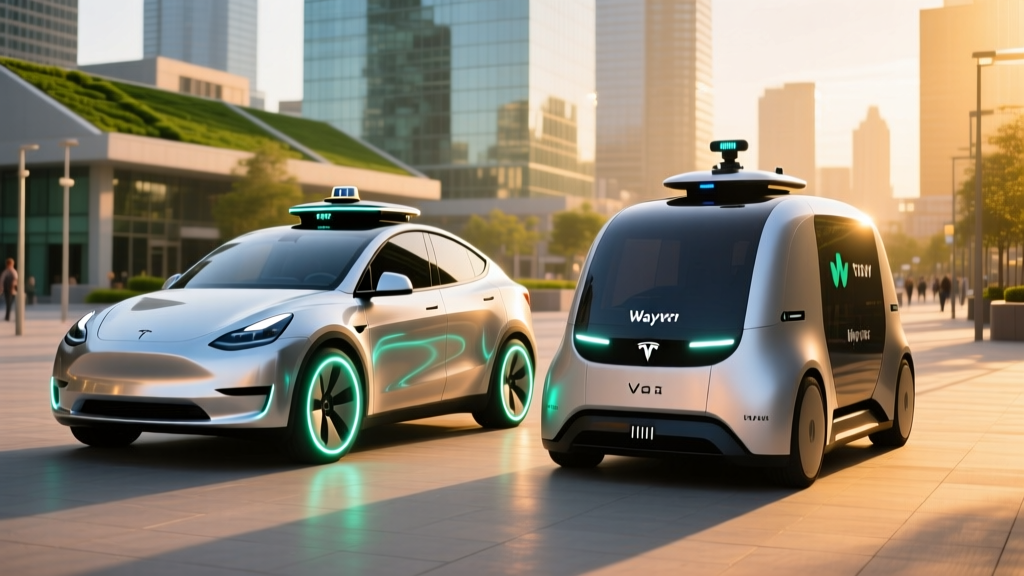
Tesla's long-promised robotaxi has slipped again. What began as a 2024 unveil target, then shifted to a limited 2025 launch, now faces an uncertain timeline heading into 2026. Meanwhile, Waymo's driverless fleet is completing over 150,000 paid rides per week across multiple U.S. cities. For buyers and investors trying to understand when — or whether — Tesla will field a true driverless service, the gap between marketing promises and operational reality has never been wider.
This article breaks down exactly where Tesla's robotaxi program stands, why the delays keep happening, and how it compares to the Level 4 services you can actually hail today.
Why the Tesla Robotaxi Delay Keeps Happening
Tesla first teased a dedicated robotaxi vehicle — internally called the "Cybercab" — at an October 2024 event, showing a two-seat prototype with no steering wheel or pedals. Elon Musk initially suggested production could begin in late 2025. As of early 2026, that timeline has slipped. Tesla has not announced a firm production start date, and the vehicle remains in pre-production testing.
The core challenge is not hardware. Tesla's AI5 inference computer and its latest HW4 camera suite are capable processors. The bottleneck is software validation: proving to regulators that a camera-only, no-lidar system can safely handle the infinite edge cases of urban driving without a human fallback driver.
Tesla's Full Self-Driving (Supervised) software, currently at version 13.x, still requires an attentive driver behind the wheel. That's SAE Level 2 automation — the same classification as Ford BlueCruise or GM Super Cruise, despite the "Full Self-Driving" branding. Transitioning from Level 2 to a Level 4 driverless robotaxi is not an incremental software update. It demands a fundamentally different safety case, redundancy architecture, and regulatory approval process.
| Level | Description | Example |
|---|---|---|
| Level 2 | Driver-assist. Human must monitor and intervene. | Tesla FSD (Supervised), Autopilot, BlueCruise |
| Level 3 | Conditional automation. Driver must take over when requested. | Mercedes Drive Pilot (limited markets) |
| Level 4 | Driverless within defined operational domain. No human needed. | Waymo One, Zoox |
| Level 5 | Full automation everywhere, all conditions. Does not exist yet. | Theoretical only |
Tesla FSD (Supervised) is Level 2. A Tesla robotaxi without a steering wheel would need to be Level 4 — a massive leap that no camera-only system has yet achieved commercially.
Where You Can Actually Use a Robotaxi Right Now
While Tesla's robotaxi remains unreleased, Level 4 driverless services are operational today. Here is where you can hail a ride with no human driver:
| Service | Cities (Live, Paid Rides) | Vehicle | Hours |
|---|---|---|---|
| Waymo One | Phoenix, San Francisco, Los Angeles, Austin (expanding) | Jaguar I-PACE (Gen 6 sensor suite) | 24/7 in most zones |
| Zoox | Las Vegas, San Francisco (limited) | Zoox purpose-built carriage | Limited hours |
| Cruise | Suspended since Oct 2023; slow phased re-entry in Phoenix, Dallas | Chevrolet Bolt EV / Origin | Limited/supervised |
| Tesla Robotaxi | Not available — no live service | Cybercab (announced prototype) | N/A |
Waymo is the clear leader. According to NHTSA reporting and Waymo's published data, the company surpassed 50 million cumulative driverless miles by mid-2025 and now operates over 1,000 vehicles across its active markets.
Robotaxi Pricing: How Does It Compare to Uber and Lyft?
One of Tesla's core robotaxi promises is dramatically cheaper rides — Musk has floated figures as low as $0.20 per mile. But that's theoretical. Here's what real robotaxi pricing looks like today versus conventional rideshare:
| Service | Avg Cost/Mile | Avg 5-Mi Ride | Surge Pricing | Tips |
|---|---|---|---|---|
| Waymo One | $1.50–$2.50 | $10–$18 | Yes (moderate) | Optional (in-app) |
| UberX | $1.20–$2.00 | $9–$15 | Yes (variable) | Expected |
| Lyft Standard | $1.10–$1.90 | $8–$14 | Yes (variable) | Expected |
| Tesla Robotaxi (projected) | $0.20–$0.50 (claimed) | $3–$5 (claimed) | Unknown | None (no driver) |
The reality: Waymo currently prices at or slightly above UberX in most markets. The no-driver cost advantage exists, but it's offset by expensive sensor suites (lidar, radar, cameras), remote-assistance infrastructure, and fleet maintenance. Tesla's ultra-low pricing claims assume massive scale and minimal hardware cost — both unproven at this stage.
How Safe Are Robotaxis? The Real Data
- Waymo driverless miles: Over 50 million cumulative autonomous miles (as of mid-2025)
- Waymo injury crash rate: Approximately 85% lower than human benchmarks in comparable urban environments, per IIHS-cited studies and Waymo's published safety reports
- Cruise suspension (Oct 2023): A Cruise vehicle in San Francisco struck and dragged a pedestrian who had been thrown into its path by another car. California DMV suspended Cruise's permit. The incident highlighted the gap between "miles without incident" and handling rare, complex edge cases.
- Tesla FSD (Supervised): Tesla reports roughly 1 accident per 4–5 million FSD miles, but FSD requires driver supervision. NHTSA's Standing General Order data shows Tesla Autopilot/FSD involved in hundreds of reported crashes, though exposure-adjusted rates remain debated.
Sources: Waymo Safety Reports, NHTSA Standing General Order, California DMV disengagement reports
The key distinction: Waymo's safety record is built on Level 4 driverless operation — no human in the loop. Tesla's FSD numbers reflect Level 2 supervised driving, where a human can intervene. These are not directly comparable. A Level 4 system must handle every scenario without human backup, which is why the validation bar is exponentially higher and why the Tesla robotaxi delay persists.
Tesla's Camera-Only Tech Stack vs. Waymo's Lidar Approach
The fundamental technical disagreement between Tesla and every other robotaxi operator comes down to sensors:
| Component | Tesla (Cybercab Prototype) | Waymo (Gen 6) |
|---|---|---|
| Cameras | 8+ cameras, vision-only | Multiple cameras (supplementary) |
| Lidar | None | Custom-built 360° lidar arrays |
| Radar | None (removed in recent HW) | Imaging radar |
| Compute | Tesla AI5 chip | Custom Waymo driver platform |
| HD Maps / Geofencing | Minimal (vision-based localization) | Detailed HD maps, strict geofence |
| Redundancy | Software-based (single sensor modality) | Hardware redundancy across lidar, camera, radar |
Tesla argues that cameras plus neural networks can replicate human vision and that lidar is an expensive crutch. Waymo — along with Zoox, Cruise, and nearly every other robotaxi developer — argues that sensor redundancy is essential for safety-critical systems. Lidar provides precise depth measurement regardless of lighting; cameras can struggle with glare, darkness, fog, and heavy rain.
This is the heart of the Tesla robotaxi delay. Validating a camera-only system to Level 4 safety standards means proving it handles every scenario that lidar-equipped competitors handle — and more — without the redundancy fallback. That's a steeper regulatory hill than any company has climbed.
Current Limitations of Robotaxi Services
Even Waymo's live Level 4 service has significant constraints that illustrate why Tesla's path to a scalable robotaxi is so difficult:
- Geofencing: Waymo operates within mapped zones. Rides cannot originate or terminate outside these boundaries. Expanding a zone requires extensive mapping and validation.
- Weather: Heavy rain, fog, and snow degrade sensor performance. Waymo may suspend service or limit routes during severe weather. Tesla's camera-only system would face even greater challenges here — cameras cannot see through fog or heavy precipitation the way lidar partially can.
- Construction zones: Unexpected lane closures, temporary signage, and flaggers remain challenging. Remote human assistance is sometimes needed.
- Edge cases: Unusual road configurations, emergency vehicles behaving unpredictably, and pedestrian behavior in dense urban environments still trigger conservative responses (pulling over, waiting for remote guidance).
- Pickup/dropoff precision: Finding exact safe stopping points in crowded urban streets is imperfect — passengers sometimes walk a short distance to/from the vehicle.
- No highway operation: Current Level 4 robotaxi services operate on surface streets only, typically at speeds under 65 mph.
These limitations apply to Waymo's lidar-equipped, geofenced, extensively tested fleet. A Tesla robotaxi operating camera-only, without HD maps, and at scale across diverse U.S. cities would need to overcome all of these — plus additional challenges unique to its sensor approach.
The Regulatory Landscape: Who Approves Robotaxis?
Deploying a driverless vehicle for paid rides requires navigating a patchwork of state and federal approvals:
- NHTSA (federal): Sets vehicle safety standards (FMVSS). A vehicle without a steering wheel or pedals — like Tesla's Cybercab prototype — requires an exemption or new rulemaking. As of 2026, no blanket exemption exists for mass-produced steering-wheel-free vehicles.
- State DMVs: California, Arizona, Texas, and others each have their own permitting process for driverless testing and commercial deployment. California's DMV and CPUC jointly regulate robotaxi operations; Arizona has a lighter-touch framework.
- Local municipalities: Cities can impose additional restrictions on operating zones, hours, and fleet sizes.
Tesla faces a specific regulatory challenge: the Cybercab's lack of a steering wheel means it cannot be sold or operated under current FMVSS without a formal exemption. NHTSA has not yet established a clear pathway for this at production scale. Waymo's Jaguar I-PACE vehicles, by contrast, are production cars with standard controls — the driver simply isn't using them.
Is Tesla FSD Actually Self-Driving?
Despite the name, Full Self-Driving requires continuous driver attention. You must keep your hands near the wheel and eyes on the road. The system can make errors — misread lane markings, fail to detect stopped vehicles, misjudge merging traffic — and the driver is legally responsible for all vehicle operation. Tesla's own owner's manual states this explicitly.
A true self-driving robotaxi (Level 4) has no steering wheel, no driver, and handles all situations within its operating domain without human intervention. Waymo operates at this level. Tesla does not — not yet, and possibly not for years.
What This Means for Buyers and Investors
The Tesla robotaxi delay is not just a scheduling inconvenience — it reflects a fundamental gap between Tesla's vision and the engineering and regulatory realities of Level 4 autonomy. Here's the practical takeaway:
| Factor | Tesla Robotaxi | Waymo (Current) |
|---|---|---|
| Service status | Not available | Live in 4+ cities |
| Autonomy level | Targeting Level 4 (unproven) | Level 4 (validated) |
| Sensor approach | Camera-only | Lidar + camera + radar |
| Regulatory approval | Not obtained; FMVSS exemption needed | Approved in operating markets |
| Safety data (driverless) | None (no driverless miles) | 50M+ driverless miles |
| Earliest realistic wide launch | 2027–2028+ (speculative) | Now (expanding) |
If you're considering a Tesla purchase primarily for its future robotaxi potential — or buying Tesla stock on that thesis — understand that the timeline remains uncertain and the technical hurdles are substantial. The camera-only approach may ultimately prove viable, but it has not been validated at Level 4 anywhere in the world, and the regulatory pathway for a steering-wheel-free production vehicle is not yet established.
Frequently Asked Questions
Where can I use a robotaxi service right now?
Waymo One is available for paid driverless rides in Phoenix, San Francisco, Los Angeles, and Austin, with additional cities planned. Zoox operates a limited service in Las Vegas and parts of San Francisco. No Tesla robotaxi service exists as of early 2026.
How much does a robotaxi ride cost vs. Uber or Lyft?
Waymo currently prices similarly to UberX — roughly $1.50–$2.50 per mile depending on market and demand. It's not meaningfully cheaper than rideshare yet. Tesla has claimed future robotaxi rides could cost $0.20–$0.50/mile, but this is unverified and assumes massive scale.
How safe are robotaxis — is there real data?
Waymo reports over 50 million driverless miles with an injury crash rate approximately 85% lower than human benchmarks in comparable urban environments. However, Cruise's October 2023 pedestrian incident in San Francisco demonstrated that rare edge cases remain a challenge. Tesla FSD data reflects supervised Level 2 driving and is not directly comparable to Level 4 robotaxi safety records.
What are the current limitations of robotaxi services?
Geofencing (restricted operating zones), weather sensitivity (heavy rain, fog, snow), construction zones, unusual road configurations, and speed limits (typically under 65 mph on surface streets only). These limitations apply even to Waymo's lidar-equipped fleet. A camera-only Tesla system would face additional challenges in low-visibility conditions.
Is Tesla FSD actually self-driving?
No. Tesla Full Self-Driving (Supervised) is SAE Level 2 driver-assist. The driver must remain attentive and is legally responsible for vehicle operation at all times. A Level 4 robotaxi — like Waymo — operates without any human driver. Tesla's Cybercab aims for Level 4 but has not achieved regulatory approval or demonstrated driverless operation.
When will the Tesla robotaxi actually launch?
Tesla has not provided a firm date as of early 2026. The Cybercab prototype was unveiled in October 2024 with an initially suggested 2025 production start, which has since slipped. Realistically, wide commercial deployment — if it happens — is unlikely before 2027–2028, contingent on FMVSS exemptions, state-level permits, and validated driverless safety data.