Tesla's robotaxi ambitions have been a central pillar of the company's valuation narrative for years. But when the Cybercab unveiling failed to deliver concrete timelines, regulatory approvals, or live service data, the resulting stock selloff raised a critical question: Is Tesla's autonomous driving vision technically viable, or is it a valuation premium built on unproven promises?
As of early 2026, Tesla's Full Self-Driving (Supervised) remains an SAE Level 2 driver-assist system — not a driverless robotaxi service. Meanwhile, competitors like Waymo are operating Level 4 commercial services in multiple U.S. cities. Understanding this gap is essential for both investors weighing Tesla's stock and EV buyers deciding whether FSD is worth its price tag.
SAE Automation Levels: What They Actually Mean
| Level | Name | Who Drives | Example |
|---|---|---|---|
| 0–1 | Assistance | Human | Cruise control, lane-keep assist |
| 2 | Partial Automation | Human (must supervise) | Tesla Autopilot, FSD (Supervised), GM Super Cruise |
| 3 | Conditional Automation | System (human fallback) | Mercedes Drive Pilot (limited conditions) |
| 4 | High Automation | System (no driver needed in geofence) | Waymo One, Zoox |
| 5 | Full Automation | System (all conditions) | Does not exist commercially |
The Cybercab Announcement vs. Reality
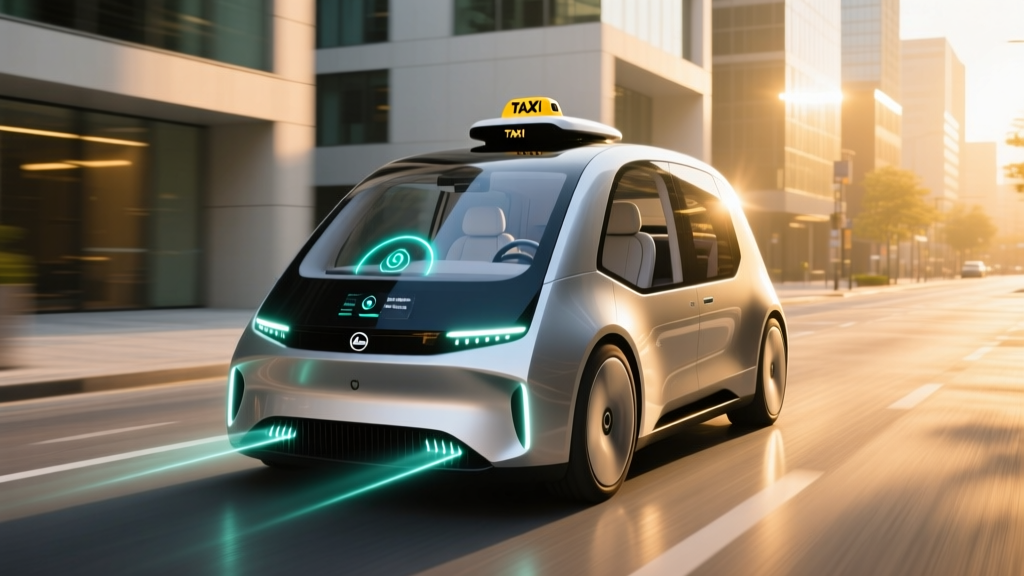
At its October 2024 "We, Robot" event, Tesla unveiled the Cybercab — a two-seat, steering-wheel-free concept vehicle designed for autonomous ride-hailing. The presentation showcased a futuristic design and projected a sub-$30,000 production cost, but conspicuously absent were key details that investors and regulators require: a production timeline with firm dates, a regulatory approval pathway, or a single mile of driverless testing data.
Tesla projected "volume production" starting in 2026, but as of this writing, no Cybercab has been homologated for U.S. road use, no state has issued Tesla a driverless testing or commercial deployment permit, and no third-party safety validation has been published. The stock drop following the event — and subsequent volatility through 2025 and into 2026 — reflects growing investor skepticism about the gap between Tesla's autonomous narrative and its technical deliverables.
Where Tesla FSD Stands Today: Level 2, Not Level 4
Tesla's Full Self-Driving (Supervised) software, currently at version 13.x as of early 2026, is classified as an SAE Level 2 system. This means:
- The human driver is legally and operationally responsible for monitoring the vehicle at all times.
- Hands must remain on the steering wheel (or torque must be applied) per Tesla's driver-monitoring system.
- The system can disengage at any time, requiring immediate human takeover.
- Tesla explicitly states in its owner's manual that FSD "does not make the vehicle autonomous."
This is the core of the "Tesla robotaxi concerns" narrative: the company's multi-billion-dollar valuation premium for autonomous driving is anchored to a technology that, by SAE definitions and Tesla's own documentation, is not autonomous at all.
How Tesla's Approach Compares to Waymo's Level 4 Service
To understand why the stock reacted negatively, it's necessary to compare Tesla's camera-only, neural-network approach with the only scaled robotaxi service operating in the U.S. today: Waymo One.
| Feature | Tesla FSD (Supervised) | Waymo One (Level 4) |
|---|---|---|
| SAE Level | Level 2 (driver-assist) | Level 4 (driverless in geofence) |
| Sensor Stack | Camera-only (8 cameras, no lidar/radar on newer models) | Lidar + radar + cameras + audio sensors |
| HD Maps | No (relies on real-time vision) | Yes (pre-mapped geofenced areas) |
| Driver Required | Yes (always) | No |
| Commercial Service | None | Phoenix, San Francisco, Los Angeles, Austin (expanding) |
| Regulatory Approval | N/A (sold as ADAS) | CPUC + state DMV permits |
| Miles Driven (Driverless) | 0 | 50+ million fully autonomous miles (as of 2025) |
| Vehicle Cost | ~$40,000–$55,000 (Model Y/3) | ~$150,000+ (6th-gen Waymo vehicle) |
The tech-stack divergence is fundamental. Tesla bet that a camera-only vision system, powered by neural networks trained on fleet data, could achieve autonomy without lidar or HD maps. Waymo's approach uses lidar for precise 3D spatial awareness, radar for velocity detection in poor weather, cameras for object classification, and pre-built HD maps for redundancy. Both have merits, but only Waymo's approach has received regulatory approval for driverless commercial deployment.
Robotaxi Safety Data: What the Numbers Show
📊 Waymo Safety Record (Published Data)
According to Waymo's published safety reports and independent analyses:
- 50+ million fully autonomous miles driven across Phoenix, SF, LA, and Austin
- ~85% fewer injury-causing crashes compared to human benchmarks in comparable urban environments (per Waymo's insurance-claims analysis)
- Contact rate: approximately 1 police-reported contact per ~1.2 million autonomous miles — significantly below the human average of ~1 per 500,000 miles in dense urban driving
- Limitations: Most operations occur in fair weather, low-speed urban environments with pre-mapped routes
By contrast, Tesla has not published equivalent driverless safety data because no Tesla vehicle operates without a driver. Tesla's FSD safety statistics, reported quarterly, measure miles between driver interventions — but these interventions are mandatory under the Level 2 framework and do not equate to autonomous safety performance.
The NHTSA Standing General Order requires both Tesla and Waymo to report crashes involving automated systems. Tesla's crash reports under this order show hundreds of incidents involving Autopilot and FSD — but context matters: Tesla has millions of vehicles on the road running these systems daily, while Waymo operates a fleet of roughly 1,000–1,500 vehicles. Raw incident counts are not directly comparable without normalizing for fleet size, miles driven, and operating conditions.
The Regulatory Hurdle: Why Tesla Can't Just Flip a Switch
Even if Tesla achieved Level 4 technical capability tomorrow, deploying a driverless robotaxi service in the United States requires navigating a complex regulatory landscape:
Federal Level (NHTSA)
- Federal Motor Vehicle Safety Standards (FMVSS) require a steering wheel, mirrors, and pedals for passenger vehicles. The Cybercab, as unveiled, has none of these — meaning it would require an FMVSS exemption petition, which NHTSA grants on a limited, case-by-case basis.
- NHTSA investigations: Tesla has faced multiple NHTSA probes into Autopilot/FSD behavior at crash scenes, emergency vehicles, and unexpected disengagements. These investigations create regulatory headwinds.
State Level
- California DMV: Requires separate permits for testing (with driver) and deployment (without driver). Tesla holds a testing permit but has not applied for or received a deployment permit. California's DMV also publishes disengagement reports — Tesla's reported disengagement rates have historically been significantly higher per mile than Waymo's.
- Arizona: More permissive regulatory environment where Waymo first launched. Tesla would still need state authorization for commercial driverless operations.
- Texas, Nevada, other states: Each has its own framework, and none have granted Tesla driverless deployment authority.
The regulatory pathway for a steering-wheel-free robotaxi is not a formality — it's a multi-year process with no guaranteed outcome. This is a significant factor in the Tesla robotaxi concerns driving stock volatility.
Current Limitations of Tesla's Autonomous Ambitions
🚫 What Tesla FSD Cannot Do Today
- Operate without a human driver — legally or technically
- Handle all weather conditions — heavy rain, fog, snow, and low-visibility scenarios degrade camera-only performance
- Navigate unmapped construction zones reliably — edge cases with temporary lane shifts, missing lane markings, or unusual signage remain challenging
- Function as a ride-hailing service — no Tesla app, dispatch system, or commercial ride-hailing platform exists
- Operate outside the U.S. with FSD features — FSD is limited to North America; European and Chinese versions are more restricted
- Guarantee point-A-to-point-B reliability — drivers must be prepared to take over at any moment
The camera-only approach faces inherent physics limitations. Lidar provides active depth sensing that works identically in darkness, rain, and direct sunlight glare — conditions where camera-based depth estimation can struggle. Tesla's argument that humans drive with "just cameras and a neural net" (eyes and brain) is technically true but ignores that human drivers also use auditory cues, have 200+ degree peripheral awareness, and can reason about novel scenarios in ways that current neural networks cannot reliably replicate.
What This Means for Tesla's Stock and EV Buyers
The stock drop tied to Tesla robotaxi concerns reflects a repricing of risk. Tesla's market capitalization has historically included a substantial premium for autonomous driving potential — some analysts have estimated that robotaxi-related valuation accounts for $200–$500 billion of Tesla's market cap. When concrete progress toward Level 4 deployment fails to materialize on the timelines implied by management, that premium comes under pressure.
For EV buyers considering whether to purchase Tesla's FSD package (currently priced at $8,000 as a one-time purchase or $99/month as a subscription in 2026), the calculus is straightforward:
- You are buying a Level 2 driver-assist system — an advanced one, but one that requires your full attention and does not reduce your legal liability.
- There is no guaranteed upgrade path to autonomy. Tesla has promised "full self-driving" since 2016; the goalposts have moved repeatedly.
- The value proposition depends on your driving patterns. If you commute in heavy traffic daily, FSD's stop-and-go management and lane-keeping can reduce fatigue. If you mostly drive on highways, standard Autopilot (included free) handles most scenarios adequately.
For investors, the key questions remain: Can Tesla's camera-only approach achieve Level 4 without lidar? Will NHTSA grant an FMVSS exemption for the steering-wheel-free Cybercab? Can Tesla build the ride-hailing infrastructure (dispatch, fleet management, insurance, maintenance) to compete with Waymo's years-long head start? Until these questions have concrete answers — not projections — the stock will remain sensitive to every robotaxi-related headline.
Frequently Asked Questions
Where can I use a Tesla robotaxi service right now?
You cannot. As of 2026, Tesla does not operate any driverless ride-hailing service anywhere in the world. Tesla FSD (Supervised) is available as a driver-assist feature on Tesla vehicles you own or lease, but a human driver must be present and attentive at all times. The only commercially available robotaxi services in the U.S. are Waymo One (Phoenix, San Francisco, Los Angeles, Austin) and limited Zoox operations in Las Vegas and Foster City, CA.
How much does a robotaxi ride cost vs. Uber or Lyft?
Waymo One pricing in 2026 is generally competitive with UberX and Lyft standard fares in the same markets — typically within 10–15% of comparable rideshare prices, and occasionally cheaper during surge-pricing events when Uber/Lyft apply multipliers. Waymo does not surge-price in the traditional sense, which can make it significantly cheaper during peak demand. A typical 5-mile urban trip costs roughly $12–$18 on Waymo One, similar to UberX without surge.
How safe are robotaxis — is there real data?
Waymo has published safety data covering 50+ million autonomous miles, showing significantly lower injury-crash rates than human benchmarks in comparable urban environments. However, this data covers geofenced, low-to-moderate speed urban routes in generally fair weather. There is no equivalent published data for Tesla FSD operating without a driver, because Tesla does not operate driverless vehicles. NHTSA's Standing General Order crash data is available for both companies but requires careful normalization for fleet size and operating conditions.
What are the current limitations of robotaxi services?
Current Level 4 robotaxis (Waymo) operate within geofenced areas only, cannot handle severe weather (heavy snow, flooding), may refuse trips to unmapped destinations, have limited highway-speed capability in most markets, and cannot accommodate special requests like multiple stops or pet transport without advance configuration. Tesla FSD, as a Level 2 system, has no geofence but requires constant driver supervision and struggles with construction zones, adverse weather, and ambiguous road markings.
Is Tesla FSD truly self-driving or just driver-assist?
It is driver-assist. Tesla's own documentation, the SAE classification system, and the National Highway Traffic Safety Administration all classify FSD (Supervised) as a Level 2 system. The driver must monitor the road, keep hands available for steering input, and be prepared to take over instantly. The "Supervised" in the product name is a legal and technical designation — not marketing language.
Will the Cybercab ever be available to buy?
Tesla has announced the Cybercab as a future production vehicle targeting sub-$30,000 pricing, with volume production projected for 2026 or later. However, no production timeline has been confirmed, no FMVSS exemption has been filed or granted, and no pre-orders are currently available. Tesla has a history of announcing vehicles years before production (the Roadster 2.0 was announced in 2017 and has yet to ship). Treat the Cybercab as an announced concept until firm production and regulatory milestones are met.
Sources: NHTSA Automated Vehicles Safety, California DMV Autonomous Vehicle Program, SAE J3016 Automation Levels. Tesla FSD pricing and version information based on Tesla's U.S. website as of early 2026. Waymo operational data from Waymo's public safety reports and CPUC filings.