In early 2026, Tesla significantly increased its robotaxi base fare in Austin, Texas — a move that sent ripples through the ride-hailing industry and raised questions about the economics of autonomous mobility. The adjustment, which pushed the base fare from its introductory promotional rate to a level closer to conventional rideshare pricing, signals a shift from Tesla's initial land-grab strategy toward sustainable unit economics. For Austin riders, the change demands a fresh look at whether Tesla's driverless service still delivers value.
This article breaks down exactly what changed with Tesla's Austin robotaxi pricing, how the service operates today, and whether it stacks up against Uber, Lyft, and Waymo in real-world cost and reliability.
Tesla's Austin Robotaxi: What the Fare Increase Actually Means
When Tesla launched its commercial robotaxi service in Austin in late 2025, it did so with aggressively low introductory pricing — a base fare of approximately $2.50 plus a per-mile rate well below what Uber and Lyft charged in the same market. The strategy was classic market penetration: subsidize rides to build ridership, collect real-world miles, and refine the system.
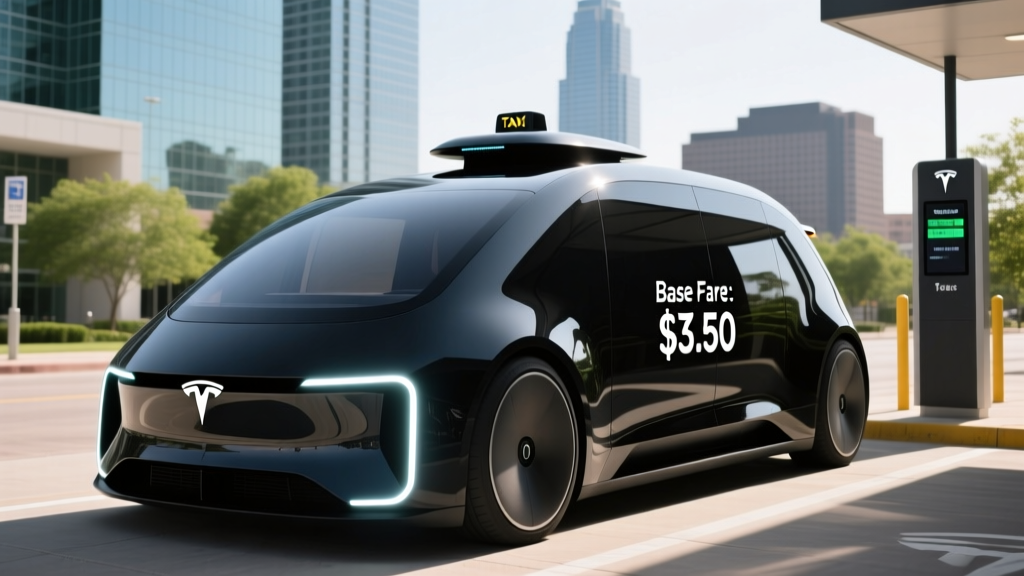
By mid-2026, that promotional window closed. Tesla significantly increased its robotaxi base fare in Austin to approximately $5.00, with a per-mile rate that now sits in the $1.25–$1.50 range depending on time of day and demand. A per-minute waiting charge of roughly $0.35 applies when the vehicle is stationary during a trip.
Estimated Pricing Comparison: Austin Robotaxi & Rideshare (Mid-2026)
| Service | Base Fare | Per-Mile Rate | Per-Minute Rate | Est. 5-Mile Trip |
|---|---|---|---|---|
| Tesla Robotaxi (Austin) | $5.00 | $1.25–$1.50 | $0.35 | $13.50–$15.50 |
| Waymo One (Phoenix/SF) | $5.50 | $1.50–$1.80 | $0.40 | $15.00–$17.50 |
| UberX (Austin avg.) | $3.50 | $1.40–$1.75 | $0.45 | $13.00–$16.00 |
| Lyft Standard (Austin avg.) | $3.25 | $1.35–$1.70 | $0.42 | $12.50–$15.50 |
Estimates based on publicly reported rates and typical Austin pricing as of mid-2026. Surge pricing and promotional discounts may alter actual costs. Sources: Tesla app, Waymo One app, Uber/Lyft fare estimators.
The upshot: a typical 5-mile robotaxi ride in Austin now costs roughly the same as an UberX trip — sometimes slightly more during off-peak hours when human-driven rideshare discounts apply, sometimes slightly less during surge periods when Tesla's algorithmic pricing stays more stable. The days of $6 robotaxi rides across town are, for now, over.
Where Can You Actually Use Tesla's Robotaxi Service?
Tesla's commercial robotaxi service remains geographically limited. As of mid-2026, the service is operational in the following areas:
Tesla Robotaxi Service Availability (2026)
| City | Status | Operational Zone | Hours |
|---|---|---|---|
| Austin, TX | Commercial (paid) | Downtown, South Congress, East Austin, Domain area (~65 sq mi geofence) | 6 AM – 1 AM daily |
| San Francisco, CA | Limited pilot (invite-only) | SoMa, Mission, Financial District (~20 sq mi) | 7 AM – 10 PM weekdays |
| Phoenix, AZ | Announced / testing | Not yet commercial | N/A |
| Los Angeles, CA | Announced / testing | Not yet commercial | N/A |
Austin remains the only city where any rider can hail a Tesla robotaxi through the Tesla app without an invitation. The geofenced zone covers the core urban area but does not extend to suburbs like Round Rock, Cedar Park, or Pflugerville, nor does it include Austin-Bergstrom International Airport. If your destination falls outside the geofence, the app will not allow you to book the ride.
Expansion to additional cities has been announced but no firm timelines have been published. Regulatory approval in California, in particular, remains a multi-step process involving the California Public Utilities Commission (CPUC) and the California DMV.
SAE Automation Level: Is Tesla's Robotaxi Truly Self-Driving?
This distinction matters enormously, and it is where consumer confusion runs deepest. Let's be precise:
SAE Automation Levels — What Each Level Actually Means
| SAE Level | Name | Who Drives? | Example Systems |
|---|---|---|---|
| Level 0 | No Automation | Human | Basic cruise control |
| Level 1 | Driver Assistance | Human (one feature assisted) | Adaptive cruise OR lane-keep |
| Level 2 | Partial Automation | Human (must supervise at all times) | Tesla Autopilot, FSD Supervised, GM Super Cruise, Ford BlueCruise |
| Level 3 | Conditional Automation | System (human must take over on request) | Mercedes DRIVE PILOT (limited conditions) |
| Level 4 | High Automation | System (no human needed in defined ODD) | Waymo One, Tesla Robotaxi (commercial service), Zoox |
| Level 5 | Full Automation | System (all conditions, everywhere) | None currently deployed |
Tesla's consumer vehicles running FSD (Supervised) are SAE Level 2. The driver is legally and practically responsible for the vehicle at all times. Hands may be off the wheel, but eyes and attention must remain on the road.
Tesla's commercial robotaxi service operating in Austin is SAE Level 4 within its defined Operational Design Domain (ODD) — meaning the geofenced service area, approved road types, and weather conditions under which the system is permitted to operate. There is no driver in the vehicle. The system handles all driving tasks, and a remote operations team monitors the fleet and can intervene if the vehicle encounters a scenario it cannot resolve autonomously.
These are fundamentally different products. A Tesla Model Y with FSD Supervised that you buy at a dealership is not a robotaxi. The Austin robotaxi fleet consists of purpose-configured vehicles running a validated Level 4 software stack with additional remote-telematics hardware and redundant systems not present in consumer vehicles.
Technology Stack: Cameras, Compute, and the Lidar Question
Tesla Robotaxi Tech Stack Overview
| Component | Specification |
|---|---|
| Primary Sensors | 8+ cameras (high-resolution, multi-focal), no lidar |
| Compute Platform | HW5 (AI5) — dual redundant inference chips, ~2,000+ TOPS estimated |
| Perception Approach | Vision-only neural network (end-to-end learned driving policy) |
| Localization | HD maps + visual SLAM + GPS/IMU fusion |
| Connectivity | Dual-SIM 5G with redundant cellular carriers |
| Remote Operations | Teleoperations center for edge-case resolution and dispatch |
| Redundancy | Dual compute paths, redundant braking and steering actuators |
Tesla's camera-only approach remains the most debated technical decision in the autonomous vehicle industry. Waymo uses a sensor suite combining lidar, radar, and cameras — providing depth perception and object detection that functions independently of lighting conditions. Tesla has bet that advances in neural-network-based perception, powered by increasingly capable custom silicon, can match or exceed lidar-based systems using cameras alone.
The practical implications of this choice show up in edge cases. Camera systems can struggle in scenarios with extreme glare, heavy rain that obscures lens surfaces, or sudden transitions between bright sunlight and deep shadow. Tesla's robotaxi service in Austin has weather-related service restrictions — during heavy thunderstorms, the system may reduce speed limits within the geofence or temporarily suspend service, a limitation the app communicates to riders in real time.
On the compute side, Tesla's HW5 (AI5) platform represents a significant leap over the HW4 hardware in consumer vehicles. The dual-chip architecture provides the redundancy required for Level 4 operation: if one compute path fails or produces an anomalous result, the second path can safely bring the vehicle to a controlled stop.
Safety Record: What the Data Actually Shows
Tesla Robotaxi Austin — Safety Metrics (Through Mid-2026)
- Estimated commercial miles driven: ~1.5–2 million miles (paid service, Austin)
- Reported at-fault collisions: Low single digits (exact figure not publicly disclosed by Tesla)
- Remote intervention rate: Estimated 1–3 interventions per 1,000 miles (based on early rider reports and industry benchmarks for new Level 4 deployments)
- Injuries to riders or pedestrians: None publicly reported as of mid-2026
- Regulatory reporting: Texas does not currently mandate the same granular disengagement reporting that California's DMV requires, making independent verification more difficult
Note: Tesla has not published a comprehensive safety transparency report for its Austin robotaxi service comparable to Waymo's published research. The figures above are estimates based on available reporting, rider accounts, and industry context. For California-based AV data, see the California DMV Disengagement Reports.
Context matters here. Waymo, which has operated commercially in Phoenix since 2020 and expanded to San Francisco and Los Angeles, has accumulated over 30 million paid rider miles and published peer-reviewed safety research showing a roughly 85% reduction in injury-causing crashes compared to human benchmarks in its operational areas. Tesla's Austin fleet has not yet accumulated comparable mileage, and the company has not released equivalent peer-reviewed analysis.
The National Highway Traffic Safety Administration (NHTSA) requires manufacturers and operators to report crashes involving vehicles with Level 2 and above automation through its Standing General Order. Tesla's robotaxi incidents, if any meet the reporting threshold, would appear in NHTSA's database — but the data is not always timely or granular enough for consumers to draw firm conclusions.
What riders should know: no commercial robotaxi service has a perfect record. Waymo has had minor collisions (typically low-speed, other-party-at-fault). The safety advantage of robotaxis is probabilistic, not absolute — the data suggests they are generally safer than average human drivers in their approved operating conditions, but edge cases remain.
Current Limitations: What Tesla's Robotaxi Cannot Do
Understanding what the service cannot handle is as important as knowing what it can. Tesla's Austin robotaxi has the following operational constraints:
Known Limitations (Mid-2026)
- Geofencing: Service is restricted to a ~65 square-mile zone in central/east Austin. Suburbs, the airport, and rural roads are excluded.
- Weather: Heavy rain, flooding, and severe thunderstorms may trigger reduced speeds or temporary service suspension. The camera-only system is more sensitive to visibility degradation than lidar-equipped competitors.
- Night operation: While the service runs until 1 AM, rider reports indicate more conservative driving behavior (slower speeds, wider margins) in poorly lit areas.
- Construction zones: Active lane-shift construction zones with temporary barriers and flaggers remain a challenge. The vehicle may pull over and request remote teleoperator assistance, adding minutes to your trip.
- Complex multi-point turns: Unusual parking scenarios, tight cul-de-sacs, or driveways that require multi-point maneuvers may result in the vehicle stopping short of the exact requested drop-off point.
- No intermediate stops: You cannot ask the robotaxi to stop at a convenience store mid-trip or add a second pickup. The ride is point A to point B only.
- Luggage and cargo: While the vehicles have trunk space, there is no driver to assist with loading. Oversized items may not be practical.
- Child seats: Tesla's robotaxi fleet does not currently provide child safety seats. Riders with children under 8 (or under 57 inches tall, per Texas law) cannot use the service.
These limitations are not unique to Tesla. Waymo, Cruise (now restructured), and Zoox all operate within defined ODDs with similar constraints. The difference is degree: Waymo's lidar-equipped vehicles tend to handle low-visibility conditions with more confidence, while Tesla's vision-only stack may be more conservative in those same scenarios.
Regulatory Landscape: Who Approves Robotaxi Operations?
Robotaxi regulation in the United States is a patchwork of federal, state, and local oversight with no single authority in charge:
- Federal (NHTSA): Sets vehicle safety standards (FMVSS) and investigates crashes. Does not directly approve or license robotaxi services, but can issue recalls or demand operational changes if safety defects are identified.
- State (Texas): Texas passed SB 2809 in 2023, establishing a framework for autonomous vehicles to operate commercially without a human driver. The Texas Department of Licensing and Regulation (TDLR) oversees AV permitting. Texas's regulatory environment is generally considered more permissive than California's.
- State (California): The California DMV issues testing and deployment permits, while the CPUC regulates commercial passenger service. Operators must submit disengagement reports and safety data. This dual-agency process has slowed Tesla's San Francisco expansion.
- Local (City of Austin): Austin's Transportation and Public Works department coordinates on curb management, pickup/drop-off zones, and traffic integration. The city has generally been supportive of AV testing and deployment.
The regulatory landscape is evolving rapidly. As of 2026, no federal legislation has created a unified national framework for robotaxi deployment, meaning operators must navigate state-by-state requirements — a significant barrier to rapid expansion.
How to Use Tesla's Robotaxi in Austin: A Practical Guide
If you're in Austin and want to try the service, here's how it works:
- Download the Tesla app (or update to the latest version). The robotaxi option appears as a ride-hailing tab alongside vehicle management features.
- Create an account with a valid payment method. You must be 18 or older.
- Enter your pickup and drop-off locations. The app will confirm whether both points fall within the geofence. If either is outside, the ride cannot be booked.
- Review the upfront fare estimate. Unlike early Uber/Lyft, Tesla provides a fixed price before you confirm — no surprise surge after booking.
- Walk to the designated pickup point. The vehicle will arrive (typically within 3–7 minutes in the core zone) and identify itself with your name on an exterior display.
- Unlock via the app. Doors unlock when you're within a few feet. There is no driver — the front seats are either empty or occupied by a safety monitor in some early-phase vehicles.
- Confirm departure on the in-vehicle screen. A rear-seat tablet displays the route, ETA, and a "Start Ride" button. You can also adjust cabin temperature and select music.
- Monitor the ride. The screen shows a live visualization of what the vehicle's cameras and perception system are detecting. An emergency stop button and a live-support call button are always accessible.
Riders consistently report that the driving style is smooth but conservative — expect the vehicle to take wider turns, leave larger following gaps, and occasionally pause at ambiguous intersections slightly longer than a human driver would.
Frequently Asked Questions
Why did Tesla increase its robotaxi base fare in Austin?
The initial low pricing was a promotional strategy to build ridership and accumulate real-world miles. As the service matures, Tesla needs to move toward sustainable unit economics — covering vehicle depreciation, energy costs, remote operations staffing, insurance, and software development. The fare increase reflects this transition from growth-subsidy mode to commercial viability.
Is Tesla's robotaxi safer than driving myself?
The available data suggests that Level 4 robotaxis, as a category, are involved in fewer injury-causing crashes per million miles than the average human driver in comparable urban environments. However, Tesla's Austin fleet has not yet published the mileage volume or peer-reviewed safety analysis that would allow a definitive comparison. Waymo's published research (based on 30+ million miles) provides stronger statistical evidence at this point.
Can I use Tesla's robotaxi at the Austin airport?
No. Austin-Bergstrom International Airport (AUS) falls outside the current geofence. Airport pickup and drop-off for robotaxis requires separate agreements with airport authorities, which have not yet been finalized for Tesla's service.
What happens if the robotaxi encounters a situation it can't handle?
The vehicle will pull over safely (or stop in place if pulling over is not possible) and connect to Tesla's remote teleoperations center. A human operator can assess the situation and either provide a path resolution or dispatch a support vehicle. This adds time to your trip — typically 2 to 8 minutes depending on complexity.
How does Tesla's camera-only approach compare to Waymo's lidar?
Lidar provides precise, lighting-independent 3D depth data, giving Waymo an advantage in low-visibility conditions (heavy rain, darkness, glare). Tesla's vision-only approach relies on neural networks trained on billions of camera-image miles, which has improved dramatically but remains inherently dependent on adequate lighting and clear camera lenses. In practice, Tesla's robotaxi is more likely to reduce speed or suspend service in marginal weather than a lidar-equipped Waymo vehicle.
Will Tesla's robotaxi pricing come back down?
Possibly, but not soon. As fleet scale increases and per-ride operational costs decline (through improved software reducing teleoperator interventions and higher vehicle utilization), there is room for pricing optimization. However, the era of deeply subsidized $3 robotaxi rides is likely over. Expect pricing to track closely with conventional rideshare, with modest discounts during off-peak hours to boost utilization.
Is FSD Supervised on my personal Tesla the same as the robotaxi?
No. FSD Supervised on consumer vehicles is SAE Level 2 — you must remain attentive and are legally responsible for the vehicle. The Austin robotaxi fleet runs a different, more restricted software configuration validated for Level 4 operation within its geofence, with additional redundant hardware and remote-monitoring infrastructure not present in consumer vehicles.
Tesla's decision to raise robotaxi fares in Austin is a milestone in the commercialization of autonomous ride-hailing. It signals that the service is moving beyond its proof-of-concept phase and into the harder challenge of building a financially sustainable transportation business. For riders, the value proposition now hinges not on rock-bottom pricing but on reliability, safety, and the simple novelty of a driverless ride. Whether that's enough to compete with the convenience and ubiquity of Uber and Lyft — or the more mature robotaxi operations of Waymo — will be determined over the next 12 to 18 months of Austin operation.