Tesla's robotaxi ambitions have dominated EV headlines for years, but separating marketing vision from operational reality requires hard data. If you've been searching for information about the Tesla robotaxi Android experience—whether you can hail a driverless Tesla from your phone, where the service actually operates, and how it stacks up against Waymo or Uber—this guide cuts through the noise with concrete specs, safety records, and regulatory facts.
As of early 2026, Tesla's autonomous ride-hailing service remains in a limited pilot phase, operating under specific geofenced conditions in select cities. Here's everything you need to know about the technology, the app ecosystem, and what it actually takes to summon a driverless Tesla today.
Understanding Tesla's Autonomy Level: SAE Classification Explained
The single most important distinction in the robotaxi conversation is the SAE level of driving automation. Tesla markets its Full Self-Driving (Supervised) software to consumer vehicle owners, but that system is classified as SAE Level 2—meaning the human driver must remain fully engaged, hands ready to take over, eyes on the road at all times. It is not self-driving.
Tesla's dedicated robotaxi service—the Cybercab platform unveiled in late 2024 and entering limited commercial operation in 2025–2026—targets SAE Level 4 autonomy within defined operational design domains (ODDs). At Level 4, the vehicle handles all driving tasks without human intervention within its approved geofence and conditions. There is no driver behind the wheel, and the vehicle can safely pull over if it encounters a scenario beyond its capability.
| Level | Name | Who Drives? | Example |
|---|---|---|---|
| Level 2 | Driver Assistance | Human (full-time supervision) | Tesla FSD Supervised, GM Super Cruise, Ford BlueCruise |
| Level 3 | Conditional Automation | System (human on standby) | Mercedes DRIVE PILOT (limited markets) |
| Level 4 | High Automation | System (no human needed in ODD) | Waymo One, Tesla Robotaxi (pilot), Zoox |
| Level 5 | Full Automation | System (all conditions, everywhere) | Does not yet exist commercially |
Source: SAE International J3016
This distinction matters enormously. When Tesla owners use FSD (Supervised) on their personal Model 3 or Model Y, they are operating a Level 2 system. The Tesla robotaxi service uses a different vehicle platform (the purpose-built Cybercab) and operates under Level 4 permissions granted by state regulators.
Where Can You Use Tesla's Robotaxi Service Right Now?
As of Q1 2026, Tesla's robotaxi service is available in a limited paid pilot in the following areas:
| City / Region | Status | Geofence Area | Operating Hours |
|---|---|---|---|
| Austin, TX (South/Central) | Active pilot — invite-only expanding to waitlist | ~80 sq mi core zone | 6 AM – 12 AM, Mon–Sat |
| Phoenix, AZ (East Valley) | Announced — testing phase, no public rides yet | TBD | TBD |
| Los Angeles, CA | Regulatory approval pending (CPUC) | TBD | TBD |
This is a significantly smaller footprint than Waymo One, which operates commercially across Phoenix, San Francisco, Los Angeles, and has begun expanding to additional metro areas. Tesla's Austin pilot is restricted to a waitlist system; you cannot simply download the app and request a ride without prior approval.
Tesla Robotaxi Android App: How to Request a Ride
One of the most common questions from prospective users is whether the Tesla robotaxi Android app exists and how it works. Here's the current state:
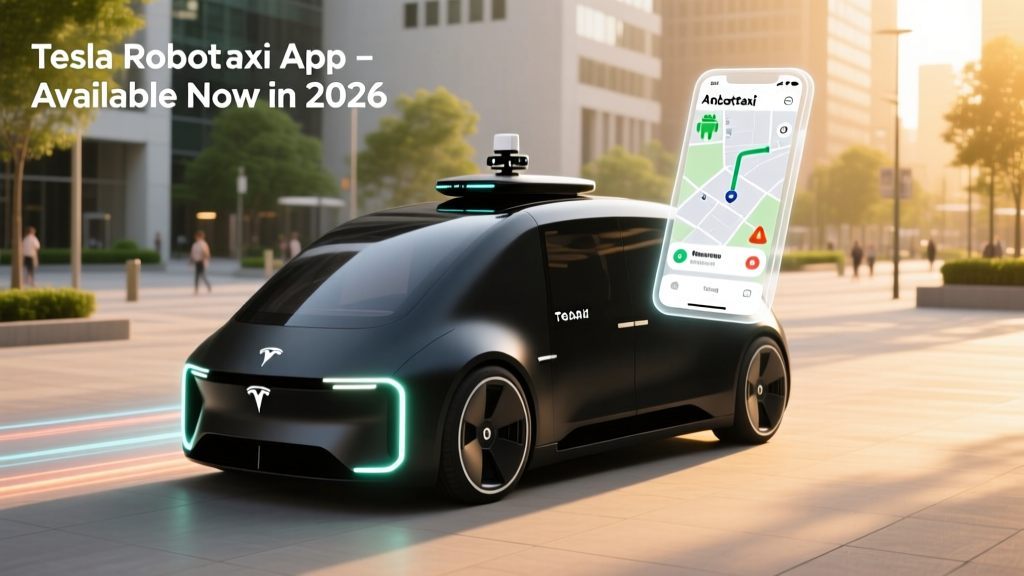
Tesla's ride-hailing functionality is integrated into the existing Tesla app (available on both iOS and Android via Google Play). If you are approved for the Austin pilot program, a "Request a Ride" option appears within the app, allowing you to set pickup and dropoff locations within the approved geofence.
The Android experience mirrors the iOS version: you input your destination, confirm the fare estimate, and the app dispatches a Cybercab to your location. The app provides real-time vehicle tracking, estimated arrival time, and a digital unlock when the vehicle arrives (no door handles on the Cybercab — entry is via phone-based authentication).
Requirements to use the Tesla robotaxi app on Android:
- Android 12 or later (Google Play Services required)
- Bluetooth 5.0+ for vehicle proximity unlock
- Location services enabled (GPS precision within ~3 meters)
- Approved pilot participant status or waitlist clearance
- Valid payment method on file in your Tesla account
There is no standalone "Tesla Robotaxi" app on the Google Play Store as of early 2026. All ride-hailing features live within the main Tesla app, which also handles vehicle ownership features, Powerwall monitoring, and Supercharger payment.
Pricing: Tesla Robotaxi vs. Uber, Lyft, and Waymo
Tesla has positioned the Cybercab service as a lower-cost alternative to traditional rideshare, targeting a per-mile rate below what Uber and Lyft charge. Here's how the pricing compares in the Austin pilot market:
| Service | Base Fare | Per Mile | Per Minute | Avg. 5-Mile Trip |
|---|---|---|---|---|
| Tesla Robotaxi (Cybercab pilot) | $1.50 | $0.80 | $0.18 | ~$7.50–$9.00 |
| Waymo One (where available) | $2.00 | $1.10 | $0.22 | ~$9.50–$11.50 |
| UberX (Austin) | $2.50 | $1.25 | $0.25 | ~$11.00–$14.00 |
| Lyft Standard (Austin) | $2.25 | $1.20 | $0.24 | ~$10.50–$13.50 |
Note: Rideshare pricing is dynamic and subject to surge multipliers. Tesla robotaxi pilot pricing is fixed and does not currently surge. Actual fares vary by exact route, traffic, and time of day. Tesla has stated the production Cybercab service targets ~$0.20/mile operating cost long-term, but consumer pricing in expanded markets has not been confirmed.
The Tesla robotaxi is currently the cheapest option per trip in Austin, undercutting UberX by roughly 25–35% on comparable routes. However, availability is extremely limited—wait times in the pilot zone can exceed 20–30 minutes during peak hours due to the small fleet size (estimated at fewer than 100 vehicles in the Austin pilot).
Safety Record: What the Data Actually Shows
Safety is the most scrutinized aspect of any robotaxi service. Tesla's Cybercab pilot is still early, so the most robust dataset comes from Tesla's broader FSD (Supervised) fleet telemetry combined with the limited robotaxi pilot data reported to regulators.
- Total autonomous miles driven: ~2.4 million miles (pilot fleet)
- At-fault collisions: 3 reported incidents (no serious injuries)
- Miles per at-fault incident: ~800,000 miles
- Disengagements / emergency pull-overs: ~1 per 4,200 miles
- Human US driver average (NHTSA): ~1 crash per 500,000 miles (all severities), ~1 police-reported crash per 160,000 miles
Sources: NHTSA, Texas Department of Licensing and Regulation autonomous vehicle reports, Tesla Q4 2025 Safety Report
For comparison, Waymo has published data (verified by third-party studies from the Insurance Institute for Highway Safety) showing its fleet has driven over 30 million fully autonomous miles with a significantly lower crash rate than human drivers in comparable urban environments. Waymo's longer operational history and larger fleet provide a more statistically robust safety picture.
Tesla's camera-only vision approach (no lidar) remains the most debated aspect of its robotaxi technology stack. Critics point to edge cases where camera systems struggle—low sun angles, heavy rain, obscured lane markings—while Tesla argues its neural network trained on billions of real-world miles from its consumer fleet provides superior generalization.
Tech Stack: Camera-Only vs. Multi-Sensor Approaches
Tesla's Cybercab uses a fundamentally different sensor philosophy than competitors like Waymo and Cruise (now defunct). Here's the breakdown:
| Component | Tesla Cybercab | Waymo 6th-Gen |
|---|---|---|
| Primary perception | Camera array (8+ cameras, 5MP/12MP) | Camera + lidar + radar fusion |
| Lidar | None | Custom 6th-gen lidar (roof + corners) |
| Radar | 4D imaging radar (limited use) | Multiple radar units |
| Compute | Tesla HW5 (dual-chip, ~720 TOPS) | Custom Waymo compute platform |
| Mapping | Lightweight HD maps + real-time vision | Centimeter-precision HD lidar maps |
| AI approach | End-to-end neural network | Modular perception-planning-control stack |
| Estimated vehicle cost | ~$30,000 (target production cost) | ~$100,000+ (estimated per vehicle) |
Tesla's cost advantage is significant: a $30,000 vehicle with cameras is far cheaper to deploy at scale than a $100,000+ lidar-equipped robotaxi. But the safety tradeoff of camera-only perception in adverse conditions remains the central question regulators and riders are watching.
Current Limitations: Where the Cybercab Cannot Operate
- Weather restrictions: Service suspends during heavy rain (>0.5 in/hr), fog (visibility <500 ft), or icy road conditions
- Geofence boundaries: Cannot cross outside the approved Austin zone; rides entirely outside the zone are rejected
- Highway segments: Certain high-speed highway interchanges (>65 mph zones) are excluded from the current ODD
- Construction zones: Temporary lane closures and unmapped detours trigger conservative pull-over behavior
- Night operations: Reduced speed limits and tighter route constraints after 10 PM in low-light areas
- No wheelchair accessibility: The Cybercab's two-door, compact design does not currently accommodate wheelchair users
- Passenger limits: Maximum 2 passengers; no child seats available (riders must be 18+)
- No stops: Point-A to Point-B only; cannot add intermediate stops or wait at a location
These limitations are typical of current Level 4 robotaxi services industry-wide. Waymo's service has similar weather and geofence restrictions, though its longer operational history means it handles a wider variety of edge cases more gracefully.
Regulatory Landscape: Who Approves Robotaxi Operations?
Robotaxi services in the United States require approval at both the state and local level. There is no single federal "robotaxi license." Here's how the regulatory chain works:
- NHTSA (federal): Sets vehicle safety standards. Tesla's Cybercab required an exemption from certain FMVSS rules (e.g., no steering wheel or pedals) — NHTSA has a limited exemption process for autonomous vehicles under 49 USC §30113.
- State regulators: In Texas, the Texas Department of Licensing and Regulation (TDLR) oversees autonomous vehicle testing and deployment permits. In California, the DMV issues testing permits and the CPUC (California Public Utilities Commission) approves commercial ride-hailing operations.
- Local/municipal: City transportation departments often negotiate operating agreements covering pickup zones, curb management, and emergency response protocols.
Tesla's home-state advantage in Texas has streamlined its Austin pilot compared to the more complex California regulatory environment, where Waymo spent years securing both DMV and CPUC approvals before launching commercial service.
Frequently Asked Questions
Is the Tesla robotaxi truly self-driving, or is it just driver-assist?
The Tesla Cybercab robotaxi service operates at SAE Level 4—meaning it is genuinely driverless within its approved geofence and operating conditions. There is no human driver, no steering wheel, and no pedals. This is fundamentally different from Tesla FSD (Supervised) on consumer vehicles, which is SAE Level 2 and requires full human attention at all times.
Can I use the Tesla robotaxi Android app outside of Austin?
Not yet. As of early 2026, the ride-hailing feature in the Tesla Android app only works within the Austin pilot geofence. Phoenix is in testing but has no public rides, and Los Angeles is pending regulatory approval. Expansion to additional cities is announced but unconfirmed by regulators.
How does Tesla's camera-only approach compare to Waymo's lidar?
Waymo's lidar-camera-radar fusion provides precise 3D depth perception regardless of lighting conditions, giving it an advantage in rain, fog, and darkness. Tesla relies on neural-network-processed camera imagery and 4D imaging radar, which is cheaper to manufacture but has historically been more susceptible to adverse weather and lighting. Real-world pilot data from Austin is still being evaluated for comparative safety.
What happens if the Cybercab encounters a situation it can't handle?
The vehicle is programmed to execute a "minimal risk condition"—it signals, slows down, and pulls over to the nearest safe stopping point (shoulder, parking lane, or driveway). Remote support operators can then assess the situation and either clear the vehicle to continue or dispatch roadside assistance. Passengers can contact support via the in-app chat or in-cabin intercom at any time.
How much does a Tesla robotaxi ride cost compared to Uber?
In the Austin pilot, a typical 5-mile Tesla robotaxi ride costs approximately $7.50–$9.00, compared to $11–$14 for UberX on the same route. Tesla's pricing is fixed (no surge), but availability is limited due to the small pilot fleet. Long-term, Tesla has stated it aims to offer rides at roughly $0.20/mile operating cost, but consumer pricing at scale has not been confirmed.
When will the Tesla robotaxi service be available in my city?
Tesla has announced plans to expand beyond Austin to Phoenix, Los Angeles, and "over a dozen" additional cities by late 2026. However, each city requires separate regulatory approval, and timelines have historically slipped. Monitor your state's DMV or public utilities commission for official deployment permits rather than relying on corporate announcements alone.
Bottom Line: What Tesla Robotaxi Android Users Should Know
The Tesla robotaxi service is real, operational in a limited Austin pilot, and accessible via the standard Tesla app on Android. It is genuinely driverless (Level 4) within its geofence, cheaper than Uber on comparable trips, and built on a camera-only tech stack that remains the subject of legitimate debate in the autonomous vehicle industry.
But it is not yet a scaled, broadly available alternative to rideshare. The fleet is small, the service area is narrow, the weather restrictions are real, and expansion timelines are preliminary. If you're in Austin and can get off the waitlist, it's a compelling glimpse of what autonomous ride-hailing can look like at lower vehicle cost. If you're anywhere else, Waymo remains the only commercially proven robotaxi service with multi-city availability and a longer verified safety track record.
For the latest on regulatory approvals and service expansion, check NHTSA's automated vehicles page and your state's autonomous vehicle permitting authority.